

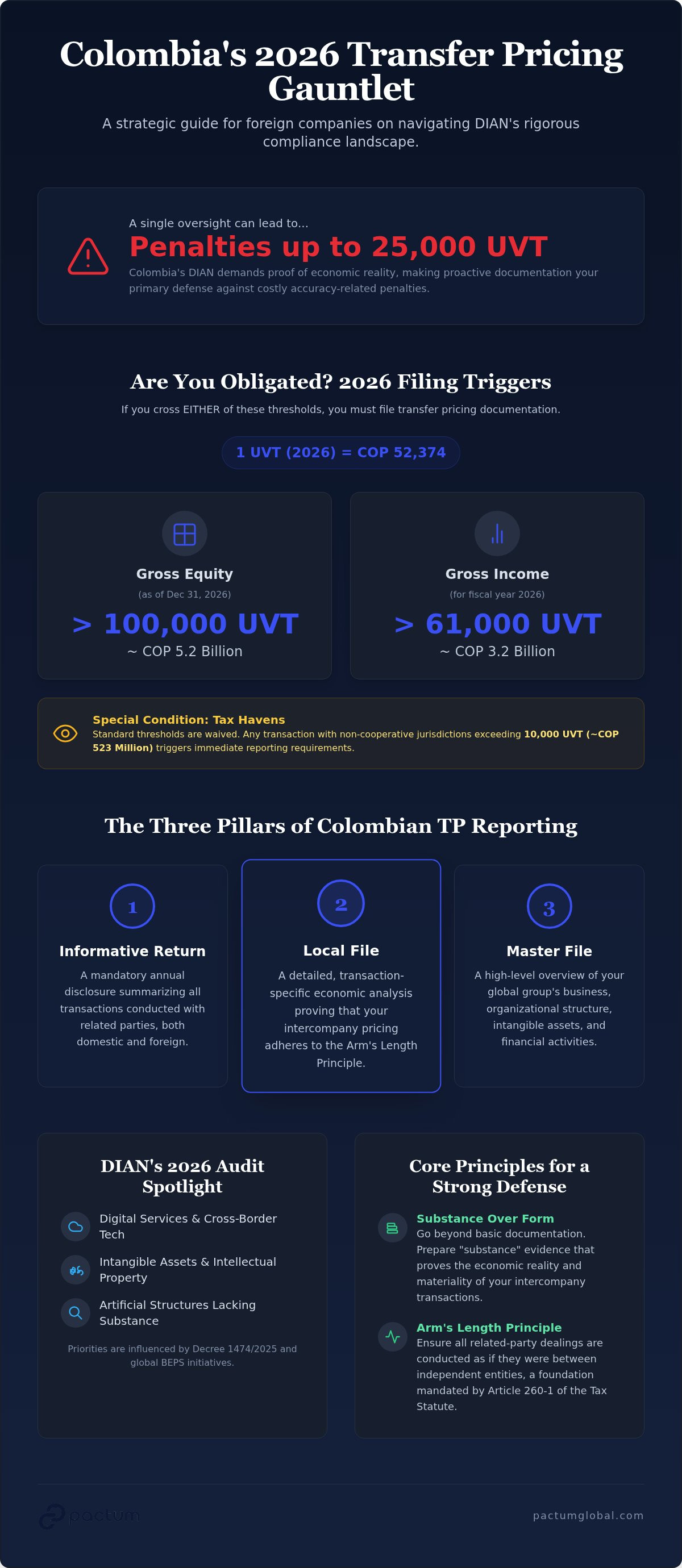
In Colombia, transfer pricing is a high-stakes defense exercise rather than a simple administrative filing. For foreign companies, the challenge isn't just reporting numbers; it's proving the economic reality of every intercompany transaction to a highly vigilant DIAN. You likely feel the pressure of these stringent regulations, especially when a single oversight in transfer pricing colombia documentation can lead to penalties as high as 25,000 UVT. It's natural to feel concerned about the complexity of annual UVT calculations or the difficulty of justifying service costs to tax authorities who demand absolute transparency.
You can protect your operations and achieve full compliance with the Colombian Tax Statute without the constant fear of audits. This guide will help you master the 2026 reporting thresholds, including the specific 100,000 UVT equity and 61,000 UVT income triggers for filing. We'll break down the latest requirements from Decree 1474/2025 and provide a clear roadmap for preparing your Local and Master Files. By the end of this article, you'll have a reliable strategy to allocate intercompany costs efficiently while shielding your business from accuracy-related penalties.
Key Takeaways
- Determine your 2026 compliance obligations by calculating your gross equity and income against the latest UVT thresholds.
- Move beyond basic documentation by preparing "substance" evidence that meets the DIAN's rigorous reality and materiality tests.
- Master transfer pricing colombia rules to shield your intercompany transactions from audits and avoid accuracy related penalties.
- Follow a structured roadmap for your 2026 reporting, from identifying related parties to conducting deep functional analyses.
- Learn how robust intercompany contracts provide a proactive defense against bureaucratic hurdles and ensure efficient cost allocation.
Navigating Colombia’s Transfer Pricing Landscape in 2026
Colombia's tax environment is famously rigorous. For foreign investors, managing transfer pricing colombia requires more than just filling out forms. It requires a deep understanding of Article 260-1 of the Tax Statute. This article establishes that all transactions between related parties must be conducted as if they were between independent entities. This is the foundation of the "Arm’s Length Principle." If you're new to the concept, understanding What is Transfer Pricing? helps clarify that these rules prevent profit shifting and ensure tax bases remain intact.
The DIAN (Dirección de Impuestos y Aduanas Nacionales) acts as a vigilant guardian. They don't just check for math errors. They look for the economic substance behind every dollar moved across borders. Colombia has earned its reputation as one of the most demanding jurisdictions in Latin America because the DIAN's enforcement capabilities have expanded significantly. They now use sophisticated data cross-referencing to flag inconsistencies in real-time. Colombian courts have historically sided with the DIAN when companies cannot prove that their pricing matches market reality; making proactive documentation your best defense.
The Legal Foundation: Tax Statute and Decree 2120
Foreign companies must look beyond the surface of the Tax Statute. While Art. 260-1 sets the stage, Decree 2120 provides the specific regulatory framework for documentation. Colombia closely aligns its local laws with OECD guidelines, but it adds a local layer of complexity. You'll find that "complementary tax" regimes often apply to windfall profits or specific intercompany dividends. Understanding these specific articles isn't just about avoiding fines. It's about building a stable foundation for your long-term growth in the region. We focus on removing this complexity so you can focus on scaling your operations.
Why 2026 is a Critical Year for Compliance
This year marks a turning point due to Decree 1474/2025. The DIAN has shifted its audit priorities toward digital services and intangible assets. If your company relies on intellectual property or cross-border tech support, you're in the spotlight. The global conversation around a minimum 15% tax rate has also accelerated local scrutiny. DIAN officials are now trained to look for "treaty shopping" or artificial structures that lack physical presence. For companies operating in 2026, the margin for error has disappeared. You must prove that your intercompany agreements aren't just paper, but reflect the actual functions and risks your local branch manages.
Determining Your Compliance Obligations: Thresholds and Rules
Determining your obligations starts with the UVT system. The Unidad de Valor Tributario is the standard measure for all tax obligations in Colombia. For the 2026 tax year, 1 UVT equals COP 52,374. This system ensures that thresholds stay consistent with economic shifts, but it requires foreign companies to perform a conversion every year to check their status. We believe that clarity in these numbers is the first step toward a secure corporate structure.
You are legally obligated to prepare and file documentation if your gross equity on December 31, 2026, exceeds 100,000 UVT. Alternatively, the same rule applies if your gross income for the year reaches 61,000 UVT. These figures represent roughly COP 5.2 billion and COP 3.1 billion, respectively. If you cross either of these lines, the DIAN expects full transparency regarding your intercompany dealings. The OECD Transfer Pricing Country Profile for Colombia highlights how these thresholds integrate with global BEPS Action 13 standards. However, Colombia adds its own strict layer for transactions with non-cooperative jurisdictions. If you deal with entities in tax havens, the standard materiality thresholds vanish. Any transaction exceeding 10,000 UVT, approximately COP 523 million, triggers immediate reporting requirements.
The Three Pillars of Colombian TP Reporting
Reporting in Colombia is a tiered process. First, the Informative Return acts as a mandatory annual disclosure of all related party transactions. Second, the Local File provides a transaction-specific economic analysis to justify your pricing. Finally, the Master File offers the DIAN a high-level overview of your global group’s organizational structure and intangibles. Failing to submit even one of these can lead to significant penalties. It's a comprehensive approach that requires diligent record-keeping throughout the year.
Exemptions and Special Cases
Not every transaction requires the full weight of a Local File. If your total operations with a single related party are under 45,000 UVT, you might be exempt from the economic study, though the Informative Return usually remains mandatory. These nuances are why many firms seek specialized transfer pricing services to ensure they aren't over-reporting or, more importantly, under-complying. It is about finding the balance between efficiency and safety. Special rules also apply to "minor" transactions, but remember that the 10,000 UVT rule for preferential tax regimes always takes precedence. Protecting your business means knowing exactly where you stand before the filing season begins.
The "Reality and Substance" Test: Beyond Basic Documentation
A signed contract is no longer a shield against a DIAN audit. In the context of transfer pricing colombia, the Colombian tax authority and the Council of State have made it clear that "paper reality" must match "economic reality." You can't simply point to a legal agreement to justify a deduction. You must prove that the service was actually rendered and that it provided a tangible benefit to the local entity.
The Council of State has repeatedly emphasized the importance of materiality. If you pay for global marketing services, you need to show how those services impacted the Colombian market. Relying on generic global chargeback keys is a common, and often expensive, mistake. Allocation keys based on total group revenue might seem efficient, but the DIAN often rejects them if they don't reflect the specific benefit received by the Colombian branch.
Building a "Defense File" is essential. This isn't just about the annual report; it's a living archive of evidence. It should include everything from project logs to specific deliverables. We help clients move beyond basic compliance by drafting robust intercompany agreements that anticipate these substance tests. This proactive approach acts as a shield against the bureaucratic errors that often lead to heavy penalties.
Proving the Effective Provision of Services
Evidence is the currency of a successful audit defense. You need more than just emails. The DIAN expects to see verifiable work products such as internal reports, timesheets, or meeting minutes. Labeling a payment as an "administrative service" is particularly risky. This vague category is a red flag for auditors. In past cases, the DIAN has rejected millions in deductions simply because the taxpayer couldn't prove that the foreign parent actually performed the work described. To protect your intercompany transactions, you must document the "who, what, and when" of every service provided.
Substance Over Form in Intangible Transfers
Intangibles like trademarks and proprietary technology face even higher scrutiny. You must clearly document IP ownership and the specific rights granted to the Colombian entity. Valuation methods accepted by the DIAN typically follow OECD standards, but they require local economic context. There's also a critical distinction between technical assistance and royalties. Technical assistance involves a transfer of knowledge, whereas royalties involve the use of a right. Misclassifying these can lead to incorrect withholding taxes and severe penalties. Proactive planning ensures your valuation stands up to the most rigorous technical analysis.
Your 2026 Roadmap for Transfer Pricing Reporting
A successful filing begins months before the deadline. For foreign companies, the process of managing transfer pricing colombia requires a methodical, five-step approach to ensure no transaction goes undocumented. Step one is the identification of all related party transactions and their respective jurisdictions. You must look beyond simple sales; loans, service fees, and cost-sharing arrangements all fall under scrutiny. Once identified, step two involves performing a functional and economic analysis. This is where you document the risks assumed and the assets used by the Colombian branch compared to its global affiliates.
The third step is selecting the most appropriate transfer pricing method. While the Comparable Uncontrolled Price (CUP) method is the gold standard, it's often difficult to find perfect market matches. Step four is the compilation of the Local and Master Files. These documents tell your company’s story, explaining why your pricing is fair and how it aligns with your global strategy. Finally, step five is the submission of the Informative Return. This is the digital filing that summarizes your intercompany activity for the DIAN.
We understand that this process can feel overwhelming. Our team provides specialized transfer pricing services to guide you through each of these steps, ensuring your documentation is both accurate and defensible. We act as your global navigator, removing the complexity from these bureaucratic hurdles.
Selecting the Right Economic Analysis Method
Colombian law establishes a clear hierarchy for methods. The DIAN prefers "traditional" methods like CUP, Resale Price, or Cost Plus. However, if those aren't feasible due to a lack of data, you may move to transactional profit methods. Finding local comparables in the Colombian market is a frequent challenge for foreign firms. Often, you'll need to use regional data from other Latin American markets and apply specific economic adjustments. For complex structures involving unique intangibles, the "profit split" method might be necessary, but it requires a very high level of documentation to satisfy auditors.
Deadlines and Penalty Risks
Timing is everything in 2026. The filing deadlines for the Informative Return and the Local File are staggered between July and August 2026. Your specific date depends on the last digit of your Tax ID (NIT). Missing these dates is a costly error. A late filing within just five business days triggers a penalty of 0.05% of the total transaction value. If you wait longer, the penalty increases to 0.2% monthly, capped at 20,000 UVT (approximately COP 1.04 billion). The risk is even higher for inaccurate data; the DIAN can charge 1% of the transaction value for inconsistencies. Accuracy isn't just about compliance; it's about protecting your bottom line from avoidable losses.
Strategic Transfer Pricing Management with Pactum Global
Managing transfer pricing colombia shouldn't be a reactive scramble during tax season. Many firms treat compliance as a mere filing exercise, but we view it as a strategic foundation for your international growth. A "navigator" approach looks ahead. It identifies potential audit triggers before they appear on the DIAN's radar. This proactive stance allows you to align your global corporate strategy with the specific, often rigid, requirements of Colombian law. By the time you need to file, the evidence for your "substance" is already organized and defensible.
Success starts with the drafting of intercompany agreements. These aren't just legal templates. They're the primary evidence of your economic reality. We focus on creating robust service agreements and intellectual property licenses that clearly define risks and assets. This integration ensures that your transfer pricing isn't an isolated tax task. It becomes a central part of your broader corporate structuring. It protects your margins. It protects your reputation in the Latin American market.
Protecting Your Global Mobility and Assets
Compliance is rarely a standalone issue. For many founders and executives, intercompany transactions are closely tied to their personal relocation and asset protection goals. Effective Legal Support for Global Mobility ensures that your corporate tax obligations don't conflict with your residency status or wealth preservation plans. We help you synchronize these moving parts. For example, succession planning for founders often involves transferring intangible assets. If these transfers aren't handled with precise documentation, they can trigger unexpected tax liabilities that jeopardize your legacy.
Get Started with a Compliance Diagnostic
The best way to secure your operations is through a comprehensive compliance diagnostic. We review your existing intercompany agreements to ensure they meet the Colombian "substance" test. This isn't just about looking backward. It’s about preparing your business for future expansions into other complex markets. If you are considering growing into neighboring jurisdictions, understanding Brazil Transfer Pricing Regulations is essential, as Brazil has recently overhauled its rules to align with OECD standards. We provide the steady, expert guidance you need to navigate transfer pricing colombia with confidence, whether you're scaling in Bogota, Sao Paulo, or Mexico City.
Secure Your Colombian Operations for 2026
Managing transfer pricing colombia is a continuous process of proving economic substance. You've learned about the 100,000 UVT equity threshold and the critical importance of the "Reality and Substance" test. Documentation is no longer just about the numbers; it's about the verifiable deliverables that justify your intercompany fees. By following the 2026 roadmap, you can transform a complex filing requirement into a robust defense strategy that protects your global assets.
Pactum Global provides the cross-border legal expertise and clear advisory you need to navigate these Latin American compliance hurdles. We have a proven track record in LATAM compliance and focus on removing complexity from your international expansion. Contact Pactum Global for an Expert Transfer Pricing Diagnostic to ensure your intercompany agreements are robust and defensible. You don't have to face the DIAN alone. With the right roadmap, you can scale your business in Colombia with security and calm confidence.
Frequently Asked Questions
What is the UVT value for Colombia in 2026?
For the 2026 tax year, the UVT (Unidad de Valor Tributario) is COP 52,374. This unit is the standard measure used by the DIAN to set all tax thresholds and penalty caps. You should use this value to determine if your gross equity exceeds the 100,000 UVT filing trigger. Keeping track of the annual UVT adjustment is the first step in maintaining accurate transfer pricing colombia records and avoiding unexpected compliance gaps.
Does Colombia follow the OECD Transfer Pricing Guidelines?
Colombia is an active member of the OECD and its regulations are closely aligned with international standards. The local Tax Statute incorporates the Arm's Length Principle and BEPS Action 13 requirements, including Master File and Country-by-Country reporting. While the framework is global, the DIAN applies it with specific local nuances. You must ensure your documentation reflects both international best practices and the specific evidentiary requirements of Colombian law.
What are the penalties for transfer pricing non-compliance in Colombia?
Penalties for non-compliance are strictly enforced and can be substantial. For late filing beyond five days, a monthly penalty of 0.2% of the transaction value applies, capped at 20,000 UVT. If you fail to submit documentation entirely, the fine can reach 4% of the total transaction value. In cases involving tax havens, this increases to 6%. These costs highlight why proactive compliance is much more efficient than dealing with a DIAN assessment.
When is the deadline for filing the 2026 Transfer Pricing Informative Return?
The deadlines for the 2026 Informative Return and Local File are staggered throughout July and August 2026. Your specific date is determined by the last digit of your taxpayer ID (NIT). It's vital to check the DIAN’s annual tax calendar resolution for the exact day. For multinational groups, the Country-by-Country report for the 2025 fiscal year is generally due by December 2026, depending on the specific group structure and filing requirements.
Do I need a Local File if my transactions are below 45,000 UVT?
You generally don't need to prepare a Local File if your total transactions with a single related party are below 45,000 UVT. However, you must still file the Informative Return if your company meets the gross equity or income thresholds. This exemption does not apply to transactions with non-cooperative jurisdictions. In those cases, the threshold for documentation drops significantly to 10,000 UVT, requiring a much more detailed level of reporting and economic analysis.
Can I use my U.S. transfer pricing study for my Colombian subsidiary?
You cannot simply use a U.S. study for your Colombian subsidiary. While the global Master File can be shared, the Local File must include a specific economic analysis based on the Colombian market. The DIAN requires local comparables and a functional analysis that reflects the specific risks and assets managed by the branch in Colombia. We often help clients adapt global data to meet these rigorous local technical standards and avoid inconsistencies.
What is a "non-cooperative jurisdiction" according to the DIAN?
A non-cooperative jurisdiction is a territory that the Colombian government identifies as having low or no taxation. These jurisdictions typically lack transparency or effective exchange of information with the DIAN. Transactions with entities in these areas trigger stricter transfer pricing colombia rules. Materiality thresholds are lower, and the penalties for documentation errors are higher. It is essential to identify these jurisdictions early in your reporting cycle to ensure full compliance.
How does the "Benefit Test" apply to intercompany services in Colombia?
The Benefit Test requires you to prove that an intercompany service provided actual economic or commercial value to the Colombian entity. It's not enough to show that the service was performed; you must show that an independent party would have been willing to pay for it. The DIAN often rejects deductions for "administrative" costs if the taxpayer cannot provide tangible deliverables, reports, or logs. Documenting this benefit is the key to passing a substance audit.


