

What if a routine transfer between your parent company and a foreign subsidiary triggered a tax audit that lasted over 30 months? For many international entrepreneurs, the fear of double taxation and aggressive enforcement isn't just a possibility; it's a constant source of anxiety. You likely already feel the pressure of keeping up with shifting regulations, such as Brazil's complex transition to OECD standards or the U.S. international tax law changes that took effect in 2026. It's frustrating to realize that a price that seems fair to you might be viewed as a compliance red flag. Mastering the arm's length principle is the only way to replace that confusion with the security of a defensible global structure.
We'll help you master the essentials of this concept to ensure your cross-border transactions remain compliant and audit-ready. This article provides a clear framework for setting intercompany prices and a practical look at the latest OECD guidelines. You'll gain the confidence to align your global strategy with these evolving rules and learn exactly when to hire professional transfer pricing services to protect your bottom line from costly penalties. By the end, you'll have a roadmap to navigate international bureaucracy with calm confidence.
Key Takeaways
- Learn how to price intercompany transactions as if parties were unrelated to prevent profit-shifting flags and ensure fair tax allocation.
- Identify the five standard OECD transfer pricing methods to determine the most defensible strategy for your unique business model.
- Discover common audit red flags, including consistent subsidiary losses, and how to mitigate them through proactive documentation.
- Master the arm's length principle by conducting thorough functional and comparability analyses using specialized commercial databases.
- Align your corporate structure with global standards to ensure seamless compliance and tax optimization when expanding into the USA, Brazil, or Portugal.
What is the Arm's Length Principle in International Business?
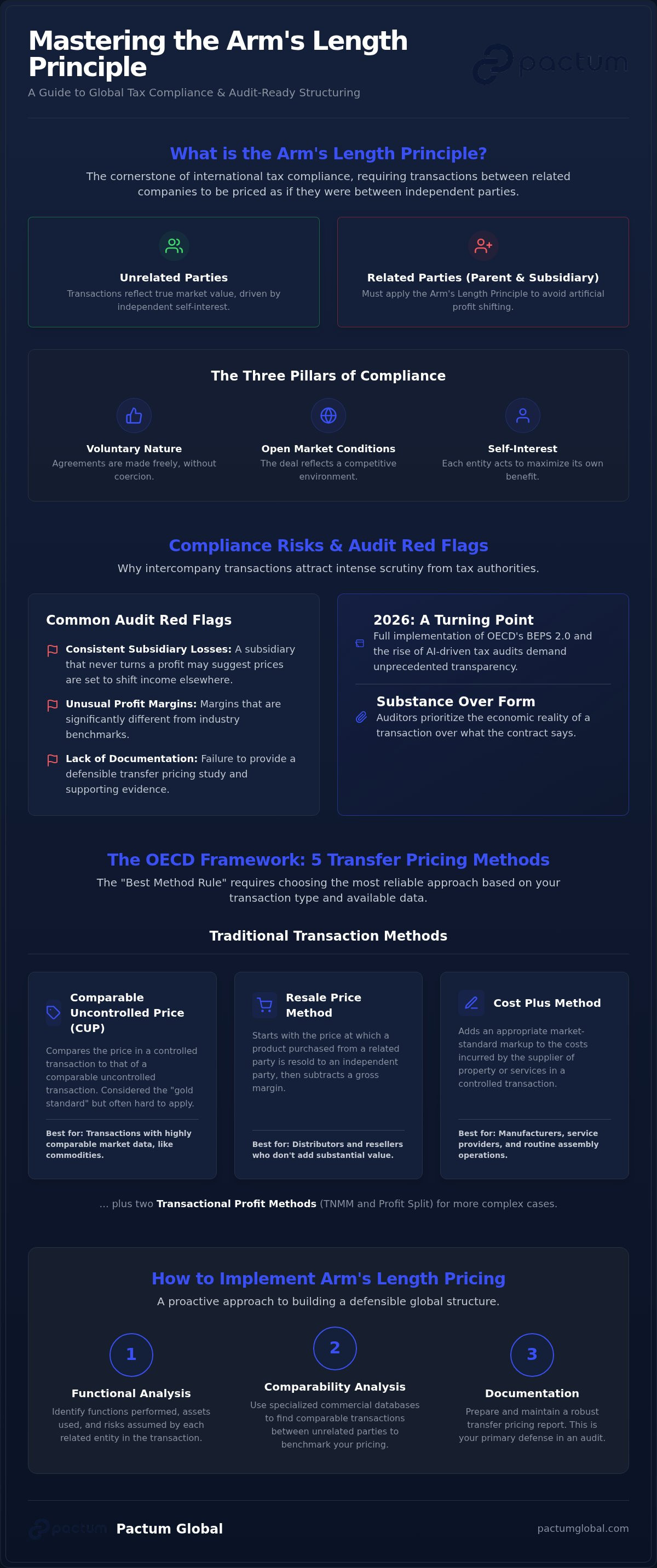
The Arm's Length Principle is the cornerstone of international tax compliance. It requires that transactions between related entities, like a parent company and its subsidiary, be priced as if they were between independent parties. If you sell a software license to your branch in Portugal, the price shouldn't be lower just because you own both companies. It must reflect what an unrelated buyer would pay in an open market. This ensures that profits are taxed where the actual economic activity happens, preventing artificial profit shifting across borders. Without this standard, multinational groups could easily move income to low-tax jurisdictions, leaving other nations without their fair share of revenue.
Tax authorities look for three specific pillars to verify compliance:
- Voluntary Nature: Both parties must enter the agreement of their own free will without coercion.
- Open Market Conditions: The deal must happen in a competitive environment where prices aren't suppressed.
- Self-Interest: Each entity must act to maximize its own economic benefit, just as a stranger would.
You can't just sign a contract that looks good on paper. The economic reality of the transaction must match its legal form. If your legal documents describe a high-risk service agreement but the performing subsidiary takes no actual risk, the tax price will be adjusted. Auditors prioritize what actually happened over what the contract says. This "substance over form" approach is why detailed documentation is your best defense against heavy penalties and unexpected tax bills.
The Difference Between Related and Unrelated Parties
In the eyes of tax authorities, "control" isn't just about owning 51% of the shares. It refers to any relationship where one party can influence the business decisions of another. This makes parent-subsidiary relationships and family-owned businesses high-risk targets for scrutiny. Auditors look for confidential agreements or non-independent pricing that wouldn't exist between strangers. They use complex data sets to identify when a relationship has skewed the financial terms of a deal, often leading to costly adjustments.
Why 2026 is a Turning Point for Global Compliance
The year 2026 marks a significant shift due to the full implementation of OECD's BEPS 2.0. These rules demand unprecedented transparency from digital and service-based startups. Governments are now using AI-driven tax audits to process massive amounts of data instantly. These tools make it easier for authorities to enforce the arm's length principle by comparing your intercompany prices against global benchmarks in seconds. Staying compliant isn't just a best practice anymore; it's a requirement for your company's global survival.
The OECD Framework: Common Methods for Determining Arm's Length Prices
Selecting the right pricing method is more than a technicality. It's a strategic decision that protects your business from future disputes. The OECD provides five standard methods to help you apply the arm's length principle effectively. These are split into traditional transaction methods and transactional profit methods. Under the "Best Method Rule," you're expected to choose the approach that provides the most reliable measure of an arm's length result. This depends on the nature of your transaction and the quality of available market data. Documentation isn't just a chore; it's the evidence that justifies your choice. Without it, tax authorities may impose their own methods, often leading to higher tax liabilities.
Traditional Methods: CUP, Resale Price, and Cost Plus
Traditional methods look directly at the terms of a specific transaction. The Comparable Uncontrolled Price (CUP) method is often called the gold standard. It compares the price charged in a controlled transaction to the price in a comparable uncontrolled transaction. However, it's notoriously difficult to apply in modern industries like tech because finding truly identical "uncontrolled" deals is rare. If you act as a distributor, the Resale Price Method is usually more appropriate. It focuses on the gross margin a reseller earns. For manufacturers or service providers, the Cost Plus Method adds a market-standard markup to the costs incurred. These methods rely heavily on finding direct market benchmarks, which can be challenging in niche sectors.
Transactional Profit Methods: Profit Split and TNMM
When direct price comparisons aren't possible, transactional profit methods offer a solution by looking at net profits. The Transactional Net Margin Method (TNMM) is the most widely used approach for startups and digital businesses. It examines the net profit margin that a taxpayer realizes from a controlled transaction relative to an appropriate base, such as costs or sales. It's often easier to find data for TNMM than for CUP. If both your parent company and subsidiary contribute unique, high-value intellectual property, the Transactional Profit Split Method may be necessary. This method divides the total profits between entities based on their relative economic contributions. Understanding the legal and tax implications of these profit-based approaches is essential for long-term compliance.
The right method depends on your specific business reality and the jurisdiction involved. If you're expanding and need to ensure your methodology holds up in court, our Transfer Pricing Services can help you navigate these complex OECD standards. We focus on creating a clear, defensible framework so you can focus on growth instead of tax audits. Clear documentation of your chosen method is your primary shield against bureaucratic errors.
Compliance Risks: Why Intercompany Transactions Attract Tax Audits
Tax authorities no longer focus solely on Fortune 500 giants. Today, startups and mid-sized firms are frequent targets for transfer pricing scrutiny. Auditors look for specific red flags that suggest a company isn't following the arm's length principle. One of the most common triggers is a subsidiary that reports consistent losses while the parent company remains highly profitable. Sudden shifts in profitability after a corporate restructuring also invite investigation. Tax inspectors use these anomalies to justify deep dives into your financial records, often looking back several years to identify patterns of profit shifting.
Low-value intra-group services, such as management fees or administrative support, are another high-risk area. Many founders assume these are simple deductions, but authorities often view them as "disguised dividends" if they lack a clear benefit analysis. You must prove that the service was actually rendered and that it provided a tangible economic benefit to the recipient. This is where the authoritative statement of the arm's length principle becomes your primary defense. It sets the global standard for how these fees should be justified during a rigorous audit process.
The "Brazil Factor" adds another layer of complexity for international founders. As Brazil completes its transition to OECD standards in 2026, many businesses are struggling to move away from the old fixed-margin rules. Failing to adapt to these new requirements can lead to double taxation. This happens when one country increases your taxable income but the other refuses to lower it, forcing you to pay tax twice on the same profit. It's a costly mistake that can drain a company's cash reserves.
Intangibles and Intellectual Property Risks
Pricing the use of trademarks, patents, and proprietary software is exceptionally difficult. A robust intellectual property strategy for startups must include a clear transfer pricing framework. Modern audits focus on "DEMPE" functions: Development, Enhancement, Maintenance, Protection, and Exploitation. It isn't enough to own the legal title to an asset. You must demonstrate which entity actually performs the work and manages the risks associated with that IP to justify your royalty rates.
The Cost of Non-Compliance: Penalties and Interest
The financial impact of a failed audit is staggering. In the U.S., the IRS applies a strict penalty framework under IRC Section 6662, which can reach 40% for gross valuation misstatements. Beyond the money, the time commitment is exhausting. OECD data from 2024 shows that transfer pricing cases take an average of 30.9 months to close. This level of disruption can stall your growth and damage your reputation with global partners. Utilizing legal support for global mobility helps you build a protective shield, ensuring your international expansion remains secure and efficient.
How to Implement Arm's Length Pricing: Documentation and Benchmarking
Implementing the arm's length principle requires a methodical approach that moves from abstract theory to concrete data. You begin with a Functional Analysis. This involves identifying which entity performs specific tasks, which assets are used, and who bears the economic risks. If your U.S. parent company manages the R&D while the Brazilian subsidiary handles local distribution, your pricing must reflect this division of labor. Next, you conduct a Comparability Analysis by searching commercial databases for similar transactions between unrelated parties. This leads to the Economic Analysis, where you apply your chosen method to establish a compliant price range. Finally, you must maintain annual documentation. This typically consists of a Master File for the whole group and a Local File for each jurisdiction.
The Role of Intercompany Agreements
A written contract is your first line of defense during a tax audit. Auditors will immediately ask to see the legal framework governing your transactions. It's essential to integrate arm's length clauses into your cross-border shareholders' agreements to ensure all parties understand the tax obligations. Every international service agreement should clearly define the scope of work, payment terms, and the specific transfer pricing method used. These documents prove that your pricing wasn't an afterthought but a deliberate, compliant decision. Without these contracts, you leave your business vulnerable to arbitrary adjustments by tax inspectors.
Benchmarking: Finding the 'Comparable' in a Unique Market
Finding a "comparable" company in a unique or emerging market is one of the hardest parts of compliance. You'll likely need specialized commercial databases to find arm's length ranges that satisfy local tax authorities. When comparing a U.S. firm to a Brazilian subsidiary, you must make geographic adjustments to account for different inflation rates, market sizes, and labor costs. These benchmarks aren't static. You should update them every 1 to 3 years to reflect current market realities. If your data is outdated, your entire compliance structure could collapse during a routine check. Maintaining fresh data ensures your price ranges remain defensible as economic conditions shift.
If you're overwhelmed by the technical requirements of benchmarking or need to secure your corporate governance, our Transfer Pricing Services provide the precise data and documentation you need to stay audit-ready. We help you build a foundation that satisfies both tax authorities and your long-term growth goals.
Strategic Corporate Structuring: The Pactum Global Advantage
Strategic global expansion requires more than meeting minimum tax requirements. It demands a structure where legal authority and economic reality work in harmony. At Pactum Global, we move beyond basic compliance to offer strategic tax and legal optimization. By correctly applying the arm's length principle from day one, you create a defensible foundation that supports long-term growth. We help you navigate the complexities of international bureaucracy with calm confidence, ensuring your corporate architecture is both efficient and secure. This proactive approach acts as a shield against the bureaucratic errors that often plague cross-border ventures.
For US entrepreneurs looking to open a company in Brazil, the timing is critical. As the country aligns with OECD standards in 2026, having a partner who understands both US expectations and local requirements is vital. We integrate global mobility, immigration, and corporate law into a single, clear roadmap. This holistic view is essential because a decision in one area, like an immigration process, often has ripple effects on your tax residency and transfer pricing obligations. Early-stage structuring is always more cost-effective than late-stage remediation. Fixing a flawed intercompany model after a tax authority has flagged it is a high-stakes, expensive battle that we help you avoid entirely.
Customized Solutions for Brazil, Portugal, and the USA
Each jurisdiction has unique nuances that require a tailored approach. In Portugal, we help you navigate the 'participation exemption' regime while ensuring your intercompany fees stay within arm's length boundaries. We specialize in bridging the gap between US GAAP or tax rules and the specific local requirements of foreign jurisdictions. Our team also incorporates succession planning and asset protection into your corporate framework. This ensures that your global footprint isn't just compliant today, but remains a robust vehicle for your family or shareholders in the future.
Your Partner in Global Expansion
The Pactum approach is designed to be clear, punchy, and results-oriented. We don't hide behind dense academic jargon. Instead, we provide the steady, reliable partnership you need to demystify global business hurdles. Whether you are a digital startup or an established manufacturer, we offer a straightforward process for reviewing your current structures. You can get started with a comprehensive transfer pricing review to identify hidden risks before they become liabilities. We invite you to contact Pactum Global for a strategic compliance consultation and secure your company's international future today.
Build a Defensible Foundation for Your Global Growth
Success in international expansion depends on more than just revenue growth. It requires a robust framework where your intercompany pricing matches economic reality. By prioritizing functional analysis and maintaining precise documentation, you transform a complex tax hurdle into a strategic business advantage. Correctly applying the arm's length principle protects your venture from double taxation and the exhaustion of multi-year audits.
Our expertise in the USA, Brazil, and Portugal provides you with specialized cross-border legal documentation and proactive audit-defense strategies. We demystify the transition to OECD standards, allowing you to move with calm confidence in every market you enter. Secure your global structure with Pactum Global’s transfer pricing and compliance services.
You have already mapped out the vision for your company's expansion. Now, let’s ensure your corporate foundation is strong enough to support that growth for years to come.
Frequently Asked Questions
What is the arm's length principle in simple terms?
The arm's length principle is the standard requiring that prices for transactions between related entities match what independent parties would agree to under similar market conditions. If you sell services to your subsidiary, the price shouldn't be lower just because you own both companies. It ensures that taxes are paid fairly in each jurisdiction based on the actual economic value created. This principle prevents companies from artificially shifting profits to low-tax countries.
Why is the arm's length principle important for transfer pricing?
It provides a globally recognized framework for tax authorities to evaluate intercompany deals. Without the arm's length principle, companies could manipulate prices to avoid taxes, leading to legal disputes and heavy penalties. By following this standard, you ensure that your global corporate structure remains transparent and defensible. It's the foundation of modern tax treaties, helping you avoid double taxation when expanding into markets like the USA, Brazil, or Portugal.
Does the arm's length principle apply to small startups?
Yes, this principle applies to any business with cross-border related-party transactions, regardless of its size. While some countries offer simplified regimes for small enterprises, the core requirement to price transactions fairly remains. Startups are increasingly targeted by tax authorities using automated audit tools. Implementing a compliant structure early is much cheaper than fixing errors during a 30-month audit. It also makes your company more attractive to future investors or buyers.
What happens if my intercompany prices are not at arm's length?
Tax authorities can unilaterally adjust your taxable income, leading to higher tax bills and significant interest charges. In the USA, misstatement penalties can reach 40% of the tax underpayment. You also face the risk of double taxation if one country increases your profit but the other doesn't grant a corresponding deduction. Beyond the financial cost, the time spent defending your position during an audit can disrupt your business operations for several years.
How often should I update my transfer pricing documentation?
You should review your documentation annually and perform a full update of your benchmarking data every one to three years. Market conditions and local regulations change quickly, especially with Brazil's transition to OECD standards through 2026. If your business model shifts or you enter new markets, you must update your files immediately. Keeping your documentation current is your best defense against claims that your pricing no longer reflects current market reality.
What is a comparability analysis in transfer pricing?
It's a study that compares your intercompany transaction to similar deals between independent parties. You identify "comparables" by looking at factors like the functions performed, risks assumed, and assets used by each party. This often involves searching commercial databases for financial data from unrelated companies in the same industry. The goal is to find a range of market-standard prices that justify your chosen intercompany rate to tax inspectors during an audit.
Can I use the same arm's length price for all countries?
No, you generally cannot use a single price for every jurisdiction because market conditions and local laws vary. A price that's considered fair in Portugal might be rejected in Brazil due to different labor costs, inflation rates, or specific local regulations. You must adjust your benchmarking data for each geographic market to ensure compliance. Each country's tax authority expects to see data that reflects their specific economic environment and local competitive landscape.
Is an intercompany agreement enough to prove arm's length compliance?
An intercompany agreement is a vital first step, but it's not sufficient on its own. Tax authorities prioritize "substance over form," meaning they look at what actually happened rather than just what the contract says. You must back up your written agreements with economic data and functional analyses that prove the price matches market rates. A well-drafted contract provides legal authority, but your transfer pricing documentation provides the evidence required to survive a rigorous audit.


