

Losing 40% of your international revenue to overlapping tax layers isn't just a mathematical error; it's a structural failure that can cripple your global expansion before it truly begins. You've worked hard to scale your operations, yet the anxiety of international compliance and the confusion over the company double tax trap often make the process feel like a minefield. It's exhausting to manage cross-border growth when you're constantly worried about being penalized by multiple jurisdictions for the same dollar earned.
We're here to replace that stress with a sense of calm confidence by providing proven legal strategies to protect your global profits. This guide provides a clear roadmap for tax efficiency, helping you understand how the 21% U.S. federal corporate rate and the network of 68 international tax treaties impact your bottom line. We'll explore how to choose the right entity for your specific needs, whether you're looking at the USA, Brazil, or Portugal. You'll also learn how to use custom legal documentation to shield your business from unnecessary bureaucratic hurdles while maximizing your net income.
Key Takeaways
- Identify how the company double tax trap specifically targets C-corporations and what it means for your personal take-home pay.
- Uncover the risks of "triple taxation" that international founders face when they don't align their corporate structure with local tax treaties.
- Determine whether a C-corp or a pass-through LLC is the right choice for your specific business goals in jurisdictions like Brazil or the USA.
- Learn how to use Foreign Tax Credits and intercompany agreements to legally shield your global profits from overlapping tax layers.
- Find out why standard templates fail and how custom legal foundations protect you from costly international compliance penalties.
What is Company Double Tax? Defining the Two Layers of Taxation
Understanding the company double tax is the first step toward building a resilient international structure. Essentially, What is Double Taxation? It describes a scenario where the government claims a portion of the same profit twice. C-corporations are the primary vehicle for this structure because they're viewed as separate legal persons from their owners. This creates a distinction between economic double taxation, which taxes the entity and then the owner, and juridical double taxation, which involves taxing the same person in two different countries on the same income.
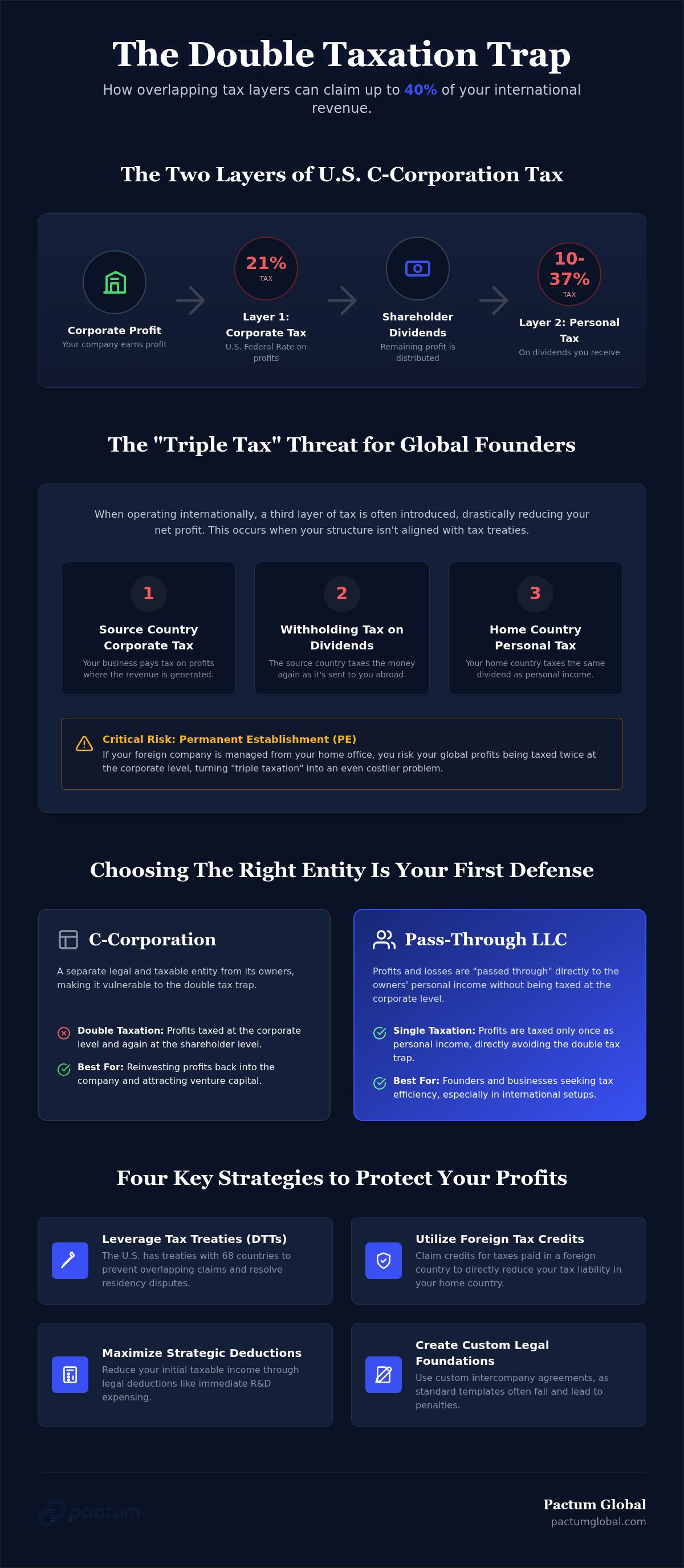
A company double tax occurs when a corporation pays income tax on its net earnings at the entity level, and the remaining profit is taxed again as personal income when distributed to shareholders as dividends.
The Corporate Level: Entity Taxation
Profits are calculated by subtracting allowable expenses from gross revenue. In the U.S., C-corporations face a flat federal rate of 21%. This is the first layer of the tax burden, but it isn't the only one. Businesses must also account for state corporate income taxes, which exist in 44 states. These rates vary significantly, ranging from 2% in North Carolina to 11.5% in New Jersey. Some states, like Texas and Washington, impose gross receipts taxes instead of income tax.
Strategic deductions are your first line of defense. The One Big Beautiful Bill Act (OBBBA) recently restored immediate R&D expensing for domestic research costs, providing a valuable way to reduce taxable income. By maximizing these legal deductions, you lower the initial amount subject to that 21% federal rate. However, once this first layer is paid, the remaining funds are still trapped within the corporate shell.
The Shareholder Level: Dividend and Capital Gains Tax
The second layer of taxation happens when you want to move money from the company to your personal pocket. Once the corporation pays its share, the remaining cash belongs to the entity. To access it, the company must issue a dividend. This distribution is considered personal income for the shareholder. In the U.S., individual income tax rates for 2026 range from 10% to 37%.
This means that out of every dollar your business earns, the government takes a slice at the corporate level and then another slice when you pay yourself. If you choose to sell your ownership stake rather than take dividends, capital gains tax creates a similar second layer of liability. For international founders, this structure can feel particularly heavy, as it often ignores the cross-border complexities we'll explore in the next section.
The Cross-Border Twist: Double Taxation in International Business
Scaling a business across borders introduces a layer of complexity that often turns the standard company double tax into "triple taxation." This happens when the source country taxes your corporate profit, then applies a withholding tax on dividends, and finally, your home country taxes that same income as personal earnings. Without a clear strategy, you risk losing nearly half your revenue to these overlapping claims. This conflict usually stems from the tension between residence-based taxation, where you live, and source-based taxation, where your money is made.
You must also stay vigilant about Permanent Establishment (PE) risks. If you manage your foreign entity from your home office, local authorities might argue that your business has a taxable presence in your home country. This could lead to your global profits being taxed twice at the corporate level. Determining your "center of vital interests" is a critical exercise here. It involves looking at where your family lives, where you vote, and where your primary business activities occur to establish which nation has the primary right to tax you.
Double Tax Treaties (DTTs) and How They Help
Tax treaties are the primary tool for Navigating Global Complexity. As of February 2026, the U.S. maintains active income tax treaties with 68 countries to prevent these overlapping claims. These agreements often include a "Tie-Breaker" rule, which provides a methodical way to resolve residency disputes when two countries claim you as a taxpayer. For those exploring a USA company setup for non-residents, these treaties are essential. They allow you to claim foreign tax credits, ensuring that tax paid in one jurisdiction offsets your liability in another, effectively neutralizing the double hit.
Withholding Taxes on International Dividends
Moving money between jurisdictions usually triggers withholding taxes. While standard rates can be high, treaty-reduced rates often lower this burden significantly. To qualify for these lower rates, you must satisfy the "Beneficial Owner" concept. This means proving that the entity receiving the funds has the actual right to use and enjoy that income, rather than just acting as a conduit.
Common traps exist when moving funds between Brazil, Portugal, and the USA. For instance, Brazil and the U.S. are still in the process of negotiating a comprehensive tax treaty for 2026, meaning you can't rely on the same automatic protections found in the U.S.-Portugal agreement. If you're unsure how these gaps affect your specific structure, seeking expert guidance on international corporate structuring can prevent expensive compliance errors before they occur.
C-Corp vs. Pass-Through: Choosing the Right Structure
Choosing your corporate entity is a strategic decision between simplicity and scalability. While we've already explored the legal theory of Defining the Two Layers of Taxation, the practical application depends entirely on your long-term goals. C-corporations are frequently criticized for the company double tax, yet they remain the most popular choice for startups looking to scale. Conversely, pass-through entities like LLCs and partnerships offer a way to bypass the corporate tax layer entirely, provided you manage the compliance requirements correctly. A powerful tool in this process is the "Check-the-Box" election. This allows you to tell the IRS how you want your entity to be treated for tax purposes, giving you the flexibility to change your tax status as your business evolves.
When a C-Corp Makes Sense
A C-corporation is often the right move if you plan to reinvest most of your profits back into growth. Since the U.S. federal corporate rate is a flat 21% for 2026, it can be more tax-efficient than personal income rates, which reach up to 37%. Institutional investors and venture capital firms almost exclusively demand C-corp structures before they'll sign Startup Contracts (SAFE) or lead a priced round. This structure also acts as a protective shield. It prevents foreign tax authorities from looking through the company directly at the shareholders' personal finances, which often removes the need for non-resident owners to file personal tax returns in that jurisdiction.
The Power of the LLC for International Founders
For many international entrepreneurs, the U.S. LLC is a premier tool for achieving tax transparency. If a non-resident owns an LLC and has no "Effectively Connected Income" (ECI) within the U.S., they may avoid U.S. federal taxes at the entity level. This typically requires a setup where no employees or physical offices are located within the States. You must align this entity choice with the specific legal documents for international startups that define your ownership and management roles. However, the danger of ECI is real. If your activities cross the threshold of being "engaged in a trade or business," those pass-through benefits can vanish, leaving you with complex filing obligations and potential penalties. We help founders navigate these nuances to ensure their structure matches their actual day-to-day operations.
Actionable Strategies to Mitigate Double Taxation
Moving from the theory of the company double tax to practical mitigation requires a surgical approach to your corporate structure. One of the most effective tools is the Foreign Tax Credit (FTC). This mechanism allows you to subtract taxes paid in a foreign jurisdiction directly from your domestic tax bill. It's a dollar-for-dollar reduction that prevents the same income from being depleted by two different nations. You can also leverage intercompany service agreements to shift profit centers legally. By having one entity provide management or technical services to another, you create deductible expenses that reduce taxable income in high-tax jurisdictions while concentrating profits in more efficient ones.
The way you fund your international operations also changes your tax liability. While equity is the traditional route, structuring a portion of your investment as debt can be far more efficient. Interest payments on a loan are typically tax-deductible expenses for the corporation. Dividends, on the other hand, are paid out of after-tax profits. This simple shift helps you bypass the first layer of the company double tax by lowering the taxable base of the entity before distributions even occur.
Transfer Pricing as a Compliance Shield
Transfer pricing is the backbone of cross-border compliance. It ensures that transactions between your related companies happen at "arm's length," meaning the prices mirror what independent parties would pay. This is especially vital when navigating Brazil business law for foreign companies. Brazil maintains strict rules on profit repatriation and transfer pricing documentation. Without robust intercompany agreements, tax authorities may recharacterize your transactions, leading to significant penalties. We provide the transfer pricing services necessary to document these transactions and protect your structure during an audit.
The Role of Shareholders' Agreements (SHA)
A Shareholders' Agreement (SHA) does more than define voting rights; it acts as a strategic tax-planning document. It dictates how and when distributions occur, which is critical for maintaining cash flow across different tax years. For those utilizing a shareholders agreement for portuguese company, it's essential to account for the international tax residency of each owner. A well-drafted SHA can protect minority shareholders from being hit with tax liabilities on "phantom income" they haven't actually received. It ensures that the company's distribution policy remains aligned with the diverse tax obligations of its global owners, providing a stable foundation for long-term growth.
Navigating Global Complexity with Pactum Global
Moving from the theoretical understanding of international tax to successful execution requires more than just a generic checklist. Standard templates often fail because they don't account for the specific interplay between your home country's laws and the regulations of your target market. Relying on a one-size-fits-all document is a common way to fall into the company double tax trap, as these forms rarely consider the nuances of bilateral treaties or local compliance requirements. At Pactum Global, we replace that uncertainty with a methodical, integrated approach that covers legal, immigration, and tax considerations in a single, cohesive strategy.
We act as a proactive shield for international founders, identifying potential fiscal errors before they become costly penalties. Whether you're expanding into the USA, Brazil, or Portugal, our goal is to streamline the process so you can focus on your business growth. We don't just provide a service; we act as a steady partner that demystifies the bureaucracy of global expansion.
Custom Corporate Structuring
Our approach to company setup in Brazil, Portugal, and the USA is built on the foundation of custom legal drafting. We don't use templates. We draft Shareholders' Contracts (SHA) and Startup Contracts (SAFE) that are specifically tailored to your business model and the tax rules of your home jurisdiction. This ensures that your ownership structure is both protective and tax-efficient from day one. We also integrate your Intellectual Property and Trademarks into this structure, ensuring your IP strategy aligns with your overall fiscal goals and protects your most valuable assets from unnecessary exposure.
Global Mobility and Compliance Integration
Your personal residency status is often the most overlooked factor in corporate tax planning. Where you live and how you move between countries can fundamentally change your company's tax profile. We coordinate our immigration processes for Portugal, Brazil, and the USA with your corporate structuring to prevent residency-based tax surprises. By providing comprehensive legal support for global mobility, we ensure that your visa status supports your business goals rather than creating a new layer of liability. This end-to-end service ensures that your international transition is seamless, compliant, and optimized for net income.
Ready to secure your global profits and move forward with confidence? Schedule a consultation with Pactum Global to optimize your international structure and build a foundation that lasts.
Secure Your International Growth Today
Expanding your business across borders shouldn't mean sacrificing your hard-earned profits to inefficient structures. We've explored how the company double tax can erode your revenue and why choosing the right entity, whether in the USA, Brazil, or Portugal, is the most critical decision you'll make this year. By leveraging international tax treaties and implementing robust transfer pricing strategies, you can transform a complex bureaucratic hurdle into a streamlined competitive advantage.
At Pactum Global, we provide more than just setup services. We offer comprehensive legal and tax compliance support through custom-drafted international corporate documentation that protects your interests at every level. Our specialized expertise in the Brazil, Portugal, and USA markets ensures that your expansion is built on a foundation of security and clarity. Don't let global complexity slow your momentum. Secure your global expansion with expert corporate structuring from Pactum Global and focus on what you do best: growing your business. Your international success is within reach, and we're here to guide you every step of the way.
Frequently Asked Questions
Is double taxation legal in international business?
Yes, double taxation is entirely legal and happens frequently. It occurs because different countries have overlapping tax jurisdictions. One nation might tax you based on where the income is earned, while another taxes you because you are a resident there. Without a specific treaty or a domestic tax credit to offset the cost, you are legally required to pay both governments for the same profit.
What is the difference between an LLC and a C-corp regarding double tax?
A C-corp is a separate legal entity that pays its own income tax. When it pays dividends to you, you pay personal income tax on that same money. This creates the classic company double tax scenario. An LLC is typically a pass-through entity. This means the business itself doesn't pay income tax; instead, the profits flow directly to your personal tax return, avoiding the corporate-level tax layer.
How do Double Tax Treaties (DTT) work for non-residents?
Treaties act as a set of tie-breaker rules between two nations. They determine which country has the primary right to tax specific types of income, such as dividends or royalties. For non-residents, a treaty often reduces the withholding tax rates in the country where the money is made. It also ensures that the tax paid abroad can be used as a credit to reduce your tax bill at home.
Can I avoid company double tax by keeping profits in the business?
You can defer the second layer of taxation but you can't eliminate it. By retaining earnings inside a C-corp, you only pay the 21% federal corporate rate. You don't trigger the personal dividend tax until you actually distribute those funds to yourself. However, once you take a distribution or sell your shares for a profit, the second layer of taxation usually applies to those gains.
Do I need a transfer pricing study for my small international startup?
Yes, documentation is vital once you have transactions between related entities in different countries. Even for smaller startups, tax authorities in Brazil and the USA expect you to prove your intercompany prices are at arm's length. Having a formal study or a well-documented agreement acts as a shield during an audit. It protects your structure from aggressive recharacterizations that could lead to unexpected tax liabilities and penalties.
What happens if my country doesn't have a tax treaty with the USA or Brazil?
You must rely on domestic laws and foreign tax credits to find relief. Without a treaty, you'll likely face the highest possible withholding rates on dividends and interest. You also won't have access to tie-breaker residency rules, which makes resolving disputes much harder if both countries claim you as a resident. This often makes it more expensive and complex to structure your global operations efficiently.
Does a US LLC always avoid double taxation for foreign owners?
Not necessarily. While the LLC is a pass-through in the U.S., your home country might treat it as a corporation. If that happens, you could still face a company double tax when you bring those funds home. Additionally, if the LLC has income effectively connected to a U.S. trade or business, it triggers U.S. tax filing and payment obligations that must be carefully managed to remain compliant.
How does the 'Permanent Establishment' rule trigger double taxation?
Permanent Establishment (PE) is triggered when a business has a fixed place of business or a dependent agent in a foreign country. If you manage your foreign company too closely from your home office, your home government might argue that the company has a PE there. This allows them to tax the foreign company's profits as if they were earned locally, creating an overlapping and expensive corporate tax layer.


