

What if your international expansion is costing you twice as much as it should? For many entrepreneurs, the dream of global growth quickly turns into a frustration of overlapping tax jurisdictions and redundant payments. It is exhausting to watch your hard-earned profits vanish because you haven't yet implemented a strategy to prevent double taxation. You likely feel the weight of high tax leakage and the constant fear that a residency mistake might trigger a local audit. This stress is common, but it isn't an inevitable part of doing business abroad.
This guide provides the legal architecture you need to protect your revenue through smarter entity selection and treaty utilization. You'll master the frameworks that keep your capital where it belongs: in your business. We'll examine the latest 2026 tax shifts, including the "One Big Beautiful Bill" updates and the updated Foreign Earned Income Exclusion of $132,900. By the end, you'll have a clear roadmap for structuring your operations in Brazil, Portugal, or the USA. This approach ensures compliance while giving you the confidence to focus on your global growth.
Key Takeaways
- Identify the specific jurisdictional overlaps where your income is most vulnerable to both juridical and economic taxation.
- Utilize Double Taxation Agreements and the OECD Model Tax Convention to establish a clear legal boundary for your international revenue.
- Select the optimal corporate structure, such as pass-through entities, as a foundational step to prevent double taxation.
- Navigate the 2026 shifts in Brazil’s transfer pricing laws to ensure your US-Brazil operations remain compliant and tax-efficient.
- Implement a step-by-step roadmap that aligns your global mobility and immigration status with your long-term tax residency goals.
What is Double Taxation and Why Does it Occur?
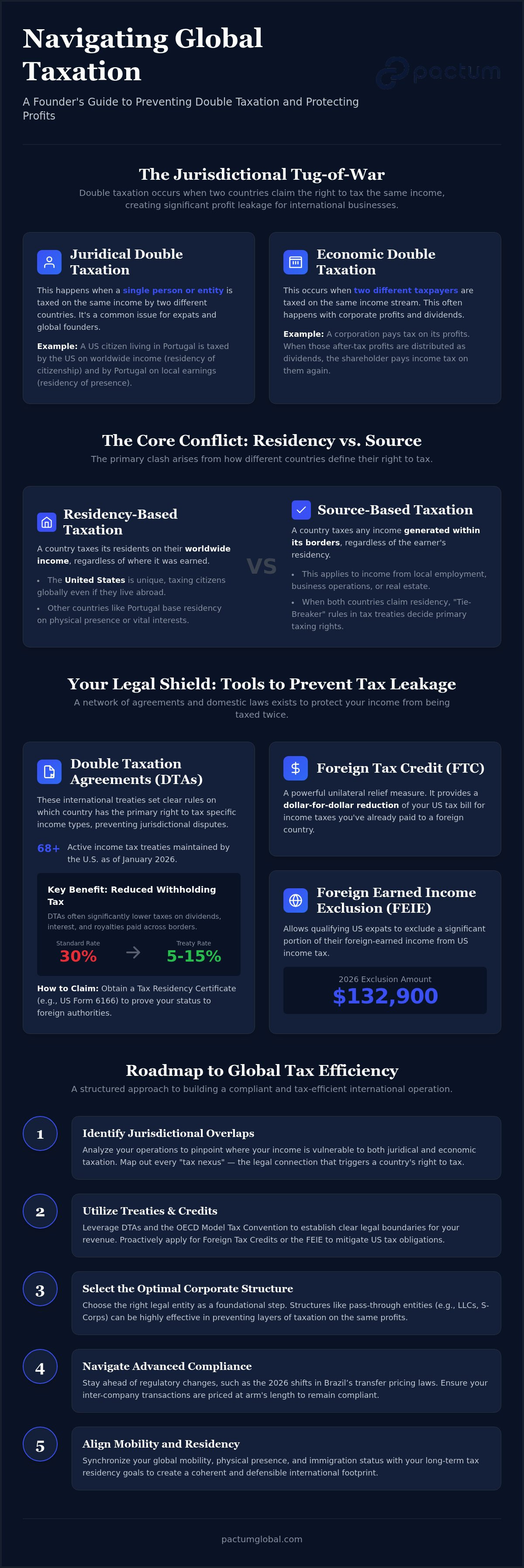
Double taxation is a jurisdictional tug-of-war. It occurs when two different countries claim the right to tax the same dollar of income, often because their tax laws overlap in ways that penalize international movement. Understanding What is Double Taxation is the first step toward protecting your income. While this overlap is a common hurdle for global entrepreneurs, it is a structural challenge that you can solve with the right legal framework.
Juridical double taxation happens when one legal entity or individual is taxed on the same income by two different nations. This usually occurs because one country taxes based on residency while the other taxes based on the source of the income. Properly structured entities are the most reliable way to prevent double taxation on cross-border profits. Without this structure, you risk losing a significant portion of your revenue to redundant filing requirements and overlapping liabilities.
Economic double taxation is a separate issue. It occurs when two separate taxpayers are taxed on the same income. A common example is a corporation paying tax on its profits, followed by the shareholder paying tax again on the dividends distributed from those same post-tax earnings. In 2026, tax authorities are increasingly aggressive about identifying where value is created. While these overlaps are legal, they aren't an inevitable cost of doing business. You can protect your margins through proactive legal architecture and strategic entity selection.
Residency-Based vs. Source-Based Taxation
The US tax system is unique because it taxes the worldwide income of its citizens regardless of where they live. If you're a US founder living in Lisbon, the IRS still expects a portion of your global earnings. This creates a constant risk of double exposure. Brazil and Portugal operate differently, typically determining tax residency based on physical presence or the center of your vital interests. When both countries claim you as a resident, modern tax treaties provide "Tie-Breaker" rules. These rules use a hierarchical list of criteria, such as your permanent home or strongest economic ties, to decide which country has the primary taxing right.
Common Scenarios for Founders and Expats
Many digital nomads fall into a trap while working from Portugal for a US-based company. They might assume their US tax payments cover them, only to find Portugal claiming tax rights based on their physical presence in the country. To prevent double taxation in these cases, you need to align your corporate structure with your physical location. Investors moving capital between the US and Brazil face similar hurdles. Without the right structure, dividends and capital gains can suffer from heavy leakage as both nations seek their share. A tax nexus is the legal connection that triggers a country's right to tax. Identifying these connections early is the first step toward efficiency.
The Legal Framework: How Treaties and Credits Protect You
The global tax landscape relies on a network of agreements designed to ensure your income isn't depleted by two different governments. As of January 2026, the US maintains active income tax treaties with over 68 countries. These international tax treaties follow the OECD Model Tax Convention to set clear rules on which nation has the primary right to tax specific types of income. Without these frameworks, expansion would be prohibitively expensive for most firms.
Even when a formal treaty doesn't exist, most countries provide unilateral relief. This means your home country may offer a credit for taxes paid abroad to help prevent double taxation. However, US citizens must be wary of the "Saving Clause" found in most treaties. This provision effectively allows the US to tax its citizens as if the treaty didn't exist. You'll need specialized legal documentation to navigate these exceptions and ensure your protection remains intact.
Leveraging Double Taxation Agreements (DTAs)
DTAs are powerful tools for reducing tax leakage. They often lower withholding tax rates on dividends, interest, and royalties. For example, a treaty might reduce a standard 30% withholding rate to 15% or even 5% depending on the jurisdiction. To claim these benefits, you must prove your status by obtaining a Tax Residency Certificate from your home tax authority. In the US, this is typically Form 6166. This document is the key that unlocks treaty benefits and provides the certainty your corporate structure needs.
Foreign Tax Credits (FTC) vs. Exclusions (FEIE)
For US taxpayers, the two primary mechanisms to prevent double taxation are the Foreign Tax Credit and the Foreign Earned Income Exclusion. The FTC provides a dollar-for-dollar reduction of your US tax bill based on taxes paid to a foreign government. It's often the best choice in high-tax jurisdictions like Portugal. It ensures you aren't penalized for paying your fair share in your host country.
In contrast, the FEIE allows you to exclude a set amount of earned income from US taxation. For the 2026 tax year, this limit is $132,900. Choosing between these requires careful modeling of your income level and local tax rates. Assumptions can be costly here. It's better to build a foundation based on data rather than habit. If you're managing complex cross-border interests, professional transfer pricing services can help align your intercompany charges with these credit strategies.
Strategic Entity Selection to Prevent Tax Leakage
The foundation of any tax-efficient global operation is the legal structure you choose. Your choice of business structure is the single most important factor in your ability to prevent double taxation. While many founders focus on liability protection, the way your entity interacts with international tax law determines how much of your profit you actually keep. A poorly chosen structure can lead to "tax leakage," where your income is chipped away by multiple jurisdictions before it reaches your personal account.
Pass-through entities are often the preferred choice for international entrepreneurs. These structures, such as LLCs or certain partnerships, allow income to flow directly to the owners without being taxed at the corporate level first. This avoids the two-tier tax system typical of C-Corporations, where the entity pays a flat 21% federal tax and shareholders pay again on dividends. However, you must be cautious with "Check-the-Box" elections. These IRS elections allow you to choose how an entity is classified, but they can create hybrid entities. If one country sees a corporation and another sees a pass-through, you may face complex compliance hurdles that negate your savings.
US LLCs for International Founders
For non-residents, a single-member US LLC offers a unique advantage: tax transparency. If the LLC does not have "Effectively Connected Income" (ECI), the non-resident owner may not owe US federal tax on foreign-source income. ECI generally refers to income generated by a trade or business within the US. This is distinct from Fixed, Determinable, Annual, Periodical (FDAP) income, such as dividends or royalties, which typically face a 30% withholding tax. Understanding these definitions is essential for those using USA Company Setup for Non-Residents to build a global brand. This strategic alignment helps you prevent double taxation while maintaining a lean operational footprint.
The Portugal Holding Company Strategy
Portugal has become a premier destination for holding companies due to its Participation Exemption regime. This rule allows a Portuguese company to receive dividends and capital gains from foreign subsidiaries tax-free, provided certain conditions regarding ownership percentage and holding periods are met. Additionally, a Portuguese entity grants you access to the EU Parent-Subsidiary Directive. This directive eliminates withholding taxes on profit distributions between associated companies in different EU member states. When combined with the U.S. Foreign Tax Credit, this structure becomes a powerful shield for global cash flow. To ensure these benefits are protected among partners, a robust Shareholders Agreement for Portuguese Company is a necessary foundation for long-term stability.
Advanced Compliance: Transfer Pricing and Substance
Transfer pricing is the most critical yet frequently overlooked component of a global tax strategy. It is the legal mechanism used to set prices for transactions between related entities, such as a parent company in the US and a subsidiary in Portugal. When you manage these intercompany charges correctly, you prevent double taxation by ensuring profits are allocated and taxed in the jurisdiction where the value is actually created. This prevents authorities from claiming that you're artificially shifting profits to avoid your obligations.
2026 marks a pivotal shift for businesses operating between the US and Brazil. Brazil's full alignment with OECD transfer pricing standards has fundamentally changed the trade dynamic. The old formula-based rules have been replaced by the international "arm's length" principle. This change simplifies cross-border operations for multinationals but requires much more rigorous documentation. You can no longer rely on fixed margins; your intercompany pricing must now reflect what independent companies would pay in a similar transaction.
Tax authorities have also moved beyond simple registrations to focus on "economic substance." This means your corporate structure must have a physical presence, local management, or active employees to be recognized for treaty benefits. Shell companies are no longer a viable way to prevent double taxation. Instead, they've become significant audit risks. If a country decides your entity lacks substance, they may ignore its legal existence and tax the income directly at the shareholder level, often at much higher rates.
Compliance also requires meticulous transparency. In the US, Form 5472 is mandatory for any domestic corporation or LLC that is at least 25% foreign-owned. This form tracks transactions with related parties, and the penalties for non-compliance or late filing are severe. Similar reporting requirements exist in Brazil and Portugal to ensure that tax authorities can verify the legitimacy of your intercompany flows.
Transfer Pricing in Brazil and the US
Your intercompany service agreements must reflect market rates to withstand scrutiny from both the IRS and the Brazilian Receita Federal. If you undercharge or overcharge your foreign branch, you risk "deemed profit" traps. In the Brazilian tax system, authorities may estimate your earnings and tax you on a percentage of gross revenue if your documentation is insufficient. Comprehensive transfer pricing documentation is your best audit defense. Our team provides specialized transfer pricing services to ensure your intercompany rates are defensible and optimized for global efficiency.
The Importance of Shareholders' Agreements (SHA)
A well-drafted Shareholders' Agreement (SHA) acts as your internal shield against tax surprises. It's essential to include tax-conscious distribution clauses that account for withholding taxes and differing tax years between countries. You should also define tax indemnity among international partners. This ensures that if one partner's residency status triggers a specific tax liability or audit, the other partners and the company itself are protected from the financial fallout. Review our Legal Documents for International Startups to ensure your corporate foundation is secure and ready for expansion.
The Pactum Global Roadmap to Tax Efficiency
Achieving a tax-efficient international structure is not a matter of luck. It is the result of a methodical, step-by-step approach to legal architecture. At Pactum Global, we've developed a roadmap that moves you from confusion to a state of calm security. This process ensures that every legal document and corporate decision works together to prevent double taxation while allowing your business to scale across borders without friction.
- Step 1: Jurisdictional Analysis. We begin by mapping your personal and corporate nexus. This involves identifying exactly where you, your management, and your assets are located to determine which tax authorities will claim a share of your income.
- Step 2: Entity Architecture. Once the nexus is clear, we select the optimal business structure. Whether it's a company setup in Brazil, Portugal, or the USA, we align the entity type with your specific trade flows and residency status.
- Step 3: Documentation. We draft the legal backbone of your operations. This includes Shareholders' Contracts (SHA), Startup Contracts (SAFE), and intercompany service agreements that satisfy substance and transfer pricing requirements.
- Step 4: Mobility Integration. Finally, we align your immigration status with your tax goals. Your visa type and physical presence directly impact your tax residency, so this step is vital for long-term protection.
End-to-End Global Mobility
Immigration planning is often the missing piece in a tax strategy. For those looking toward Europe, choosing between D2 or D7 visas in Portugal can significantly change your tax residency timeline. If you relocate without a plan, you might accidentally trigger an "exit tax" in your home country, which is a levy on the unrealized gain of your assets. Integrating your move with your corporate setup is the only way to prevent double taxation effectively. You can learn more about this process in our guide to Legal Support for Global Mobility.
Setting a Foundation for Growth
Fixing a flawed tax structure later is often ten times more expensive than doing it right during the initial setup. Retroactive changes frequently trigger audits and require complex legal filings that could have been avoided. By establishing a professional foundation from day one, you gain the peace of mind needed to focus on your actual growth rather than bureaucratic errors. We serve as your proactive expert guide, acting as a shield against the complexities of international law. Don't leave your global success to chance. Contact Pactum Global today for a strategic consultation and secure your international income.
Mastering Your Global Financial Foundation
Global expansion shouldn't feel like a constant compromise between growth and financial security. By aligning your corporate entity with international tax treaties and maintaining strict economic substance, you can effectively prevent double taxation. We have explored how strategic entity selection and OECD-aligned transfer pricing provide the legal shield your business needs to thrive in 2026. These structural decisions ensure that your capital remains focused on innovation and expansion rather than redundant tax payments in multiple jurisdictions.
Pactum Global acts as your seasoned navigator through the specific complexities of the Brazil-US-Portugal corridors. Our team provides comprehensive legal and immigration support alongside specialized transfer pricing services to keep your operations both compliant and efficient. Secure your global growth with a professional tax and legal strategy from Pactum Global. With the right architecture in place, you can move forward with the calm confidence that your international journey is fully protected and optimized for long-term success.
Frequently Asked Questions
Is double taxation legal for US citizens living abroad?
Yes, double taxation is legal because the US exercises citizenship-based taxation on worldwide income. While this creates a jurisdictional overlap, international law allows nations to set their own tax boundaries. You aren't legally protected from being taxed twice unless you proactively use mechanisms like the Foreign Tax Credit. Proper legal structuring remains the most effective way to prevent double taxation and ensure your global revenue isn't depleted by redundant claims.
Do I need a tax treaty to avoid paying taxes in two countries?
You don't strictly need a formal treaty to find relief, though treaties provide the most certainty. Most countries offer unilateral relief through foreign tax credits even without a bilateral agreement. This allows you to deduct taxes paid abroad from your home country's bill. However, treaties offer lower withholding rates on dividends and royalties that unilateral credits cannot match. Relying on a treaty is always the more robust path for long-term stability.
What happens if I live in Portugal but my company is in the USA?
Living in Portugal while owning a US company often triggers tax residency in Portugal based on physical presence. Portugal will likely claim tax rights on your worldwide income, while the US taxes the company's profits. You must use the US-Portugal tax treaty to determine which country has the primary right to tax your dividends or salary. Without careful management of your tax nexus, you could face high tax leakage from both jurisdictions simultaneously.
How does the Foreign Tax Credit (FTC) differ from the Foreign Earned Income Exclusion (FEIE)?
The Foreign Tax Credit (FTC) provides a dollar-for-dollar reduction of your tax bill, while the Foreign Earned Income Exclusion (FEIE) removes income from your taxable total. For 2026, the FEIE limit is $132,900. If you live in a high-tax country like Portugal, the FTC is often more beneficial. If you reside in a low-tax area, the FEIE might save you more. Strategic modeling is essential to determine which mechanism offers better protection.
Can an LLC help me prevent double taxation as a non-resident?
A US LLC can be a powerful tool to prevent double taxation for non-residents if it's structured as a disregarded entity. If the LLC doesn't engage in a US trade or business, its foreign-source income may not be subject to US federal tax. This allows profits to flow directly to the owner's home country. However, you must carefully manage Effectively Connected Income to ensure the IRS doesn't claim a right to your global earnings through the entity.
What is the 'Saving Clause' and how does it affect my tax treaty benefits?
The Saving Clause is a standard provision in US tax treaties that allows the US to tax its citizens as if the treaty didn't exist. It effectively prevents US citizens from using treaty provisions to reduce their US tax liability on most types of income. While the treaty still helps through credits, the Saving Clause means you can't easily escape the IRS's reach just by moving to a treaty-partner country like Portugal.
Does Brazil have a double taxation treaty with the United States?
No, Brazil does not currently have a double taxation treaty with the United States as of 2026. This lack of a formal agreement makes US-Brazil operations more complex and increases the risk of tax leakage. However, Brazil's recent alignment with OECD transfer pricing standards provides a more predictable framework for intercompany transactions. Businesses must rely on unilateral credits and sophisticated entity architecture to protect their income in this specific trade corridor.
How do transfer pricing rules help prevent double taxation for my business?
Transfer pricing rules prevent double taxation by ensuring that profits are taxed only once in the correct jurisdiction. By using arm's length pricing for intercompany services, you justify the movement of capital between a parent company and its subsidiaries. This documentation acts as your primary defense during an audit. It proves to tax authorities that your profit allocations are based on economic reality rather than an attempt to shift income to lower-tax regions.


