

For decades, tax filings were a private conversation between your enterprise and the authorities. That era has officially ended. With the first public reports under the EU Directive due by December 31, 2026, Country-by-Country Reporting is no longer just a confidential compliance check. It's now a public benchmark of your corporate ethics. If your multinational group earns over EUR 750 million, the world is watching how you distribute profits and pay taxes across every jurisdiction.
Managing inconsistent data across multiple borders can feel like a high-stakes puzzle where a single error invites a heavy BEPS audit. You're likely concerned about the friction between private filings like the U.S. Form 8975 and the new public mandates in Europe. This guide will help you master the complexities of global tax transparency and ensure your enterprise remains compliant with the latest OECD and EU standards. We'll provide a strategic framework for managing your data and a clear roadmap for meeting your global obligations with confidence.
Key Takeaways
- Learn how to accurately calculate consolidated group revenue to avoid the heavy penalties associated with missed filing thresholds.
- Discover how the Master File and Local File integrate with Country-by-Country Reporting to build a cohesive and defensible global tax strategy.
- Differentiate between private tax filings and public reporting requirements to manage both legal compliance and public perception.
- Develop a methodical framework for managing inconsistent data to mitigate the risk of BEPS audits and protect your corporate reputation.
- Understand how to align your international corporate structure in the USA, Brazil, or Portugal with modern transfer pricing standards.
Understanding Country-by-Country Reporting (CbCR) in 2026
Country-by-Country Reporting serves as a global transparency benchmark designed to show tax authorities exactly where value is created. It requires multinational enterprises to provide an aggregate breakdown of their global income, profit before tax, and income tax paid. This isn't just another administrative form. It's a high-level map of your global economic footprint that allows regulators to spot inconsistencies in where you claim profits versus where you actually conduct business.
The standard originated from the OECD BEPS Action 13 initiative, which was created to fight base erosion and profit shifting. As defined in the framework for Country-by-Country Reporting (CbCR), the primary goal is risk assessment. If your consolidated group revenue exceeds €750 million, or the local currency equivalent, your organization is likely obligated to file. While the OECD provides the template, the way you manage this data determines whether you're seen as a compliant partner or a target for an audit.
The Evolution of Tax Transparency
Tax compliance has moved from quiet, bilateral exchanges to a massive automatic information network. The Multilateral Competent Authority Agreement (MCAA) laid the groundwork for this shift, but 2026 represents a major turning point. We've entered the "Public CbCR" era. Many companies must now move beyond confidential filings with tax offices to publishing their sensitive tax data directly on their corporate websites. This change transforms a technical tax obligation into a matter of public reputation and investor scrutiny.
Key Jurisdictions and Local Variations
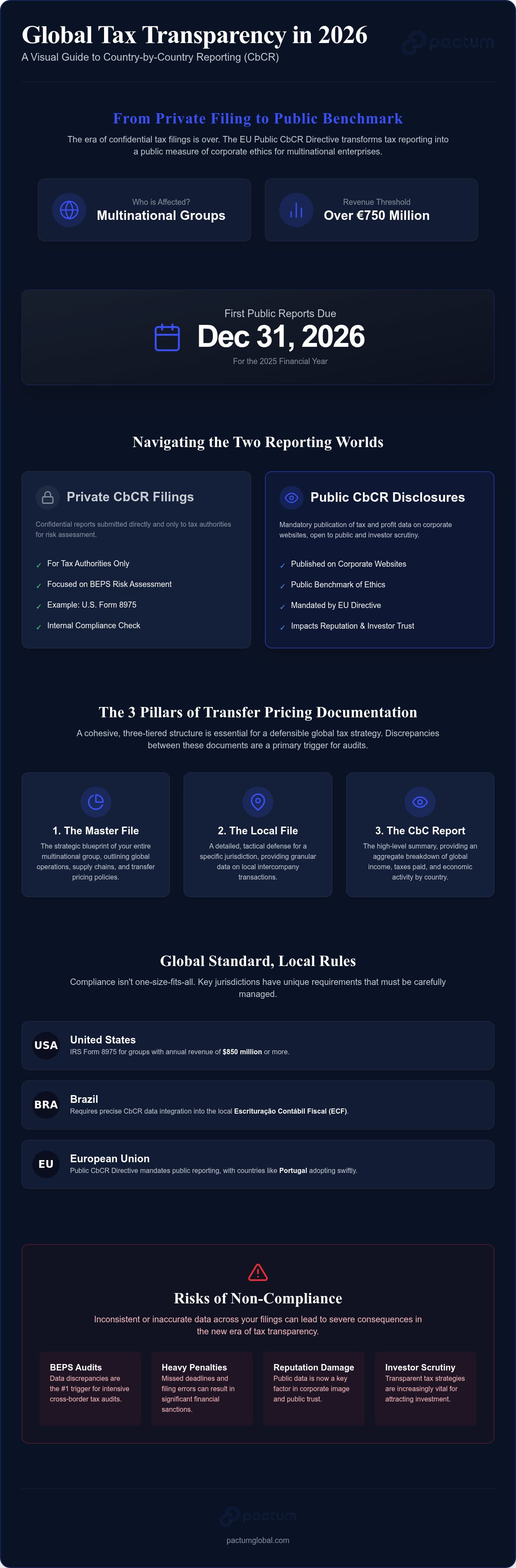
Compliance isn't identical in every country, and assuming a one-size-fits-all approach is a common mistake. In Brazil, for example, the government integrates these requirements into its Escrituração Contábil Fiscal (ECF). This requires precise coordination with local accounting data to ensure the numbers match your corporate records. Portugal has moved swiftly to adopt the EU Public CbCR Directive, with the first public reports for the 2025 financial year due by December 31, 2026.
In the United States, the IRS uses Form 8975 for groups with annual revenue of $850 million or more. For entrepreneurs managing these high thresholds, aligning your USA company setup for non-residents with global reporting standards is essential. It's the only way to avoid double taxation or triggering red flags during a cross-border audit. Each jurisdiction has its own nuances, making it vital to have a navigator who understands the local landscape and the global standard.
The Three Pillars of Transfer Pricing Documentation
OECD BEPS Action 13 established a standardized three-tier approach to documentation. This structure ensures that tax authorities have a complete view of your business, from global strategy down to specific local transactions. While Country-by-Country Reporting provides the high-level quantitative data, it relies on two other critical documents to provide the necessary context. Without all three pillars working in harmony, your enterprise risks appearing inconsistent. Discrepancies between these files are the primary trigger for cross-border tax audits in the modern era.
The Master File: Your Global Narrative
The Master File acts as the strategic blueprint of your multinational group. It describes your global supply chain, intangible asset ownership, and intercompany financing arrangements. This document is where you justify your transfer pricing policies to every jurisdiction simultaneously. For new ventures, ensuring this file aligns with your legal documents for international startups is vital. If your shareholders' agreements or intellectual property licenses contradict your Master File narrative, you invite immediate scrutiny. We structure this narrative to ensure cross-border consistency, acting as a protective shield against bureaucratic errors.
The Local File and CbC Data Alignment
The Local File is the tactical defense against specific jurisdictional audits. It provides the granular detail for intercompany transactions within a single country, such as Brazil or Portugal. One common pitfall occurs when the profit margins reported in a Brazilian ECF don't align with the aggregate data in the global CbC report. Tax authorities now use sophisticated analytics to flag these discrepancies instantly. If you are operating in the U.S., you must also ensure your local data satisfies IRS CbCR requirements to avoid penalties for the $850 million revenue threshold.
Consistency across these tiers isn't just about avoiding fines; it's about building a foundation of trust with regulators. Discrepancies in intercompany pricing are the most frequent cause of transfer pricing adjustments and double taxation. By integrating your local filings with the overarching quantitative data set of the CbC report, you create a seamless compliance trail. If you're concerned about how your data stacks up across different regions, our transfer pricing services can help you map out a clear, compliant path forward. We ensure that your local documentation supports the global story you tell tax authorities.
Public vs. Private CbCR: Navigating Transparency and Reputation
Historically, Country-by-Country Reporting was a confidential matter. It functioned as a private data exchange between tax authorities to identify potential audit targets. This changed with the introduction of the EU Public CbCR Directive. Now, your tax data isn't just a regulatory requirement; it's a public statement of your corporate values. Stakeholders, including investors, NGOs, and the general public, can now scrutinize how your profits align with your local tax contributions.
This shift creates a new layer of risk. Legal tax planning that follows every letter of the law can still result in reputational damage if the public perceives the results as "unfair." When your data shows high profits in low-tax jurisdictions without a clear narrative, it invites criticism. You must move beyond simple compliance and adopt a communication strategy that explains the economic reality behind the numbers.
The EU Landscape for Public Disclosure
Portugal and other EU member states have moved quickly to transpose the Public CbCR Directive into local law. For the 2025 financial year, companies with a calendar fiscal year must publish their first reports by December 31, 2026. This obligation applies to multinational groups with consolidated revenue exceeding €750 million. Even non-EU parent companies fall under these rules if they maintain a significant presence in the EU through medium-sized or large subsidiaries. The public report must include specific data points:
- A brief description of the nature of the group's activities.
- The number of full-time equivalent employees.
- Profit or loss before income tax.
- The amount of income tax accrued and the amount of income tax actually paid on a cash basis.
- Accumulated earnings at the end of the financial year.
Strategic Communication for MNEs
Raw data rarely tells the whole story. To protect your brand, you should consider preparing a "Tax Transparency Report" to accompany your CbC data. This document provides the necessary context for your global operations. It allows you to address concerns regarding "double non-taxation" or explain why certain jurisdictions show lower tax rates due to legitimate R&D incentives or infrastructure investments. Without this narrative, you leave your data open to interpretation by outside parties who may not understand your industry's nuances.
We help you bridge the gap between technical legal compliance and public perception. Our transfer pricing services ensure that your data is not only accurate but also defensible. We act as your guide in structuring these disclosures so they reflect your commitment to transparency while safeguarding your commercial interests. By proactively managing this narrative, you transform a potential reputational threat into a demonstration of corporate responsibility.
Compliance Thresholds and Deadlines: Is Your Business at Risk?
Determining your obligation for Country-by-Country Reporting starts with a single number: €750 million. If your multinational enterprise's consolidated group revenue reached or exceeded this threshold in the preceding fiscal year, you are in scope. For U.S. based groups, the IRS threshold remains $850 million. Missing this mark isn't just a clerical error. It's a trigger for automatic exchange failures that can lead to significant financial penalties and a permanent place on the radar of tax authorities.
Beyond the report itself, most jurisdictions require a notification filing. This is a separate document telling your local tax authority which entity in the group is the "Reporting Entity" and where the report will be filed. Failing to notify the authorities on time can result in fines even if the final report is filed correctly. Typically, you have a 12 month window after the close of your fiscal year to submit the full report. However, local notification deadlines are often much earlier, sometimes coinciding with the end of the fiscal year itself.
Determining the Reporting Entity
In a standard scenario, the Ultimate Parent Entity (UPE) files the report in its home jurisdiction. However, if the UPE's country doesn't have a tax treaty for information exchange with your other operating countries, you may need to appoint a Surrogate Parent Entity (SPE). This is a common strategy to streamline filings across the EU. Be aware that local subsidiaries in Brazil or Portugal might be forced into a secondary filing obligation if the global report isn't successfully exchanged through official channels. This adds a layer of complexity that requires proactive management to avoid duplicate work or conflicting data.
The 2026 Compliance Checklist
To ensure your group is prepared for the upcoming cycles, follow this methodical three step approach:
- Step 1: Revenue Audit. Perform a rigorous audit of consolidated revenue across all global subsidiaries to confirm if you've crossed the €750 million threshold.
- Step 2: XML Schema Validation. Ensure your data is formatted according to the OECD’s CbCR XML Schema version 2.0. Technical errors in the file format can lead to rejected submissions.
- Step 3: Internal Review. Compare your global data against specific local requirements, such as the Brazil transfer pricing regulations, to ensure consistency before the tax authorities do it for you.
Managing these moving parts requires a partner who understands both the broad OECD standards and the specific local nuances of each jurisdiction. If you need a navigator to help you map out your filing obligations, our Transfer Pricing Services provide the specialized support you need to stay ahead of these deadlines. We act as a shield against bureaucratic errors, ensuring your global compliance is seamless and secure.
Strategic Tax Compliance with Pactum Global
Global tax transparency isn't a hurdle to clear once a year. It is a fundamental part of your corporate structure. As your navigator through the BEPS Action 13 landscape, we ensure that your business isn't just reacting to new rules but is built to withstand them. Our approach integrates Country-by-Country Reporting into your broader business goals, turning a complex administrative burden into a clear, strategic advantage.
Whether you are expanding through a USA company setup for non-residents or managing established Brazilian operations, your reporting must be seamless. We look at the big picture. We align your corporate governance with your tax transparency goals, ensuring that every subsidiary and intercompany transaction reflects the same narrative of compliance and value creation.
End-to-End Transfer Pricing Support
Compliance begins long before you file a report. It starts with the intercompany agreements that define your global operations. We provide comprehensive support across the Brazil-Portugal-USA corridor, drafting the legal documentation that forms the bedrock of your Local File. Our team manages the heavy lifting of preparing the Master File and coordinating Country-by-Country Reporting data, allowing your internal tax teams to focus on growth rather than bureaucracy. By outsourcing these expert tasks, you reduce the risk of human error and ensure your documentation meets the highest international standards.
Securing Your Global Foundation
A common gap in global compliance is the disconnect between tax reporting and foundational legal documents. We bridge this gap by ensuring your Shareholders' Contracts (SHA) explicitly address tax reporting obligations. It's not enough to follow the law; you must define who is responsible for data accuracy and filing within your corporate structure. This proactive step protects founders and the firm from compliance-related litigation and internal disputes. It creates a culture of accountability that regulators respect and investors value.
We act as a shield against the complexities of international bureaucracy. Our goal is to provide you with the calm confidence that your global footprint is secure, transparent, and fully optimized for the future. Don't leave your reputation to chance or let inconsistent data trigger an avoidable audit. Consult with Pactum Global on your global tax strategy today and let us map out a straightforward path for your multinational enterprise.
Mastering Your Global Transparency Strategy
The landscape of international tax has shifted toward a future of total transparency. Between the new EU Public CbCR Directive and rigorous OECD standards, your multinational group must maintain a unified narrative across every jurisdiction. Success requires more than just meeting the €750 million threshold. It demands absolute consistency between your Master File, Local File, and Country-by-Country Reporting data. Discrepancies are no longer just administrative errors; they are direct invitations for cross-border audits.
Managing these complexities shouldn't distract you from your core business growth. We provide specialized expertise in OECD and Brazilian transfer pricing, offering strategic legal counsel to keep your cross-border operations secure. From end-to-end global mobility support to the drafting of tax-compliant Shareholders' Agreements, we act as your protective guide through the bureaucratic maze. You don't have to navigate these transitions alone.
Ensure your global operations are compliant—Contact Pactum Global today. We are ready to help you build a stable foundation for your international success.
Frequently Asked Questions
What is the revenue threshold for Country-by-Country Reporting?
The global revenue threshold is €750 million or the local currency equivalent. For multinational groups headquartered in the United States, the IRS sets the threshold at $850 million for the preceding reporting period. It's essential to calculate this on a consolidated basis, including all income from every global subsidiary. If your group falls below these specific figures, you're generally exempt from the primary filing obligation for that fiscal year.
Is Country-by-Country Reporting public information in 2026?
Yes, it's becoming public in many regions. Under the EU Public CbCR Directive, companies with significant EU operations must publish their 2025 financial data by December 31, 2026. This move shifts Country-by-Country Reporting from a confidential tax filing to a matter of public record. You'll need to host this information on your corporate website for at least five years, making it accessible to investors, journalists, and non-governmental organizations.
Which companies are exempt from CbCR requirements?
Exemptions primarily apply to groups with consolidated annual revenue under the €750 million threshold. Small and medium-sized enterprises don't typically fall within the scope of these regulations. Additionally, groups that operate entirely within a single tax jurisdiction are exempt, as the rules target cross-border profit shifting. Some jurisdictions may also exclude specific government-owned entities or non-profit organizations, though you should always verify local requirements with a qualified advisor.
What happens if a company fails to file a CbC report?
Non-compliance leads to immediate financial penalties and heightened regulatory scrutiny. Fines vary significantly by country; for instance, Poland and Brazil impose strict monetary sanctions for late or inaccurate filings. Beyond the initial cost, a failure to file often triggers a secondary filing obligation for your local subsidiaries. This can result in multiple tax authorities launching simultaneous audits into your transfer pricing policies, creating a massive administrative and financial burden for your group.
How does CbCR differ from standard transfer pricing documentation?
Country-by-Country Reporting serves as the high-level quantitative pillar of the OECD’s three-tier documentation framework. While the Master File provides a global business narrative and the Local File details specific transactions, the CbC report focuses on raw financial data. It lists profits, taxes paid, and employee counts for every jurisdiction where you operate. This aggregate data allows tax authorities to quickly identify where your profits don't align with your actual economic activity.
Do US-based companies have to file CbC reports for their foreign subsidiaries?
Yes, U.S. multinational groups meeting the $850 million threshold must file Form 8975 with the IRS. This report covers the financial activities of all foreign subsidiaries within the consolidated group. The IRS then shares this information with foreign tax authorities through established information exchange treaties. If a treaty isn't in place with a specific country, your subsidiary in that jurisdiction might be required to file a local report directly with their tax office.
What is the role of the XML schema in CbCR filing?
The XML schema is the standardized technical format required for electronic filing. Most tax authorities, including those in the EU and the U.S., use the OECD’s CbCR XML Schema version 2.0. You can't simply submit a spreadsheet or a PDF. Your data must be structured perfectly according to these technical specifications to be accepted. Technical errors in the schema often lead to rejected filings, which can result in penalties for late submission.
Can a subsidiary file the CbC report on behalf of the entire group?
A subsidiary can file as a Surrogate Parent Entity (SPE) under specific conditions. This usually occurs when the Ultimate Parent Entity’s home country doesn't have a CbCR law or lacks an active exchange agreement with other jurisdictions. Your group must formally notify the relevant tax authorities of this arrangement. Appointing an SPE in a favorable jurisdiction, such as Portugal, can streamline your compliance process across the entire European Union and avoid multiple local filings.


