

A single legal dispute in a volatile jurisdiction can suddenly freeze your global operations, leaving your family's future in limbo. Understanding how to protect assets in multiple countries is no longer a luxury for the ultra-wealthy; it's a fundamental requirement for any modern international business owner. You've worked hard to expand your reach across borders, but you likely feel the weight of double taxation and the worry that your trusts won't be recognized from one country to the next.
It's exhausting to manage global wealth when the legal rules change every time you cross a frontier. This guide provides the exact legal structures and strategic frameworks you need to build a resilient legal moat around your business and private interests. We'll show you how to move beyond basic offshore accounts into sophisticated, multi-jurisdictional frameworks that offer true security and peace of mind.
We will explore the strategic use of Shareholders' Agreements, intellectual property silos, and succession planning that bridges the gap between Civil Law and Common Law systems. You'll gain a clear roadmap to ensure your legacy remains secure and your business survives local legal disputes, regardless of where they arise. This methodical approach ensures your international transition is seamless and your assets remain shielded from bureaucratic errors.
Key Takeaways
- Identify why common legal structures like US trusts may not be recognized in Civil Law jurisdictions and how to mitigate these "conflict of laws" risks.
- Discover how to protect assets in multiple countries by implementing centralized holding companies and siloing high-risk business operations from your core wealth.
- Establish a robust defense against partner disputes and operational liability through tailored Shareholders' Agreements and strategic Intellectual Property protection.
- Streamline your global succession by identifying the legal location of your holdings and drafting jurisdiction-specific wills to bypass international probate delays.
- Build a secure bridge between US-style asset protection and European or South American compliance with a proactive, integrated legal roadmap.
The Risks of Multi-Jurisdictional Asset Ownership
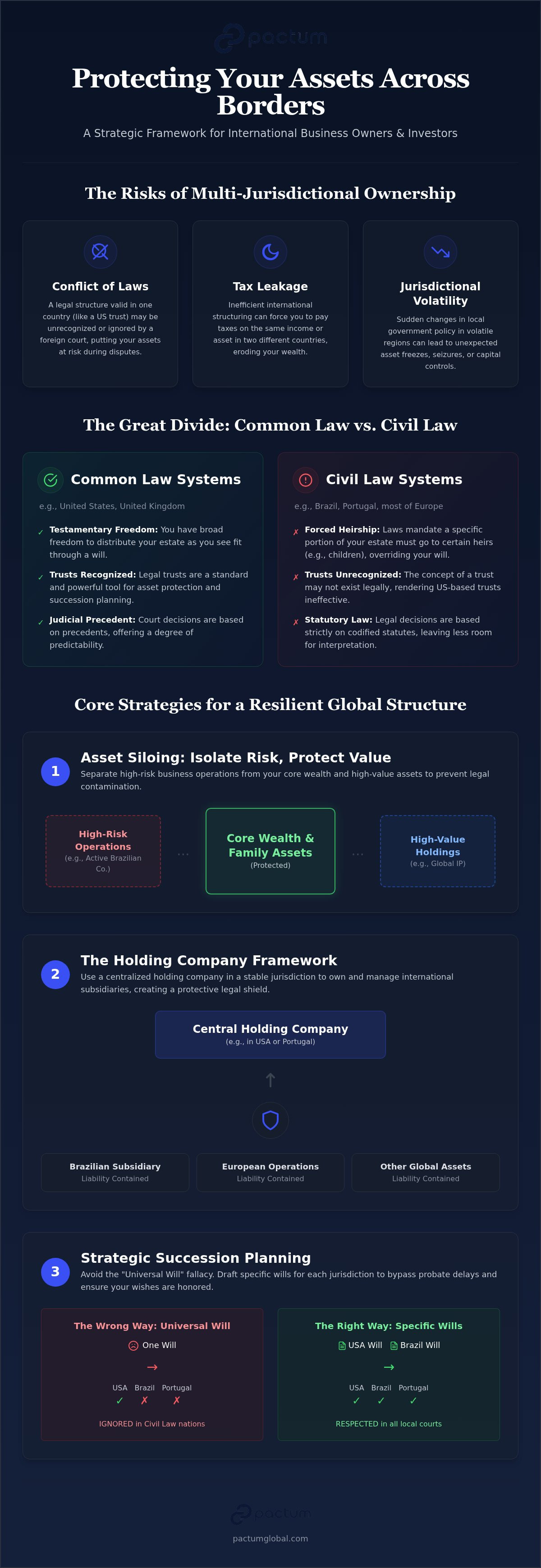
Owning wealth in different countries creates a unique set of vulnerabilities. Most investors assume that a valid legal document in one country carries weight in another. This is often a dangerous misconception. The "Conflict of Laws" problem means a foreign court may simply ignore your US-based trust because their local system doesn't recognize the legal concept of a trust. This lack of legal harmony leads to "tax leakage," where poor structuring forces you to pay double taxation on the same asset. Relying on a "Universal Will" is another common mistake; one document is rarely enough to cover assets across diverse legal landscapes.
Economic and political shifts add another layer of complexity. A sudden change in a local government's policy can lead to asset seizures or sudden freezes in volatile jurisdictions. Without a robust strategy, your global business interests remain exposed to these external shocks. Understanding how to protect assets in multiple countries involves more than just opening a foreign bank account. It requires a deep understanding of how different jurisdictions interact, or fail to interact, during a legal crisis.
Fragmented Legal Systems: Common Law vs. Civil Law
The divide between Common Law systems, like the United States, and Civil Law systems, like Brazil and Portugal, is a major hurdle. In the US, you generally have broad freedom to distribute your estate as you see fit. However, Portugal and Brazil enforce "Forced Heirship" rules. These laws mandate that a specific portion of your estate must go to certain heirs, regardless of what your will says. If you don't understand asset protection within these specific contexts, local courts might freeze your holdings during a dispute. They often prioritize their own statutes over foreign rulings, leaving your international wealth exposed to local litigation.
Bureaucratic Risks and Regulatory Compliance
By 2026, global transparency standards like the Common Reporting Standard (CRS) and FATCA have made "informal" asset holding a significant liability. Trying to manage international holdings without formal structures leads to heavy penalties and asset freezes. Effective legal support for global mobility is essential to navigate these reporting requirements without triggering unnecessary audits. You must also consider the hidden costs of informal arrangements. These often result in administrative nightmares that delay succession and complicate daily business operations. Learning how to protect assets in multiple countries requires a proactive approach that anticipates these regulatory shifts before they impact your growth.
Core Strategies for International Asset Protection
Diversification isn't just for investment portfolios; it's the foundation of legal security. To understand how to protect assets in multiple countries, you must stop viewing your holdings as a single block. Instead, you should treat your global interests as a series of interconnected but legally distinct silos. This prevents a local lawsuit or tax audit in one jurisdiction from contaminating your entire estate. Effective protection relies on building barriers that keep operational risks away from your core wealth.
Asset siloing involves separating high-risk operations from high-value holdings. For example, your active business in Brazil should never own your global intellectual property. By placing that IP in a separate entity, you ensure the brand survives even if the local company faces a dispute. This strategy creates a resilient framework that can withstand localized economic or legal shocks.
The Holding Company Framework
A centralized holding company acts as a hub for your global interests. Structuring a US or Portuguese holding company to manage Brazilian subsidiaries provides a layer of separation and simplifies capital movement. A USA company setup for non-residents often serves as this protection anchor, offering a stable legal environment for global management. This structure allows you to centralize control while keeping liabilities contained within individual subsidiaries.
Managing these relationships requires precision. You must utilize intercompany loans and formal transfer pricing services to ensure asset mobility remains compliant. This structured approach allows you to move funds between jurisdictions without triggering red flags or unnecessary taxes. If you need help establishing these boundaries, professional company setup services can provide the necessary foundation.
Trusts and Foundations in a Transparent World
The 2026 regulatory environment has ended the era of the "shell company." Global reporting standards now demand "substance," which means real economic activity or a clear legal purpose. When deciding between a Delaware Trust and a Portuguese Private Foundation, you must consider how local courts recognize these entities. While a trust is a powerful tool in Common Law, a Portuguese foundation might offer better recognition and protection within the European Union.
Each structure carries specific compliance duties. Ensuring your trust or foundation meets global reporting requirements is non-negotiable to avoid asset freezes. You should prioritize transparency and meticulous documentation over secrecy. This shift ensures your protection remains valid under modern international scrutiny.
Strategic use of jurisdictions like Portugal can also provide a stable entry point for the EU market. Diversifying your legal "home base" ensures you aren't putting all your eggs in one basket. This is the core of how to protect assets in multiple countries: building a multi-layered defense that adapts to different legal systems while maintaining a unified strategic goal.
Corporate Structuring as a Protective Shield
While holding companies provide the structural skeleton for your wealth, your corporate contracts are the muscle that protects it. Learning how to protect assets in multiple countries requires you to look beyond where you store your capital and focus on how you manage your business partnerships. Without specific legal language, a partner's personal bankruptcy or a local lawsuit could inadvertently freeze your global operations. You need a strategy that treats your business as a living entity requiring constant defense.
One of the most significant mistakes international entrepreneurs make is using "template" contracts for cross-border operations. A generic agreement found online rarely accounts for the complex interplay between different legal systems. A contract that is valid in the United States might be completely unenforceable in Brazil or Portugal. These gaps create openings for creditors or disgruntled partners to bypass your protections. Custom legal documentation is not just a formality; it is a necessary insurance policy for your global interests.
The Power of a Cross-Border Shareholders Agreement
A shareholders agreement for portuguese company serves as your first line of defense against internal conflict. When your team spans multiple countries, you must define exit strategies and dispute resolution processes in neutral jurisdictions. This prevents a local legal dispute from paralyzing the entire organization. A well-crafted SHA also includes "firewall" clauses that protect the company's assets if a shareholder faces personal legal issues or divorce. By establishing these rules early, you create a predictable environment for growth and ensure that your business remains resilient regardless of individual partner challenges.
IP and Trademark Protection as Asset Insurance
Your brand and proprietary technology are often your most valuable assets, yet they are frequently the least protected. An effective intellectual property strategy for startups prevents brand hijacking in competitive markets like Brazil or the EU. You should aim to register your trademarks in the USA, Brazil, and Europe simultaneously to establish a global footprint.
To maximize security, you should separate IP ownership into a dedicated holding entity. This means your active, high-risk operational companies use the IP through licensing agreements but do not actually own it. If the operational company faces a lawsuit or debt collection, your core trademarks and patents remain safely tucked away in the holding entity. This is a critical component of how to protect assets in multiple countries, as it ensures your brand survives even if a specific local branch fails. Using SAFE and other startup contracts also helps safeguard equity during early-stage global ventures, providing a clear path for future investment while maintaining control.
Succession Planning for Cross-Border Assets
Your global legacy is only as strong as your weakest succession link. When you hold wealth across various borders, the legal location or "Situs" of each asset determines which country's laws apply upon your passing. Understanding how to protect assets in multiple countries during a transition requires a shift from a single "Universal Will" to a coordinated, multi-jurisdictional strategy. Without this coordination, your heirs could face years of legal gridlock and significant tax leakage.
The first step is a comprehensive inventory of your global holdings. You must identify where each asset is legally situated, whether it's a Portuguese bank account, a Brazilian subsidiary, or US real estate. Once identified, you should draft jurisdiction-specific wills. This ensures that a probate court in one country doesn't accidentally revoke a valid document in another. By 2026, tax laws have become increasingly aggressive regarding cross-border inheritance; regular audits of your plan are essential to remain compliant with these shifting regulations.
You can also implement "automatic" succession tools to bypass the probate system entirely. Joint tenancies with rights of survivorship or specific beneficiary designations on financial accounts allow for an immediate transfer of ownership. These tools provide your family with instant liquidity while the more complex parts of the estate are settled. If you are ready to secure your family's future, you can schedule a consultation for succession planning services to begin building your roadmap.
Navigating Brazilian and Portuguese Probate
Probate in Civil Law jurisdictions like Brazil and Portugal is notoriously slow and rigid. If you open company in Brazil for foreigners, you must have a local succession strategy in place from day one. Brazilian law often imposes "forced heirship," which dictates how a large portion of your estate must be distributed, regardless of your personal wishes. Failing to account for this can lead to the "frozen asset" trap, where your business operations grind to a halt during a multi-year probate process. In Portugal, utilizing residency programs like the Golden Visa can offer additional layers of family asset security by establishing a stronger legal tie to the European Union.
Harmonizing International Wills
A major risk in international succession is the "Doctrine of Renvoi." This occurs when two countries' legal systems keep passing the responsibility for a case back and forth, leading to endless delays. To prevent this, your legal documents for international startups should include specific succession clauses that define which law governs the transfer of equity. You should also appoint cross-border executors who understand the nuances of both Common Law and Civil Law systems. This harmonization ensures that your various wills work in tandem rather than in conflict, providing a seamless transition for your heirs and business partners. This level of detail is the final piece in the puzzle of how to protect assets in multiple countries effectively.
Building Your Global Protection Roadmap with Pactum Global
Pactum Global operates as a steady partner in an increasingly complex international environment. We don't just provide isolated legal services; we offer an integrated strategy that aligns your corporate structure with your personal succession goals. Our team acts as a proactive shield against bureaucratic errors by mapping out your entire journey before you take the first step. Understanding how to protect assets in multiple countries is the first step, but executing that plan requires a partner who understands the friction between different legal codes. By moving from defensive reactions to strategic asset management, you gain the clarity needed to focus on your business growth.
Our approach is designed to remove the stress of international bureaucracy. We replace confusion with a sense of calm confidence by providing transparent, no-nonsense advice. Whether you are navigating the intricacies of a Delaware trust or a Brazilian subsidiary, we ensure every piece of your global puzzle fits together perfectly. This methodical flow ensures that your business interests and private wealth are governed by a single, cohesive strategy rather than a collection of disconnected documents.
Tailored Structuring for Brazil and Portugal
Navigating the complexities of Civil Law in Brazil and Portugal requires more than a basic understanding of the statutes. It demands a specialized perspective that can harmonize these rules with US-style protections. We leverage our local expertise to help you navigate the specific hurdles of these jurisdictions, ensuring your business structure supports your global mobility goals. We coordinate with an elite network of international tax and legal professionals to provide a seamless, end-to-end service. This collaborative approach ensures that your setup in Lisbon or São Paulo remains fully compliant while maintaining the flexibility you need as a global entrepreneur.
Secure Your Future Today
The most effective time to master how to protect assets in multiple countries is before a dispute ever reaches a courtroom. Waiting for a legal challenge or a tax audit to occur often means it's already too late to implement the strongest protective layers. We encourage a proactive stance that secures your legacy while the horizon is clear. Asset protection is a foundation-building exercise that must happen before the storm arrives.
Your 2026 international asset owner checklist should include:
- A verified inventory of all global asset "Situs" locations.
- Custom Shareholders' Agreements for every cross-border venture.
- Jurisdiction-specific succession documents that avoid probate delays.
- A centralized holding company with documented economic substance.
If you are ready to secure your global legacy, the next step is simple. You can schedule a confidential consultation with our global navigators to review your current holdings and identify potential vulnerabilities. We'll help you build a resilient legal moat around your wealth, providing the peace of mind you need to continue your international expansion. Your global wealth deserves a foundation that is as ambitious as your business goals.
Securing Your Global Legacy for 2026 and Beyond
Mastering how to protect assets in multiple countries requires a shift from reactive legal fixes to a proactive, integrated strategy. You've learned that effective protection relies on siloing high-risk operations, utilizing robust Shareholders' Agreements, and harmonizing your succession documents across diverse legal systems. These structures prevent local disputes from paralyzing your entire global operation. By bridging the gap between the United States, Brazil, and Portugal, you can ensure your wealth remains shielded from bureaucratic errors and unintentional tax leakage.
Pactum Global specializes in the United States, Brazil, and Portugal, providing the high-level expertise needed for complex cross-border Intellectual Property protection and international company formation. Our team acts as a seasoned navigator, mapping out your journey so you can focus on growth. We provide the precise documentation and strategic frameworks necessary to build a resilient legal moat around your global interests. Don't leave your family's future or your business legacy to chance in a volatile legal landscape. Secure your global assets with a professional strategy from Pactum Global today. You can move forward with the calm confidence that your international foundation is built to last.
Frequently Asked Questions
Do I need a separate will for every country where I own assets?
Yes, having jurisdiction-specific wills is the most effective way to avoid international probate delays. While a single universal will might be legally recognized in some places, it often leads to administrative gridlock. Local courts in Brazil or Portugal may require extensive translations and legalizations before accepting a foreign document. Separate wills ensure each asset is handled under its local Situs rules without interfering with your other global holdings.
Are offshore asset protection trusts still legal in 2026?
Offshore trusts remain legal, but they must adhere to strict 2026 global transparency standards like CRS and FATCA. The focus has shifted from secrecy to legitimate tax and legal structuring. To be effective, your trust needs substance, meaning it must have a clear business or personal purpose beyond simple tax avoidance. Failure to comply with modern reporting requirements can lead to severe penalties or the freezing of your international accounts.
How does Brazil’s forced heirship law affect my US-based assets?
Brazil's forced heirship rules generally apply to assets located within Brazil or to the global estate of a Brazilian resident. If you are a Brazilian resident, your US-based assets could be included in the calculation of the mandatory portion for heirs. Properly structuring your wealth through US holding companies can help mitigate these conflicts. This is a key part of how to protect assets in multiple countries while navigating civil law restrictions.
Can I protect my business from a personal lawsuit using an SHA?
A Shareholders' Agreement (SHA) can include firewall clauses that prevent a partner's personal legal issues from affecting company operations. These clauses can trigger a mandatory buy-out or temporary suspension of voting rights if a shareholder faces a lawsuit or bankruptcy. While it doesn't stop the lawsuit itself, it ensures the business remains operational. This separation is vital for anyone learning how to protect assets in multiple countries effectively.
What is the best country for international asset protection in 2026?
There is no single best country; the ideal choice depends on your specific business goals and residency. The United States remains a top choice for its stable common law and robust trust structures. Portugal is excellent for those seeking an entry point into the European Union with predictable tax rules. Brazil offers unique opportunities for expansion but requires specialized local knowledge to navigate its complex civil law and probate systems successfully.
How do I report foreign assets to the IRS while maintaining privacy?
You must report foreign assets using forms like the FBAR and Form 8938 to remain compliant with US law. Privacy is maintained through the use of legal structures like LLCs or trusts rather than holding assets in your personal name. These structures don't hide assets from the government, but they do protect your information from public record searches and potential private litigants who might target your global wealth.
Does setting up a company in Portugal protect my assets in the rest of the EU?
A Portuguese company provides a solid legal base within the EU, but it doesn't automatically shield assets located in other member states. Each country has its own specific regulations and court systems. However, a Portuguese entity can act as a centralized holding company, allowing you to manage various EU subsidiaries under a unified strategic framework. This setup simplifies compliance and provides a consistent layer of protection across your European business interests.
What happens to my digital assets and IP if I become incapacitated abroad?
Without specific planning, your digital assets and intellectual property can become inaccessible or tied up in foreign courts. You should include specific clauses for digital succession and IP management in your global legal documents. Appointing a digital executor who understands cross-border technology laws is essential. This ensures your brand and proprietary data continue to be managed according to your wishes, even if you are unable to oversee them personally.


