

In the Brazilian market, your domain name isn't just a digital address; it's a regulated corporate asset that requires a local legal foundation to stay protected. You've likely realized that Brazil's e-commerce market, valued at over $81 billion, represents a massive opportunity for global growth. However, you've probably also felt the frustration of facing complex bureaucracy, from the difficulty of obtaining a Brazilian Tax ID (CNPJ) to the strict registration rules of Registro.br. Implementing a robust strategy for domain protection brazil .br is essential to prevent local competitors from squatting on your brand identity before you even launch.
We understand that these administrative hurdles can feel like a barrier to your international expansion. This article provides the clarity you need to secure your .br assets with confidence in 2026. You'll learn the strategic legal requirements for ownership and the protective measures necessary to shield your intellectual property from local risks. We'll preview the latest 2026 regulatory updates, explain how to establish the necessary local representation, and outline a clear path to securing your primary .com.br domain. By the end, you'll have a steady, reliable roadmap for building a secure digital foundation in one of the world's most dynamic economies.
Key Takeaways
- Understand why a .com.br extension is essential for establishing commercial legitimacy and trust with consumers in the Brazilian market.
- Identify the specific legal requirements mandated by Registro.br, including the necessity of a local tax identification number (CNPJ).
- Learn how to proactively monitor for bad faith registrations and implement a robust strategy for domain protection brazil .br.
- Discover the structured process for foreign entities to secure local legal representation and navigate Brazilian bureaucracy efficiently.
- Align your digital presence with your broader intellectual property strategy by integrating domain ownership with trademark registration.
Why .br Domain Protection is Critical for Brazil Market Entry
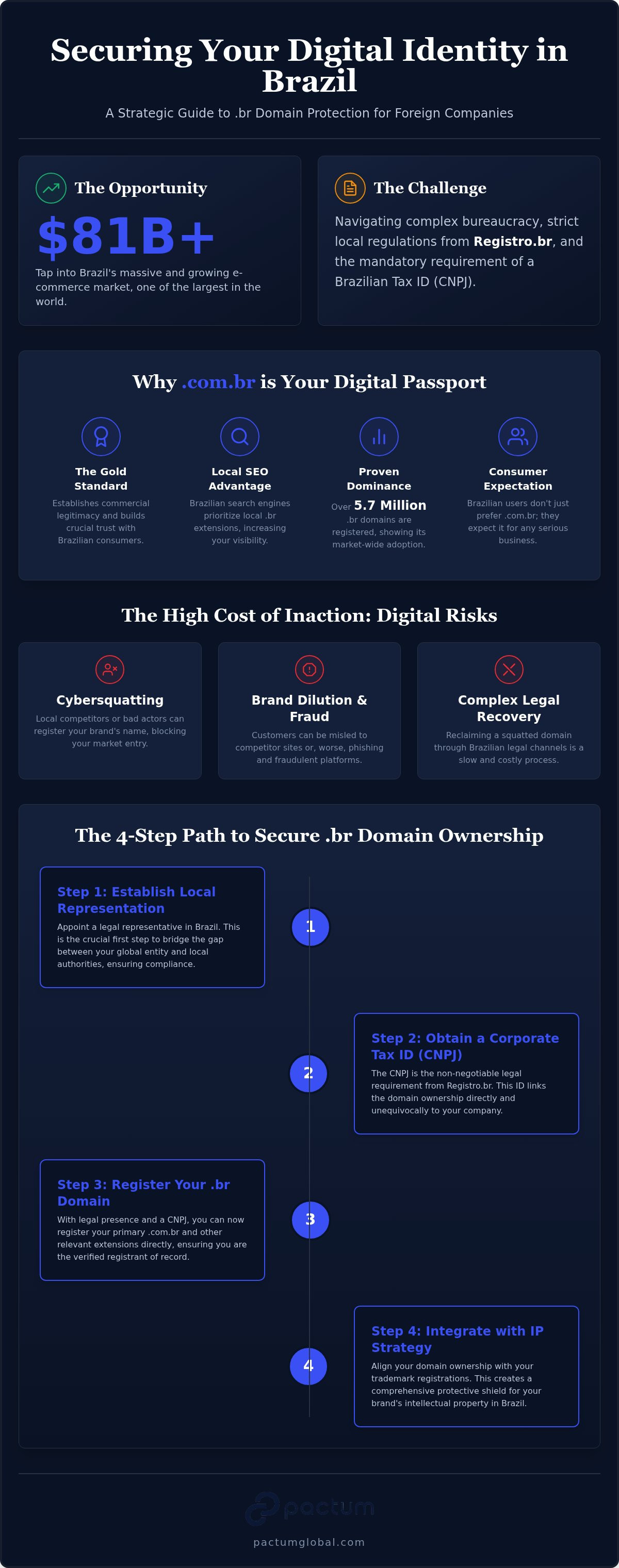
Entering the Brazilian market requires more than just a localized website. It demands a strategic approach to your digital assets. As the world's ninth largest economy, Brazil offers immense potential, but its digital landscape is highly specific. Brazil's .br ccTLD acts as the official gateway to this market. Without a local domain, your brand remains an outsider to the millions of consumers who drive the country's $81.7 billion e-commerce sector. Securing your presence early is the first line of defense against local competitors or opportunists who might claim your name first.
Effective domain protection brazil .br isn't just about ownership; it's about visibility. Search engines in Brazil prioritize local extensions in their results. If you rely solely on a .com address, you're likely losing traffic to local rivals who use the .br suffix. This technical advantage directly impacts your customer acquisition costs and market penetration speed. It's a foundational step in your broader Intellectual Property Strategy. We view this as a protective shield for your brand's future growth.
The Dominance of .com.br in the Brazilian Market
In Brazil, the .com.br extension is the undisputed gold standard for commercial legitimacy. While other countries have moved toward diverse top-level domains, Brazilian users maintain a deep-rooted trust in the traditional hierarchy. Most users don't just prefer .com.br; they expect it. Using industry-specific variants like .net.br or .org.br can be useful for niche visibility, but they don't carry the same weight as the primary commercial extension. By mid-2026, the number of registered .br domains has surpassed 5.7 million, proving that local businesses understand this value. If your brand doesn't occupy this space, you're essentially handing your credibility to someone else.
The Risks of Digital Absence
Failing to secure your domain creates a vacuum that others will fill. Cybersquatting is a persistent threat in Latin America, where organizations face an average of 3,100 cyber threats per month. When a local entity registers your brand's name, it leads to immediate brand dilution. Customers may end up on a competitor's site or, worse, a phishing platform designed for fraud. Recovering a domain through legal channels in Brazil is often a complex and slow process. In contrast, proactive protection is a low-cost investment that secures your digital borders. We help you navigate these risks by integrating domain management into your legal setup, ensuring your brand stays under your control from day one.
Navigating the Registro.br Regulatory Framework
The Brazilian internet landscape is governed by a unique hierarchy designed to ensure local accountability and stability. At the top sits the Brazilian Internet Steering Committee (CGI.br), which sets the strategic guidelines. Its executive arm, NIC.br, manages the technical operations, while Registro.br serves as the actual registry for all .br extensions. Understanding these Registro.br regulations is the first step toward building a secure digital presence. Unlike generic top-level domains where ownership is often loosely verified, Brazil requires every registrant to be linked to a valid Brazilian tax identification number.
For companies, this means providing a CNPJ (Corporate Tax ID). For individuals, a CPF is required. Many foreign businesses attempt to bypass this by using proxy or "trustee" registrations. While this might seem like a quick fix, it creates significant legal vulnerabilities. In the eyes of the registry, the owner of the tax ID is the legal owner of the domain. If a dispute arises, you may find yourself without legal recourse because you don't officially own your brand's digital assets. Robust domain protection brazil .br starts with ensuring your company is the direct, verified registrant of record.
The Legal Requirement for Local Presence
Foreign entities cannot own a .br domain directly without a local presence or a designated legal representative. This representative acts as the bridge between your global headquarters and the Brazilian authorities. They don't just sign papers; they ensure your registration remains compliant with evolving local laws. We simplify this complexity by providing the legal representation and company setup in Brazil necessary to meet these requirements. This ensures that your domain is tied to your corporate structure rather than a third-party service provider, giving you total control over your intellectual property.
Renewal and Maintenance Cycles
Maintenance is just as critical as the initial registration. Registro.br operates on strict timelines. If a domain isn't renewed during the grace period, it enters the "Processo de Liberação" (Release Process). This is a competitive window where the domain is eventually made available to the public again. In 2026, administrative oversight has tightened, making it harder to reclaim domains lost to expiration. We recommend multi-year registrations to avoid the risks of administrative oversight. Standard domain names must be between 2 and 26 characters. While Portuguese accented characters are permitted, using standard alphanumeric strings remains the best practice for global accessibility and technical stability.
Combating Cybersquatting and Bad Faith Registrations
Cybersquatting in the Brazilian market often involves local entities registering well-known international trademarks to extort the original owners or divert traffic. In the context of domain protection brazil .br, 'bad faith' is legally defined as registering a domain primarily to sell it to the trademark owner, preventing a competitor from reflecting their brand, or intentionally creating confusion for commercial gain. Identifying these infringements early requires consistent monitoring of the Registro.br database for strings that are identical or confusingly similar to your brand name.
When an infringement is discovered, you don't always need to head to the courtroom. Brazil utilizes a streamlined domain name dispute resolution system known as SACI-Adm. This administrative proceeding is designed to resolve conflicts quickly and efficiently. To succeed in a transfer request, you must prove three specific criteria: the domain is identical or confusingly similar to your trademark, the registrant has no legitimate rights or interests in the name, and the domain was registered or is being used in bad faith.
Administrative vs. Judicial Recovery
Choosing the right path for recovery depends on your timeline and budget. The SACI-Adm system is generally faster and more cost-effective than traditional litigation. Disputes are handled by accredited centers like CAS-CIESP, which provide expert panels to review the evidence. Because these decisions are administrative, they don't prevent later judicial action, but they offer a rapid resolution for clear-cut cases of brand hijacking. This is why a comprehensive intellectual property strategy for startups must include active domain monitoring. Catching a squatter during the early stages of market entry can save thousands in legal fees and prevent long-term brand dilution.
Proactive Defensive Registration
The most efficient way to handle disputes is to prevent them from occurring. Defensive registration involves securing not just your primary brand name, but also common typos and phonetic variations that a Brazilian user might naturally type. You should also consider securing secondary extensions like .net.br or .art.br if they are relevant to your industry. This "digital perimeter" makes it much harder for bad-faith actors to find a foothold. Additionally, if you are retiring a sub-brand, don't let the domain lapse immediately. A gradual sunsetting strategy ensures that old traffic is safely redirected and prevents squatters from picking up your discarded assets to mislead former customers. This proactive stance is the cornerstone of effective domain protection brazil .br.
Step-by-Step: Securing a .br Domain as a Foreign Entity
Registering a .br domain as a foreign entity is a multi-layered process that transitions from legal setup to technical execution. It's not a task that can be completed in isolation. It requires a local foundation. We've mapped out a clear, step-by-step path to help you secure your assets without falling into common bureaucratic traps. By following this sequence, you ensure that your domain protection brazil .br strategy is both legally sound and technically robust.
- Establish Local Representation: You must appoint a Brazilian resident to act as your legal representative before Registro.br.
- Obtain a CNPJ: We facilitate the acquisition of a Corporate Tax ID for your foreign entity, which is mandatory for direct ownership.
- Verify the Domain String: Conduct a thorough search to ensure your desired name is available and complies with the 2 to 26 character limit.
- Configure Infrastructure: Set up your DNS and nameservers according to Brazilian technical standards to ensure local propagation.
- Validate Ownership: Finalize the registration by linking it to your verified tax ID and validating all administrative contacts.
To begin your secure entry into the market, you can explore our company setup services in Brazil to handle these requirements professionally.
The Role of the Legal Representative
The legal representative must be a resident of Brazil. They are granted specific power of attorney to manage your domain's administrative records. It's vital to recognize that this individual or entity carries legal liability for the content hosted on your domain. They act as a shield against administrative errors but also as a point of accountability for the authorities. Our approach ensures that while the representative provides the necessary local footprint, your foreign company retains 100% beneficial ownership and control of the asset.
Documentation and Compliance
Registration isn't a one-time event. You must link your digital presence to your Brazil company registration to ensure long-term stability. This involves providing corporate documents that are properly apostilled and translated into Portuguese. Maintaining accurate WHOIS data is non-negotiable. If the registry identifies discrepancies in your ownership records, they can initiate an administrative cancellation process. We manage these compliance updates for you, ensuring your digital assets remain protected against sudden loss or administrative challenges.
Integrating Domain Security into Your Brazilian IP Strategy
A common mistake international founders make is assuming that a domain registration grants them legal rights to their brand name in Brazil. It doesn't. In the Brazilian legal system, your digital presence and your intellectual property are managed by two different entities. While Registro.br handles your URL, the National Institute of Industrial Property (INPI) manages your trademark. True domain protection brazil .br requires a synchronized approach where these two assets work together. Owning the domain without the trademark leaves you vulnerable to "first-to-file" claims from local competitors who can legally seize your brand identity.
There is a powerful synergy between these assets. A registered trademark is your strongest weapon in any domain dispute. Conversely, your domain registration can serve as vital evidence of "prior use" if you ever face a trademark challenge. By securing both simultaneously, you build a digital fortress. This fortress should extend beyond just the .com.br extension. It must include your social media handles and secondary extensions to ensure no gaps exist in your brand's perimeter. We help you bridge the gap between technical registration and high-level legal protection.
Trademark Primacy in Domain Disputes
If a squatter registers a domain that mirrors your brand, having a registered Brazilian trademark simplifies the recovery process immensely. The Brazilian legal system operates primarily on a "First to File" basis. This means the person who files the trademark application first is generally recognized as the rightful owner, regardless of who used the name first globally. Because of this, you shouldn't delay your INPI filing. We recommend consulting with a cross border contract lawyer to ensure your international agreements and IP filings are coordinated. This proactive legal alignment makes administrative recovery through systems like SACI-Adm much more predictable.
Future-Proofing Your Digital Presence
The digital landscape is constantly shifting. As we move through 2026, we anticipate the expansion of new Brazilian geographic Top-Level Domains (gTLDs) and industry-specific extensions. You shouldn't just "set and forget" your digital assets. We recommend conducting annual audits of your global digital portfolio to ensure all registrations are current and aligned with your latest corporate structure. Our team manages this intersection of corporate law and IP protection for you. We act as your steady partner, monitoring for new threats and ensuring your Brazilian foundation remains secure as your business grows. This methodical approach removes the complexity of international bureaucracy, allowing you to focus on your market expansion with absolute confidence.
Building a Secure Digital Foundation in Brazil
Securing your brand's digital presence in Brazil requires a methodical approach that goes beyond a simple domain purchase. You've seen that a successful strategy for domain protection brazil .br involves meeting strict Registro.br requirements, including the necessity of a local tax ID (CNPJ). Integrating your domain ownership with a registered trademark at the INPI is the only way to ensure your brand is fully shielded from local competitors and bad-faith actors. Don't leave your brand's future to chance in a complex regulatory environment.
At Pactum Global, we specialize in Brazilian corporate and IP law to remove the complexity of international bureaucracy. We provide localized support for international entrepreneurs, offering a seamless integration of company setup and brand protection. Our team acts as a steady partner, mapping out the journey so you can focus on your business goals. Secure your Brazilian digital assets with Pactum Global's expert legal guidance.
Your expansion into the world's 9th largest economy is a bold move. With the right legal foundation in place, you can move forward with confidence and clarity.
Frequently Asked Questions
Can a foreign company own a .br domain directly?
A foreign company can own a .br domain, but it isn't a direct process like registering a generic .com address. You must appoint a Brazilian resident as your legal representative and obtain a local tax ID (CNPJ) for your entity. This ensures the domain is legally tied to your corporate structure. We handle the necessary bureaucracy to ensure your company maintains 100% beneficial ownership of the asset.
What is the difference between .com.br and .br?
The .com.br extension is the gold standard for commercial entities in Brazil. It signals legitimacy to local consumers and search engines. While Registro.br offers a plain .br extension, it's far less common for businesses. Most Brazilian users instinctively type .com.br when looking for a company. Securing the .com.br version is the most critical step for any domain protection brazil .br strategy to establish market authority.
Do I need a Brazilian trademark to register a .br domain?
You don't need a registered trademark to secure a domain name. Registro.br operates on a first come, first served basis. However, having a trademark registered with the INPI provides the legal leverage needed to recover your domain if someone else registers it in bad faith. A domain registration alone doesn't grant you intellectual property rights. Combining both ensures your digital assets are shielded from local competitors.
What is a CNPJ and why is it required for domain registration?
The CNPJ is the Cadastro Nacional da Pessoa Jurídica, which is the official tax identification number for companies in Brazil. Registro.br requires a CNPJ or a CPF for individuals to ensure every domain has a legally accountable owner within the country. This requirement is a primary measure against anonymous cybersquatting. For foreign entities, obtaining a CNPJ is a prerequisite for direct ownership and long term domain protection brazil .br.
How long does it take to recover a 'squatted' domain in Brazil?
The timeline for recovery depends on the method used. The SACI-Adm administrative proceeding usually resolves disputes within 60 to 90 days. This is significantly faster than the judicial system, which can take several years. To succeed, you must provide clear evidence of your prior rights and proof of the registrant's bad faith. Using the administrative route is the most efficient way to reclaim your brand's digital identity without prolonged litigation.
What happens if my legal representative in Brazil leaves or changes?
If your legal representative changes, you must update your registration data with Registro.br immediately. The representative acts as the bridge between your company and the Brazilian authorities. If this contact information becomes outdated, you risk missing critical renewal notices or legal notifications. We manage this transition for our clients to ensure there's never a gap in representation, protecting your domain from administrative cancellation due to inaccurate or expired WHOIS data.
Are there any restrictions on the type of content allowed on a .br domain?
Content on .br domains must comply with Brazilian legislation, including the Marco Civil da Internet and the General Data Protection Law (LGPD). Recent 2026 decrees have also tightened regulations regarding content moderation and platform liability. Any content that promotes illegal activities, hate speech, or violates intellectual property rights can lead to the suspension of the domain. Your local representative is legally responsible for ensuring the domain's use aligns with these national standards.
Can I transfer a .br domain from a local person to my foreign company?
You can transfer a .br domain from a local individual to your foreign company, but the process is formal and requires specific documentation. Both parties must authorize the transfer within the Registro.br system. Your foreign company will still need its own CNPJ and a local legal representative to accept the transfer. This is a common step for companies that initially had a local partner or employee register the domain on their behalf.


