

A Brazilian company is not just a registration; it's a sophisticated legal architecture that requires precise local representation and cross-border governance to succeed. You might feel overwhelmed by the prospect of the 34% corporate tax rate or the mandatory requirement for a local resident representative. However, the decision to open company in Brazil for foreigners remains one of the most strategic moves for global scaling in 2026. With the new dual VAT system pilot beginning this year, the path to entry is shifting from a bureaucratic maze into a structured opportunity for those who have the right roadmap.
We understand that the language barrier in legal documentation and uncertainty about shareholder protection can make the process feel high-risk. It's natural to worry about how your intellectual property will be handled or if you can repatriate profits without friction. This guide will help you master these legal complexities and establish a fully compliant, scalable business entity from abroad. We'll walk through obtaining your CNPJ, securing your assets, and drafting Shareholders' Agreements that ensure clear governance and long-term security for your investment.
Key Takeaways
- Learn the precise 5-step roadmap to open company in Brazil for foreigners, including drafting compliant Articles of Association and executing necessary Powers of Attorney.
- Understand the mandatory role of the local legal representative and how this resident bridge protects your entity's compliance and operational status.
- Discover how Shareholders' Agreements (SHA) and SAFE contracts secure your capital and provide a clear framework for managing governance deadlocks.
- Explore the connection between corporate ownership and global mobility, including how to leverage your business for the Brazil Investment Visa (VITEM IX).
- Secure your brand's future by integrating Intellectual Property registration with the INPI into your initial setup strategy.
Navigating the Brazilian Market: Legal Realities for Foreigners in 2026
Brazil remains the primary engine of South American growth, attracting billions in foreign direct investment annually. When you look at Brazil's Economic Landscape, it's clear the country offers a scale that other regional markets simply cannot match. By 2026, the process to open company in Brazil for foreigners has undergone a significant digital transformation. Most states now utilize fully integrated digital Boards of Trade. This shift has slashed incorporation timelines that used to take months, replacing paper bureaucracy with streamlined, electronic filings that prioritize efficiency.
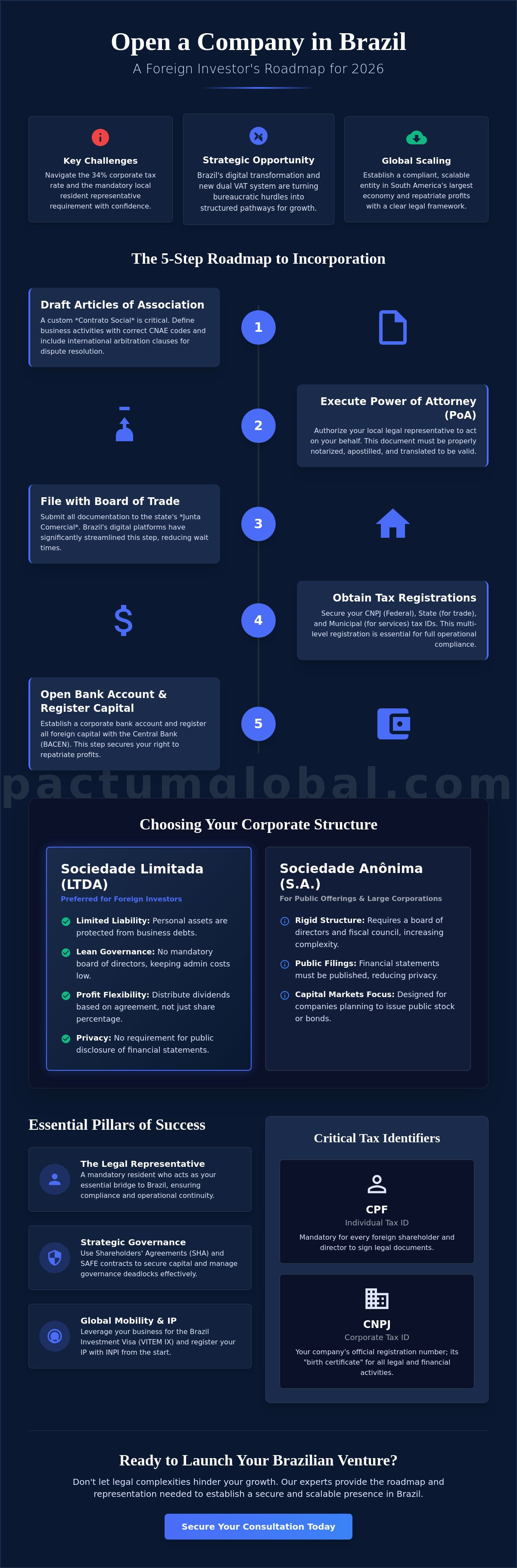
Investors must choose between two primary structures: the Sociedade Limitada (LTDA) and the Sociedade Anônima (SA). While the SA offers a rigid, corporate structure suitable for public offerings, the LTDA remains the gold standard for private ventures. Regardless of the structure, all foreign capital must be registered with the Central Bank of Brazil (BACEN) via the SCE-IED system. This registration is vital. It's the only way to ensure your legal right to repatriate profits and capital in the future. Without this digital record, moving money out of the country becomes a significant legal hurdle.
Why the LTDA is the Preferred Vehicle for Foreigners
The LTDA is the most popular choice because it offers a lean governance model. It doesn't require a board of directors or public financial disclosures, which keeps administrative costs low. Shareholders enjoy limited liability. This means their personal assets are protected from business debts. This structure also allows for total flexibility in how you distribute profits. You don't have to distribute dividends strictly according to share ownership. It's a protective, efficient foundation for international growth that adapts to your specific business needs.
Understanding the CPF and CNPJ Requirements
Your business journey starts with two critical identifiers. Every foreign shareholder or director needs a CPF. This is the Brazilian individual tax ID. Without it, you cannot sign the legal documents required to open company in Brazil for foreigners. Once the company is registered, it receives a CNPJ, the corporate tax ID. This is essentially your business's birth certificate. Delays often happen because of mismatched data between the CPF and the company's articles of association. We prevent these bottlenecks by ensuring all personal records are synchronized with federal databases before any filing begins. This proactive approach ensures your tax IDs are issued without the typical bureaucratic friction.
The 5-Step Roadmap to Open a Company in Brazil
Establishing a business entity requires a methodical approach to avoid the bureaucratic traps that often stall international ventures. To successfully open company in Brazil for foreigners, you must follow a structured five-step sequence that aligns local requirements with your global corporate strategy. This process ensures your entity is not only registered but also fully operational and legally protected from the outset.
The first step involves drafting the Contrato Social (Articles of Association). Unlike standard local templates, a customized document is essential for international compliance. You must precisely define your business activities using CNAE codes. Selecting the wrong code can lead to significantly higher tax burdens or restricted operations. We also recommend including international arbitration clauses. This provides a familiar legal framework for resolving disputes, which is a key recommendation in the Forbes Guide to Investing in Brazil.
Second, you must execute a Power of Attorney (PoA). Since you're likely operating from abroad, this document authorizes a resident representative to sign legal filings on your behalf. Without a properly legalized and translated PoA, the process cannot move forward. Third, your documents are filed with the Junta Comercial (Board of Trade). Thanks to recent digitalization, this step is now faster and more transparent than in previous years.
Fourth, your company must obtain tax registrations at three distinct levels: federal (CNPJ), state (for commercial trade), and municipal (for services). Finally, you must open a local corporate bank account and register your initial capital with the Central Bank (BACEN). This final step is the bridge that allows for future profit repatriation. If you find these requirements daunting, our team can help you manage the entire company setup in Brazil to ensure every detail is handled correctly.
Drafting the Contrato Social for Global Standards
A standard template often lacks the nuances required by foreign shareholders. Customization allows you to define specific governance rules and profit distribution models that match your home country's accounting standards. By carefully selecting CNAE codes, you can optimize your tax bracket from day one. High-level legal protection starts with a document that anticipates cross-border challenges rather than just meeting local minimums.
Timeline and Administrative Milestones
In 2026, the incorporation timeline typically ranges from 15 to 45 days. This efficiency is largely driven by the use of e-CPF digital signatures, which eliminate the need for physical notarization in many states. However, the Alvará (municipal license) remains a critical milestone. Whether you use a virtual office or a physical facility, securing this license is what truly unlocks your ability to issue invoices and hire employees. Managing these milestones with a clear roadmap prevents the open company in Brazil for foreigners process from stretching into months of uncertainty.
The Legal Representative: Your Essential Bridge to Brazil
One of the most misunderstood requirements to open company in Brazil for foreigners is the mandatory appointment of a legal representative. Brazilian law dictates that every non-resident shareholder must have a local resident to act as their bridge to the state. This individual isn't necessarily a business partner or a shareholder; they're a regulatory necessity. Their primary function is to receive legal notices and represent the foreign investor before the Federal Revenue and other government bodies. Confusing a local partner with a legal representative is a common mistake that can lead to unnecessary loss of equity or control.
The duties of a representative are strictly defined by law. They're responsible for ensuring the company complies with local regulations and for receiving service of process in legal matters. However, this doesn't grant them the right to manage your business operations or dictate your corporate strategy. Many entrepreneurs worry that appointing a local representative means giving up power. We solve this through fiduciary representation. This model ensures you maintain 100% decision-making authority while we handle the bureaucratic liaison duties required by the Brazilian government.
Mitigating Risk with Fiduciary Representation
To protect your interests, we structure representation so the foreign investor retains absolute control. This is achieved by drafting a robust Service Agreement that sits alongside the company's official filings. This contract clearly defines the representative's limited scope and includes immediate termination clauses. We also build in succession planning. If a representative needs to be replaced, the transition is seamless and doesn't disrupt your company's standing with the Board of Trade. This methodical approach removes the risk of "deadlock" or unauthorized interference in your business.
The Legal Representative and Tax Liability
The representative acts as your primary point of contact with the Receita Federal (Federal Revenue). They ensure that tax filings are acknowledged and that the company’s corporate tax ID remains in good standing. Crucially, a professional representative has no access to company funds or bank accounts without specific, separate authorization from the foreign shareholders. We implement strict internal controls to ensure that financial management remains entirely in your hands. The legal representative serves as a specialized regulatory liaison for the foreign shareholder rather than a director with executive business authority. This clear separation of duties is what allows you to open company in Brazil for foreigners with total confidence and security.
Strategic Governance: Shareholders Agreements and SAFE Contracts
Many investors stop once they receive their corporate tax ID. This is a strategic mistake. To successfully open company in Brazil for foreigners, you must look beyond basic registration and focus on long-term governance. The Contrato Social is a public filing that meets basic statutory requirements, but it rarely addresses the complexities of international partnerships. A Shareholders' Agreement (SHA) acts as your private rulebook. It defines how decisions are made and how the company is managed behind the scenes, providing a level of detail that public documents cannot match.
Deadlock situations are particularly risky in cross-border ventures. If founders cannot agree on a strategic direction, the company's operations can freeze. We structure SHAs with specific tie-breaker or buy-sell provisions to resolve these conflicts without the need for court intervention. For startups, we often utilize Startup Contracts (SAFE). While originally a Silicon Valley concept, the SAFE has gained legal traction in Brazil as a flexible way to secure future equity for early-stage investors without the immediate complexity of a full capital increase or valuation dispute.
Transfer pricing is another critical layer of governance that requires your attention. Brazil recently overhauled its system with Law 14.596/23 to align more closely with OECD standards. This means your Brazilian entity must justify the prices it charges or pays to its parent company abroad. If these transactions aren't documented correctly, you face significant tax penalties and potential audits. Managing these intercompany agreements is just as important as the initial setup to ensure your global tax position remains secure.
The Shareholders’ Agreement (SHA) for Cross-Border Protection
We prioritize three essential clauses for our international clients: Tag-along, Drag-along, and Right of First Refusal. These protections ensure you aren't left behind in a sale or forced to work with an unwanted new partner. The SHA sits alongside the Contrato Social, providing a layer of protection that is fully enforceable in Brazilian courts. You can learn more about our Shareholders Agreement services to see how we tailor these protections to your specific industry and ownership structure.
Tax Compliance and Profit Repatriation
Moving money out of the country requires a clear, compliant legal path. Dividends are currently the most efficient way to send profits to the USA or Europe. However, you must avoid Permanent Establishment risks. This happens when the foreign parent company is deemed to be doing business directly in Brazil rather than through its subsidiary. By strictly following Law 14.596/23 and maintaining proper records, you protect your global tax position. If you need help structuring these intercompany flows, we offer specialized Transfer Pricing Services to keep your operations compliant and your profits moving smoothly.
Scaling Your Venture: From Incorporation to Global Mobility
Establishing your business entity is the first milestone. Scaling that venture requires a broader vision that encompasses your physical presence and the protection of your intangible assets. For many entrepreneurs, the decision to open company in Brazil for foreigners is the strategic starting point for a permanent move to the region. Once your company is operational and the initial capital is registered with the Central Bank, you unlock a clear legal path toward residency and long-term security.
Success in the Brazilian market also demands a proactive approach to asset protection. Beyond managing your daily operations, you must consider the long-term survival of your business through Succession Documents. These legal instruments ensure that your Brazilian business assets are protected and that your heirs have a clear, friction-free path to ownership. This level of planning prevents your investment from becoming trapped in local probate courts, providing the same level of security you expect in your home jurisdiction.
The Brazil Investment Visa Pathway
Your corporate setup facilitates the VITEM IX (Investment Visa). To qualify for this residency permit, a standard investment of BRL 500,000 into your Brazilian company is typically required. However, if your venture focuses on technology or innovation, this requirement can be reduced to BRL 150,000. The timeline for converting your corporate setup into a residency permit usually takes between 60 and 90 days once the funds are fully registered. This process also allows for family reunification, enabling you to bring spouses and dependents with the same level of legal certainty.
Protecting Your Intellectual Property
A common mistake is assuming that a trademark registered in the US or EU provides protection in South America. Intellectual property is territorial. Your brand is only secure in Brazil once it's registered with the Instituto Nacional da Propriedade Industrial (INPI). The registration process can take several months, so we recommend filing as soon as your company receives its CNPJ. Without this local protection, you're vulnerable to "trademark squatting," where third parties register your brand name to extort your business later. You can explore our IP and Trademark protection services to secure your brand before you begin major marketing efforts.
The Pactum Global Advantage
We act as your seasoned navigator through every phase of the business lifecycle. Our "no-nonsense" approach removes the stress of international bureaucracy, replacing it with a structured, efficient roadmap. From the initial Power of Attorney to your first tax filing and eventual residency application, we provide end-to-end support that prioritizes your control and protection. We don't just file papers; we build the legal architecture your business needs to thrive. If you're ready to start your journey, schedule a consultation to open your company in Brazil and let us map out your path to success.
Building Your Brazilian Business Foundation
Mastering the Brazilian market requires more than just meeting administrative requirements. It's about building a legal foundation that protects your capital and your intellectual property while allowing for global mobility. You've seen how the right corporate structure and a robust Shareholders' Agreement can prevent governance deadlocks and secure your interests. By choosing to open company in Brazil for foreigners with a strategic mindset, you transform a bureaucratic hurdle into a scalable international asset.
Our team acts as your expert guide through this complex landscape. We specialize in cross-border Shareholders' Agreements and provide deep expertise in Brazil-USA-Portugal tax compliance. Our bilingual legal navigators handle the intricacies of local bureaucracy so you can focus on your business growth. We're here to ensure your transition is seamless, secure, and fully compliant with the latest 2026 regulations. Your journey toward a successful, compliant venture starts with a single, well-informed step.
Start your Brazilian expansion with a professional legal consultation and secure your future in Latin America's largest economy today.
Frequently Asked Questions
Can a foreigner own 100% of a company in Brazil?
Yes, foreigners can hold 100% of the shares in most Brazilian business sectors. You don't need a local partner to hold equity in your company. While certain industries like domestic aviation or media have specific ownership caps, the standard Sociedade Limitada (LTDA) structure allows for full foreign ownership. This ensures you maintain absolute control over your capital and corporate decisions from the start.
Do I need to travel to Brazil to open a company?
No, you can complete the entire process to open company in Brazil for foreigners without ever visiting the country. By executing a Power of Attorney (PoA) and utilizing digital signatures, we can handle all filings with the Board of Trade and the Federal Revenue remotely. Your documents only need to be properly legalized and translated according to Brazilian regulations to be fully valid for incorporation.
What is the minimum capital required for a Brazilian LTDA?
There is no statutory minimum share capital requirement to form a Sociedade Limitada (LTDA) in Brazil. You can establish your entity with any amount that suits your initial operational needs. However, if your goal is to obtain a permanent investor visa, you'll need to meet specific investment thresholds. Currently, these are BRL 500,000 for standard businesses or BRL 150,000 for qualifying technology startups.
How long does the company registration process take in 2026?
The registration process to open company in Brazil for foreigners typically takes between 15 and 45 days. This timeline covers the approval of the Articles of Association and the issuance of your corporate tax ID (CNPJ). While the initial registration is fast due to digital integration, you should allow an additional 30 to 60 days for opening a corporate bank account and completing your Central Bank registration.
What are the main taxes for a company in Brazil?
Brazilian companies generally face a combined effective corporate tax rate of approximately 34%. This includes the Corporate Income Tax (IRPJ) and the Social Contribution on Net Profit (CSLL). Starting in 2026, the country is transitioning to a dual VAT system consisting of the federal CBS and the subnational IBS. This reform aims to simplify the previous complex system of consumption taxes over the next several years.
Is a local partner mandatory for a foreign-owned business?
No, a local partner is not a legal requirement for most business types. You can own the company entirely as an individual or through a foreign holding entity. The law only requires that you appoint a local resident to serve as your legal representative. This person acts as a regulatory liaison for the foreign shareholder but doesn't need to own any shares or participate in your profits.
How do I open a corporate bank account in Brazil as a foreigner?
Opening a corporate account requires your company's registered Articles of Association, a valid CNPJ, and a resident legal representative. Banks perform a rigorous "Know Your Customer" (KYC) check on all foreign shareholders. You must also demonstrate that your initial capital investment was properly registered with the Central Bank (BACEN). Many international firms now use specialized digital banks that offer faster onboarding for foreign-owned entities.
What is a legal representative and why do I need one?
A legal representative is a Brazilian resident who serves as your mandatory bridge to the local government. Their role is to receive legal notices and represent the foreign shareholder before tax authorities. They don't have to be a business director or hold executive power. Think of them as a regulatory liaison who ensures your company remains in good standing with the Federal Revenue while you manage your business from abroad.


