

Establishing a US entity is more than a simple registration; it's a strategic legal bridge to global scale. If you're a non-resident founder, you already know that LLC formation in USA for foreigners offers unparalleled access to essential payment processors like Stripe and PayPal. However, the prospect of facing an IRS audit or getting trapped in complex state regulations often feels overwhelming. You want the protection of limited liability for your global assets without the stress of cross-border legal traps or double taxation.
We believe that international bureaucracy shouldn't stand in the way of your growth. This guide delivers a comprehensive 2026 strategy for non-residents, replacing confusion with a methodical roadmap for security and compliance. We'll explore how to choose between the prestige of Delaware and the cost-efficiency of New Mexico, the impact of the 2025 FinCEN reporting exemptions, and the precise steps required to secure a US business bank account without setting foot on American soil.
Key Takeaways
- Identify the ideal jurisdiction for your market entry by comparing the legal prestige of Delaware with the cost-effective regulations of Wyoming and New Mexico.
- Simplify the technical process of LLC formation in USA for foreigners by securing a compliant registered agent and a unique business designator.
- De-risk your operations by mastering the "Engaged in Trade or Business" (ETBUS) test and fulfilling mandatory IRS reporting requirements like Form 5472.
- Leverage your US entity as a strategic foundation for global mobility, connecting your corporate structure to L-1 and E-2 business visa pathways.
- Protect your global assets through a hybrid legal framework that combines robust US liability protection with tax-efficient partnership flexibility.
Understanding the US LLC for Non-Resident Founders
A US Limited Liability Company (LLC) is a hybrid legal structure designed to offer the best of both worlds. It provides the robust asset protection of a corporation while maintaining the tax simplicity of a partnership. For entrepreneurs exploring LLC formation in USA for foreigners, this structure is particularly attractive because US law allows for 100% foreign ownership. You don't need a local partner, a US-based director, or even a physical presence in the country to maintain a fully compliant legal entity.
The primary advantage for international founders is the "pass-through" tax model. In this setup, the LLC itself doesn't pay federal income tax. Instead, the profits and losses flow directly to the individual members. For non-residents who aren't physically present in the US, this can lead to significant tax efficiencies if the business isn't "Engaged in Trade or Business" (ETBUS) within the United States. This flexibility is a cornerstone of Understanding the US LLC as a global business tool.
Beyond tax benefits, establishing a US entity provides immediate global credibility. It grants you access to the world's most stable financial ecosystem, including essential payment processors like Stripe and PayPal that are often unavailable in other jurisdictions. Furthermore, the regulatory environment has recently become even more founder-friendly. According to the FinCEN interim final rule issued on March 26, 2025, entities created in the United States are now exempt from reporting beneficial ownership information (BOI) to FinCEN, significantly reducing the administrative burden for new registrations.
LLC vs. C-Corp for International Founders
Choosing between an LLC and a C-Corp depends on your growth strategy. A C-Corp is often subject to double taxation; the company pays tax on profits, and shareholders pay tax on dividends. An LLC avoids this by taxing income only once at the member level. While C-Corps are the standard for founders seeking institutional venture capital, an LLC is often the superior starting point. It's more flexible for non-citizens and fully supports startup contracts like a SAFE (Simple Agreement for Future Equity). If your business scales to a point where a corporate structure is required, converting from an LLC to a C-Corp is a well-documented process.
The Reality of Limited Liability for Foreign Assets
The "corporate veil" acts as a legal barrier that separates your personal life from your business obligations. If your LLC faces a legal challenge in a US court, your personal assets located outside the US, such as your home or international bank accounts, remain protected. This protection requires you to maintain strict "separateness." You must use a dedicated business bank account and avoid mixing personal funds with company capital. Many founders worry that US lawsuits can easily reach across borders, but a properly managed LLC provides a formidable shield against such risks, ensuring your global wealth remains secure.
Selecting the Best State for Your US Market Entry
Selecting the ideal jurisdiction is a foundational step in LLC formation in USA for foreigners. While you can register in any state, Delaware, Wyoming, and Nevada remain the most frequent choices for non-residents. Your decision should hinge on your business model rather than just the initial filing fee. The official process of forming a US LLC involves more than just picking a name; you must evaluate how state-level laws interact with your international operations. For instance, if you establish a physical presence in a state other than where you formed, you'll face "Foreign Qualification" requirements and additional fees.
Taxation and privacy are the two pillars of state selection. You must distinguish between state income tax and franchise tax. States like Wyoming have no state income tax, making them highly efficient for foreign owners. In contrast, Delaware charges a mandatory annual franchise tax, which increased to $400 effective January 1, 2026. Privacy is equally important. Some states keep member names off public records, providing a layer of anonymity for global founders. If you're unsure which jurisdiction aligns with your growth plans, our team can guide your company setup in USA to ensure long-term compliance.
Delaware: The Venture Capital Powerhouse
Delaware is the undisputed leader for startups planning to raise US investment. Its prestige comes from the Court of Chancery, a specialized court that handles only business disputes with judges instead of juries. This provides a level of legal predictability that institutional investors demand. However, this sophistication comes with a price. Beyond the $110 one-time filing fee, the $400 annual tax is significantly higher than other jurisdictions. It's the right choice for high-growth tech companies but may be unnecessary for solo consultants.
Wyoming: The Cost-Effective Choice for Service Providers
Wyoming has become the go-to state for international service providers and digital nomads. It offers some of the strongest asset protection laws in the country and charges no state income tax. The maintenance costs are minimal; you'll pay a $100 formation fee and a $60 annual report fee. While Nevada was once a top contender, Wyoming often wins in 2026 due to its lower fees and simpler compliance. It's an efficient, "no-nonsense" jurisdiction that prioritizes founder privacy and capital preservation.
The Step-by-Step Process of Forming a US LLC
Executing LLC formation in USA for foreigners requires a methodical approach to satisfy both state and federal requirements. Your first task is selecting a unique business name that includes a mandatory designator like "LLC" or "L.L.C." Once you've confirmed the name's availability, you must appoint a registered agent. This agent provides the required physical address within your chosen state to receive official legal and government correspondence. They serve as your local point of contact while you manage operations from abroad.
After securing an agent, you'll file the Articles of Organization with the Secretary of State. This document officially brings your entity to life. However, the most critical internal step is drafting a custom operating agreement. While many digital platforms offer generic templates, these often fail to address the specific needs of international founders. A well-crafted agreement serves as your internal rulebook, defining how the company is managed and how profits are distributed across borders.
Why Generic Operating Agreements Fail Foreigners
Standard templates rarely account for cross-border complexities. If a dispute arises between international members, a generic document may not specify whether US or foreign law takes precedence. You need clear jurisdiction clauses and defined member roles that reflect your global structure. This level of detail is vital for long-term stability and protection. For a deeper dive into these requirements, review our Legal Documents for International Startups checklist. Having a tailored contract is a proactive shield against future bureaucratic errors.
The EIN and ITIN: Your US Tax Identity
Your entity's federal journey begins with the Employer Identification Number (EIN). This is your business's tax ID; it's essential for opening a US bank account and hiring employees. For non-residents without a Social Security Number, you'll need to submit Form SS-4 via fax. As of July 2026, the IRS is experiencing significant backlogs. Applicants are currently seeing processing times of 6-8 weeks or longer.
You might also require an Individual Taxpayer Identification Number (ITIN). While the EIN identifies the company, an ITIN identifies you as an individual for tax purposes. You'll generally need an ITIN if you're required to file a US tax return but aren't eligible for an SSN. Navigating these federal hurdles is a core part of successful LLC formation in USA for foreigners. It ensures your business has a legitimate financial identity from day one.
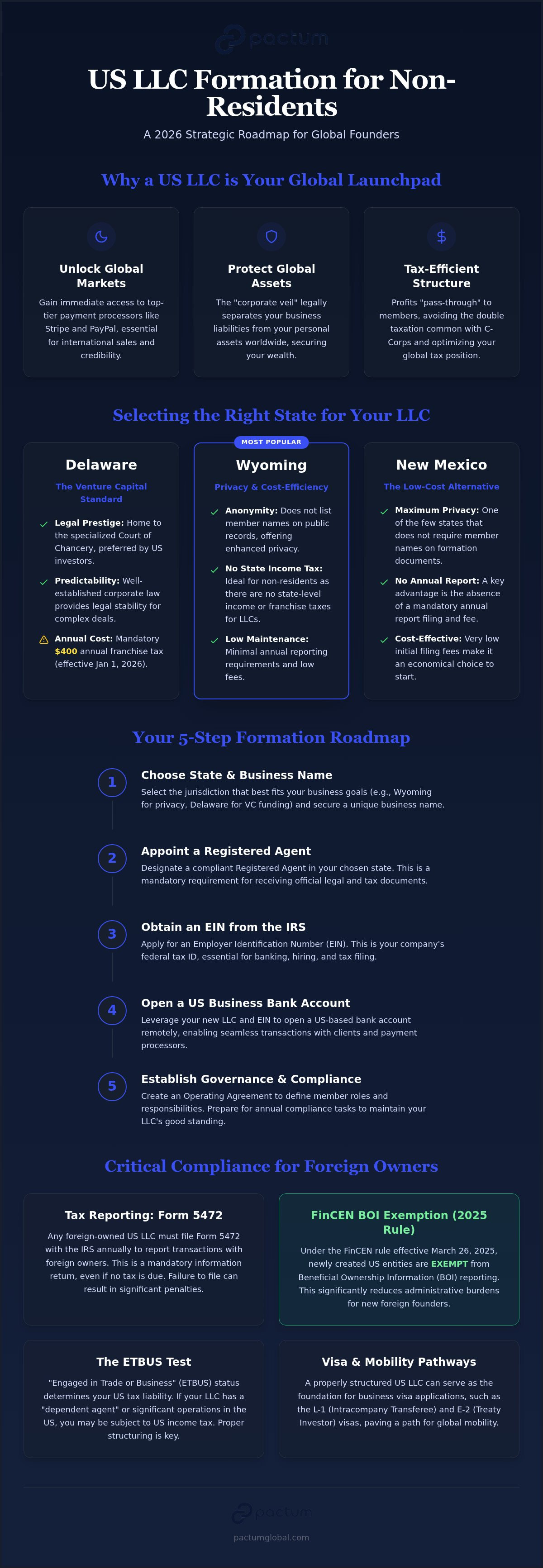
Navigating US Tax Obligations and Compliance for Foreigners
Tax compliance is often the greatest source of anxiety for non-residents. The complexity of the US tax code leads many to believe they'll be double-taxed or face aggressive audits. However, successful LLC formation in USA for foreigners relies on understanding the "Engaged in Trade or Business" (ETBUS) test. If your business doesn't have a physical office, employees, or a dependent agent in the US, you may not owe federal income tax on your foreign-sourced earnings. But there's a critical distinction: owing no tax doesn't mean you have no filing obligations.
The IRS requires all foreign-owned single-member LLCs to file Form 5472 along with a pro-forma Form 1120. This is an informational filing, yet the stakes are incredibly high. Missing the deadline or filing an incomplete form triggers a mandatory penalty of $25,000. This isn't a discretionary fine; it's an automatic assessment that can devastate a growing business. Beyond federal income tax, you must also monitor "Nexus" for sales tax purposes. In a digital economy, selling products or services to customers in specific states may require you to collect and remit sales tax once you cross certain revenue thresholds, even without a physical presence.
Effectively Connected Income (ECI) Explained
Effectively Connected Income (ECI) is the bridge between your global activity and US tax liability. If you utilize a US-based warehouse for fulfillment or hire a US-based employee to manage operations, your income likely becomes ECI. For a non-resident digital service provider, ECI is income derived from services physically performed within the United States or through a dependent agent who has the authority to conclude contracts on your behalf. Distinguishing between US-source and foreign-source income is vital for accurate reporting and avoiding unnecessary tax payments.
Maintaining Annual Compliance
Compliance doesn't end with the IRS. You must also satisfy state-level requirements to keep your entity in good standing. This includes filing annual reports; for example, Delaware LLCs must pay their franchise tax by June 1st each year. You must also renew your registered agent service and maintain accurate records of all cross-border transactions for potential international audits. Navigating these requirements is a fundamental part of LLC formation in USA for foreigners, ensuring your entity remains a shield rather than a liability. If you want to ensure your entity remains fully protected and compliant, our team provides expert support for company setup in USA.
Strategic Next Steps: Banking, Governance, and Global Mobility
Completing the administrative phase of LLC formation in USA for foreigners is a milestone, but it's only the beginning of your journey. To truly leverage your US entity, you must integrate it into your broader global strategy. This involves securing financial infrastructure, protecting your interests through robust governance, and potentially using the entity as a vehicle for personal relocation. A US LLC isn't just a tax-efficient shell; it's a dynamic platform for international expansion that requires proactive management to remain effective.
One of the most critical components of this strategy is succession planning. Many non-resident founders overlook what happens to their US assets in the event of an emergency. Without specific provisions in your operating agreement or a dedicated succession plan, your business interests could become entangled in the US probate system. This is a complex and expensive process for foreign heirs to navigate. By implementing transfer-on-death clauses or trust-based ownership now, you ensure that your global legacy remains protected and accessible to your family without legal interference.
From LLC Formation to US Residency
For many founders, a US company is the first step toward a physical move. Your LLC can serve as the petitioner for an L-1 intra-company transfer visa, allowing you to move executives or managers from a foreign office to the US branch. Alternatively, if you're a citizen of a treaty country, the E-2 Treaty Investor Visa allows you to live and work in the US based on a substantial investment in your LLC. These pathways transform your business registration into a legitimate residency strategy. For detailed guidance on these transitions, explore our Legal Support for Global Mobility guide.
Opening Bank Accounts and Payment Gateways
Securing a US business bank account is essential for operational fluidity. While traditional "Big Four" banks often require a physical presence and a US-based signer, digital-first platforms like Mercury and Relay have simplified the process for non-residents. These platforms allow you to manage capital without a US visit, provided your structure is transparent and compliant. Once your account is active, you can seamlessly connect your LLC to Stripe or PayPal. This enables you to accept global payments with the credibility of a US-based merchant, which is often a prerequisite for scaling in Western markets.
Governance for Global Teams
As your venture grows, simple operating agreements may no longer suffice. You need sophisticated Shareholders' Agreements for cross-border business to manage expectations between international partners. These documents should cover intellectual property (IP) ownership, ensuring that patents and trademarks are held by the US entity rather than individual members. This centralization provides a clear chain of title that is recognized globally and simplifies future licensing or sale. If you're ready to build a secure foundation for your international growth, you can Schedule a consultation for your USA company setup to ensure every legal detail is expertly mapped out.
Building Your Global Foundation
A successful US presence depends on strategic choices made long before the first filing. By selecting a jurisdiction that aligns with your capital needs and implementing custom governance, you turn a complex bureaucratic process into a powerful engine for growth. LLC formation in USA for foreigners offers the legal protection and financial access required to scale in the world's most robust market. It's about more than just registration; it's about creating a secure bridge for your global assets.
Pactum Global acts as your expert guide, offering specialized support for Brazil, Portugal, and USA cross-border legal structures. We replace the confusion of international regulations with a methodical roadmap designed for your success. From custom-drafted corporate governance to specialized global mobility and immigration consulting, we ensure your entity is built on a solid foundation. Start your US business journey with Pactum Global's expert legal support and secure your future in the global economy. Your international expansion is ready to begin, and we're here to map out the way forward with confidence.
Frequently Asked Questions
Can a foreigner own 100% of a US LLC?
Yes, US law allows non-residents to own 100% of a Limited Liability Company. There are no citizenship or residency requirements for members or managers. This flexibility allows you to maintain full control of your entity without the need for a local partner or a US-based director.
Do I need to visit the USA to form an LLC?
No, you can complete the entire process remotely from your home country. You'll file the necessary documents with the Secretary of State and appoint a registered agent to handle official correspondence. Most entrepreneurs manage LLC formation in USA for foreigners entirely through digital platforms and legal advisors.
Which state is best for a non-resident LLC in 2026?
The ideal state depends on whether you prioritize prestige or cost. Delaware remains the top choice for those seeking venture capital. However, Wyoming and New Mexico are more affordable for service providers. New Mexico is particularly cost-effective, featuring a $50 filing fee and no annual report requirements or fees.
How do I get an EIN without a Social Security Number (SSN)?
You must apply for an Employer Identification Number by submitting Form SS-4 to the IRS via fax. Non-residents without an SSN or ITIN cannot use the online application system. As of July 2026, you should expect significant delays of 6 to 8 weeks due to current IRS processing backlogs.
Will I be double-taxed on my LLC profits in the US and my home country?
Double taxation is usually avoided because the LLC is a pass-through entity. Profits flow directly to the members, who are typically taxed in their country of residence. If your business isn't "Engaged in Trade or Business" in the US, you may owe no US federal income tax, though informational filings remain mandatory.
Can I open a US bank account remotely for my LLC?
Yes, remote banking is possible through digital-first financial institutions. While traditional "Big Four" banks often require an in-person visit for identity verification, platforms like Mercury and Relay are designed for international founders. You'll need your formed LLC documents and a valid EIN to open these accounts.
What are the annual maintenance costs for a US LLC?
Annual costs depend on your state of registration and service needs. For LLC formation in USA for foreigners, you'll pay annual fees like Delaware's $400 franchise tax or Wyoming's $60 annual report fee. You must also budget for a registered agent service, which typically costs between $50 and $300 per year.
Does owning a US LLC give me the right to work in the USA?
No, owning a business entity does not grant you the right to live or work in the United States. To gain work authorization, you must apply for a specific visa, such as an E-2 Treaty Investor or L-1 Intra-company Transferee visa. The LLC serves as the corporate foundation for these immigration pathways.

