

What if your most profitable international contract is actually a ticking time bomb waiting to explode in a foreign court? If your strategy for service agreement drafting international relies on recycled templates, you're likely exposed to unenforceable clauses and hidden tax liabilities. It's frustrating to face the confusion of differing labor laws or the complexity of protecting intellectual property across multiple borders. You want a secure foundation for growth, not a series of legal hurdles that slow you down.
This guide will help you master these complexities by providing expert insights on jurisdiction, compliance, and risk mitigation for your global expansion. We'll explore the 2026 ICC Arbitration Rules, the impact of Brazil's dual VAT system under Lei Complementar No. 227/2026, and the critical distinction between governing law and jurisdiction. By the end, you'll have a clear understanding of how to build a robust legal framework that protects your global service delivery and minimizes the risk of costly litigation.
Key Takeaways
- Understand why domestic contract templates fail in cross-border scenarios and how to effectively solve the "Conflict of Laws" challenge.
- Master the technical nuances of service agreement drafting international by distinguishing between governing law and jurisdiction to ensure global enforceability.
- Learn to protect your profit margins by strategically addressing currency fluctuations and withholding tax leakage within your payment terms.
- Gain a competitive edge with jurisdiction-specific strategies for the USA, Portugal, and Brazil's new 2026 dual VAT system.
- Discover how bespoke drafting aligns your legal framework with your corporate structure to provide a secure foundation for international growth.
What is an International Service Agreement and Why is it Unique?
An international service agreement is a legally binding contract between parties located in different countries. It defines the scope, payment, and delivery of services across borders. While many businesses start with a standard Service-Level Agreement (SLA), these domestic documents often fail in a global context. Effective service agreement drafting international requires more than just translating terms; it requires a deep understanding of how different legal systems interact.
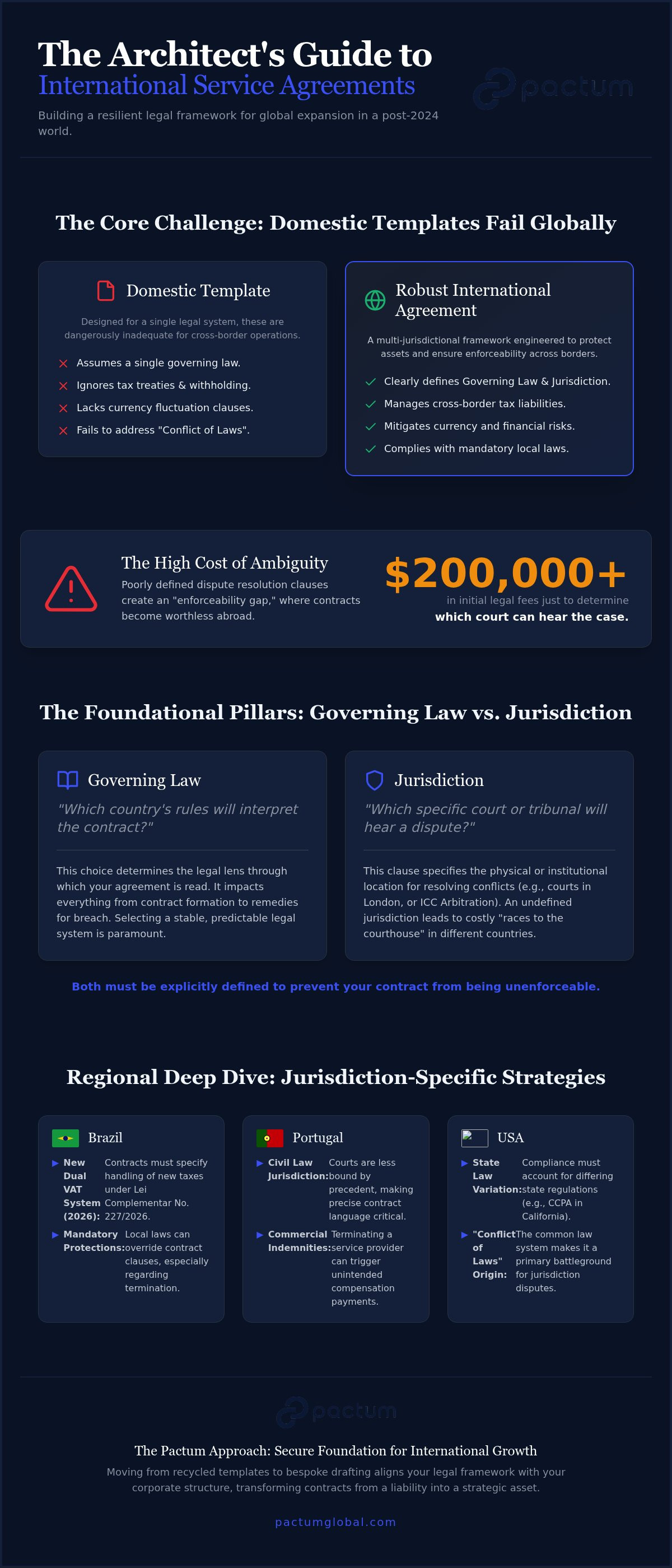
The primary challenge is the "Conflict of Laws." This occurs when the rules of two different nations apply to the same contract. A clause that's perfectly legal in the United States might be completely void in Brazil or Portugal due to mandatory local protections. These agreements serve as the essential foundation for global mobility and expansion, acting as a shield against the bureaucratic friction that often stops international growth in its tracks.
It's also important to distinguish between B2B service agreements and consumer-facing customer agreements. B2B contracts focus on risk allocation, liability caps, and intellectual property ownership. Consumer agreements, however, must comply with strict local consumer protection laws, such as the 2026 updates to the CCPA or the EU's Digital Services Act. Mixing the two can lead to significant regulatory penalties.
Domestic vs. International Drafting: The 2026 Landscape
The global regulatory environment has shifted significantly as of 2026. Standard boilerplate clauses are increasingly scrutinized by foreign courts. For example, Brazil's 2026 tax reform under Lei Complementar No. 227/2026 has introduced a dual VAT system that changes how service taxes are calculated. If your contract doesn't account for these specific shifts, your profit margins will suffer.
Digital service taxes and new remote work regulations also impact modern contracts. Many jurisdictions now require specific language to ensure a service provider isn't accidentally classified as a local employee. Moving from a local mindset to a global strategic framework means anticipating these hurdles before they occur. You aren't just drafting a document; you're building a multi-jurisdictional risk-management framework.
The Cost of Poor Drafting in Cross-Border Deals
Ambiguity in international contracts is expensive. Industry data shows that poorly defined dispute resolution clauses can lead to over $200,000 in legal fees just to determine which court has the right to hear the case. These costs don't include the operational delays that happen when a project is frozen during a legal stalemate. When service agreement drafting international is handled without precision, the result is often an unenforceable document that offers zero protection. The enforceability gap is the primary risk in international business where a contract clause valid in its home country is ignored or overturned by a foreign court.
Core Clauses: Negotiating Protection in Cross-Border Contracts
In 2026, a contract's strength isn't measured by its length but by its precision in high-stakes scenarios. Effective service agreement drafting international requires a dual focus on governing law and jurisdiction. These two concepts are often confused, yet they serve distinct purposes. Governing law determines which country's rules interpret the contract, while jurisdiction identifies the specific court or tribunal that will hear a dispute. If you don't define both, you risk a "race to the courthouse" where parties sue in different countries simultaneously.
Resilience in a post-2024 world also means rethinking Force Majeure. Modern clauses must account for digital disruptions, cyberattacks, and sudden regulatory shifts rather than just "acts of God." Performance metrics must be equally robust. For remote service delivery, your Practical Law's overview of international supply agreements highlights how risk allocation and performance standards are foundational to cross-border success. Clear exit strategies are also vital. You must navigate foreign labor protections, especially in civil law jurisdictions like Portugal or Brazil, where terminating a service provider can sometimes trigger unintended commercial indemnities.
Governing Law and Dispute Resolution Mechanisms
Choosing between litigation and international arbitration is a strategic decision. As of June 1, 2026, the ICC Arbitration Rules have increased the threshold for the Expedited Procedure to US$4,000,000. This change allows more businesses to resolve disputes faster and with lower costs. While neutral jurisdictions like Delaware or London are popular for their predictability, they aren't always optimal. If your counterparty has no assets in those regions, enforcing a judgment there might be a hollow victory. It's often better to choose a forum where enforcement is most practical.
IP Protection and Data Privacy (GDPR/LGPD)
Protecting your intellectual property across borders is a multifaceted challenge. Many founders rely on an international startup legal package to ensure their "Work for Hire" clauses actually transfer ownership under local laws. In the US, this concept is well-established, but in many civil law countries, you need a specific "Assignment of Rights" to be valid.
Privacy compliance adds another layer of complexity. With the 2026 GDPR amendments and Brazil's LGPD, your service agreements must include specific Data Processing Addendums (DPAs). In California, the CPPA now issues fines of $7,500 for intentional violations, making compliance a financial necessity. If you're unsure how these clauses apply to your specific entity, our team can help you draft bespoke service agreements that bridge these jurisdictional gaps. We ensure your IP remains yours, regardless of where your team is located.
Navigating Financial and Compliance Risks in Global Service Delivery
Currency volatility can wipe out your profit margins before a single service is delivered. In 2026, international business requires more than just a fixed price; it demands contractual protection against exchange rate shifts. Many modern agreements now include "currency collars" or re-pegging clauses to ensure that payments remain stable even when local markets don't. Without these safeguards, a 5% swing in currency value can turn a profitable contract into a liability. Precision in service agreement drafting international ensures these financial leaks are plugged before they occur.
Withholding taxes (WHT) represent another significant risk of "tax leakage." As of July 2026, the average statutory WHT rate for royalties across 146 jurisdictions is 14.5%, while interest sits at 12.8%. If your contract doesn't specify who bears this cost, you might find your net payment reduced significantly before it even leaves the client's country. For U.S. source income, the default withholding rate for Fixed, Determinable, Annual, or Periodic (FDAP) income remains at 30% in 2026. Effective service agreement drafting international must define the "net of tax" amount to ensure you receive the full value of your services.
Transfer Pricing and Intra-Group Agreements
Intercompany service agreements are currently the primary target for global tax audits. Tax authorities look for "Arm's Length" pricing in global consulting or technical support to ensure profits aren't being shifted unfairly. If your parent company provides services to a subsidiary at an artificial price, you face heavy penalties and reputational damage. This is especially critical when navigating Brazil transfer pricing regulations, where alignment with OECD standards has increased the need for transparent, well-documented contracts. Your internal agreements must be just as rigorous as your external ones to survive a 2026 audit.
Tax Residency and Permanent Establishment (PE) Risks
A poorly drafted agreement can accidentally create a taxable "branch" in a foreign country, known as Permanent Establishment (PE). If your service provider acts as a "Dependent Agent" by negotiating contracts or making key decisions on your behalf, you may trigger local corporate tax obligations. In the U.S., the Global Intangible Low-Taxed Income (GILTI) tax rate has increased to 13.125% in 2026, adding another layer of financial complexity. Strategic use of Double Taxation Treaties (DTA) can mitigate these risks, but only if the contract clearly defines the independent status of the provider and the specific nature of the services.
Finally, align your contracts with Anti-Bribery and Corruption (ABC) standards like the FCPA and the UK Bribery Act. These clauses protect you from the actions of third-party providers who might engage in unethical practices in your name. In a global market, your partner's compliance failure is your liability, so your contract must act as your first line of defense.
Regional Deep Dive: Drafting Agreements for Brazil, Portugal, and the USA
Successful service agreement drafting international requires more than just a legal mind; it requires the perspective of a global navigator. A "one size fits all" template fails because it ignores the deep-rooted differences between common law and civil law systems. While a U.S. contract relies on exhaustive detail to prevent litigation, a Brazilian or Portuguese contract must align with rigid statutory codes that can't be bypassed by private agreement. If you ignore these regional nuances, you risk holding a document that's essentially a list of polite suggestions rather than a binding legal shield.
Brazil: Specificity and Strict Compliance
Brazil is famous for its "Custo Brasil," a term describing the structural and bureaucratic costs of doing business in the country. In 2026, the tax landscape is shifting with the transition to a dual VAT system under Lei Complementar No. 227/2026. During this period, the CBS is collected at 0.9% and the IBS at 0.1%. Your service agreements must explicitly account for these rates to avoid pricing errors.
Enforceability in Brazil often hinges on formalities that U.S. or EU firms find surprising. Many contracts require notarization and registration with the Registry of Deeds and Documents to be valid against third parties. You must also proactively address the "Labor Link" risk. If a service agreement looks too much like an employment relationship, Brazilian courts may reclassify your contractor as an employee, triggering back taxes and benefits. Aligning your contract with Brazil business law for foreign companies is the only way to mitigate these operational risks.
Portugal and the EU Framework
Portugal offers a strategic gateway to Europe, but its legal framework is strictly tied to EU directives. In April 2026, Portugal implemented Law No. 12-A/2026, integrating the EU's Digital Services Act into national law. This affects how digital services are delivered and regulated. Additionally, the transposition of the NIS2 directive means non-compliance with cybersecurity standards can lead to fines of up to €10 million. Your agreements should reflect these high standards of data protection and operational security. It's also vital to ensure your service terms match your shareholders agreement for portuguese company to maintain a consistent corporate governance structure.
USA Market Entry: Protection and Scalability
The U.S. market is notoriously litigious, making "Limitation of Liability" clauses your most important defense. State choice is a critical strategic decision. Delaware remains the gold standard for corporate tech services due to its predictable Chancery Court, while Florida is increasingly popular for its business-friendly environment for smaller entities. Your contract must be tailored to the specific statutes of the state you choose. When coordinating your service agreement drafting international, ensure the terms support your broader USA company setup for non-residents goals. Protecting the parent company from U.S. litigation requires clear "corporate veil" protections within your service documentation.
If you're ready to secure your international operations, you can start your global expansion with Pactum Global to ensure every clause is jurisdiction-ready.
The Pactum Approach: Streamlining Your Global Legal Infrastructure
Many companies treat contracts as a simple checklist item. They download a template, swap the names, and hope for the best. This approach is a gamble that rarely pays off in a cross-border environment. At Pactum Global, we move beyond static documents. Our philosophy on service agreement drafting international centers on the belief that a contract is a living part of your corporate infrastructure. It must align with your tax residency, your transfer pricing strategy, and your long-term growth goals. We don't just provide a document; we provide a roadmap for your global journey.
We act as a proactive shield against bureaucratic errors. By integrating legal drafting with company setup in jurisdictions like Brazil, Portugal, and the USA, we ensure that your agreements actually work when tested. This holistic view prevents the common "enforceability gap" where a contract is valid in theory but useless in practice. When your legal framework matches your corporate structure, you eliminate the friction that typically slows down international expansion. Our goal is to demystify the complexity, allowing you to focus on your core business while we handle the regulatory hurdles.
From Startup to Global Player: Scaling Your Contracts
Scaling requires a fundamental shift in your documentation. Early-stage founders often start with a basic legal documents for international startups package to get off the ground. However, as you hire globally or sign larger enterprise clients, your risk profile changes significantly. Regular contract audits are essential in 2026 to ensure your terms reflect the latest regulatory shifts, such as new digital service taxes or updated privacy fines. Integrating IP protection into every service agreement is not optional; it's a requirement for maintaining your company's valuation as you grow.
Your Next Steps for Secure Global Expansion
Reviewing your current agreements is the first step toward long-term security. Use this checklist to evaluate your current service agreement drafting international strategy:
- Does the contract clearly distinguish between governing law and the forum for disputes?
- Are withholding tax responsibilities explicitly assigned to prevent profit leakage?
- Is there a specific "Assignment of Rights" clause that complies with local civil law?
- Does the agreement match your current transfer pricing documentation?
If you're unsure about any of these points, it's time for a professional review. We provide a comprehensive legal structure analysis that bridges the gap between your home office and your foreign operations. You can secure your global growth with expert international contract drafting and build a foundation that supports your highest ambitions. Let us map out the journey so you can focus on the destination.
Secure Your Foundation for Global Growth
Expanding into international markets is a bold step that requires more than just ambition. It demands a legal framework that stands up to the scrutiny of foreign courts and tax authorities. We've explored how service agreement drafting international must move beyond generic templates to address specific regional requirements, such as Brazil's 2026 dual VAT reforms and the EU's evolving digital regulations. By aligning your contracts with your corporate structure and transfer pricing strategy, you remove the hidden obstacles that often derail global expansion.
Pactum Global provides the specialized expertise needed to navigate the complex legal corridors of Brazil, Portugal, and the USA. We offer a transparent and proactive approach to international bureaucracy, ensuring your business is protected from day one. Our end-to-end corporate structuring is trusted by global entrepreneurs who refuse to leave their success to chance. You don't have to face these hurdles alone.
Ready to build a resilient legal infrastructure for your business? Book a consultation for expert international service agreement drafting today. Your global journey deserves a steady partner who has already mapped the way forward.
Frequently Asked Questions
What is the difference between governing law and jurisdiction in an international contract?
Governing law is the legal system used to interpret your contract, while jurisdiction is the specific forum that will hear your case. You need both to prevent a scenario where a court is forced to apply foreign laws it doesn't understand. This clarity is essential in service agreement drafting international to ensure predictable outcomes if a dispute ever arises.
Can I use a standard US service agreement template for a client in Brazil?
No, using a standard US template in Brazil is a high-risk move that often leads to unenforceability. Brazil's legal system is based on civil law and requires specific formalities, such as notarization and registration, for the contract to be valid against third parties. Additionally, the 2026 dual VAT system requires precise tax language that a US template won't include.
How do I ensure my international service agreement is enforceable abroad?
Enforceability depends on meeting local formal requirements and choosing a practical forum for dispute resolution. In many jurisdictions, you must register the contract with local authorities to protect your rights. Choosing international arbitration is often more effective than litigation because arbitral awards are recognized in over 170 countries via the New York Convention.
What are the tax implications of drafting an international service agreement?
The primary tax risks involve withholding taxes (WHT) and transfer pricing compliance. In 2026, average statutory withholding rates for royalties are approximately 14.5%, and the IRS has increased scrutiny on electronic matching of tax forms. Your agreement must clearly state whether prices are gross or net of these local taxes to protect your profit margins.
Do international service agreements need to be translated to be legally binding?
Yes, most civil law jurisdictions require a sworn translation for a contract to be legally recognized by local courts or government agencies. While an English version might be binding between the private parties, you'll need a translated version for official enforcement, bank transfers, or tax filings in countries like Portugal or Brazil.
What is a 'Permanent Establishment' risk in service agreement drafting?
Permanent Establishment (PE) risk occurs when your activities in a foreign country trigger local corporate tax obligations. If your service agreement allows a provider to act as a "Dependent Agent" with the power to negotiate deals, you might be taxed as if you have a local branch. Precise service agreement drafting international helps define the relationship as independent to avoid this trap.
How does arbitration differ from litigation in cross-border contract disputes?
Arbitration is a private dispute resolution process that offers more confidentiality and flexibility than public litigation. It's often preferred for cross-border deals because of the New York Convention's enforcement rules. The 2026 ICC rules now allow for expedited procedures for disputes up to US$4,000,000, making it a significantly faster alternative to traditional foreign courts.

