
Brazil is one of the most exciting emerging markets in the world, yet countless foreign entrepreneurs walk away before they even start, convinced the process is simply too complex. That instinct is understandable. Company formation in Brazil for foreigners does come with a distinct set of legal requirements, registration steps, and bureaucratic layers that can feel overwhelming without a clear roadmap. But here's the truth: with the right guidance, establishing a business in Brazil is far more achievable than its reputation suggests.
You're not alone if you've felt uncertain about where to begin, which business structure to choose, or how long the whole process will realistically take. These are the exact concerns that stop promising ventures from getting off the ground.
This guide is designed to change that. By the time you finish reading, you'll have a clear understanding of the legal requirements, a realistic picture of the costs and timelines involved, and the confidence to move forward decisively. We'll walk you through every stage of the process, from choosing the right company structure to completing your registration, so you can focus on building your business rather than untangling red tape.
Key Takeaways
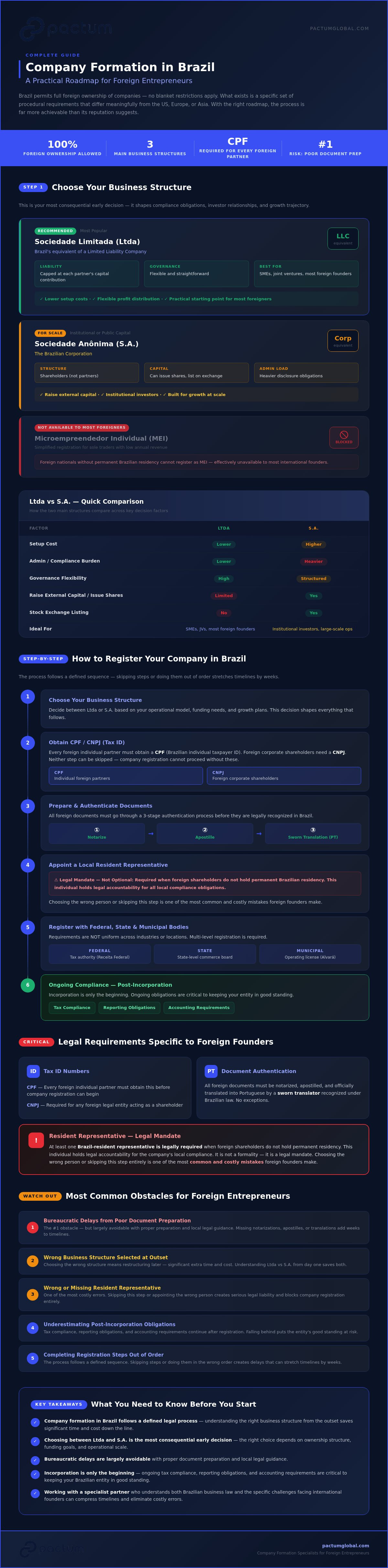
- Company formation in Brazil for foreigners follows a defined legal process — understanding the right business structure from the outset saves significant time and cost down the line.
- Choosing between an Ltda and an S.A. is one of the most consequential early decisions you'll make, and the right choice depends on your ownership structure, funding goals, and operational scale.
- Bureaucratic delays are the most common obstacle foreign entrepreneurs face, but they are largely avoidable with proper document preparation and local legal guidance.
- Incorporation is only the beginning — ongoing tax compliance, reporting obligations, and accounting requirements are critical to keeping your Brazilian entity in good standing.
- Working with a specialist partner who understands both Brazilian business law and the specific challenges facing international founders can compress timelines and eliminate costly errors.
Understanding Company Formation in Brazil: Key Concepts for Foreigners
Company formation in Brazil for foreigners is, at its core, the legal process of establishing a recognized business entity under Brazilian law. It's the foundation that determines how your business is taxed, how liability is distributed, and how you can operate, hire, and transact within the country. Getting this foundation right matters enormously. The structure you choose on day one shapes your compliance obligations, your investor relationships, and your growth trajectory for years to come.
Brazil's legal framework does permit foreign nationals to own and operate businesses. There are no blanket restrictions on foreign ownership. What does exist is a specific set of procedural requirements that differ meaningfully from what entrepreneurs encounter in the United States, Europe, or most of Asia. Understanding those differences upfront is what separates a smooth launch from a prolonged, expensive delay.
Types of Business Structures in Brazil
Three structures dominate the landscape for foreign entrepreneurs, each with a distinct purpose:
- Sociedade Limitada (Ltda): This is Brazil's equivalent of a limited liability company and the most widely used structure for foreign-owned businesses. Liability is capped at each partner's capital contribution, governance requirements are relatively flexible, and setup costs are lower than a corporation. It suits most small-to-medium operations and joint ventures.
- Sociedade Anônima (S.A.): The Brazilian corporation. An S.A. is structured around shareholders rather than partners, making it the appropriate vehicle for businesses planning to raise external capital, issue shares, or eventually list on a stock exchange. It carries heavier administrative and disclosure obligations, but it's built for scale.
- Microempreendedor Individual (MEI): A simplified registration category designed for sole traders with low annual revenue. Foreign nationals without permanent residency in Brazil cannot register as MEI, so this option is effectively unavailable to most international founders operating remotely.
For the majority of foreign entrepreneurs entering Brazil, the Ltda is the practical starting point. The S.A. becomes relevant when institutional investment or public capital is part of the plan.
Legal Considerations for Foreigners
Several legal requirements apply specifically to foreign founders. Every foreign partner must obtain a CPF, Brazil's individual taxpayer identification number, before the company can be registered. Foreign corporate shareholders require a CNPJ, the equivalent tax ID for legal entities. All foreign documents must be notarized, apostilled, and officially translated into Portuguese by a sworn translator recognized under Brazilian law.
Critically, at least one resident representative in Brazil is legally required when foreign shareholders do not hold permanent residency. This individual holds legal accountability for the company's local compliance obligations. It's not a formality. It's a legal mandate, and choosing the wrong person or skipping this step entirely is one of the most common and costly mistakes foreign founders make.
Company formation in Brazil for foreigners demands precise document preparation and a clear understanding of which municipal, state, and federal registrations apply to your specific business activity. The requirements aren't uniform across industries or locations, which is exactly why working with a specialist partner from the outset protects both your timeline and your investment.
Step-by-Step Guide to Opening a Company in Brazil
Knowing the legal landscape is one thing. Executing the process correctly is another. Company formation in Brazil for foreigners follows a defined sequence, and skipping steps or completing them out of order creates delays that can stretch timelines by weeks. Here's exactly how it works.
Choosing Your Business Structure
Your first decision shapes everything that follows. Before a single document is drafted, you need to confirm which structure fits your operational model. Use these criteria to guide the choice:
- Ltda (Sociedade Limitada): Best for most foreign entrepreneurs. Lower setup costs, flexible governance, and straightforward profit distribution. Ideal if you're launching operations, building a local team, or entering a joint venture with a Brazilian partner.
- S.A. (Sociedade Anônima): The right vehicle if institutional investment, shareholder issuance, or a future public listing is part of the plan. Heavier compliance obligations come with the territory, so only choose this if the capital structure genuinely requires it.
Be honest about your funding timeline. Founders who choose an S.A. prematurely often face administrative burdens that slow early-stage growth. Start with the structure that matches where your business is now, not where you hope it will be in five years.
Registering Your Company
Once the structure is confirmed, the process moves through five distinct stages:
- Draft and notarize your company bylaws. The Articles of Association (contrato social for an Ltda) must define the company's purpose, capital structure, partner responsibilities, and governance rules. These documents must be drafted in Portuguese and notarized before submission.
- Register with the commercial registry (Junta Comercial). Each Brazilian state has its own Junta Comercial. Submission requirements vary slightly by state, so local knowledge matters here. Processing times typically range from a few days to several weeks depending on the state and completeness of your filing.
- Obtain your CNPJ from the Receita Federal. The CNPJ is your company's federal tax identification number. Without it, your business cannot issue invoices, open a bank account, or hire employees. It's issued after commercial registry approval.
- Complete municipal and state registrations. Depending on your business activity, you'll need a municipal operating license (alvará) and potentially state-level registrations for tax purposes. These requirements vary by industry and location.
- Open a corporate bank account. Brazilian banks require your CNPJ, notarized company documents, and identification for all partners. Account opening timelines vary by institution, and some banks have more streamlined processes for foreign-owned entities than others.
Your resident legal representative plays a central role throughout this process. They sign documents on the company's behalf, liaise with Brazilian authorities, and carry legal accountability for local compliance. Getting the right person in this role before registration begins is non-negotiable.
The steps are manageable. The details are where things go wrong. If you want to move through this process without preventable setbacks, working with a specialist in Brazilian company formation from the outset is the most reliable way to protect your timeline.
Common Challenges Faced by Foreign Entrepreneurs in Brazil
Even with a clear process in hand, the reality of company formation in Brazil for foreigners rarely unfolds without friction. The challenges aren't insurmountable, but they are specific, and knowing what to expect before you encounter them is the difference between a manageable delay and a derailed launch.
Navigating Bureaucracy
Brazil's regulatory environment operates across federal, state, and municipal levels simultaneously. Each layer has its own timelines, submission formats, and communication norms. A document that satisfies the Receita Federal may still require supplementary materials at the Junta Comercial. These aren't arbitrary obstacles; they're the product of a complex federal system that simply requires local fluency to navigate efficiently.
Practical steps that protect your timeline:
- Prepare documents in parallel, not in sequence. While awaiting CPF approval, begin preparing your Articles of Association and arranging apostilles on foreign documents. Sequential processing is the single biggest source of avoidable delay.
- Verify state-specific requirements before filing. Registration requirements at the Junta Comercial vary by state. What works in São Paulo may not satisfy requirements in Rio de Janeiro or Minas Gerais.
- Appoint a qualified local representative before registration begins. This isn't just a legal requirement; it's your operational anchor. A knowledgeable resident representative can communicate directly with authorities, respond to document requests promptly, and prevent minor administrative queries from escalating into formal rejections.
Tax Obligations and Financial Regulations
Brazil's tax system is widely acknowledged as one of the most complex in the world. Foreign entrepreneurs frequently underestimate the scope of ongoing obligations that begin the moment a CNPJ is issued. Federal, state, and municipal taxes can apply concurrently depending on your business activity, and the wrong tax regime election at the outset can create compliance burdens that are difficult to unwind later.
Choosing between Simples Nacional, Lucro Presumido, and Lucro Real isn't a minor administrative decision. Each regime carries different rates, reporting requirements, and eligibility thresholds. Getting this right from the start protects your margins and keeps your entity in good standing with the Receita Federal.
Cultural Considerations
Business in Brazil runs on relationships. Decisions that might be made purely on commercial merit in other markets are often influenced by trust, personal rapport, and demonstrated commitment to the local context. Foreign entrepreneurs who treat initial meetings as transactional often find doors closing that would have opened with a little patience.
Invest time in building genuine connections with local partners, suppliers, and advisors. Understand that timelines in negotiations may feel slower than you're accustomed to, and resist the impulse to push aggressively. Brazilians respond well to entrepreneurs who show they're here to build something lasting, not simply to extract value from the market.
Language matters too. While English is spoken in major business centers, conducting formal communications and negotiations in Portuguese, or at minimum demonstrating the effort to do so, signals respect and seriousness. A specialist partner with deep roots in the Brazilian market bridges both the legal and cultural dimensions of this challenge, ensuring your entry is as smooth as your ambitions deserve.
Post-Incorporation Compliance: What You Need to Know
Getting your company registered is a milestone worth celebrating. But incorporation is the starting line, not the finish. For foreign entrepreneurs, the post-formation phase is where many businesses quietly run into trouble. Obligations accumulate, deadlines pass unnoticed, and what began as a minor oversight compounds into a serious compliance problem. Understanding what's required from day one of operations protects everything you've built.
Tax Compliance and Financial Reporting
Brazil's tax system operates across three levels simultaneously: federal, state, and municipal. Once your CNPJ is active, your obligations begin immediately, regardless of whether the company has generated revenue. The tax regime you elected at registration, whether Simples Nacional, Lucro Presumido, or Lucro Real, determines your reporting cadence, applicable rates, and the specific declarations you must file.
Key obligations to stay on top of include:
- Monthly tax declarations: Most regimes require monthly filings, even in periods of zero activity. Missing these triggers automatic penalties.
- Annual corporate income tax return (DIPJ/ECF): Filed with the Receita Federal, this consolidates your company's annual financial position.
- SPED system submissions: Brazil's digital bookkeeping system requires structured electronic submissions of accounting and fiscal data. This isn't optional and non-compliance carries significant fines.
- Municipal service tax (ISS) and state VAT (ICMS): Applicable depending on your business activity, these require separate filings at the local and state levels.
One of the most common pitfalls in company formation in Brazil for foreigners is underestimating how quickly tax obligations activate. Don't wait until your first revenue event to establish your reporting infrastructure. Set it up before you need it.
Legal Maintenance and Updates
Your company's legal documents aren't static. Brazilian law requires that the contrato social or Articles of Association accurately reflect the current reality of your business at all times. Changes in ownership, capital structure, management appointments, or registered business activities must be formally registered with the Junta Comercial. Operating with outdated documentation creates legal exposure and can complicate banking relationships, contract execution, and future investment rounds.
Review your company documents whenever:
- A partner exits or a new one joins
- The company's registered address or business purpose changes
- Management responsibilities are redistributed
- Capital contributions are increased or restructured
Annual reviews with a qualified legal advisor aren't excessive caution; they're standard practice for any well-run Brazilian entity. The regulatory environment evolves, and your documentation needs to keep pace.
Staying compliant after incorporation is just as demanding as the formation process itself. If you want expert support managing the ongoing legal and regulatory requirements of your Brazilian entity, speak with the Pactum Global team about how they can keep your business in good standing from day one.
Why Choose Pactum Global for Your Company Formation in Brazil?
You've now seen exactly how complex company formation in Brazil for foreigners can be. The layered registrations, the tax regime decisions, the resident representative requirement, the document apostilles. Each step carries real consequences if handled incorrectly. Pactum Global exists precisely to remove that risk from your path.
This isn't a generalist firm that handles Brazilian company formation as one item on a long menu of services. It's a specialist partner built around the specific challenges international entrepreneurs face when entering Brazil. That focus matters. It means the team has already encountered the edge cases, the state-level variations, and the documentation pitfalls that catch first-time founders off guard.
Tailored Support for Foreign Entrepreneurs
Pactum Global's approach is built around the reality that foreign founders don't just need legal paperwork processed. They need a partner who understands what it's like to navigate an unfamiliar regulatory system from the outside. Communication is proactive, not reactive. You're not left waiting for updates or chasing responses. Every stage of the process is explained in clear, practical terms so you always know where things stand and what comes next.
The support extends across the full scope of what foreign entrepreneurs actually need:
- Company setup in Brazil: Structuring, registration, and all associated filings handled end-to-end.
- Shareholders' Contracts and SAFE agreements: Legal frameworks that protect your ownership position from day one.
- Immigration processes for Brazil: For founders who want to establish a physical presence in the country, not just a legal entity.
- Intellectual Property and Trademarks: Protecting your brand before competitors can exploit the gap.
- Transfer Pricing Services: Essential for foreign-owned entities transacting across borders.
That breadth of capability means you're not stitching together advice from multiple providers. One team holds the full picture of your Brazilian operation.
Commitment to Transparency and Excellence
Hidden costs and vague timelines are the two things that erode trust fastest in professional services. Pactum Global's model is built on the opposite principle. Costs are explained upfront. Processes are mapped clearly before engagement begins. There are no surprises buried in the fine print.
The team's track record with international clients reflects a consistent standard: founders who came in uncertain and left with a fully registered, compliant Brazilian entity and a clear understanding of their ongoing obligations.
If you're ready to move forward with company formation in Brazil for foreigners and want a partner who treats your timeline and investment with the same seriousness you do, contact Pactum Global today and take the first step with confidence.
Your Brazilian Business Starts With the Right First Step
Company formation in Brazil for foreigners is genuinely achievable. The process has real complexity, but it's a complexity that yields to preparation, local expertise, and the right partner by your side. The structure you choose shapes your tax obligations. Your documentation determines your timeline. And your compliance habits from day one protect everything you build afterward.
Three things to carry forward: choose your business structure based on where your company is now, not where you hope it will be; get your documentation in order before you begin; and don't underestimate the ongoing obligations that follow incorporation.
Pactum Global brings deep expertise in Brazilian business law, transparent pricing with no hidden fees, and comprehensive support built specifically for international founders. You won't be piecing together advice from multiple providers or navigating the process alone.
Brazil is one of the world's most dynamic markets. The opportunity is real, and it's waiting. Start your business journey in Brazil today and take the first step with a team that already knows the way.
Frequently Asked Questions About Company Formation in Brazil for Foreigners
What are the main types of companies foreigners can form in Brazil?
Foreign entrepreneurs have two practical options: the Sociedade Limitada (Ltda) and the Sociedade Anônima (S.A.). The Ltda functions like a limited liability company and suits most foreign-owned businesses due to its flexible governance and lower administrative burden. The S.A. is structured around shareholders and works best when external investment or future share issuance is part of the plan. A third category, the MEI, is unavailable to non-residents.
How long does it take to open a company in Brazil?
Timelines vary depending on the state of registration, the completeness of your documentation, and the business activity involved. In straightforward cases with all documents properly prepared, the process can take anywhere from four to eight weeks. States like São Paulo often have faster processing at the Junta Comercial than smaller jurisdictions. Incomplete filings or missing apostilles are the most common causes of delays that push timelines significantly beyond that range.
What are the costs associated with company formation in Brazil?
Costs vary based on your chosen structure, the state where you register, and the professional support you engage. Government fees for registration, notarization, and official document translation all contribute to the total. An S.A. carries higher setup costs than an Ltda due to its additional compliance requirements. For accurate pricing specific to your situation, speak directly with a specialist before committing to a structure or timeline.
Do I need a local partner to start a business in Brazil?
You don't need a Brazilian business partner, but you do need a resident legal representative if none of the foreign shareholders hold permanent Brazilian residency. This is a legal requirement, not an optional safeguard. That representative carries formal accountability for the company's local compliance obligations. Confusing "local partner" with "legal representative" is a common misunderstanding that can stall the registration process entirely if not addressed early.
What documentation is required to register a company in Brazil?
Every foreign individual partner needs a CPF (Brazilian individual taxpayer ID), and foreign corporate shareholders require a CNPJ. All foreign-issued documents must be notarized, apostilled under the Hague Convention, and translated into Portuguese by a sworn translator recognized under Brazilian law. You'll also need drafted Articles of Association in Portuguese, identification documents for all partners, and proof of a registered address in Brazil. Requirements can vary slightly by state and business activity.
Can I operate my business in Brazil without being a resident?
Yes. Foreign nationals don't need to live in Brazil to own and operate a Brazilian company. What's required is a resident legal representative who can act on the company's behalf locally and hold accountability for compliance obligations. Many international founders manage their Brazilian entities remotely while relying on a trusted local representative and specialist advisors to handle day-to-day regulatory requirements. Company formation in Brazil for foreigners is specifically designed to accommodate this structure.
What are the ongoing compliance requirements after forming a company?
Once your CNPJ is active, compliance obligations begin immediately, regardless of revenue. These include monthly tax declarations, annual corporate income tax returns, and structured electronic submissions through Brazil's SPED digital bookkeeping system. Your company's Articles of Association must also be updated at the Junta Comercial whenever ownership, management, or business purpose changes. Failing to maintain these filings on schedule triggers automatic penalties, so building your compliance infrastructure before your first transaction is essential.


