

What if the laws of your host country decide who inherits your home and business, regardless of what your will says? Many international residents believe their home-country documents cover everything, but local "forced heirship" rules often override personal wishes. Effective inheritance planning for expats requires more than a simple will; it demands a strategy that harmonizes conflicting national laws. You deserve the peace of mind that comes from knowing your family is protected and your tax burden is minimized.
This guide provides a clear roadmap to secure your global assets in 2026. You'll learn how to leverage tools like the EU Succession Regulation to choose your own national law and understand the impact of the current 15 million dollar US federal estate tax exemption. We'll break down the specific steps to align your corporate structures in Brazil, Portugal, or the USA with your personal succession goals, ensuring a seamless transfer of wealth across borders.
Key Takeaways
- Coordinate your legal and tax strategies to address the 2026 increase in global reporting requirements and digital asset tracking.
- Understand how forced heirship rules in civil law jurisdictions like Brazil and Portugal can override your will without a proactive legal strategy.
- Implement effective inheritance planning for expats to mitigate the risk of double taxation caused by the US worldwide tax model.
- Utilize specialized tools like Situs Wills and Shareholders’ Agreements (SHA) to protect your international business interests and personal legacy.
- Learn how an integrated approach to corporate setup and immigration creates a clear, secure roadmap for cross-border asset transfers.
What is Inheritance Planning for Expats in 2026?
Inheritance planning for expats is the strategic coordination of legal and tax frameworks to protect assets held in different countries. It ensures that your legacy isn't dismantled by conflicting international regulations. In 2026, this process has become more urgent due to heightened global transparency. Digital asset tracking is now standard, and systems like the Common Reporting Standard (CRS) and FATCA provide tax authorities with real-time data on cross-border holdings. You can no longer rely on the isolation of assets; every piece of your global portfolio is now visible to multiple jurisdictions.
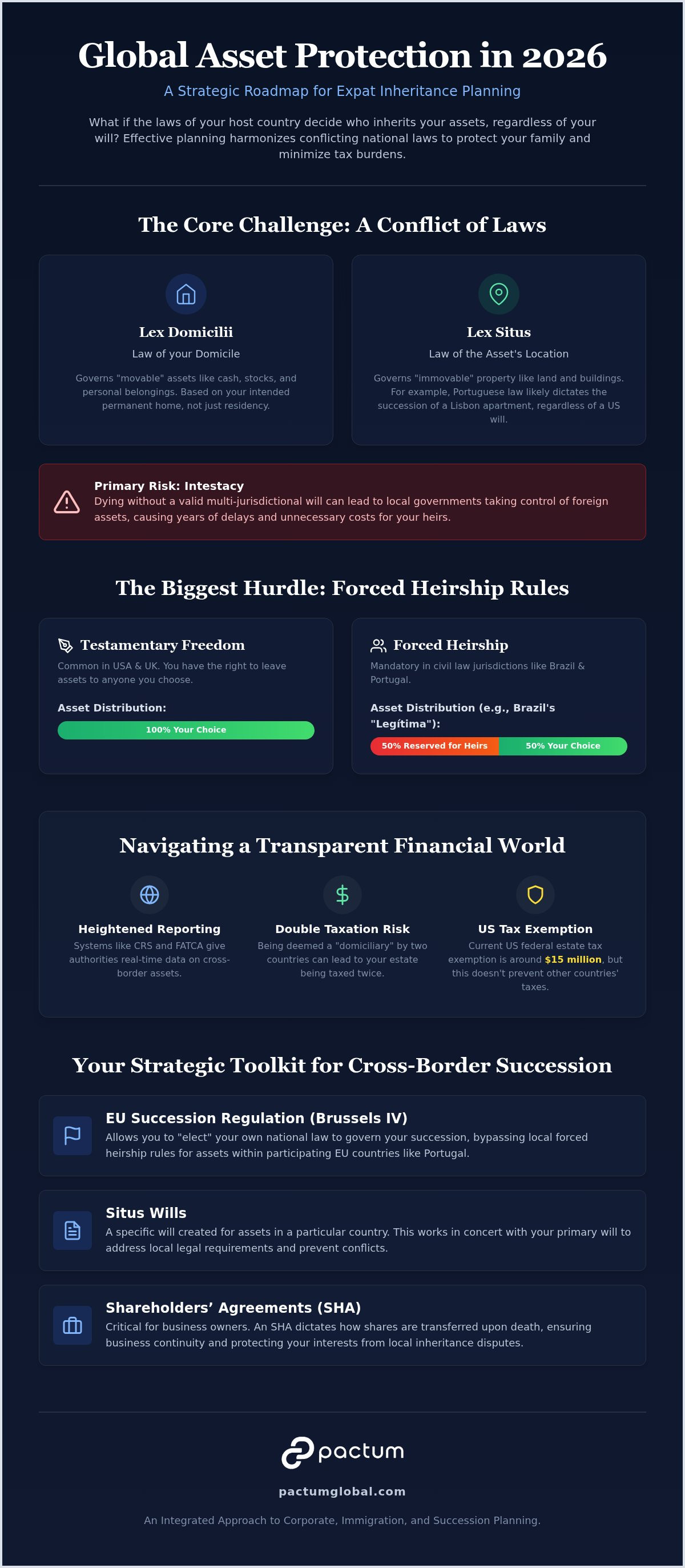
The primary challenge is the "Conflict of Laws." This occurs when two nations claim authority over the same bank account, property, or business interest. Without a clear plan, your estate could face Understanding Forced Heirship and Civil Law issues, where local statutes dictate asset distribution regardless of your personal wishes. Avoiding intestacy, or dying without a valid multi-jurisdictional will, is the most critical objective. When you die without a valid will in a foreign land, the local government often takes control, leading to years of bureaucratic delays and unnecessary costs for your heirs.
Lex Domicilii vs. Lex Situs
Succession law generally follows two competing principles. Lex Domicilii refers to the law of the country where you are permanently settled. This usually governs "movable" assets like cash, stocks, and personal belongings. In contrast, "Lex Situs" applies to "immovable" property like land and buildings. Lex Situs is the governing principle for immovable property in cross-border estates. If you own an apartment in Lisbon but live in New York, Portuguese law will likely dictate the succession of that specific property, even if your US will suggests a different outcome. Balancing these two principles is essential to avoid legal gridlock.
The Role of Domicile in Expat Succession
You might have a residency permit for a specific country, but that doesn't mean you are "domiciled" there for inheritance purposes. Residency is often a matter of immigration status. Domicile is a deeper legal concept involving your intent to remain in a place indefinitely. The risk for many expats is being deemed a "domiciliary" by two countries at once. This can lead to double taxation on your worldwide estate. To prevent this, you should take proactive steps to establish a clear primary domicile. This includes maintaining a primary residence, registering for local taxes, and ensuring your succession documents explicitly state your intended legal home. Clear documentation removes the ambiguity that tax authorities often exploit.
Understanding Forced Heirship and Civil Law Restrictions
Many Americans and Brits are accustomed to "testamentary freedom," which is the legal right to leave your assets to anyone you choose. However, inheritance planning for expats often involves navigating civil law jurisdictions like Brazil and Portugal, where this freedom is restricted. These countries utilize "forced heirship" rules. This legal requirement mandates that a specific portion of your estate must be reserved for "necessary heirs," such as children, parents, or a spouse. If your will contradicts these local statutes, the foreign court may simply invalidate those specific provisions for assets located within their borders.
A simple will drafted in the US or UK is rarely enough to protect global assets. For example, if you own real estate in a civil law country, that country's laws usually take precedence over your home-country will. Relying on a single document often leads to family disputes and frozen assets. To ensure your wishes are respected, you must harmonize your international documents with local mandatory rules. Understanding how to use Mitigating Double Taxation and Conflict of Laws strategies, including proper IRS reporting for foreign inheritances, is a vital part of this protection.
Succession in Brazil and Portugal
In Brazil, the law establishes the "Legítima," which reserves 50% of a person's assets for necessary heirs. This means you can only freely dispose of half of your Brazilian estate. Portugal follows a similar structure with its "Quota Legítima." These rules apply to foreign residents and can significantly impact how you pass down a business or family home. For a deeper look at these jurisdiction-specific requirements, see our article on Succession Planning for Foreign Assets: A Guide. Managing these restrictions often requires specialized Succession Documents that work in tandem with your corporate structures.
EU Succession Regulation (Brussels IV)
For expats living in Portugal, the EU Succession Regulation, often called Brussels IV, offers a powerful solution. This regulation allows you to "elect" the law of your nationality to govern the succession of your entire estate, even assets located in Portugal. By making this formal election in your will, a US citizen can bypass Portuguese forced heirship rules. It's important to remember that this election only governs who inherits the assets; it doesn't change local inheritance tax obligations. This regulation is a game-changer for Americans and Brits in Europe, but it must be executed correctly to be recognized by local conservatórias. We can help you draft the right Shareholders' Contracts (SHA) and succession plans to ensure your international legacy remains intact.
Mitigating Double Taxation and Conflict of Laws
Expats often face the risk of being taxed twice on the same dollar. Understanding the difference between an estate tax and an inheritance tax is the first step in protecting your legacy. An estate tax, like the one used in the US, is levied on the total value of the deceased's property before any distribution occurs. In contrast, an inheritance tax is typically paid by the individual receiving the assets. Effective inheritance planning for expats must account for both systems to ensure heirs aren't left with a fraction of their intended share.
The United States follows a "worldwide" taxation model. This means US citizens are subject to federal estate taxes on all assets, regardless of where the assets are located or where the owner dies. In 2026, the federal estate tax exemption is 15 million dollars per individual, with a top tax rate of 40%. While this exemption is generous, assets in other jurisdictions may still trigger local taxes. In Brazil, the ITCMD (Inheritance and Gift Tax) is managed at the state level. Rates and regulations vary significantly between states like São Paulo and Rio de Janeiro. Portugal utilizes a Stamp Duty (Imposto do Selo) system, which generally carries a 10% rate, though it offers vital exemptions for spouses, children, and parents.
The Power of Bilateral Tax Treaties
Bilateral treaties are designed to prevent the same asset from being taxed by two different countries. These agreements use "tie-breaker" rules to determine which nation has the primary taxing rights based on factors like permanent residence or the location of real estate. While the US has income tax treaties with many nations, estate and gift tax treaties are much rarer. The US currently maintains these specific treaties with only 17 countries, including the United Kingdom, France, and Germany. You must verify the specific treaty status between your home and host countries to avoid redundant tax liabilities.
Foreign Tax Credits and Unilateral Relief
When a formal treaty isn't in place, you can often rely on foreign tax credits to provide relief. For instance, if your estate pays ITCMD in Brazil on a property, the US tax system typically allows a credit for those taxes against any US estate tax due on that same property. Proper documentation is essential for this process. You'll need a formal valuation of the asset at the time of death that meets the standards of both jurisdictions. This level of compliance is a central theme in our Legal Support for Global Mobility: A Strategic Guide for 2026. Managing these credits requires a proactive approach to ensure that your global mobility doesn't result in an accidental tax penalty for your family.
Essential Succession Documents for the Global Citizen
Successful inheritance planning for expats requires a modular approach to documentation. Relying on a single, "all-encompassing" will is a common mistake that often leads to legal gridlock. Instead, global citizens should implement a "Situs Will" strategy. This involves drafting separate wills for each country where you hold significant assets. For example, a Portuguese will would exclusively govern your property in Lisbon, while a US will manages your domestic accounts. This prevents a foreign court from having to interpret unfamiliar legal language from another jurisdiction, which significantly accelerates the probate process.
Beyond the will, you must secure your operational interests and personal agency through these critical steps:
- Step 1: Draft Multi-Jurisdictional Wills. Use the Situs Will approach to ensure each document complies with local formalities like the "Legítima" in Brazil or the "Quota Legítima" in Portugal.
- Step 2: Align Shareholders’ Agreements (SHA). Ensure your business contracts reflect your personal succession goals. Check our Legal Documents for International Startups: The 2026 Global Founder’s Checklist to see how these documents interlink.
- Step 3: Establish Durable Powers of Attorney. A US Power of Attorney is rarely recognized by a Brazilian bank or a Portuguese conservatória. You need local documents to ensure someone can manage your affairs if you become incapacitated.
- Step 4: Review Beneficiary Designations. Life insurance policies and retirement accounts often pass outside of a will. Ensure these designations are current and don't conflict with your broader tax strategy.
- Step 5: Consolidate Asset Records. Provide your executor with a clear roadmap of your global holdings, including digital keys and corporate registry details.
Shareholders' Agreements (SHA) as Succession Tools
For business owners, the Shareholders' Agreement is as vital as a will. It should include specific "Death of a Shareholder" clauses to prevent the company from being paralyzed during a cross-border probate. Without these provisions, your heirs might inherit shares but have no right to manage the company, or the surviving partners might be unable to make critical decisions. Integrating buy-sell agreements into your SHA provides necessary liquidity for your family while keeping the business stable. If you need to secure your business interests, we can help you draft specialized Shareholders' Contracts (SHA) that protect your legacy.
Trusts and Holding Companies
Trusts are powerful tools in the US, but they face recognition challenges in civil law countries like Brazil. While a US Trust can hold American assets efficiently, using it for Brazilian real estate can lead to complex tax disputes. In Europe, many expats find success using a Portuguese holding company to centralize their EU-based assets. This structure simplifies inheritance planning for expats by moving the succession from the individual level to the corporate level, where transfers are often more straightforward. We provide the expertise needed to manage these Succession Documents and corporate structures across borders.
How Pactum Global Secures Your Cross-Border Legacy
Pactum Global provides a unified solution for inheritance planning for expats. We don't just draft a document; we build a protective shield around your global assets. Most traditional firms focus solely on local law, leaving you to bridge the gaps between different countries. We eliminate this fragmentation by integrating your corporate structure, immigration status, and succession goals into one cohesive strategy. When you choose Pactum Global, you gain a partner who understands that inheritance planning for expats is a dynamic, multi-jurisdictional process that requires constant oversight.
We understand that your life doesn't fit neatly into a single jurisdiction. Our team proactively monitors shifts in international regulations, such as the 2026 updates to digital asset tracking and global tax reporting. This forward-thinking approach ensures that your plan remains effective as transparency increases. By managing the complexities of cross-border asset transfer, we allow you to focus on your growth while we secure your family's future.
Your Global Navigator for Succession
Coordination is the most difficult part of international succession. We act as your central point of contact, managing relationships with local counsel across multiple borders so you don't have to. This ensures that a decision made for your US estate doesn't inadvertently trigger a tax penalty in Brazil or violate a Portuguese forced heirship rule. We also specialize in ensuring your Shareholders Agreement for Portuguese Company is future-proof and aligned with your personal legacy. If you're ready to secure your assets, booking a discovery call to audit your current global asset structure is the best way to start.
Peace of Mind for International Founders
Founders face unique risks when their business interests span continents. A sudden incapacity or death can paralyze a startup if the corporate documents don't account for international probate. We protect both your company and your family through a unified strategy that includes Succession Documents and robust Shareholders' Contracts (SHA). Our no-nonsense approach removes the stress of international bureaucracy, replacing it with clear, actionable steps. Pactum Global is the preferred partner for cross-border asset protection because we combine high-level legal authority with a modern, client-centric focus on long-term security.
Securing Your International Legacy
Success in 2026 requires more than a standard will. As global transparency increases, the need for integrated inheritance planning for expats has never been more critical. You've seen how conflicting laws in the Brazil, Portugal, and USA corridor can disrupt even the most well-intended plans. By harmonizing your corporate Shareholders' Agreements with local succession documents, you can bypass the rigidity of forced heirship and protect your family from the burden of double taxation.
Pactum Global provides the specialized expertise needed to bridge these complex legal frameworks. We are trusted by international founders and high-net-worth expats to deliver a unified strategy that covers everything from company setup to final asset transfer. You don't have to navigate these bureaucratic hurdles alone. Our proactive approach acts as a shield against errors, ensuring that your global assets are protected and your legacy remains seamless across every border you cross.
Secure your global legacy with Pactum Global's expert succession planning today. Your family's future depends on the strategic steps you take now, and we're ready to guide you through every transition with confidence.
Frequently Asked Questions
Do I need a separate will for each country where I own property?
Yes, maintaining a separate "Situs Will" for each country where you hold significant property is the most effective strategy. This approach ensures that each document complies with local formalities and language requirements. It prevents the significant delays that occur when a foreign court must interpret a document written for a different legal system.
What happens if I die abroad without a will (intestate)?
Dying without a will means the local government in your host country will distribute your assets according to their specific statutes. This often triggers forced heirship rules that might contradict your personal wishes. Your family could face years of frozen accounts and expensive legal proceedings while multiple countries claim authority over your estate.
Can forced heirship rules in Brazil be bypassed using a trust?
No, trusts are not recognized as a valid way to bypass the 50% "Legítima" requirement in Brazil. Brazilian law mandates that half of your assets go to necessary heirs regardless of any foreign trust structure. Effective inheritance planning for expats in Brazil usually involves corporate tools like Shareholders' Agreements (SHA) rather than foreign trusts.
Is US life insurance taxable for an expat living in Portugal?
US life insurance proceeds are generally not subject to Portuguese income tax, but they may trigger a 10% Stamp Duty if the beneficiary is not a spouse, child, or parent. From the US perspective, these proceeds remain part of your worldwide estate. Proper reporting is essential to ensure you don't face penalties under 2026 transparency standards.
How often should I update my international inheritance plan?
You should review your plan every three to five years or immediately after a major life event. Moving to a new country, purchasing foreign real estate, or changes in tax laws require a professional update. The 2026 shift toward stricter digital asset tracking and global reporting makes an audit of your current structure a priority.
What is the difference between inheritance tax and estate tax for expats?
An estate tax is levied on the total value of your property before distribution, while an inheritance tax is paid by the person receiving the assets. The US uses the estate tax model for all citizens worldwide. Brazil and Portugal primarily use inheritance or stamp duty models, which can lead to complex double taxation issues.
Does a US 'Living Trust' work for real estate in Brazil?
A US Living Trust is typically not recognized by Brazilian real estate registries for the direct transfer of property. Using one often leads to "legal gridlock" where the property cannot be sold or inherited without a court order. It's better to hold Brazilian real estate through a local corporate structure or a specific Brazilian will.
How do I choose an executor for a multi-country estate?
Choose an executor who understands the legal systems in your primary jurisdictions or hire a professional firm to act in this capacity. The individual must be able to manage assets across borders and communicate with various tax authorities. Inheritance planning for expats often requires a professional navigator to handle the administrative burden of multi-country probate.

