

In 2026, international relocation is no longer just a logistical task; it's a high-stakes corporate structuring strategy that determines the long-term safety of your assets. If you're planning a move, you've likely realized that the global landscape is tightening, with over 110 countries implementing stricter immigration measures in the last year alone. Securing reliable legal support for global mobility is the only way to ensure your expansion doesn't get derailed by a single filing error or a misunderstood tax treaty.
It's exhausting to feel overwhelmed by the clash between Brazilian social security updates, Portuguese tax shifts, and rising US visa fees. You shouldn't have to choose between growing your business and staying compliant with shifting local regulations. We're here to help you navigate these complex legal landscapes without the typical bureaucratic stress that keeps entrepreneurs awake at night.
This guide provides a clear roadmap for relocation to Brazil, Portugal, or the USA. You'll learn how to protect your intellectual property, structure your company for foreign jurisdictions, and maintain total legal security for your family's future. We've already mapped out the journey so you can focus entirely on your next chapter of growth.
Key Takeaways
- Shift your focus from simple visa applications to a comprehensive strategy that bridges the gap between immigration, corporate law, and tax compliance.
- Compare specific residency pathways within the Brazil-Portugal-USA corridor, including entrepreneur visas and strategic market entry requirements for 2026.
- Protect your business from common compliance traps like "Permanent Establishment" risks and unexpected "Exit Tax" liabilities in your home jurisdiction.
- Secure your intellectual property and corporate assets by integrating professional legal support for global mobility into your initial expansion planning.
- Build a resilient international foundation through a methodical approach to company formation, shareholders' contracts, and cross-border service agreements.
Beyond Visas: What Legal Support for Global Mobility Really Means
Many people think moving a business abroad is just about getting a stamp in a passport. It isn't. True legal support for global mobility sits at the intersection of three critical fields: immigration, corporate law, and tax compliance. If you ignore one, the others will eventually collapse. A visa gets you into the country, but corporate law ensures you can actually trade there, and tax compliance ensures you don't lose your profits to penalties.
Understanding the Expatriate Experience requires looking past the excitement of a new market. Most entrepreneurs take a reactive approach, filing papers only when they're forced to. This creates "bureaucratic friction" that slows down growth and drains resources. A Global Navigator acts as a shield, using proactive legal planning to map out every hurdle before you even pack a suitcase.
Early-stage intervention is the difference between a smooth transition and a costly corporate failure. By the time a tax authority flags your foreign income, it's often too late to restructure. Dealing with these issues from day one protects your assets and your peace of mind.
The Difference Between Immigration and Global Mobility
Think of immigration as the door to a new country. It's the entry point. Global mobility is the entire house, including the foundation, the plumbing, and the roof. Your corporate structure directly affects your personal residency options. For example, setting up a specific company type in Brazil or Portugal might qualify you for a founder's visa that a simple service contract wouldn't. Securing professional legal support for global mobility means your strategy works in your home country and your new destination simultaneously.
Why 2026 is a Turning Point for Mobile Entrepreneurs
The landscape has shifted significantly. In 2026, we're seeing a massive rise in entrepreneur-specific residency paths and digital nomad visas that didn't exist a few years ago. However, this freedom comes with increased scrutiny. Global tax transparency standards like CRS and FATCA mean that governments share data more efficiently than ever. You can't hide a business in one country while living in another without clear documentation. A modern global citizen is one who balances tax residency with business growth through intentional, transparent planning.
The Four Pillars of a Compliant Global Mobility Strategy
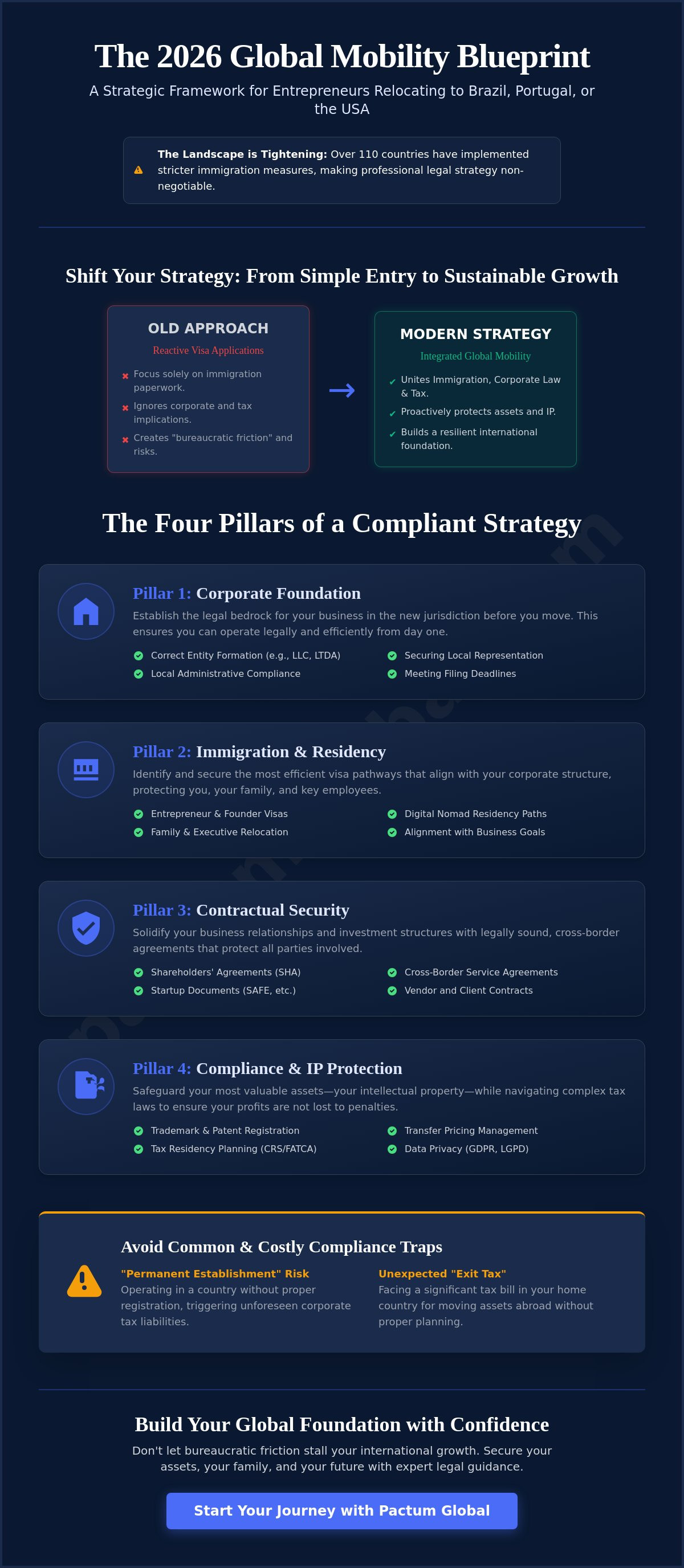
A successful transition across borders isn't a single event; it's the result of a structured framework. While an academic perspective on global HR often focuses on large-scale workforce management, founders and entrepreneurs need a more specialized approach. Comprehensive legal support for global mobility rests on four distinct pillars that ensure your business and personal life remain secure during expansion.
- Pillar 1: Corporate Foundation. This involves the legal formation of your entity and securing local representation to handle administrative requirements.
- Pillar 2: Immigration and Residency. You must identify the most efficient visa pathways for yourself, your family, and any key executives.
- Pillar 3: Contractual Security. This focuses on cross-border Shareholders' Agreements (SHA) and startup-specific documents like SAFE agreements.
- Pillar 4: Compliance and IP. Protecting your trademarks and managing transfer pricing ensures your intellectual property stays safe and your tax burden remains optimized.
Ignoring any of these pillars creates structural weaknesses. For example, a perfect visa won't save a business that hasn't properly registered its trademarks in the new jurisdiction. Building these four pillars simultaneously is the only way to avoid the bureaucratic friction that stalls most international ventures.
Establishing Your Corporate Foundation
You can't build a business in a vacuum. Before you become a legal resident in a new country, you often need a local legal representative to act on your behalf. This representative ensures your company meets local filing deadlines and remains in good standing with the authorities. Choosing the right entity is your first major decision. While a US-based LLC offers flexibility, you might find the LTDA in Brazil or the LDA in Portugal better suited for local market entry. If you're targeting the South American market, understanding how to open a company in Brazil for foreigners is a critical first step in your roadmap. Consulting with a global navigator can help you decide which structure protects your assets most effectively.
Contractual Security for International Teams
Standard contract templates are a liability when you're operating across borders. They often fail to account for the mandatory labor laws or dispute resolution requirements of a foreign jurisdiction. A robust Shareholders' Agreement (SHA) must be drafted to bridge the gap between two legal systems. For startups expanding into the US, the SAFE (Simple Agreement for Future Equity) is an essential tool for raising capital quickly. However, it's vital that these agreements are tailored to your specific international footprint. When you invest in professional legal support for global mobility, you're ensuring that your contracts are enforceable regardless of where your team is located. To complement this legal security, organizations in the care and social economy can utilize digital solutions from fokus digital GmbH to maintain operational efficiency and communication within their global workforce.
Navigating the Brazil-Portugal-USA Corridor: A Comparative View
Moving between Brazil, Portugal, and the USA creates a unique triangle of opportunity for modern founders. Each jurisdiction offers distinct advantages. Brazil serves as a massive consumer hub, Portugal acts as the strategic entry point to the European Union, and the USA remains the premier destination for scaling and raising venture capital. Managing these three regions simultaneously requires more than just local help. It requires integrated legal support for global mobility to ensure your corporate structure in one country doesn't create a tax disaster in another.
Brazil: Market Entry and Local Compliance
Entering the Brazilian market requires patience and precise documentation. The corporate landscape is notably complex. Recent updates from January 2026 have adjusted social security contributions, with rates now progressive from 7.5% to 14%. If you're a business owner, you must manage these costs alongside your market entry strategy. Protecting your intellectual property is non-negotiable here. Brazil's trademark system is distinct, and failing to secure your brand locally can lead to expensive loss of market share. Additionally, transfer pricing services are essential for companies moving capital between Brazilian entities and foreign parents to stay compliant with local tax authorities. The recent Decree No. 12,864 has also standardized the short-stay visa exemption with the EU to 90 days in any 180-day period, which impacts how often you can visit your operations from abroad.
Portugal and the USA: Strategic Relocation
Portugal has evolved its residency offerings for 2026. While the original NHR regime is closed, the new NHR 2.0 (IFICI) provides specific benefits for high-skilled professionals and entrepreneurs. The D2 visa remains a popular choice for those establishing physical operations. In contrast, the USA offers a scale-up environment but with significantly higher entry costs. As of March 1, 2026, premium processing for visas like the L-1 has risen to $2,965. This highlights why Legal and Compliance Considerations are so vital. You aren't just comparing visa types; you're comparing the total cost of operation and the speed of your expansion.
Protecting your assets across these three regions requires a unified approach. Succession documents must be valid in all jurisdictions. A well-structured plan ensures your family is protected regardless of where you are currently resident. There are also specific reciprocity benefits between Brazil and Portugal that can simplify certain legal filings, but these must be leveraged correctly to be effective. Whether you're choosing between an LLC in the US or an LDA in Portugal, your legal support for global mobility must account for how these entities interact across borders.
Common Compliance Traps in International Relocation
The most dangerous mistakes in international expansion are the ones you don't see coming until you've already moved. Relying on generic advice instead of specialized legal support for global mobility often leads to expensive "Exit Tax" surprises. When you leave your home jurisdiction, some governments treat your unrealized gains as if you sold all your assets on the day you departed. Without a proactive strategy, this can create a massive tax bill before you've even earned your first dollar in a new market.
Another silent risk is "Permanent Establishment." If you move to Portugal but continue managing your US or Brazilian company from your new home, local authorities might claim your foreign company owes taxes locally. This happens because the "mind and management" of the business has shifted. IP fragmentation is equally lethal. Failing to register your trademarks in each target market early can kill your expansion, as a competitor could legally hijack your brand name before you arrive. Finally, succession planning gaps are often ignored. If your assets are spread across three countries, you need Succession Documents that are valid in every jurisdiction to prevent your estate from entering years of legal limbo.
To mitigate these risks, especially when operating between the US and the European Union, partnering with a specialized firm like CiDATax SRL ensures that your tax and regulatory obligations are met with precision.
The Hidden Risks of Template Contracts
Many founders try to save costs by using "standard" Shareholders' Agreements (SHA). This is a mistake. Standard templates don't account for the enforceability issues that arise when partners live in different countries. If a dispute occurs, which court has jurisdiction? As of 2026, international law requires specific clauses for remote governance to verify that corporate decisions are legally tied to the intended jurisdiction. You need contracts that act as a shield, not just a formality. For those scaling into North America, using a properly drafted SAFE agreement for startups ensures your equity remains protected during future funding rounds.
Transfer Pricing and Global Tax Compliance
Transfer pricing isn't just for multinational giants anymore. If your Brazilian company provides services to your US entity, the price you charge must reflect market rates. Entrepreneurs must use inter-company service agreements to document these transactions clearly. If you don't, you're inviting a tax audit that could span multiple countries. Professional consultancy helps demystify these rules, ensuring your legal support for global mobility includes a robust tax defense. We recommend reviewing your transfer pricing strategy before finalizing your relocation to ensure every cross-border payment is fully compliant.
Building Your Global Foundation with Pactum Global
Pactum Global serves as your seasoned navigator in an increasingly complex world. We understand that international expansion is more than a logistical challenge; it is a strategic maneuver that requires precision and foresight. By providing comprehensive legal support for global mobility, we act as a shield against the bureaucratic errors that often derail even the most promising ventures. Our approach is designed to replace the typical stress of relocation with a sense of calm confidence and security. We believe that your focus should remain on your business while we handle the intricate legal hurdles that come with crossing borders.
Our "one-stop" model eliminates the need for multiple, disconnected advisors. We integrate company setup in Brazil, Portugal, or the USA with streamlined immigration processes and robust intellectual property protection. This holistic view ensures that your corporate foundation is strong enough to support your residency goals from day one. Whether you are managing transfer pricing services or drafting complex service agreements, our team provides the specialized local knowledge required for success in these specific jurisdictions. We don't just provide a service; we provide a foundation for your future.
A Methodical Approach to Global Success
We follow a logical, step-by-step process to secure your international future. Our work begins with initial corporate structuring to ensure total compliance with local regulations in your target country. Next, we manage the immigration pathways for founders and their families, ensuring every document is filed correctly and on time. Finally, we secure your long-term assets through succession planning and trademark registration. Our philosophy is simple: we remove the complexity so you can focus on growth. You shouldn't have to spend your time decoding foreign tax codes when you could be closing deals. Plan your international transition with Pactum Global to start your journey with a clear, expert roadmap.
Why Legal Authority Matters
Expertise in high-level documentation is what separates a successful move from a costly mistake. We specialize in drafting Shareholders' Contracts (SHA) and Startup Contracts (SAFE) that are specifically designed to be enforceable across multiple jurisdictions. This proactive guidance means we've already mapped out the journey and identified potential hurdles before you ever encounter them. Our authority in corporate law and global migration allows us to act as a protective partner, deeply invested in your long-term success. We don't just react to problems; we build the legal frameworks that prevent them from occurring. This is the Pactum Global promise: a steady, reliable partnership that demystifies global business hurdles and provides a secure path for the modern international entrepreneur. With the right legal support for global mobility, your expansion becomes a predictable, structured process rather than a gamble.
Building a Resilient Path for Global Expansion
Navigating the complexities of international relocation requires a shift from reactive filing to proactive strategy. Success depends on balancing corporate structure, residency, and intellectual property protection from day one. By addressing these factors before you move, you eliminate the bureaucratic friction that stalls growth and threatens your assets. Professional legal support for global mobility ensures that your business remains compliant across the Brazil, Portugal, and USA corridors while you focus on scaling.
Expertise in integrated corporate and immigration law is no longer optional for the modern entrepreneur. Whether you need specialized help with cross-border Shareholders' Agreements or startup-specific SAFE contracts, the right navigator makes all the difference. We've already mapped out the journey so you can transition with total security and peace of mind. Secure your global future with Pactum Global's expert consultancy and move forward with calm confidence. Your international journey is ready to begin, and we're here to ensure it's a success.
Frequently Asked Questions
What is the difference between global mobility and standard immigration services?
Global mobility is a comprehensive strategy that integrates immigration, tax compliance, and corporate law, whereas standard immigration services focus only on the visa application. Effective legal support for global mobility ensures your business structure doesn't conflict with your personal residency status. This holistic approach prevents tax penalties and corporate friction that often arise when these areas are handled in isolation.
Do I need to set up a company before applying for an entrepreneur visa?
Most entrepreneur visas require you to have either a registered company or a finalized business plan before you apply. In jurisdictions like Brazil, you must establish local legal representation and a corporate entity to qualify for a business investor visa. Setting up your foundation first demonstrates a genuine commitment to the local economy and streamlines the residency approval process.
Why is a Shareholders' Agreement (SHA) critical for international startups?
A Shareholders' Agreement (SHA) is critical because it establishes clear governance and dispute resolution rules for partners living in different countries. Without one, you risk being governed by local laws that might not favor your original intent. A well-drafted SHA acts as a shield, protecting your equity and defining how decisions are made across international borders.
Can Pactum Global help with IP and trademark protection in Brazil?
Yes, Pactum Global specializes in securing intellectual property and trademarks within the Brazilian market. Brazil follows a "first-to-file" system, meaning your brand isn't protected until it's officially registered with the local authorities. We manage this process to ensure your brand identity remains secure as you expand your operations into South America.
How long does it typically take to move a business from Brazil to the USA?
Moving a business from Brazil to the USA typically takes between six and eight months, depending on the visa category and processing method. For example, standard L-1 visa processing in 2026 takes approximately 6 to 6.5 months, though premium processing can reduce the USCIS action time to 15 business days. You should also account for consular processing, which can add several weeks to the timeline.
What are the common legal mistakes founders make when moving to Portugal?
Founders moving to Portugal often fail to realize that the original Non-Habitual Resident (NHR) tax regime is closed to new applicants. Another mistake is ignoring the specific corporate requirements for the D2 entrepreneur visa, such as demonstrating the business's economic impact. Proactive legal support for global mobility helps you navigate these shifts and utilize the newer NHR 2.0 framework effectively.
Does Pactum Global provide court representation for immigration disputes?
Pactum Global does not provide litigation or court representation for immigration disputes. Our expertise is focused on proactive strategy, administrative filings, and the creation of legal foundations like company setups and contracts. We act as your guide to prevent legal conflicts before they reach a courtroom, ensuring your transition remains smooth and compliant.
What is a SAFE agreement and why is it used for international scaling?
A SAFE (Simple Agreement for Future Equity) is a concise contract used by startups to raise capital without an immediate valuation. It's a standard tool for international scaling, especially when entering the US market, because it simplifies the investment process. By using a SAFE, founders can secure funding quickly while delaying the complex legal work of equity allocation until a later date.


