

What if the contract designed to protect your company is the very thing that freezes your global operations? By 2026, the complexity of cross-border business has reached a tipping point, where a standard shareholders agreement for international startups is no longer enough to prevent jurisdictional deadlock. You likely feel the pressure of choosing between Delaware's $400 LLC tax, Portugal's digital-first mandates, or Brazil's 10% withholding tax on dividends. It's exhausting to worry about intellectual property leakage while trying to satisfy investors across three different continents.
We understand that you need security, not more bureaucracy. This guide promises to demystify these hurdles and provide a clear roadmap for robust cross-border governance. You'll learn how to protect your global assets and ensure your documentation is ready for any funding round. We'll preview the essential 2026 regulatory updates, including the shift toward alphanumeric CNPJs in Brazil and the phased corporate tax reductions in Portugal, so you can lead your venture with calm confidence and a solid legal foundation.
Key Takeaways
- Avoid the "template trap" by understanding why generic Silicon Valley contracts often prove unenforceable in the specific legal landscapes of Brazil and Portugal.
- Secure your venture's future by implementing robust intellectual property assignment clauses that protect assets regardless of where founders are physically located.
- Evaluate the strategic trade-offs between Delaware, Portugal, and Brazil when drafting a shareholders agreement for international startups to align with your long-term funding goals.
- Leverage your equity structure to support global mobility, ensuring your agreement meets the specific requirements for Portuguese D2 or Brazilian Investment Visas.
- Build an investor-ready foundation by integrating tax compliance, succession planning, and cross-border governance into one cohesive documentation workflow.
Why Standard Shareholders Agreement Templates Fail International Startups
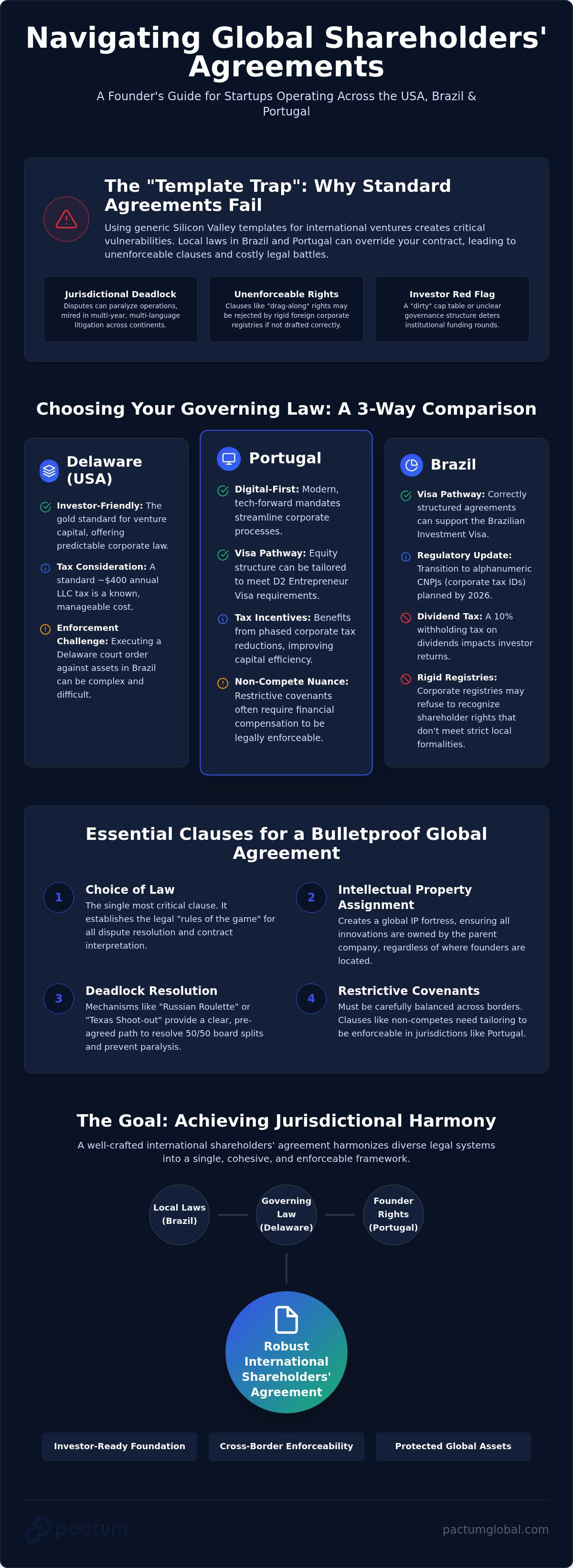
An international SHA is a private contract that harmonizes shareholder rights across multiple legal systems. It acts as the connective tissue for a global venture, ensuring that founders and investors follow the same rules regardless of their physical location. Many founders fall into the "Template Trap" by using free Silicon Valley documents that assume every party resides in the United States. While these templates work for a local Delaware entity, they often become unenforceable when applied to shareholders in Brazil or Portugal.
Jurisdictional friction occurs when local labor or corporate laws override your contract. In Brazil, for example, rigid corporate registries may refuse to recognize specific "drag-along" or "tag-along" rights if they aren't drafted to meet local formal requirements. Silence in these documents is equally dangerous. If your agreement doesn't define a clear resolution mechanism for cross-border disputes, you risk expensive, multi-year litigation in two different languages and legal systems simultaneously.
The Reality of Cross-Border Legal Conflicts
Enforceability is the ultimate test of a shareholders agreement for international startups. You might obtain a favorable court order in Delaware, but executing that order against a shareholder's assets in Brazil is a complex, often impossible task without the right contractual foundations. Many countries have mandatory public policies that limit "freedom of contract." If your SHA conflicts with Portuguese labor protections or Brazilian tax regulations, local courts will prioritize national law over your private agreement every time. Jurisdictional Harmony is the goal of an international SHA, creating a framework where the contract remains valid and enforceable across every territory the company operates in.
Managing Expectations with Global Founders
Founders in different countries face vastly different tax and residency realities. A standard four-year vesting schedule with a one-year cliff might be the industry norm, but the tax trigger for that vesting varies significantly between the US and Europe. A robust SHA ensures that these schedules are aligned to prevent "tax surprises" for the team. This document also serves as the professional foundation for future institutional funding. Investors look for "clean" cap tables and clear governance before they commit capital. Ensuring your SHA is part of a comprehensive set of legal documents for international startups demonstrates that your venture is built for global scale, not just local survival.
Essential Clauses for Cross-Border Governance and IP Protection
The "Choice of Law" clause is the most critical decision in your shareholders agreement for international startups. It establishes the legal "rules of the game" for every future conflict. If your parent company is in Delaware but your founders are in Lisbon, choosing the wrong jurisdiction can lead to a nightmare of conflicting court orders. You must select a governing law that is both investor-friendly and enforceable in the countries where your primary assets and founders are located.
Deadlock resolution mechanisms are equally vital for international boards. When a board is split 50/50 on a strategic pivot, you need a pre-defined exit path. Common tools include the "Russian Roulette" clause, where one party offers a price to buy the other out or be bought out at that same price, and the "Texas Shoot-out," which involves sealed bids to determine who takes control. These mechanisms prevent the "jurisdictional deadlock" that can paralyze a growing company for years. Structuring these complex governance terms requires a customized shareholders' contract that reflects your specific jurisdictional mix.
Restrictive covenants require careful balancing across borders. While non-compete clauses are standard in many US states, they often require mandatory financial compensation to be enforceable in European jurisdictions like Portugal. Failing to account for these local nuances can render your non-compete entirely void, leaving your company vulnerable if a founder departs to start a rival venture.
Protecting Your Global IP Fortress
IP leakage is a primary fear for global founders. If your R&D happens in Brazil but the parent company is in Delaware, your SHA must explicitly assign those rights across borders. This includes navigating "Moral Rights" in civil law countries like Portugal or Brazil, where certain creator rights are inalienable and cannot be fully waived. Aligning your contract with a comprehensive intellectual property strategy for startups ensures your assets remain secure during an exit or a future funding round.
Board Composition in a Distributed World
As of 2026, corporate administration has shifted toward a "digital-first" model. Portugal, for instance, now requires the use of tools like the Chave Móvel Digital for official acts. Your SHA should explicitly allow for virtual board meetings and electronic signatures to maintain agility. You must also consider residency requirements. If an international investor cannot legally hold a formal board seat due to local tax residency rules, your agreement should provide for "Observer Rights" to keep them engaged without triggering compliance hurdles.
Choosing Your Governing Law: Brazil, Portugal, or Delaware?
Selecting the governing law for your shareholders agreement for international startups is a strategic decision that dictates your tax burden, administrative costs, and investor appeal. Each jurisdiction offers distinct advantages, but they also bring specific 2026 regulatory changes that can catch unprepared founders off guard. Choosing the wrong path can lead to a compliance nightmare that hinders your ability to scale across borders.
Delaware remains the "Gold Standard" for venture capital. Investors globally are familiar with its established legal precedents and efficient Court of Chancery. However, simplicity comes with a price. As of August 1, 2026, Delaware increased the annual tax for LLCs, LPs, and GPs to $400. While this remains manageable for most, the rising costs of filing fees and Service of Process (SOP) requirements mean you must budget for a higher administrative floor than in previous years.
Brazil presents a more complex landscape governed by the Civil Code. Founders must choose between the flexible LTDA (Limited Liability) or the more rigid S.A. (Corporation) structure. Navigating this choice requires understanding Law No. 15,270/2025, which introduced a 10% withholding tax on dividends paid to non-residents starting January 1, 2026. If your SHA doesn't account for these tax triggers, you may find your global capital distribution significantly diluted. In cases where founders are split between continents and cannot agree on a "home" jurisdiction, choosing a neutral ground like the UK or Singapore for arbitration can provide a fair, third-party framework for dispute resolution.
The Delaware Flip and Its Impact on the SHA
Many international startups eventually undergo a "Delaware Flip," where a US entity becomes the parent of the original Brazilian or Portuguese company. This transition fundamentally rewrites your SHA. You must maintain local compliance for the subsidiary while adopting Delaware corporate law for the parent. This structural shift is a critical step in preparing for institutional VC investment. For a deeper look at the logistics of this move, consult our USA company setup for non-residents guide.
Portugal as a Strategic Hub for 2026
Portugal has emerged as a premier entry point to the European Union. For 2026, the standard corporate income tax rate is 19%, with a reduced 15% rate for SMEs on their first €50,000 of income. Startups qualifying under Law 21/2023 benefit even further, with a 12.5% rate on that same threshold. Your agreement must align with these benefits while following the shareholders agreement for Portuguese company standards. This alignment ensures you maximize tax efficiency through the Participation Exemption regime while maintaining flexible governance.
Managing Global Mobility and Exit Strategies in Your SHA
Your shareholders agreement for international startups is more than a governance framework; it is a critical component of your residency and relocation strategy. For founders moving between the US, Brazil, and Portugal, the equity percentages defined in the SHA often serve as the primary evidence for business visa eligibility. If your shareholding falls below specific thresholds, you may inadvertently disqualify yourself from the Portuguese D2 visa or the Brazilian Investment Visa. Your agreement must be drafted to protect your legal status while managing the company's growth.
Bad Leaver clauses take on a new dimension in a cross-border context. In a domestic startup, a "bad leaver" usually involves a breach of contract or criminal act. In an international venture, you must also account for the loss of work authorization or residency status. If a founder is forced to leave a country due to visa issues, the SHA must clearly define whether this triggers a mandatory share buyback and at what valuation. This prevents a "ghost shareholder" from sitting on your cap table while unable to contribute to operations. For a comprehensive look at these transitions, consult our guide on legal support for global mobility.
Succession planning is often overlooked until it is too late. When a founder holds shares in multiple jurisdictions, incapacity or death can trigger a bureaucratic nightmare involving different probate laws. Your SHA should include specific succession provisions that harmonize with your personal estate planning, ensuring that the company remains operational and shares are transferred according to your wishes without freezing the cap table. You can secure your global mobility and succession strategy by working with experts who understand both corporate and immigration law.
The Intersection of Corporate Law and Immigration
Most business visas require "Active Management" of the local entity. Your SHA must reflect this by granting the founder-shareholder sufficient voting rights and management authority to satisfy immigration officers. Coordinating share transfers with immigration filings is essential to avoid status gaps. If you issue new shares to an investor, you must ensure the resulting dilution doesn't push a founder below the minimum equity requirement for their specific visa category.
Structuring the Exit for Global Investors
International buyers look at your SHA before they look at your product. They want to see clean Drag-Along and Tag-Along rights that work across borders. These clauses ensure that a minority shareholder in one country cannot block a global acquisition. You must also consider tax efficiency during an exit. For example, the general withholding tax rate for non-resident entities receiving income from Portugal is 25%, though this can often be reduced by a double tax treaty. Exit Readiness is the state of having all cross-border legal and tax hurdles pre-cleared before a liquidity event occurs.
Building Your Global Foundation: The Pactum Global Approach
Pactum Global moves beyond the limitations of generic templates to provide jurisdiction-specific protection. A standard shareholders agreement for international startups often ignores the friction between different legal systems. We bridge this gap by integrating tax, legal, and immigration needs into a single, cohesive workflow. This approach ensures that your company setup in Portugal or Brazil doesn't conflict with your Delaware parent structure. We don't just provide a document; we build a resilient framework for your venture's growth.
Managing a global venture requires a strategic foundation that accounts for every operational detail. Our team provides the expertise needed to navigate complex corporate structures, such as the transition from a Brazilian LTDA to a US-based parent entity. We handle the drafting of Shareholders' Contracts (SHA) and Startup Contracts (SAFE) while simultaneously managing your intellectual property and trademarks. This integrated service model removes the stress of coordinating multiple firms across different time zones and legal traditions. It's about creating a "no-nonsense" path to expansion.
Strategic advisory is at the heart of our process. We help founders choose the right structure for long-term growth, whether that involves leveraging the participation exemption regime in Portugal or navigating the 2026 tax treaty updates between Brazil and Europe. By aligning your corporate governance with your global mobility goals, we ensure that your equity structure supports your right to live and work in the countries where you do business. This holistic view is what differentiates a professional agreement from a basic template.
Why Founders Trust Pactum Global
Our philosophy is built on clear communication and transparent processes. We recently helped a tech team bridge the gap between their US-based lead investors and their core operations in Brazil. By aligning the SHA with both Delaware corporate standards and Brazilian civil law, we secured the funding round while protecting the founders' local residency status. You gain access to a global network of specialized lawyers and consultants who understand the intricacies of 2026 regulations. This includes everything from the new alphanumeric CNPJ system in Brazil to the digital-first administrative requirements in Portugal.
Next Steps for Your International Startup
The first step toward global security is a thorough audit of your current founder agreements. Many early-stage contracts contain hidden international risks, such as unenforceable non-compete clauses or ambiguous IP assignment terms. We help you identify these gaps before they become deal-breakers for future investors. Scheduling a consultation for cross-border corporate structuring allows you to map out your journey with confidence and precision. Secure your startup's future with a professional Shareholders' Agreement from Pactum Global.
Securing Your Global Legacy with Strategic Governance
Building a successful venture across borders requires more than just a great product. It demands a legal foundation that bridges the gap between different legal systems. You've seen why generic templates fail and how choosing the right governing law dictates your tax and administrative efficiency. A robust shareholders agreement for international startups ensures that your intellectual property remains secure and your cap table stays investor-ready as you scale. It's the difference between a venture that struggles with local bureaucracy and one that thrives globally.
Pactum Global provides the specialized expertise needed to handle these complexities. We offer end-to-end support for both corporate and immigration needs, ensuring your equity structure supports your global mobility goals. Our team excels in cross-border SAFE and SHA drafting across Brazil, Portugal, and US jurisdictions. Don't let bureaucratic friction slow your expansion. Book a Consultation for Your International Shareholders Agreement today. It's time to lead your venture with the calm confidence that comes from professional protection. Your global journey is just beginning, and we're here to guide every step.
Frequently Asked Questions
What is the difference between a Founders Agreement and a Shareholders Agreement for international startups?
A Founders Agreement is an informal, early-stage document used before incorporation to outline equity splits and initial roles. In contrast, a shareholders agreement for international startups is a formal, legally binding contract executed after the company is formed. It governs the relationship between all shareholders, including investors, and provides enforceable protections that a simple founders memo cannot offer in a cross-border dispute.
Can we have one Shareholders Agreement that covers multiple countries?
You can have a single master agreement, but it must be jurisdiction-aware to be effective across different legal systems. While one document sets global governance standards, it needs specific clauses to address mandatory local laws in places like Brazil or Portugal. This approach ensures that your central governance doesn't conflict with the rigid corporate registries or labor protections of the countries where your founders reside.
Which country's law is best for an international startup's Shareholders Agreement?
Delaware is often considered the gold standard due to its established legal precedents and investor familiarity. However, the best choice depends on your specific operational footprint. If most of your activity is in the EU, Portugal offers a strategic entry point with competitive tax rates. You must weigh the $400 Delaware annual tax against the compliance requirements of civil law jurisdictions like Brazil.
How do vesting schedules work for founders living in different countries?
The vesting schedule typically follows a four-year term with a one-year cliff, but the tax implications vary by residency. In the US, a Section 83(b) election is common, while Portuguese or Brazilian founders face different triggers upon share issuance or vesting. Your SHA should align these timelines to ensure no founder faces an unexpected tax bill before they have the liquidity to pay it.
What happens to the Shareholders Agreement if a founder moves to another country?
A founder moving countries often changes their tax residency, which can impact dividend distributions and withholding taxes. Your SHA should include provisions for Bad Leaver events if a founder loses their legal right to work in the company's primary jurisdiction. You may need to amend the agreement to ensure the company remains compliant with the new country's reporting and corporate governance requirements.
Is a SAFE agreement enough, or do I need a full Shareholders Agreement immediately?
A SAFE is a simple instrument for early-stage fundraising, but it doesn't provide the governance framework found in a shareholders agreement for international startups. While a SAFE is enough to secure initial capital, you need an SHA to define voting rights, board composition, and IP protection. Most institutional investors will require a robust SHA before they commit to a significant funding round.
How can an SHA help me get a business visa in Portugal or Brazil?
Your SHA serves as primary evidence of your active management and equity stake, both of which are required for the Portuguese D2 or Brazilian Investment Visas. Immigration officers review these contracts to verify that you have the authority and financial interest to justify your residency. Ensuring your SHA meets these specific immigration thresholds is a critical step in your global relocation strategy.
How much does it cost to draft a cross-border Shareholders Agreement in 2026?
The cost of drafting a cross-border agreement depends on the complexity of your jurisdictional mix and the number of shareholders involved. Factors like the 2026 Delaware fee increases and the new alphanumeric CNPJ system in Brazil add layers of administrative work. Founders should consider the long-term value of professional drafting to avoid the high costs associated with jurisdictional deadlock or intellectual property leakage.


