

Spain's Digital Nomad Visa is a corporate gateway, not a travel permit. It requires a robust legal architecture to ensure your long-term success. While many see the move as a lifestyle choice, seasoned professionals understand it's a complex jurisdictional shift. For digital nomads spain represents a unique opportunity to integrate into the European market, provided you can navigate the 2026 income requirements of €2,850 per month and the intricacies of the Beckham Law.
You likely feel the weight of potential bureaucratic hurdles and the fear of tax double-exposure. It's a valid concern when your residency and corporate compliance are on the line. This guide promises to clarify those complexities. You'll learn how to master the legal requirements and strategic advantages of Spain's residency programs for a seamless international transition.
We will compare Spain's offerings with Portugal's updated IFICI regime, where income requirements now sit at €3,680. You'll discover how to protect your assets, ensure your remote work contracts are compliant, and build a corporate structure that supports your global growth. From initial filing to long-term asset protection, we've mapped out the journey so you can focus on your business.
Key Takeaways
- Identify the 2026 eligibility criteria for digital nomads spain, including the €2,850 monthly income threshold and essential remote work documentation.
- Navigate the technical application phases, from securing an NIE to managing the specific criminal record certificate requirements for 2026.
- Compare Spain’s Beckham Law with Portugal’s updated IFICI tax regime to select the most efficient jurisdiction for your corporate profile.
- Establish a robust legal architecture using service agreements and Shareholders' Agreements to protect your assets during a cross-border transition.
- Learn how a strategic global mobility framework aligns your residency goals with compliant international corporate structures and IP protection.
Understanding the Spanish Digital Nomad Visa in 2026
The Spanish Digital Nomad Visa (DNV) is a specialized residency path for non-European professionals. It allows you to live in Spain while working for entities located outside the national territory. For those pursuing a Digital Nomad Lifestyle, this visa provides legal security and a path to permanent residency. For digital nomads spain offers a unique blend of lifestyle and legal benefits. The core requirement is clear: your income must come from non-Spanish sources via telecommunications.
In 2026, the DNV has evolved to favor entrepreneurs and tech founders. While traditional employees qualify, the Spanish government has streamlined the process for those who own their businesses. If you're a freelancer or business owner, you can earn up to 20% of your total income from Spanish companies. This flexibility allows you to build local networks and grow your business without losing your visa status.
Who Qualifies? The Three Pillars of Eligibility
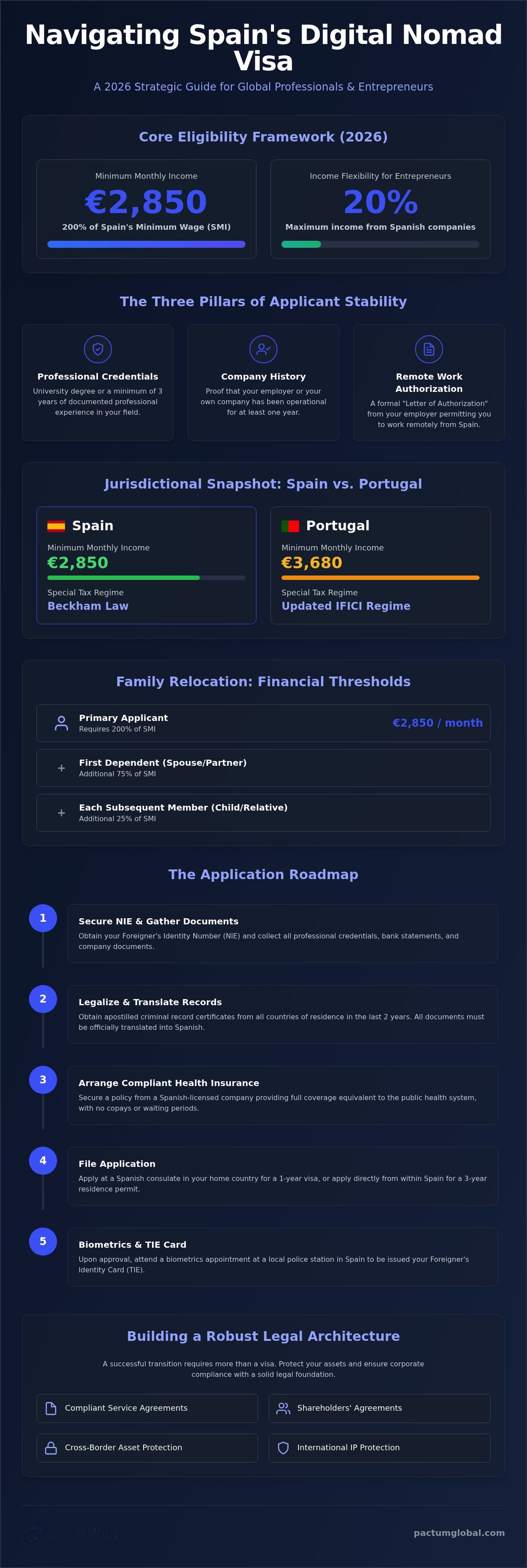
Spanish consulates look for three specific markers of stability. First, you need professional credentials. This means a university degree or at least three years of documented experience in your specific field. Second, your employer or own company must have a history. You'll need to prove the entity has existed for at least one year. Third, you must provide a "Letter of Authorization." This document confirms your employer allows you to work remotely from Spain. For digital nomads spain represents a structured environment, and these requirements ensure only established professionals enter the system.
Family and Dependents: Expanding Your Global Mobility
Relocating doesn't mean leaving family behind. The legal framework allows you to include spouses or unmarried partners in a single application. You can also include dependent children and even elderly relatives if you can prove they rely on you financially. Each family member increases the financial threshold you must meet. In 2026, the primary applicant needs to show at least 200% of the Spanish Minimum Wage (SMI), which is approximately €2,850 per month. The first dependent adds 75% of the SMI to this requirement, and each subsequent member adds 25%. This tiered approach ensures your family has the resources to thrive in their new home.
Technical Requirements and the Application Process
The application for digital nomads spain starts with the NIE (Número de Identidad de Extranjero). This number is your primary legal identifier. You'll need it to sign contracts, open bank accounts, or register for utilities. While you can obtain it separately, most applicants process it alongside their visa to save time. This foundational step ensures you can operate within the Spanish system from day one.
Criminal record certificates require careful attention in 2026. You must provide a certificate from every country where you resided during the last two years. You'll also need to provide a sworn statement that you have no record for the five years prior to that. Every document must be legalized via the Hague Apostille and translated by an official Spanish translator. Missing even one jurisdiction can lead to a formal request for more information, delaying your move.
Health insurance standards are strict. Travel insurance or basic international plans are usually rejected because they lack the necessary depth of coverage. Your policy must be from a company licensed in Spain and provide coverage equal to the public health system. This means the policy must have no copays and no waiting periods for treatments. It's a protective measure to ensure you don't become a burden on the state system.
Financial stability is measured against the 2026 Minimum Interprofessional Salary (SMI). You must demonstrate a monthly income of at least €2,850, which equals 200% of the SMI. Reviewing the Official Spanish Digital Nomad Visa Requirements helps confirm which specific bank documents the government accepts as proof of these funds.
The Step-by-Step Filing Roadmap
- Step 1: Document Gathering. Collect your professional credentials, bank statements, and apostilled records.
- Step 2: Filing. You can apply at a consulate for a one-year visa or apply from within Spain for a three-year permit.
- Step 3: Biometrics. Visit the local police station for fingerprinting once you receive your approval notification.
The TIE (Tarjeta de Identidad de Extranjero) is the physical card that serves as official proof of your residency status.
Common Pitfalls in the Application Phase
A frequent error involves social security coverage. Self-employed applicants must prove their home country has a reciprocal agreement with Spain. Without this, you must register for Spanish social security and pay monthly contributions. Additionally, your service agreement must explicitly state that your work can be performed remotely and has been authorized by your client or employer.
If you're applying based on education, your degree must be from a recognized university or business school. If you find the documentation phase stressful, securing professional immigration filing support can help you avoid these common bureaucratic mistakes and protect your relocation timeline.
Spain vs. Portugal: Choosing the Right European Hub
Spain and Portugal present two distinct paths for remote professionals. For digital nomads spain currently serves as a more accessible entry point due to its faster processing times and lower income thresholds. In 2026, the Spanish minimum requirement is €2,850 per month. This is significantly lower than the Portugal D7 visa requirements and D8 nomad visa, which demand €3,680. This monthly difference of over €800 makes Spain a more practical choice for many independent founders.
Taxation structures also diverge. Spain’s Beckham Law provides a 24% flat tax rate on Spanish-sourced income for six years, while foreign income remains largely exempt. Portugal’s new IFICI regime offers a lower 20% rate but limits it to specific highly skilled roles. If your corporate structure involves a US-based LLC or a Brazilian entity, Spain’s broader exemptions for foreign-sourced dividends and capital gains often offer superior asset protection.
When to Choose Spain for Your Business
Spain is the ideal hub for founders who want to benefit from the 2025 Startup Law. This law provides unique corporate tax breaks and simplified hiring processes for tech-driven companies. Accessing the European market from a Spanish base is efficient, and the country serves as a primary gateway for businesses with Brazilian interests. For digital nomads spain offers a residency timeline that moves from a one-year visa to a three-year permit, with permanent residency reachable after five years.
When Portugal Might Be the Better Fit
Portugal remains a strong contender for those who intend to be physically active in the local business ecosystem. The Portugal D2 visa is specifically tailored for entrepreneurs establishing new operations or branches. Beyond residency, the strategic benefits of setting up a holding company in Portugal are substantial for long-term wealth management. While the application processing time in Portugal is longer, typically 2 to 4 months compared to Spain’s 15 to 45 days, the lower overall cost of living can be an attractive trade-off.
Legal Foundations for the Global Nomad Entrepreneur
Moving to Spain involves more than personal relocation; it requires a complete audit of your corporate architecture. For digital nomads spain serves as a base of operations that must be supported by a precise set of legal documents for international startups. If you own a business, your residency permit is inextricably linked to your corporate status. Consular officers look for service agreements that aren't just informal letters but legally binding contracts that prove your professional autonomy.
Shareholders’ Agreements (SHA) become critical during this transition. When founders move across borders, the governing law of their existing contracts may conflict with Spanish regulations. An SHA ensures that your voting rights, dividend distributions, and dispute resolution mechanisms remain enforceable regardless of your physical location. It acts as a protective shield for your equity as you navigate new tax jurisdictions. Without these foundations, you risk administrative delays that could jeopardize your residency status.
Structuring for Global Investment
The Digital Nomad Visa can influence your startup's ability to raise capital. Investors often scrutinize the residency status of founders before signing SAFE agreements. You must ensure your governance structure accounts for a "nomad-led" approach, especially when managing teams across multiple time zones. A shareholders agreement for a Portuguese company or Spanish entity is vital for founders because it defines decision-making power and exit strategies in a cross-border environment. This clarity prevents operational paralysis if your residency status changes or if you decide to expand into other EU markets.
IP and Trademark Strategy
Protecting your intellectual property is a priority that should precede your arrival. Jurisdictional drift occurs when a brand operates in a new region without local trademark protection, leaving your assets vulnerable to infringement. We recommend filing for EU-wide trademark protection through the EUIPO as part of your relocation strategy. This ensures your brand identity is secure from the moment you begin your residency. Additionally, you should consider succession planning. As a Spanish resident, your foreign assets may be subject to local inheritance laws. Drafting clear succession documents ensures your global portfolio remains protected and your intent is legally recognized.
If you need to align your corporate structure with your new residency status, securing specialized legal documentation services is a critical step toward long-term security.
Strategic Global Mobility with Pactum Global
Managing an international move involves more than just a visa stamp. For digital nomads spain represents the first step in a long-term European strategy. Pactum Global acts as your seasoned navigator, managing the end-to-end relocation process for entrepreneurs who demand high-level legal authority. We replace the confusion of international bureaucracy with a sense of calm security. Our approach integrates your immigration filing with a robust legal support for global mobility framework.
Having a single point of contact for Brazil, Portugal, and USA compliance is a significant strategic advantage. You won't need to coordinate between multiple detached law firms across different time zones. We provide proactive guidance to reduce bureaucratic friction at every stage. This includes managing your company setup in the USA or Brazil while you establish yourself in Europe. We handle the technical details of transfer pricing services and service agreements so you can focus on your business growth.
Transitioning to Permanent Residency
The journey moves in logical stages. Your initial one-year visa typically leads to a three-year residency permit. During these years, maintaining corporate compliance is essential for your renewal. You'll need to keep your Shareholders' Contracts (SHA) updated and ensure your tax filings align with your residency status. After five years of legal residence, you can apply for permanent residency. This path eventually opens the door to EU citizenship and a Spanish passport, securing your mobility and asset protection for the future.
Your Next Steps: The Consultation Process
Our process is methodical and thorough. We begin with a comprehensive assessment of your corporate and personal eligibility. Every founder's situation is different, so we create customized document checklists tailored to your specific jurisdiction. This proactive approach prevents the errors that often delay consular approvals. We act as a protective shield against bureaucratic mistakes. Partnering with Pactum Global ensures that digital nomads spain can build a lasting legacy with full legal protection and a compliant international corporate structure.
Building Your International Legacy
Success for digital nomads spain depends on a proactive approach to both residency and corporate law. You now understand that securing a permit is only the first step. True security comes from aligning your move with a robust legal framework, including compliant service agreements and protected intellectual property. Whether you choose the flat tax benefits of Spain's Beckham Law or the entrepreneurial focus of Portugal's D2 visa, your decision must support your long-term business goals.
Pactum Global acts as your shield against bureaucratic error. We're specialized in the specific legal landscapes of Brazil, Portugal, and the USA. Our team provides comprehensive support for international company formation and expert legal drafting for global founders. We handle the complexity so you can focus on scaling your business in a new jurisdiction. Secure your global transition with Pactum Global’s expert mobility services.
Your international transition is a strategic move toward greater freedom and professional growth. With a seasoned navigator by your side, you can move forward with total confidence in your legal and financial security.
Frequently Asked Questions
How much income do I need for the Spain Digital Nomad Visa in 2026?
You need a minimum monthly income of at least €2,850. This amount represents 200% of Spain's Minimum Interprofessional Salary (SMI) for 2026. If you're bringing family, the requirement increases by 75% of the SMI for the first dependent and 25% for each additional member. You must provide bank statements or contracts to prove this income is stable and originates from entities outside of Spain.
Can I work for a Spanish company while on a Digital Nomad Visa?
Yes, you can earn up to 20% of your total income from Spanish entities. The primary purpose of the visa is remote work for foreign companies, but this allowance supports local networking for self-employed professionals. If you exceed this 20% limit, you may need to transition to a standard local work permit. This flexibility is a key advantage for digital nomads spain who wish to explore the local market.
Is the Spanish Digital Nomad Visa a path to citizenship?
The visa provides a direct path to permanent residency and eventual citizenship. You typically start with a one-year visa or a three-year residency permit, which you can renew until you reach the five-year mark for permanent status. After ten years of legal residence, you can apply for Spanish citizenship. For citizens of Ibero-American countries, Brazil, or the Philippines, this timeline is reduced to only two years.
Do I need to pay taxes in both my home country and Spain?
Spain’s tax treaties generally prevent double taxation, but your specific liability depends on your tax residency status. Under the Beckham Law, qualifying nomads pay a flat 24% tax on Spanish-sourced income while foreign-sourced income is often exempt. You should review your home country's specific treaty with Spain to ensure full compliance. Establishing a proper corporate structure helps protect your assets from unnecessary exposure during your relocation.
What is the difference between a visa and a residency permit in Spain?
A visa is an entry document issued by a consulate, while a residency permit is a legal status granted to those already in Spain. Consular visas for digital nomads are valid for one year. If you apply from within Spain on a tourist stay, you receive a three-year residency permit immediately. Both paths allow you to obtain the TIE card, which serves as your physical proof of legal residence in the country.
Can I apply for the Spanish Digital Nomad Visa while on a tourist visa?
You can apply directly from within Spain while on a legal tourist stay. This "in-country" application is often preferred because it grants a three-year residency permit instead of the one-year consular visa. You must submit your application electronically before your tourist stay expires. This route is particularly efficient for digital nomads spain who want to secure a longer initial stay without the need for multiple filings or consular visits.
Does the Spanish DNV allow me to travel freely within the Schengen Area?
Your residency permit allows you to travel freely through the Schengen Area for up to 90 days within any 180-day period. This mobility is one of the primary strategic advantages of the Spanish DNV. However, you must maintain your primary residence in Spain for at least six months per year to remain eligible for permit renewals. It's a perfect balance for professionals who value both stability and European exploration during their residency.
What happens if my remote work contract ends while I am in Spain?
You must notify the immigration authorities if your professional situation changes significantly. Since the visa is based on your status as a remote worker, losing your primary source of income can impact your eligibility for renewal. However, you can often maintain your status if you secure a new contract that meets the income requirements. Proactive legal guidance ensures you have a contingency plan to protect your residency and assets during career transitions.


