

With over $37.9 billion in Brazilian investment already flowing into the United States, the question isn't whether you should expand, but whether your corporate structure will survive the transition. You've worked hard to scale in Brazil, and the US market represents the ultimate frontier for global growth and venture capital. Setting up a US subsidiary for a Brazilian company doesn't have to be a bureaucratic nightmare that leads to double taxation or frozen bank accounts.
It's natural to feel overwhelmed by the choice between an LLC and a C-Corp, or to worry about the 10% withholding tax on dividends introduced by Law 15,270/2025. We're here to help you handle these complexities with expert precision. This 2026 strategic roadmap provides a clear path to ensure your expansion is both tax-efficient and legally sound. We'll break down the "flip" structure, explain how to manage transfer pricing under the latest OECD-aligned rules, and show you how to build a financial foundation that American investors will trust. By the end of this guide, you'll have the clarity needed to bridge the gap between Sao Paulo and Silicon Valley.
Key Takeaways
- Learn why a US entity serves as the essential bridge for Brazilian founders to access American venture capital and scale globally.
- Discover the strategic differences between LLCs and C-Corps to avoid the specific taxation pitfalls inherent in setting up a US subsidiary for a Brazilian company.
- Navigate the 2026 Brazil-US tax landscape with confidence, including the latest dividend withholding rules and OECD-aligned transfer pricing regulations.
- Follow a methodical 5-step roadmap to secure your incorporation and obtain your EIN without common bureaucratic delays.
- Protect your international interests with bespoke Shareholders' Agreements and SAFE contracts designed to reconcile Brazilian and US legal frameworks.
Why Establish a US Subsidiary for Your Brazilian Business?
Expanding into the American market is a strategic pivot that moves your business from local success to global dominance. While Brazil offers a massive consumer base, the US provides a stable currency environment and the world's deepest capital markets. Setting up a US subsidiary for a Brazilian company allows you to bypass the limitations of the local market, such as high interest rates and currency volatility, which often hinder rapid scaling.
There are four primary drivers for this expansion:
- Capital Access: Most US venture capital firms and angel investors won't consider a pitch unless the company has a US legal structure. They want the familiarity and protection of US corporate law.
- Liability Protection: A subsidiary acts as a firewall. It separates your Brazilian assets and the "Limitada" structure from US-based legal risks.
- Global Credibility: Operating as a US entity builds immediate trust with international customers. It signals that you're committed to global standards and facilitates easier contracting.
- Operational Efficiency: US-based entities have seamless access to payment processors like Stripe and traditional banking services that are often difficult to secure from abroad.
Subsidiary vs. Branch: The Strategic Choice
Choosing between a branch and a subsidiary is a choice between exposure and protection. A branch is essentially an extension of your Brazilian company. This means the Brazilian parent company remains legally responsible for all US liabilities. For founders, understanding what a foreign corporation is in the U.S. is the first step in realizing that a subsidiary is almost always the better choice. A subsidiary is a separate legal entity. It owns its own assets and carries its own debts, ensuring that a dispute in Miami doesn't drain your bank accounts in São Paulo. US partners and clients also prefer subsidiaries because they offer a clearer tax and legal framework for domestic transactions.
The 'Flip' Structure for Brazilian Startups
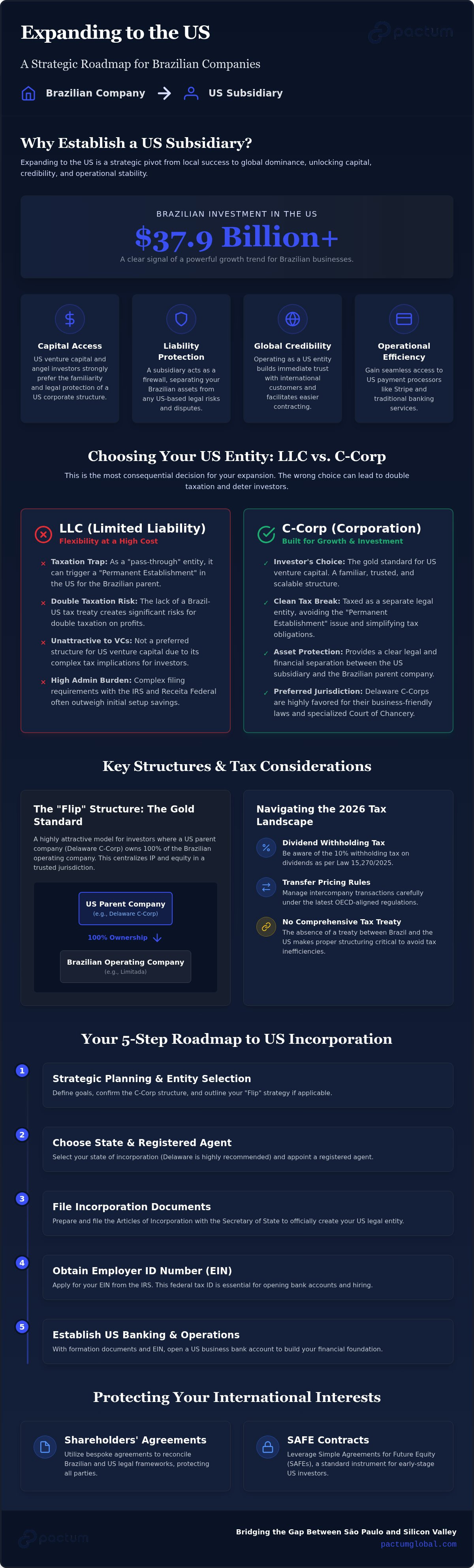
The "Flip" is the gold standard for high-growth Brazilian startups seeking international investment. In this model, you create a US parent company, often a Delaware C-Corp, which then owns 100% of the Brazilian operating company. This structure is highly attractive to investors because it centralizes intellectual property and equity in a jurisdiction they trust. When you're preparing for a USA company setup for non-residents, the Flip allows you to maintain your operations in Brazil while positioning your equity for a global exit or IPO. It's a sophisticated way of setting up a US subsidiary for a Brazilian company that prioritizes long-term growth and capital efficiency.
Choosing the Right Entity: LLC vs. C-Corp for Brazilians
Choosing the right legal structure is the most consequential decision you'll make when setting up a US subsidiary for a Brazilian company. While the LLC is often praised for its simplicity, it frequently creates a taxation trap for Brazilian residents. Delaware remains the preferred jurisdiction for international firms, attracting a significant share of recent trends in foreign direct investment due to its specialized Court of Chancery and business-friendly legal environment. Your choice of entity doesn't just affect your tax bill; it dictates your ability to raise capital and protect your parent company's assets.
The LLC: Flexibility at a Cost
An LLC is a "pass-through" entity. This means the company itself doesn't pay federal income tax. Instead, profits flow directly to the owners. For a Brazilian parent company, this can be problematic. The IRS may view the Brazilian parent as having a "Permanent Establishment" (Engajamento) in the US. This triggers complex filing requirements and potential double taxation because Brazil and the US don't have a comprehensive income tax treaty. While an LLC might work for a solo consultant or a small-scale service provider with no plans for outside capital, it's rarely the right fit for a scaling business. The administrative burden of reporting pass-through income to the Receita Federal often outweighs any initial setup savings.
The C-Corp: Built for Growth
C-Corporations are the gold standard for any Brazilian firm seeking US venture capital. Unlike LLCs, C-Corps are taxed as separate legal entities. This creates a clean break between the US subsidiary and the Brazilian parent. Although this involves corporate-level tax, currently set at a flat 21%, it simplifies the process of reinvesting profits and issuing stock options to US-based employees. If you're planning to raise funds using a shareholders agreement for cross border business, a Delaware C-Corp provides the most robust legal framework available. Investors trust the C-Corp structure because it's predictable and allows for various classes of stock. When drafting your Certificate of Incorporation, you must ensure it complies with international standards to facilitate future investment rounds.
Delaware's corporate law is predictable. This predictability is why investors insist on it. When setting up a US subsidiary for a Brazilian company, your choice of entity dictates your future tax liability and your ability to attract talent. Selecting the wrong path early on can lead to expensive "re-domestication" costs later. If you're unsure which path aligns with your five-year plan, the team at Pactum Global can help you evaluate your specific tax and investment goals.
Navigating Brazil-US Tax and Transfer Pricing
The absence of a comprehensive tax treaty between Brazil and the United States remains the most significant challenge when setting up a US subsidiary for a Brazilian company. Without a treaty, you must rely on foreign tax credits and meticulous documentation to avoid the heavy hand of double taxation. Success depends on how you structure the financial relationship between your Brazilian parent and the new US entity. Every dollar that moves across the border must be justified under two very different sets of tax laws.
Profit repatriation requires a proactive strategy. Effective January 1, 2026, Law 15,270/2025 introduced a 10% withholding tax on dividends paid from Brazil to non-residents. On the American side, the IRS typically imposes a 30% withholding tax on dividends paid to foreign parents. Navigating these percentages requires more than just basic bookkeeping. It requires a structural approach that considers the 21% US corporate tax rate and the potential for tax credits in Brazil.
Transfer Pricing Compliance
Brazil's recent alignment with OECD standards via Law 14,596/2023 has fundamentally changed the compliance landscape. You can no longer rely on the old system of fixed margins. Instead, every transaction, whether it is a service fee, royalty payment, or intercompany loan, must reflect "arm's length" pricing. This means your internal prices must match what two unrelated companies would agree upon in an open market.
Robust documentation is now mandatory to satisfy both the IRS and the Receita Federal. We provide specialized transfer pricing services to help you draft intercompany service agreements that withstand audit scrutiny. Failure to document these transactions correctly can lead to heavy penalties and disallowed expenses in Brazil, effectively increasing your global tax burden by a significant margin.
Succession and Asset Protection
Founders often overlook the impact of US estate taxes, which can reach up to 40% for non-resident assets exceeding a surprisingly low threshold. Setting up a US subsidiary for a Brazilian company should always be paired with succession planning for foreign assets. Many of our clients use holding companies to consolidate international wealth and provide a protective layer for their families. This ensures that your global expansion builds a lasting legacy rather than a future tax liability for your heirs. Proper planning today prevents the forced liquidation of US assets tomorrow.
The 5-Step Roadmap to US Incorporation
Transitioning from strategic planning to execution requires a disciplined sequence of actions. Setting up a US subsidiary for a Brazilian company follows a specific legal path that ensures your entity is recognized by both the IRS and international investors. Skipping a step or misfiling a document can lead to months of delays, particularly when dealing with federal agencies in the United States. Following a methodical roadmap is the only way to guarantee a compliant launch.
- Step 1: State Selection and Filing. As established, Delaware is the standard for venture-backed firms. Your Articles of Incorporation must be filed precisely to reflect your corporate purpose and share structure.
- Step 2: Obtaining the EIN. The Employer Identification Number is your company's tax ID. It's the equivalent of a CNPJ. Without it, you can't hire employees, pay taxes, or open a bank account.
- Step 3: Appointing a Registered Agent. You must have a physical address and a designated agent in your state of incorporation to receive official legal notices and government correspondence.
- Step 4: Opening a US Business Bank Account. This is the most complex phase for non-resident directors due to strict anti-money laundering regulations.
- Step 5: Governance Documents. Drafting Bylaws and initial Board resolutions establishes the internal rules for your new subsidiary and defines the roles of its officers.
The Banking Hurdle for Brazilian Directors
Opening a US bank account remains the primary bottleneck for Brazilian founders. While digital banking options have expanded, many traditional institutions still require a physical presence or a US-based signatory. You'll need to provide comprehensive KYC (Know Your Customer) documentation, including your Brazilian passport and proof of your company's status in Brazil. It's also vital to ensure your US accounts can seamlessly connect to Brazilian "Câmbio" systems to facilitate the legal transfer of capital between jurisdictions. We help our clients identify the right banking partners to avoid frozen funds or rejected applications.
Post-Incorporation Compliance
Formation is only the beginning. To protect your Brazilian parent company, you must maintain strict corporate "separateness." This means avoiding the commingling of funds and ensuring all intercompany transactions are documented through formal service and customer agreements. Additionally, you must meet annual obligations, such as filing reports and paying the Delaware Franchise Tax, which increased to $400 as of August 1, 2026. Failure to comply can lead to the loss of your "Good Standing" status, jeopardizing your legal protections.
Ready to begin your expansion? You can start your US incorporation process today with our expert guidance to ensure every step is handled with precision.
Pactum Global: Your Bridge to the US Market
Pactum Global acts as your steady partner throughout the entire expansion process. We don't just file papers; we build a legal bridge that respects the rigidities of Brazilian law while embracing American corporate flexibility. Our approach ensures that setting up a US subsidiary for a Brazilian company is a foundation for growth rather than a source of administrative stress. We specialize in drafting custom Shareholders' Agreements (SHA) and Startup Contracts (SAFE) that are specifically tailored to the needs of cross-border founders. These documents are essential for reconciling the interests of Brazilian owners with the expectations of US investors.
Beyond the initial setup, we provide ongoing management for transfer pricing and corporate compliance. This proactive stance acts as a shield against bureaucratic errors and ensures your subsidiary remains in good standing. We understand that international expansion is a multifaceted journey. That's why our services integrate legal, tax, and mobility support into a single, cohesive strategy. You focus on growing your business while we handle the complexities of two different legal systems.
Global Mobility and Executive Relocation
Successful expansion often requires leadership on the ground. We provide legal support for global mobility to help Brazilian founders and executives navigate the US immigration system. Whether you're pursuing an L-1 visa for intra-company transfers or exploring E-2 treaty investor options, our team manages the complex documentation required for a successful application. We also provide guidance on the tax implications of becoming a US tax resident. This is a critical step because your global income may become subject to US taxation once you meet the substantial presence test. We help you plan this transition to avoid unexpected fiscal liabilities in either jurisdiction.
Protecting Your Intellectual Property
Your brand and technology are your most valuable assets. When setting up a US subsidiary for a Brazilian company, you must ensure your intellectual property is protected in the American market from day one. We assist with registering trademarks with the USPTO and implementing a global intellectual property strategy for startups. This includes drafting licensing agreements between your US subsidiary and the Brazilian parent company. These agreements are not just for protection; they're also vital for transfer pricing compliance. By clearly defining who owns and who uses the IP, we create a transparent structure that satisfies both the IRS and the Receita Federal. Our ongoing management ensures your subsidiary remains compliant as international regulations continue to evolve.
Secure Your Global Future Today
Expanding your Brazilian business into the United States is more than a geographic move; it's a strategic evolution. We've explored how choosing the right corporate structure and mastering transfer pricing under 2026 regulations protects your parent company while attracting global capital. Setting up a US subsidiary for a Brazilian company requires a partner who understands the delicate balance between American corporate speed and Brazilian tax rigidities.
Pactum Global provides the specialized expertise you need. We offer end-to-end global mobility and immigration services alongside specialized Brazil-US transfer pricing support. Our team excels at drafting cross-border SHA and SAFE contracts that satisfy both international investors and local compliance standards. You don't have to face these bureaucratic hurdles alone.
Schedule a consultation with Pactum Global to bridge your business to the US market and take the first step toward a seamless international expansion. Your vision for growth deserves a foundation built on precision and security.
Frequently Asked Questions
Do I need a US social security number to start a US subsidiary?
No, you don't need a US Social Security Number (SSN) to incorporate. Foreign directors can obtain an Individual Taxpayer Identification Number (ITIN) to manage tax obligations. When setting up a US subsidiary for a Brazilian company, the IRS allows the entity to obtain an Employer Identification Number (EIN) using the Brazilian parent's information. This process ensures you remain compliant without requiring US residency or citizenship. It's a standard procedure for international founders.
Can a Brazilian 'Limitada' own 100% of a US LLC or C-Corp?
Yes, a Brazilian 'Limitada' can hold 100% ownership of either a US LLC or a C-Corp. US corporate law is highly flexible regarding foreign ownership. This structure is the foundation of the "Flip" model, where the Brazilian entity becomes a subsidiary of a US parent or vice-versa. Maintaining this clear ownership line is essential for protecting assets and ensuring a clean legal separation between your Brazilian and American operations.
How long does it take to set up a US company from Brazil in 2026?
You can typically complete the incorporation and obtain an EIN within two to four weeks. While state filing in Delaware is fast, the IRS processing times for EINs for foreign owners can vary. The most time-consuming phase is usually opening a bank account and setting up payment processors. We recommend starting the process at least sixty days before you intend to begin active operations to account for these administrative variables.
Is there a double taxation treaty between Brazil and the United States?
There is currently no comprehensive income tax treaty between Brazil and the United States. This means you won't benefit from reduced withholding tax rates typically found in such agreements. Instead, you must utilize foreign tax credits to mitigate double taxation. Meticulous documentation of all cross-border payments is required to ensure the Receita Federal recognizes taxes paid to the IRS. Professional guidance is vital to navigate this specific complexity.
Which US state is best for a Brazilian tech company?
Delaware is the superior choice for tech companies due to its advanced corporate law and the Court of Chancery. Most venture capital investors require a Delaware C-Corp before they will commit funds. While Florida is popular for its proximity and large Brazilian community, it lacks the legal prestige and predictability that Delaware offers. If your goal is to raise US investment, Delaware provides the most secure and scalable legal environment.
Do I need to travel to the US to open a business bank account?
You don't always need to travel, but it depends on the banking partner. Many traditional US banks require a physical meeting with a company director to satisfy KYC regulations. However, specialized digital banks for startups often allow for fully remote account opening. When setting up a US subsidiary for a Brazilian company, we help you evaluate which banking path fits your travel schedule and operational needs to avoid unnecessary trips.
What is the difference between a SAFE and a traditional Shareholders' Agreement?
A SAFE (Simple Agreement for Future Equity) is a short document used to raise early-stage capital without setting a valuation. It converts to equity during a future funding round. A Shareholders' Agreement (SHA) is a much more complex document that defines the long-term governance, voting rights, and exit strategies for all owners. While a SAFE gets you the cash, the SHA provides the structural rules that keep the company running smoothly.
How does transfer pricing affect my Brazilian tax filings?
Transfer pricing dictates how you price goods and services sold between your Brazilian and US entities. Under Law 14,596/2023, these prices must reflect the "arm's length" principle. If your prices are too high or too low, the Receita Federal may adjust your taxable income and impose significant penalties. Proper documentation ensures that your intercompany contracts are defensible during an audit, protecting your Brazilian company's bottom line from unexpected tax adjustments.


