

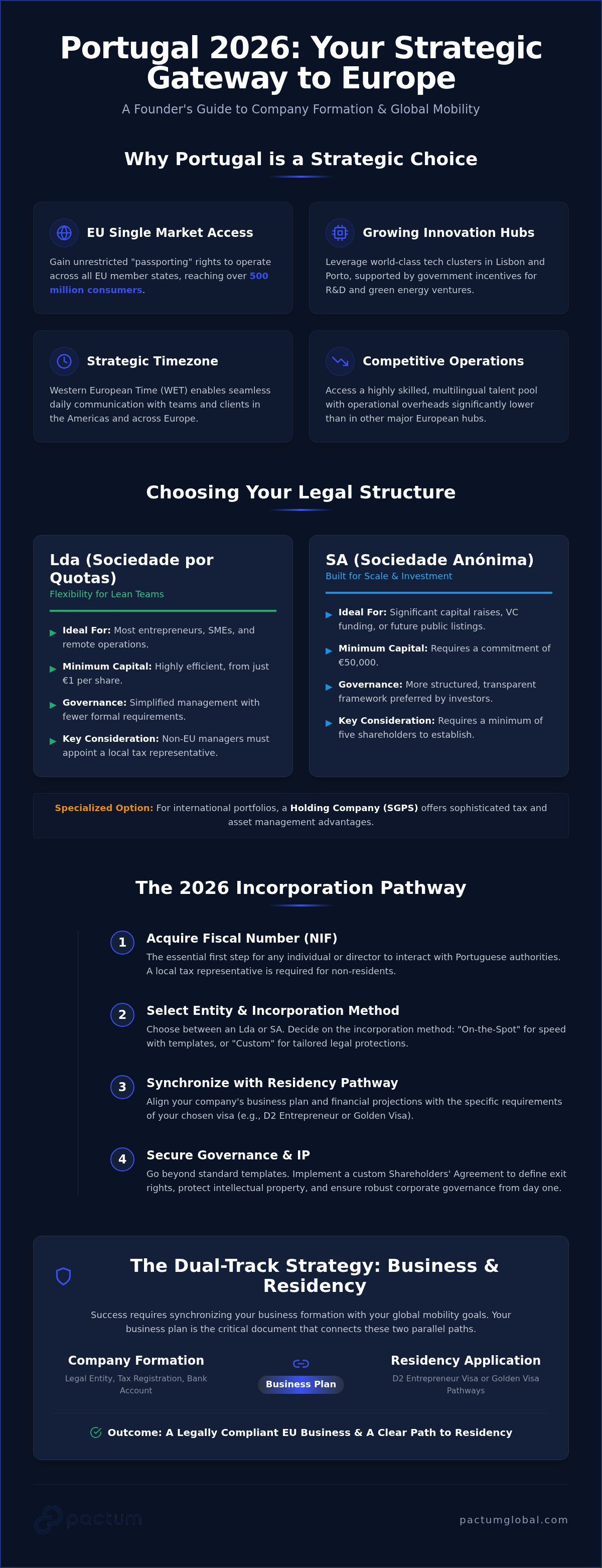
What if your entry into the European market wasn't just a legal requirement, but a strategic move for your global legacy? Starting a business in Portugal in 2026 offers a powerful gateway to the EU, yet many founders find themselves trapped in a maze of NIF applications and social security bureaucracy. It's exhausting to manage complex entity types while trying to align your company registration with strict visa timelines.
We agree that your focus should be on growth, not administrative friction. This guide will help you master the dual-track process of Portuguese company formation and global mobility to secure your future. You'll learn how to establish a legally compliant entity that paves a clear path toward a D2 or Golden Visa. We'll preview how to navigate the 15% SME tax rate and ensure your governance is robust from day one. By the end of this guide, you'll have the calm confidence of a founder who has already mapped out the journey to success.
Key Takeaways
- Understand why a dual-track strategy is essential for aligning your Portuguese company formation with long-term global mobility goals.
- Identify the most suitable legal structure for your venture by comparing the flexibility of an Lda with the investment-ready framework of an SA.
- Master the 2026 administrative steps for starting a business in Portugal, including NIF acquisition and the choice between "on-the-spot" or custom incorporation.
- Learn how to synchronize your business plan with residency pathways like the D2 Entrepreneur Visa or the Golden Visa.
- Secure your corporate governance and intellectual property using custom legal protections that go beyond standard government templates.
Why Portugal is the Strategic Gateway to Europe in 2026
Portugal has evolved far beyond its reputation as a premier tourism destination. For international founders, it now represents a calculated entry point into the European Union. Choosing this jurisdiction means placing your venture in a stable, pro-business environment that prioritizes international growth. When you're starting a business in portugal, you aren't just registering an entity; you're securing a launchpad for the entire Eurozone.
The EU Single Market Advantage
The primary draw for global entrepreneurs is unfettered access to the EU Single Market, which comprises over 500 million consumers. A Portuguese entity benefits from "passporting" rights. This allows your services to operate across all member states without the need for additional, redundant licenses in every country. The Economy of Portugal remains resilient, utilizing the Euro to provide a stable financial hedge for founders coming from more volatile markets. In 2026, Portugal serves as the definitive Atlantic Gateway, offering a sophisticated legal and financial bridge that connects the Americas to the heart of the European consumer base.
Portugal’s Growing Innovation Hubs
Lisbon and Porto have solidified their status as world-class tech clusters. Lisbon’s infrastructure has matured significantly following years of hosting the Web Summit, creating a dense network of investors and service providers. Meanwhile, Porto has emerged as a specialized centre for high-tech manufacturing and software scale-ups. The government supports this growth through aggressive incentives for Research and Development (R&D) and green energy ventures. These programs make starting a business in portugal particularly attractive for founders focused on sustainability or deep-tech innovation.
Operationally, Portugal offers a unique timezone advantage. Its position on Western European Time (WET) allows for seamless communication between the United States, Brazil, and the rest of Europe in a single workday. This cultural and temporal synergy reduces the friction of managing global teams. You'll also find that operational overheads remain highly competitive. While the talent pool is exceptionally skilled and multilingual, the cost of office space and local salaries is often significantly lower than in Northern European hubs like Berlin or Amsterdam. This balance of quality and cost-efficiency is a cornerstone of the Portuguese value proposition in 2026.
Choosing Your Legal Structure: Lda vs. SA vs. Holding Companies
Selecting the right legal vehicle is the most critical decision you'll make when starting a business in portugal. Your choice impacts everything from personal liability to future exit strategies. While many founders default to the most common options, a strategic approach requires matching the entity to your long-term growth and residency objectives.
The Lda: Flexibility for Small to Medium Teams
The Sociedade por Quotas (Lda) is the preferred choice for most entrepreneurs. It offers a simplified management structure that suits lean teams and remote operations. Key features include:
- Nominal Capital: The minimum capital requirement is often just €1 per share, allowing for high capital efficiency at the start.
- Simplified Governance: It requires fewer formal meetings and administrative filings than larger corporate structures.
- Resident Representation: Non-EU managers must appoint a local resident representative to coordinate with Portuguese tax authorities.
This structure provides a secure foundation while keeping administrative costs manageable for those just entering the European market.
The SA: Preparing for Scale and Investment
If your roadmap includes significant capital raises or a public listing, the Sociedade Anónima (SA) is the necessary path. This structure requires a minimum share capital of €50,000 and a minimum of five shareholders. Institutional investors and venture capital firms favor the SA because it offers greater transparency regarding share transferability and corporate governance. To ensure your interests are protected during these complex transitions, it's vital to implement a custom Shareholders Agreement for Portuguese Company to define exit rights and voting power from the outset.
Holding Companies and Strategic Expansion
For founders managing international portfolios, a Holding Company (SGPS) provides a sophisticated layer of tax and asset management. It allows you to consolidate European operations under a single Portuguese umbrella, which can be highly efficient for dividend distribution. If you're expanding an existing international business, you must also decide between a branch and a subsidiary. A branch is merely an extension of your home company, while a subsidiary is a distinct legal entity. Most founders choose the subsidiary model when starting a business in portugal because it isolates risk and simplifies local tax compliance. If you need help determining which structure fits your specific expansion plan, our team at Pactum Global can provide a clear, customized roadmap.
The 2026 Process for Business Incorporation in Portugal
The path to starting a business in portugal has become increasingly digital, yet the procedural requirements remain strict. Moving from a strategic plan to an active legal entity requires a methodical, five-step approach. By following this sequence, you ensure that your corporate foundation is compliant and ready for immediate operation within the European market.
The NIF: Your First Bureaucratic Hurdle
Your journey begins with the Número de Identificação Fiscal (NIF). For non-EU or non-EEA residents, appointing a fiscal representative is a mandatory requirement to bridge the gap with the Portuguese Tax Authority. While it's possible to obtain a NIF remotely via a legal power of attorney, 2026 has introduced significant digital updates. The government now prioritizes the use of the Chave Móvel Digital (CMD) for secure digital signatures. This shift streamlines the process but demands precise documentation to avoid initial rejections that can delay your entire timeline.
Once your NIF is secured, you must obtain a Name Approval Certificate (Certificado de Admissibilidade). You have two primary routes for the actual incorporation: "Empresa na Hora" (Company on the Spot) or the traditional online registration. While Empresa na Hora allows for setup in under an hour for a €360 fee, it often limits you to pre-approved names and rigid, standard bylaws. For international founders, the traditional route is often superior as it permits the use of custom articles that reflect your specific governance needs.
Custom Articles of Association vs. Standard Templates
Standard bylaws offered by "on-the-spot" services are designed for simplicity, not protection. If your venture involves multiple partners, cross-border intellectual property, or complex vesting schedules, standard templates will fail you. Custom Articles of Association act as a shield in potential disputes, clearly defining the rights and obligations of each shareholder. For a comprehensive look at the paperwork required for global ventures, refer to our guide on Legal Documents for International Startups.
After drafting your articles, the final stages move quickly but require precision:
- Capital Deposit: You must open a Portuguese business bank account and deposit your share capital. For an Lda, this can be as low as €1 per share.
- Commercial Registry: Your company must be formally registered with the Commercial Registry and Social Security.
- Compliance Deadlines: Within 15 days of registration, you're legally required to appoint a Certified Accountant (TOC) and declare the start of activity. Additionally, you must register the ultimate beneficial owner in the Central Register of Beneficial Owners (RCBE) within 30 days.
Following these steps ensures that starting a business in portugal results in a robust, legally sound entity. This methodical approach prevents the bureaucratic errors that often plague founders who rush through the "on-the-spot" options without professional guidance.
Navigating the Intersection of Business Setup and Global Mobility
Most guides treat company formation and residency as separate silos, but for the international founder, they are two sides of the same coin. Successfully starting a business in portugal requires a dual-track strategy where your corporate structure directly supports your immigration goals. In 2026, the Portuguese government prioritizes "genuine economic activity," meaning your business registration and visa application must tell a single, cohesive story.
The D2 Visa: The Founder’s Path
The D2 Entrepreneur Visa is the primary route for those moving to Portugal to run their own ventures. Unlike other pathways, the D2 demands a robust, localized business plan that demonstrates clear economic interest for the country. It is not enough to show capital; you must prove that your business is viable and integrated into the local market. Approval chances increase significantly when you can demonstrate higher initial investment or specific metrics for local job creation. To ensure your relocation and incorporation timelines align perfectly, you can access specialized Legal Support for Global Mobility to manage the entire transition.
Golden Visa and Business Investment
The Portugal Golden Visa (ARI) remains a powerful tool for founders who require maximum flexibility. The 2026 regulations focus heavily on investment funds and direct business paths rather than real estate. You can secure residency by investing €500,000 into a Portuguese company that creates at least five permanent jobs, or by creating ten new jobs directly. The hallmark of this program is the minimum stay requirement of just seven days per year. This allows busy founders to maintain their global operations while building a clear path toward permanent residency and EU citizenship. It is a strategic hedge that protects both your family's future and your corporate interests.
For those whose businesses are already global, the D7 Visa or the Digital Nomad Visa provides an alternative base in Portugal. These routes allow you to enjoy the high quality of life and tax benefits of the region while your revenue is generated internationally. Regardless of the path you choose, remember that family reunification is a legal right. Your move to Europe can include your spouse and children from day one. If you are ready to secure your gateway to the European market, you can book a strategic consultation with our team to map out your dual-track success.
Beyond Registration: Protecting Your Portuguese Venture
Starting a business in Portugal is a significant milestone, but registration is only the beginning of your journey. To ensure your venture thrives in the European market, you must transition from a mindset of formation to one of protection. Robust corporate governance and strategic asset management are the shields that defend your company against internal disputes and external bureaucratic risks. By moving beyond the basics, you build a resilient entity that stands the test of time.
The Role of the Shareholders’ Agreement
While the standard bylaws (estatutos) registered with the Commercial Registry provide a basic legal framework, they're rarely sufficient for international teams. A custom Shareholders’ Agreement (SHA) is essential for managing the relationship between founders and investors. This document allows you to define "drag-along" and "tag-along" rights, ensuring that minority shareholders can't block a future sale and that everyone is protected during a liquidity event. In a cross-border context, where partners might be based in different jurisdictions, these specific clauses provide the clarity that Portuguese law alone does not offer. A professionally drafted SHA prevents the "founder freeze" often seen in Portuguese law by establishing clear deadlock resolution mechanisms from the outset.
Intellectual Property Strategy
Your brand and innovations are often your most valuable assets. Protecting them requires a proactive approach to Intellectual Property (IP). In Portugal, you register trademarks and patents with the Instituto Nacional da Propriedade Industrial (INPI). However, if your vision extends beyond Lisbon, you should consider an EU-wide trademark. This centralized filing provides protection across all 27 member states, simplifying your expansion and increasing your company's valuation. For a deeper dive into safeguarding your innovations, refer to our Intellectual Property Strategy for Startups guide.
Ongoing compliance in Portugal is strict and requires professional oversight. You must maintain a certified accountant (TOC) for monthly tax filings and ensure your Central Register of Beneficial Owners (RCBE) is updated whenever shareholding changes occur. Finally, don't overlook succession planning. Securing your Portuguese assets through formal succession documents ensures that your business legacy remains intact for your heirs. Taking these protective steps after starting a business in portugal ensures your venture is built on a foundation of security and long-term growth.
Securing Your European Future in 2026
Your entry into the European market requires more than just a registration number. Success in starting a business in portugal depends on a dual-track strategy that synchronizes your corporate structure with your global mobility goals. We've explored how choosing the right entity and implementing custom shareholders' agreements provides the protection that standard templates lack. By aligning your business plan with residency pathways like the D2 or Golden Visa, you build a foundation that supports both your venture and your family's legacy.
Navigating these bureaucratic hurdles doesn't have to be overwhelming. At Pactum Global, we specialize in US-Portugal cross-border legal structures and comprehensive global mobility management. We replace complexity with clarity, ensuring your bespoke corporate documentation avoids the pitfalls of generic templates. Secure your Portuguese business foundation with Pactum Global and focus on your growth. The Atlantic gateway is open, and with the right partner, your transition to the Portuguese ecosystem will be seamless and secure.
Frequently Asked Questions
Can a foreigner start a business in Portugal without living there?
Yes, you can establish a Portuguese entity without residing in the country. You'll need to obtain a Tax Identification Number (NIF) and appoint a fiscal representative if you live outside the EU or EEA. Many founders manage the process of starting a business in portugal remotely by granting Power of Attorney to a local legal partner, allowing for full incorporation without a physical visit.
What is the minimum capital required to start an Lda company in Portugal?
The minimum share capital for a Private Limited Company (Lda) is highly flexible. Each quota can have a nominal value as low as €1. While you can technically start with very little capital, it's practical to deposit an amount that covers your initial operational costs. This capital must be deposited into a Portuguese business bank account during the incorporation phase.
How long does it take to register a company in Portugal in 2026?
Registration times vary based on the chosen route. Using the "Empresa na Hora" service allows you to incorporate in under an hour at a registry office. However, if you choose the online route with custom articles of association, the process typically takes between five to ten business days. This timeframe assumes you already have your NIF and name approval certificate ready.
Do I need a Portuguese bank account to start a business?
Yes, you must open a local business bank account to complete the incorporation process. The account is necessary for depositing your share capital and managing future tax and social security obligations. While some digital banks now offer Portuguese IBANs, traditional banks are often preferred for their stability and seamless integration with the local tax authority's reporting systems.
What is the difference between a NIF and a NISS in Portugal?
The NIF is your Tax Identification Number, which is required for all legal and financial transactions. The NISS is your Social Security Identification Number, used for managing employee contributions and your own social security as a director. You'll need the NIF first to register the company, while the NISS is typically obtained once the business is active and registered with social security.
Can I get a residency visa by starting a small business in Portugal?
Yes, the D2 Entrepreneur Visa is designed for founders who wish to live in the country while starting a business in portugal. You'll need to provide a solid business plan that demonstrates the venture's economic interest and viability. While there is no strict minimum investment amount, showing sufficient capital to support the business and your own living expenses is crucial for approval.
What are the main taxes for companies in Portugal?
Companies are subject to Corporate Income Tax (IRC), which is 19% for mainland businesses in 2026. Small and medium-sized enterprises benefit from a reduced rate of 15% on their first €50,000 of taxable income. You'll also manage Value Added Tax (VAT) at a standard rate of 23% and social security contributions (TSU) of 23.75% on gross salaries paid to employees.
Is it mandatory to have a local lawyer or accountant to start a business?
While a lawyer isn't legally mandatory for incorporation, appointing a Certified Accountant (TOC) is a strict legal requirement for all companies. Your accountant must be declared to the tax authorities within 15 days of the company's registration. Engaging a legal expert is highly recommended to ensure your articles of association and shareholders' agreements protect your interests in complex cross-border scenarios.


