

Most founders view international legal structuring for startups as a complex tax optimization chore. In reality, your corporate architecture is the strategic bridge that determines whether global investors can fund you and how safely you can scale across borders. You might feel paralyzed by the choice between jurisdictions or the fear that a mismanaged SAFE could lead to double taxation. It's a common stress, especially as the OECD's 15% global minimum tax and shifting visa requirements in 2026 change the playing field for international entrepreneurs.
We are here to replace that confusion with a sense of calm security. This roadmap provides the clarity you need to build a resilient foundation. You'll learn how to design a holding company structure that protects your assets and simplifies cross-border operations. We also provide a practical checklist of required legal documents and a strategy for founder relocation. By the end of this guide, you'll have a clear path to move your business and your life wherever growth takes you.
Key Takeaways
- Identify why the "born-global" model is the standard for 2026 and how a proactive multi-jurisdictional approach prevents future bureaucratic hurdles.
- Master the distinction between holding company and subsidiary models to centralize your intellectual property while maintaining local compliance in markets like Brazil and Portugal.
- Learn how international legal structuring for startups enables you to draft cross-border SAFEs and Shareholders’ Agreements that protect your equity and define clear dispute resolution.
- Navigate the complexities of founder relocation by aligning your corporate structure with European residency options like the Portugal D2 and D7 visas.
- Discover a streamlined methodology for expanding across the Brazil-Portugal-USA triangle through integrated company formation and immigration management.
Why International Legal Structuring for Startups is Critical in 2026
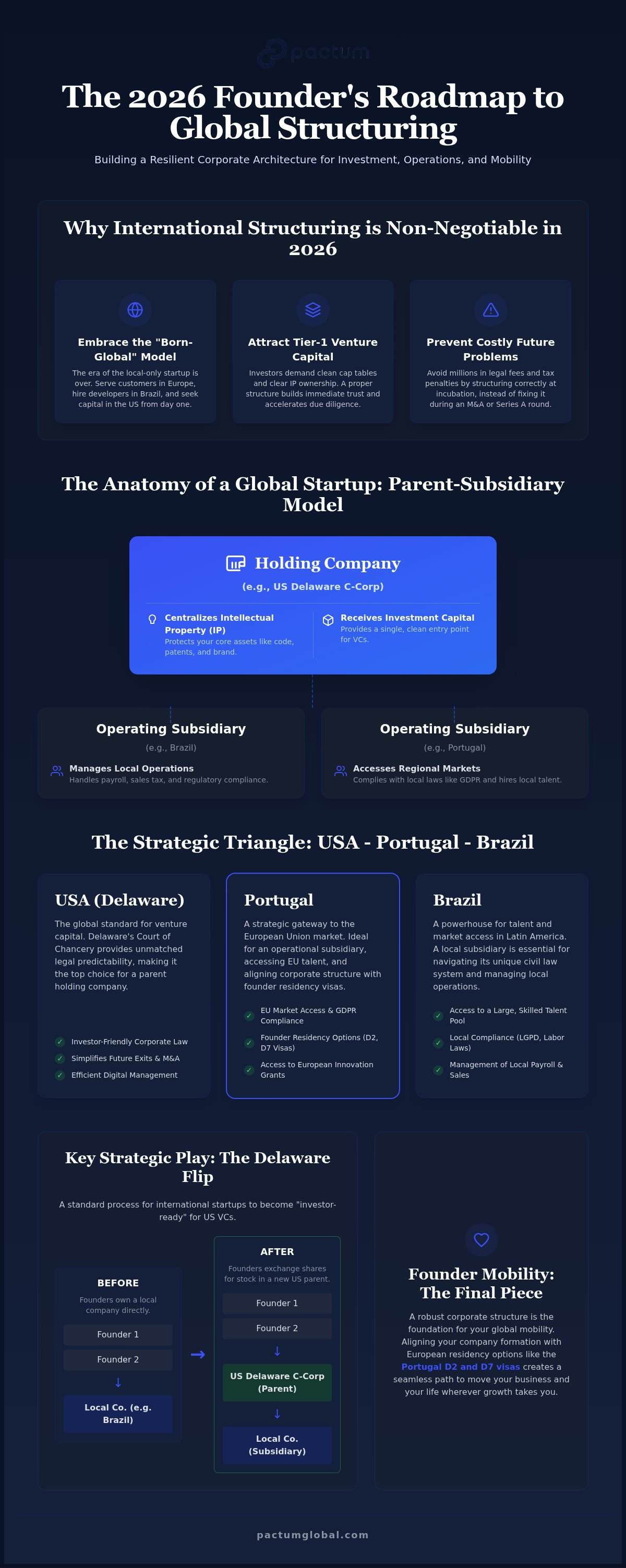
International legal structuring for startups isn't a luxury for the distant future; it's a foundational requirement for any business launched today. We define this process as the deliberate arrangement of legal entities and contracts to manage global operations, taxes, and investments. In 2026, the era of the "local" startup is over. Most new ventures are born-global, serving customers in Europe while hiring developers in Brazil and seeking capital in the United States. This multi-jurisdictional reality requires a structure that can withstand diverse regulatory pressures from day one.
A proactive approach builds immediate trust with Tier-1 venture capital firms. Investors look for "clean" cap tables and clear ownership of intellectual property. If your entities aren't properly aligned, a Series A round can stall for months while lawyers untangle conflicting local requirements. Fixing a broken structure during the due diligence phase of an M&A deal is incredibly expensive. It often costs millions in legal fees and tax penalties that could've been avoided at the incubation stage. Understanding the foundations of international commercial law is essential for founders who want to scale without these self-imposed friction points.
The Risks of Regulatory Fragmentation
There's a significant compliance gap between US Delaware laws and the rigid civil law systems found in Portugal or Brazil. Mismatched corporate governance is a common deal-killer. For example, a contract that's valid in the US might be unenforceable in Europe if it doesn't account for local labor protections or specific data privacy mandates like GDPR and LGPD. Your legal architecture must bridge these gaps to ensure your global operations remain seamless and compliant.
Structuring for Operational vs. Investment Needs
Smart international legal structuring for startups often involves separating where you work from where you raise money. This is the core of jurisdictional arbitrage. You might choose to:
- Centralize your intellectual property in a jurisdiction with strong legal protections and favorable tax treaties.
- Establish local subsidiaries in Brazil or Portugal to manage payroll and local sales tax compliance.
- Incorporate your parent holding company in the US to attract venture capital and simplify future exits.
The Anatomy of a Global Startup Structure: Key Models
Choosing the right architecture is a defining moment for your venture. The most common framework for international legal structuring for startups is the parent-subsidiary model. In this setup, a holding company owns the intellectual property and the shares of local operating entities. This separation protects your core assets from local litigation or operational liabilities in markets like Brazil or Portugal. It creates a clean, centralized point of entry for investors while allowing your local teams to operate within their specific regulatory environments.
The "Delaware Flip" remains a critical maneuver for international teams. This process involves creating a new US parent company that acquires the shares of your original local entity. It's often a prerequisite for Tier-1 US investors who demand the familiarity of Delaware corporate law. While it sounds complex, it's a standard path for companies moving from seed stage to global scale. We've seen this transition save companies months of due diligence friction during later funding rounds.
Hybrid structures are gaining traction in 2026. These models allow founders to leverage European innovation grants while remaining eligible for US venture capital. It's a delicate balance. You must ensure that your governance documents don't conflict with the requirements of grant-issuing bodies in the EU. This requires precise legal drafting to maintain a structure that's both grant-compliant and investor-ready.
The US Holding Company (Delaware C-Corp)
Delaware continues to be the undisputed leader for startup incorporation. Its Court of Chancery provides a level of legal predictability that other jurisdictions can't match. For founders living outside the US, managing a Delaware C-Corp is remarkably efficient. You can handle most filings and board actions digitally. If you're starting this journey, our USA Company Setup for Non-Residents guide offers a strategic walkthrough for international founders.
European Entry via Portugal
Portugal has emerged as the preferred gateway to the European Union. Its holding company regime and favorable tax treaties make it an excellent hub for managing European intellectual property. Beyond the tax benefits, Portugal offers a stable legal environment that aligns well with international standards. When setting up here, a robust Shareholders Agreement for Portuguese Company is vital to define the rights of global partners. We can help you design a custom structure that bridges these jurisdictions seamlessly.
Essential Legal Documents for Cross-Border Startups
Once you've established your corporate architecture, you must secure it with precise documentation. These contracts act as the connective tissue between your entities, investors, and partners. A SAFE (Simple Agreement for Future Equity) is the primary instrument for early-stage global funding, providing a streamlined way to delay valuation while securing capital. However, while a standard SAFE works well in Delaware, international legal structuring for startups requires specific modifications to account for different legal systems. We ensure your funding documents are enforceable across the Brazil-Portugal-USA triangle.
The Shareholders' Agreement (SHA) is another pillar of your legal foundation. Cross-border SHAs require specific dispute resolution clauses to avoid expensive litigation in multiple countries. We often recommend international arbitration in a neutral jurisdiction to provide a predictable outcome for all parties. Similarly, your International Service and Customer Agreements must protect your revenue streams across borders. These documents should clearly define the choice of law and the currency of payment to mitigate risks associated with operating in diverse markets.
Founders often overlook IP Assignment Agreements during the early stages. This is a critical error. You must ensure the company, not the founder, owns the technology and all related intellectual property. Without these signed agreements, your startup's value is compromised, and future investors will likely walk away during due diligence. We treat IP protection as a non-negotiable part of your expansion strategy.
Customizing the SAFE for International Investors
Standard SAFEs often lack the necessary language to handle foreign currency fluctuations. If you're raising in USD but operating in BRL or EUR, your contracts must specify how exchange rates affect the conversion price at the time of a triggering event. We help you localize these documents for Brazil or Portugal to ensure they comply with local tax and corporate rules. For a complete list of what you'll need, review our guide on Legal Documents for International Startups.
Intellectual Property and Trademark Strategy
In jurisdictions like Brazil, the "First to File" rule is absolute. You don't own a trademark simply because you've used it; you must register it with the local authorities. We also utilize the Madrid Protocol to streamline international trademark filing across multiple countries simultaneously. This proactive approach prevents competitors from squatting on your brand as you scale. You can learn more about securing your assets in our Intellectual Property Strategy for Startups.
Global Mobility: Relocating Founders and Key Talent
Your physical location is a critical component of international legal structuring for startups. It isn't enough to simply incorporate in Delaware or Lisbon; you must ensure your residency status aligns with your corporate tax nexus. If a founder moves to a new country without adjusting the legal structure, they risk creating a "permanent establishment" for the company in that jurisdiction. This can lead to unexpected corporate tax obligations and complex compliance hurdles. We help you synchronize your personal relocation with your business architecture to prevent these costly errors.
Portugal remains a top destination for founders in 2026. The D2 Entrepreneur Visa is designed for those actively managing a Portuguese company, while the D7 Visa serves those with qualifying passive income. Both pathways offer a route to European residency and eventually citizenship. For those targeting the American market, options like the L-1 intracompany transferee visa or the E-2 treaty investor visa provide the necessary legal footing to lead operations on the ground. We also see high-growth founders utilizing the O-1 visa for individuals with extraordinary ability to secure their place in the US ecosystem. Each of these paths requires specific corporate documentation to prove the relationship between the founder and the entity.
Managing a remote-first global team adds another layer of complexity. You must remain compliant with local labor laws and social security requirements in every country where you have talent. This often involves setting up local subsidiaries or using professional employer organizations that fit into your broader legal framework. If you are ready to plan your move, we can manage your global mobility process from start to finish to ensure a seamless transition for your entire team.
Residency Planning for Strategic Growth
Securing residency in Portugal provides more than just a place to live; it facilitates visa-free access to the entire Schengen Area. This mobility is vital for founders who need to meet investors or partners across Europe on short notice. However, you must be mindful of the 183-day rule. Spending more than half the year in a country typically makes you a tax resident there. This transition requires careful planning to manage your global tax exposure and avoid double taxation on your startup's equity. For a deeper look at these transitions, read our guide on Legal Support for Global Mobility.
Succession and Asset Protection
Founders with interests in multiple countries need a "Global Will" to ensure their shares and intellectual property are protected across jurisdictions. Without a unified succession plan, your heirs could face conflicting probate laws in the US, Brazil, and Portugal. Additionally, maintaining a compliant international legal structuring for startups requires a focus on transfer pricing. This ensures that the fees paid between your global entities for services or IP usage are documented at "arm's length" prices. This proactive documentation acts as a shield against audits and ensures your global mobility strategy remains financially sound as you scale.
How Pactum Global Navigates Your International Expansion
Pactum Global acts as your seasoned navigator within the Brazil-Portugal-USA triangle. We've removed the detached feel of traditional legal firms to provide a supportive, end-to-end solution for founders. Our methodology is built on transparency and efficiency. We guide you through the initial company setup, manage complex immigration pathways, and secure your intellectual property across multiple borders. This methodical approach ensures that no bureaucratic detail is overlooked as you move from one jurisdiction to the next.
We understand that international legal structuring for startups is a high-stakes endeavor. A single error in a transfer pricing document or a mismatched clause in a Shareholders' Agreement can halt your growth or complicate a funding round. That's why we act as a proactive shield against regulatory hurdles. We don't just react to problems; we map out the entire journey before you start. This allows you to focus on scaling your product and team while we handle the intricate legal architecture that supports your global ambitions.
When you partner with us, international legal structuring for startups becomes a clear, step-by-step process. We replace the confusion of cross-border bureaucracy with a sense of calm security. Our goal is to ensure your corporate foundation is as scalable as your technology, providing the stability global investors demand.
A Personalized Approach to Cross-Border Law
We avoid generic templates because they rarely survive the scrutiny of Tier-1 investors or local tax authorities. Every market has its own nuances. Our network of local experts in Brazil, Portugal, and the USA ensures that your contracts are enforceable and tax-efficient in every jurisdiction. For instance, we recently managed the transition of a Brazilian technology firm to a Delaware holding company structure. We synchronized the US incorporation with Portuguese residency for the founders, creating a seamless bridge that simplified their Series A funding process and protected their personal assets.
Ready to Scale Globally?
Scaling without borders shouldn't be a source of constant stress. We're here to demystify the international bureaucracy that holds many talented founders back. By integrating company formation, immigration management, and asset protection into one steady, logical process, we provide the clarity you need to lead. If you're ready to build a resilient foundation and move your business into new markets, it's time to Consult with Pactum Global on your international legal structure and secure your startup's global future.
Build Your Global Foundation Today
Your startup's success depends on a legal architecture that is as scalable as your technology. We've explored how the right international legal structuring for startups prevents the compliance gap and builds trust with Tier-1 investors. By centralizing your intellectual property and managing local operations through strategic subsidiaries, you protect your assets while maintaining global mobility. Custom-drafted contracts like SAFEs and Shareholders' Agreements are the final piece of this puzzle, ensuring your equity remains secure across the Brazil, Portugal, and USA triangle.
The journey to becoming a global leader requires a steady hand to navigate the shifting regulations of 2026. We specialize in end-to-end global mobility and custom-drafted legal documents that remove the friction from your expansion. You don't have to face the complexity of international bureaucracy alone. Secure your startup's future with Pactum Global's international legal structuring services. We've already mapped the route; now it's time for you to lead. Your borderless growth starts here.
Frequently Asked Questions
What is the best country for a startup holding company in 2026?
Delaware in the United States remains the gold standard for startups seeking venture capital investment due to its predictable corporate law. However, Portugal is an excellent alternative for companies targeting the European market, offering a strategic gateway and favorable tax treaties. Your choice should depend on where your primary investors are located and where you plan to centralize your intellectual property.
How do I protect my startup's intellectual property globally?
You protect your intellectual property by registering trademarks and patents in each target jurisdiction, often utilizing the Madrid Protocol for streamlined international filings. It's equally important to have all founders, employees, and contractors sign IP assignment agreements. These documents ensure that the company owns the technology and assets, which is a vital requirement for any successful funding round.
What is a Delaware Flip and does my startup need one?
A Delaware Flip is a corporate reorganization where a new US parent company is created to acquire the shares of an existing foreign entity. You likely need one if you're pursuing investment from Tier-1 US venture capital firms that demand the legal familiarity of Delaware. This process simplifies the due diligence phase and makes your startup more attractive to American investors.
Can I open a company in Brazil as a non-resident?
Yes, non-residents can open a company in Brazil, but you must appoint a resident representative to handle local administrative and legal responsibilities. This representative serves as the point of contact for government authorities while you retain full ownership and strategic control. We help you manage this process to ensure your Brazilian subsidiary integrates perfectly with your global corporate architecture.
What are the benefits of setting up a business in Portugal for US founders?
Portugal offers US founders a cost-effective gateway to the European Union and access to innovation grants that aren't available in the States. It also provides a clear pathway to EU residency through the D2 Entrepreneur visa. This allows founders to live in a stable, high-quality environment while managing their European operations and talent within the Schengen Area.
Do I need a different Shareholders' Agreement for each country?
You typically use one primary Shareholders' Agreement (SHA) to govern the parent holding company, but local subsidiaries may need specific bylaws to comply with regional regulations. We draft your primary SHA with international dispute resolution clauses to ensure consistent governance across all your entities. This unified approach prevents conflicting legal requirements from stalling your operations in different markets.
How does transfer pricing affect my international startup structure?
Transfer pricing requires that any transactions between your global entities, such as licensing fees or service charges, are conducted at market-standard "arm's length" prices. Proper documentation is essential to ensure your international legal structuring for startups remains compliant with tax authorities in every jurisdiction. Failing to manage this can lead to double taxation and significant penalties during a government audit.
What are the most common legal mistakes startups make when going global?
The most frequent errors include neglecting IP assignment agreements, ignoring the tax implications of founder residency, and using generic contract templates that aren't enforceable across borders. These mistakes often create "legal debt" that becomes incredibly expensive to fix during a Series A round or an exit. A proactive approach to international legal structuring for startups identifies these risks early to ensure a clean path to growth.


