

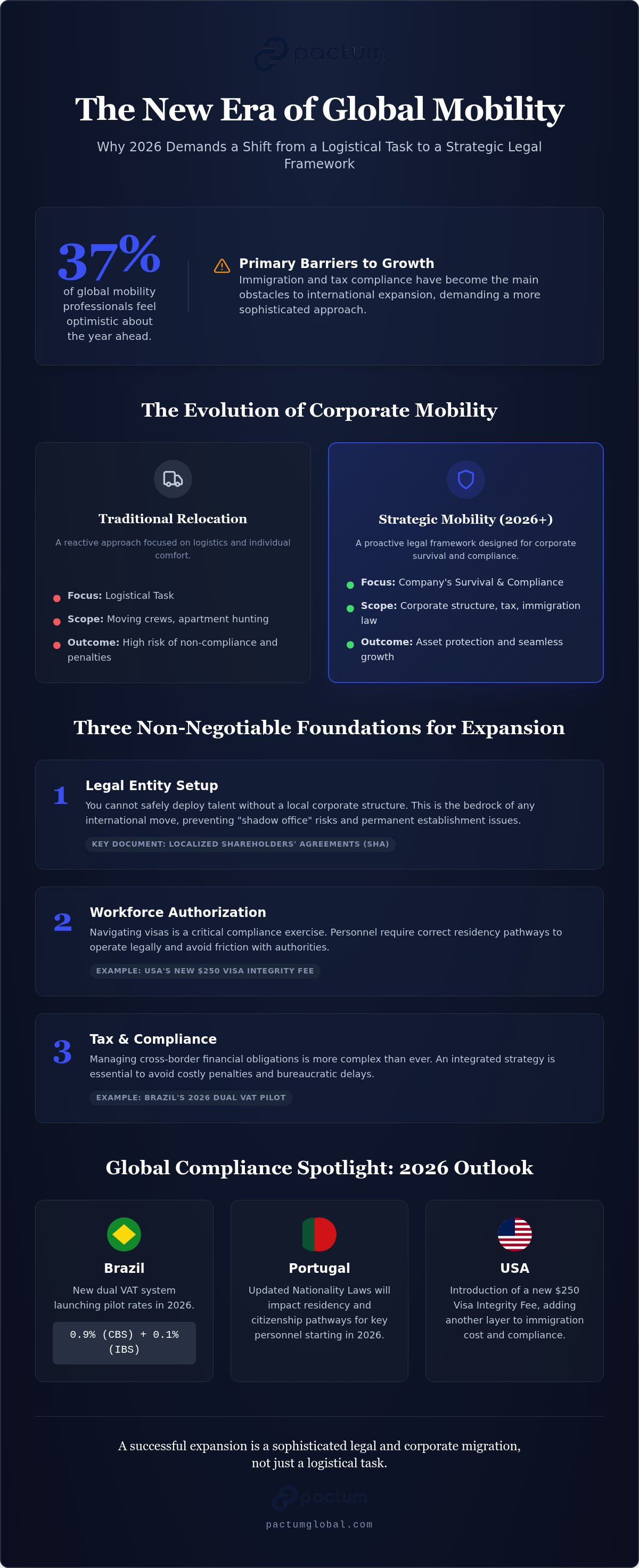
Only 37% of global mobility professionals feel optimistic about the year ahead, according to recent industry data. This sharp decline in confidence reflects a reality where immigration and tax compliance have become the primary barriers to international growth. If you're looking for global mobility services for companies, it's clear that traditional relocation tactics are no longer enough. You need a strategy that treats international movement as a sophisticated legal and corporate migration rather than just a logistical task.
You're right to worry about the complexity of managing different legal jurisdictions simultaneously. With Brazil's new dual VAT system launching its pilot rates in 2026 and Portugal's updated nationality laws, the fear of non-compliance is a valid concern for any expanding business. We'll show you how to integrate corporate structuring, immigration, and tax compliance into a seamless global mobility strategy. This article provides a clear roadmap for 2026, offering the legal protection your assets require and the streamlined visa processing your key personnel deserve to ensure a successful expansion.
Key Takeaways
- Understand why global mobility in 2026 is a strategic legal framework rather than a logistical move, requiring a foundation of solid corporate structuring.
- Learn how comprehensive global mobility services for companies integrate local entity setup with specific immigration pathways in Portugal, Brazil, and the USA.
- Discover how to protect your business assets by localizing Shareholders' Agreements (SHA) and SAFE contracts before moving key personnel across borders.
- Identify the critical intersection between transfer pricing, intellectual property protection, and tax compliance to avoid costly bureaucratic delays.
- Gain a clear roadmap for international expansion that prioritizes asset security and seamless visa processing through a specialized, "no-nonsense" legal approach.
What are Global Mobility Services for Companies in 2026?
In 2026, global mobility services for companies have transformed into a high-stakes legal framework. It's no longer just about hiring a moving crew or finding an apartment for an executive. Instead, it's a holistic suite of services designed to manage the legal, tax, and logistical movement of both your workforce and your corporate entity. We're seeing a definitive shift from "relocation" to "strategic mobility." While relocation focuses on the individual's comfort, strategic mobility focuses on the company's survival and compliance in a new jurisdiction.
This evolution is driven by a compliance-first reality. Expanding internationally today means navigating a web of digital borders and heightened tax scrutiny. A modern mobility strategy must integrate four key components to be effective: immigration, tax advisory, corporate structuring, and intellectual property (IP) protection. Without these elements working in unison, a business expansion risks stalling before it even begins.
The Evolution of Corporate Mobility
The rise of remote work and digital nomadism initially suggested that borders were becoming irrelevant. The reality of 2026 has proved the opposite. Governments have tightened their grip on tax nexus and labor regulations to ensure they don't lose revenue to "invisible" workforces. This has created a clear divide between traditional relocation agencies and specialized consultancies. While an agency might help with the logistics of a move, they often lack the legal depth to handle complex corporate structures or transfer pricing. For founders, legal certainty is now the primary driver for any move. With only 37% of mobility professionals feeling optimistic this year, the focus has shifted toward building a protective shield against bureaucratic errors and tax penalties.
Core Pillars of a Mobility Strategy
A successful expansion relies on three non-negotiable foundations that protect your business from unnecessary risk:
- Legal Entity Setup: You can't safely deploy talent without a local corporate structure. Establishing a firm foundation in Brazil, Portugal, or the USA requires specific documentation like Shareholders' Agreements (SHA) that are localized to that jurisdiction.
- Workforce Authorization: Navigating visas is now a compliance exercise. Whether it's Portugal's 2026 Nationality Law amendments or the new $250 Visa Integrity Fee in the US, your personnel need the correct residency pathways to avoid legal friction.
- Tax and Compliance: Managing cross-border obligations is more complex than ever. In Brazil, for example, the 2026 pilot rates for the new dual VAT system (0.9% for CBS and 0.1% for IBS) require immediate reporting adjustments.
By treating these pillars as a single, integrated strategy, companies can move their key talent and corporate assets without facing the penalties that come from a fragmented approach.
The Legal Foundation: Why Corporate Structuring is the Core of Mobility
Moving a CEO to Lisbon or a tech lead to São Paulo feels like a victory for human resources. Without a local legal entity, however, this move is a high-risk gamble. You're effectively creating a "shadow office" that local tax authorities will eventually identify. If your personnel are operating in a country where you have no legal presence, you risk permanent establishment issues and significant tax penalties. Comprehensive global mobility services for companies start with the entity, not the airplane ticket. You must establish a firm legal foundation before the first employee arrives.
Managing the relationship between the parent company and the foreign branch requires more than just a shared logo. It demands formal intercompany agreements that define how services are rendered and how revenue is recognized. This structure ensures that your customer agreements and service contracts remain enforceable across borders. It provides the continuity your clients expect while protecting your corporate assets from local liability. Integrating these documents into your company setup in Portugal or Brazil creates a shield for your business during its most vulnerable phase of growth.
Drafting Shareholders' Agreements (SHA) for Cross-Border Success
Brazil and Portugal have distinct corporate governance requirements that a standard Delaware agreement simply won't cover. An SHA written for one jurisdiction won't protect you in a dispute in another. You need jurisdiction-specific clauses that address local voting rights, dividend distributions, and exit strategies. Linking your SHA to your mobility goals ensures that founders maintain control while expanding their reach. For a deeper look at these requirements, see our guide on the Shareholders Agreement for Portuguese Company.
Startup Contracts and Global Investment
Startups often rely on SAFE (Simple Agreement for Future Equity) contracts to maintain speed. In an international context, these must be structured to satisfy both local regulators and future global investors. If your legal foundation is weak, you'll struggle to raise capital during your expansion. Investors in 2026 are looking for "clean" corporate structures that minimize cross-border legal friction. Our Legal Documents for International Startups checklist provides the necessary framework for founders to stay investment-ready while moving into new markets. By localizing your startup contracts early, you remove the bureaucratic hurdles that often stall late-stage funding rounds.
Strategic Market Entry: Expanding into Brazil, Portugal, and the USA
Expansion into high-growth markets requires a calculated balance between potential revenue and administrative friction. Brazil offers a massive consumer base but presents some of the highest bureaucratic hurdles in the world. Portugal serves as a stable, cost-effective entry point for Europe, while the USA remains the gold standard for global scaling. Effective global mobility services for companies prioritize these entry points based on your specific business goals. You can't simply apply a one-size-fits-all approach when the legal requirements vary so drastically between Lisbon, São Paulo, and Miami.
Every foreign director must understand that local compliance is not a suggestion. In high-friction markets, a local legal navigator acts as your shield against document rejection and regulatory fines. You need an expert who has already mapped the journey to ensure your corporate presence is legitimate from day one. This proactive stance prevents the "shadow office" risks we discussed earlier and establishes the credibility needed to hire local talent or secure domestic contracts.
Brazil: Navigating Complexity and Opportunity
Brazil is currently undergoing a massive tax overhaul that every expanding business must track. The introduction of the dual VAT system in 2026, with pilot rates of 0.9% for CBS and 0.1% for IBS, requires immediate attention to your electronic tax document (NF-e) reporting. For US citizens and other foreign nationals, the company registration process involves specific notarization and legal representation steps that often stall launches. Our guide on How to Open a Company in Brazil for Foreigners details the 2026 requirements for a smooth entry. Despite the complexity, Brazil's record 504,000 trademark applications in 2025 shows that the market potential remains too large for ambitious companies to ignore.
Portugal and the USA: Gateway Markets
Portugal is a strategic gateway for the European Union. With a corporate tax rate of 19% in 2026 and a reduced 15% rate for the first €50,000 of taxable income for SMEs, it's a highly attractive hub. However, amendments to the Nationality Law that took effect in May 2026 have changed residency requirements, making D2 and D7 visa pathways more nuanced. In the USA, choosing between an LLC and a C-Corp is a critical mobility decision. While an LLC offers simplicity, a C-Corp is often the necessary vehicle for those seeking L-1 or E-2 visa options for their executive team. You'll also need to account for the new $250 Visa Integrity Fee that applies to most nonimmigrant visas starting in fiscal year 2026. Learn more about these nuances in our article on USA Company Setup for Non-Residents.
Managing Compliance Risks: Immigration, Tax, and Intellectual Property
Many founders believe that strict compliance is a bottleneck that slows down international growth. This is a dangerous misconception. In reality, the cost of fixing a bureaucratic error is often ten times higher than the cost of preventing it. When you invest in global mobility services for companies, you aren't just buying paperwork; you're buying a shield against legal friction. A compliance-first approach ensures that your expansion is sustainable and that your leadership isn't distracted by avoidable audits or document rejections.
Succession planning for cross-border assets is another often-overlooked risk. If a founder or key shareholder holds assets in multiple jurisdictions, you need specific succession documents to ensure company ownership remains stable during a transition. Without these, your international branch could face years of legal limbo in a foreign court. Protecting your company's future requires a clear roadmap for how ownership and assets are handled across different legal systems.
Transfer Pricing and International Tax Compliance
Transfer pricing is the silent killer of international expansion. When you move personnel between Brazil and the USA, you must justify the costs and service fees exchanged between these entities. Mobility costs, such as executive salaries and relocation packages, directly impact your global tax footprint. If these aren't documented correctly, you risk double taxation and aggressive audits. We help you establish clear Transfer Pricing Services to ensure every transaction between your branches is compliant and defensible. This proactive documentation is essential for companies operating under the General Tax Regime, especially as Brazil continues its alignment with international standards.
Intellectual Property Strategy in a Mobile World
Global mobility significantly increases the risk of IP leakage. When your talent moves, your trade secrets and brand identity move with them. Protecting your brand requires simultaneous trademark registration in every market you enter. In 2026, the Nice Classification updates for trademark applications are already in effect, requiring more precise filing categories than in previous years. If you fail to register your trademarks in Brazil and the USA simultaneously, you leave your brand vulnerable to local squatters or competitors. For a deeper dive into protecting your innovations, read our Intellectual Property Strategy for Startups. This roadmap ensures your brand remains secure as you scale across borders.
Don't leave your company's most valuable assets to chance during a move. You can secure your brand and your tax standing today by scheduling a consultation for our Intellectual Property and Trademarks services.
Pactum Global: Seamless End-to-End Mobility and Legal Solutions
Pactum Global provides the bridge between your corporate goals and the regulatory reality of new markets. We don't just offer relocation; we provide comprehensive global mobility services for companies that prioritize legal security and long-term viability. Our "no-nonsense" approach is designed to strip away the complexity of international expansion. Instead of overwhelming you with academic jargon, we provide clear, actionable steps to establish your presence in high-growth jurisdictions. We believe that transparency is the foundation of a successful partnership.
Generic agencies often focus on the logistical "experience," such as finding temporary housing or using a proprietary tracking app. While these are helpful, they don't protect your business from a surprise tax audit or a rejected visa application. A specialized consultancy like Pactum Global offers more value by addressing the legal core of your move. We act as a proactive shield, ensuring that your corporate presence in the USA, Brazil, or Portugal is built on a solid foundation of compliant contracts and tax structures. We protect your business assets while moving your most valuable people.
Why Choose a Global Navigator?
Proactive legal protection is the hallmark of a seasoned navigator. Rather than troubleshooting errors after they occur, we map out the journey to avoid them entirely. You gain direct access to jurisdictional experts who understand the specific nuances of local law in Brazil, Portugal, and the USA. This localized expertise is vital when navigating the 2026 shifts in immigration and tax reporting that we've discussed. We focus on transparency, utilizing fixed-fee structures so you have total clarity on your expansion costs from the first day of our engagement.
Getting Started with Your Global Transition
The first 90 days of an international move are the most critical for any organization. During this window, you must finalize your corporate registration, secure workforce authorizations, and align your tax reporting with local mandates. A strategic mobility audit helps identify potential gaps in your plan before they become expensive liabilities. For a complete breakdown of how to manage this transition, consult our guide on Legal Support for Global Mobility.
Your business expansion deserves a steady, reliable partner who has already mapped the route. We take the burden of bureaucracy off your shoulders so you can focus on your own growth and talent retention. By integrating your corporate structuring, immigration, and tax compliance into one seamless process, we ensure your global mobility services for companies are a strategic asset. Book your consultation today to begin your international journey with confidence and security.
Securing Your Global Future with a Strategic Legal Framework
International expansion in 2026 is a complex journey that demands more than just logistical support. It requires a robust legal foundation that protects your company assets and your people simultaneously. You've seen how localized corporate structuring, such as specialized Shareholders' Agreements and SAFE contracts, forms the core of a successful move. By integrating immigration pathways with tax compliance and intellectual property protection, you remove the bureaucratic hurdles that often stall growth in markets like Brazil, Portugal, and the USA.
Our global mobility services for companies focus on this holistic approach. We provide specialized expertise in these key jurisdictions, offering comprehensive legal, tax, and immigration support through a no-nonsense, transparent process. You don't have to face international bureaucracy alone. With a steady navigator by your side, you can focus on scaling your business and retaining your top talent. We've already mapped the journey so you can focus on the destination.
Ready to build your international roadmap? Schedule your global mobility strategy session with Pactum Global today. We're here to ensure your transition is seamless, secure, and successful.
Frequently Asked Questions
What are the core global mobility services for companies in 2026?
The core services include a strategic integration of corporate entity setup, immigration pathways, and international tax compliance. Modern global mobility services for companies have moved beyond simple relocation logistics to focus on the legal foundation of an expansion. This involves drafting localized Shareholders' Agreements (SHA), managing transfer pricing obligations, and securing intellectual property rights across different jurisdictions like Brazil, Portugal, and the USA.
How much does it cost to set up a company in Brazil for a US company?
Total costs for a Brazilian company setup depend on the chosen corporate structure and the requirement for local legal representation. Beyond standard registration fees, businesses must account for mandatory notarization of foreign documents and the appointment of a resident administrator. It's also vital to consider the 2026 tax environment, including the 15% corporate income tax rate and the 10% surtax on profits exceeding BRL 240,000 per year.
What is the difference between a relocation agency and a global mobility consultancy?
A relocation agency primarily manages the physical logistics of a move, such as finding housing or moving household goods. In contrast, a global mobility consultancy focuses on the legal and strategic framework of the transition. We handle the complex intersections of corporate law, tax nexus, and immigration status. This approach ensures that your business remains compliant and protected while your personnel move across borders.
How long does the immigration process take for Portugal's D2 visa?
Processing times for the D2 visa vary based on the specific Portuguese consulate and the complexity of the business plan submitted. Recent 2026 reforms to the Nationality Law and broader immigration regulations have increased the scrutiny placed on residence applications. It's best to prepare for a multi-month process that includes a thorough review of your investment's economic and social impact on the local market.
Can a non-resident open a company in the USA without a physical presence?
Yes, non-residents can establish an LLC or C-Corp in the USA without maintaining a physical presence or residence. This is a common strategy for international founders who need a US entity to access banking or global venture capital. While the setup is straightforward, you must still comply with federal tax obligations and the 2026 Visa Integrity Fee if you eventually plan to move key personnel to the US on an L-1 or E-2 visa.
Why is a Shareholders' Agreement (SHA) critical for international expansion?
A localized SHA is critical because it defines the governance and voting rights of a foreign branch within the context of local law. Standard agreements from your home country often fail to address specific jurisdictional requirements in places like Brazil or Portugal. Without a localized contract, you risk internal disputes that can stall operations and leave your corporate assets vulnerable to local liability or regulatory intervention.
What are the risks of ignoring transfer pricing in global mobility?
Ignoring transfer pricing leads to aggressive tax audits and the risk of double taxation on intercompany transactions. When you move employees between entities, the costs associated with their salaries and relocation must be documented at "arm's length" prices. In Brazil, failing to report these transactions correctly under the 2026 dual VAT system pilot can result in the immediate rejection of your electronic tax documents (NF-e).
How do I protect my company's trademarks when moving to a new country?
You protect your brand by filing for trademark registration in your target market simultaneously with your company setup. It's essential to use the latest Nice Classification updates, which took effect on January 1, 2026, to ensure your goods and services are categorized correctly. Proactive registration prevents competitors from squatting on your brand name and provides the legal leverage needed to defend your intellectual property in a new jurisdiction.


