

What if your next residency permit was actually your company’s most valuable strategic asset? Most entrepreneurs view the startup visa spain offers as a mere administrative hurdle, but the most successful founders treat it as a foundational pillar for their global expansion. You likely understand the massive potential of the European market, yet the fear of a rejected business plan or complex tax implications often creates a paralysis of analysis. This concern is logical; Spanish bureaucracy requires precision and a deep understanding of local regulatory expectations.
We've designed this guide to replace that uncertainty with a clear, actionable roadmap. You'll learn how to master the specific legal requirements and the ENISA approval process while building a corporate structure that protects your interests. We will explore how to secure your three-year residency permit, tap into the Beckham Law tax benefits, and fast-track your family’s reunification. From initial filing to 2026 compliance standards, this is your professional blueprint for a seamless transition into the Spanish ecosystem. We've mapped the journey so you can focus on growth.
Key Takeaways
- Learn how Law 28/2022 provides a three-year residency permit and a fast-tracked 20-day processing window for founders and high-tech talent.
- Understand the critical ENISA approval process and how to demonstrate innovation and scalability to meet 2026 standards.
- Compare the startup visa spain against other residency paths like the Digital Nomad or Golden Visa to identify the best fit for your revenue model.
- Discover the essential steps for incorporating your company and drafting Shareholders’ Agreements that protect your global interests and intellectual property.
- Follow a structured five-step roadmap to navigate the technical requirements and secure your documentation without bureaucratic delays.
Understanding the Spain Startup Visa (Law 28/2022) in 2026
The Spanish Startup Law, officially known as Law 28/2022, transformed the landscape for international entrepreneurs. By 2026, the startup visa spain provides has matured into the most efficient residency route in Europe for innovation-driven founders. This permit isn't a generic work visa; it's a specialized residency category designed specifically for founders, investors, and high-tech talent. It recognizes that modern businesses move fast and need legal frameworks that match that pace.
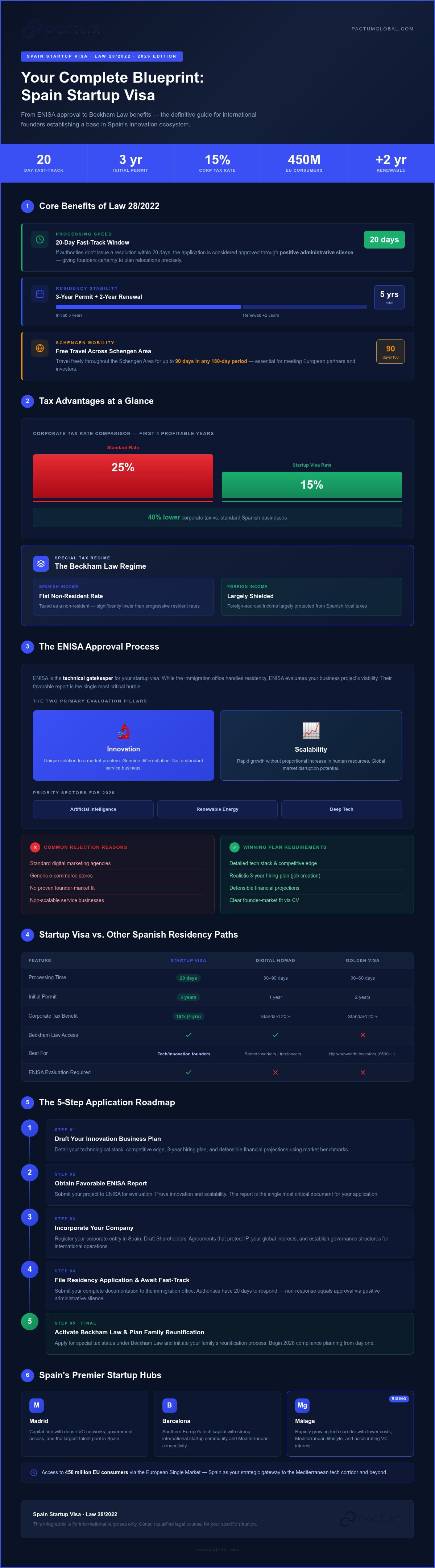
Choosing this route over traditional self-employed permits is a strategic decision. While the standard "Autónomo" path often involves grueling wait times and excessive local paperwork, the startup visa is built for speed. It features a 20-day fast-track processing window. If the authorities don't issue a resolution within this period, the application is typically considered approved through positive administrative silence. This level of bureaucratic certainty is rare and provides founders with the confidence to plan their relocation and corporate launch with precision.
Core Benefits for International Founders
The benefits extend far beyond a simple right to remain in the country. Founders and their families can secure a three-year initial residency permit, which is renewable for another two years. This stability allows you to focus on scaling your business rather than worrying about annual renewals. Key advantages include:
- Seamless Schengen Mobility: You gain the right to travel freely throughout the Schengen Area for up to 90 days in any 180-day period, which is essential for meeting European partners and investors.
- Reduced Corporate Tax: Eligible startups enjoy a reduced corporate tax rate of 15% for the first four years in which they generate a profit, significantly lower than the standard 25% rate.
- The Beckham Law Regime: Founders and employees can often apply for a special tax status. This allows you to be taxed as a non-resident, applying a flat rate to your Spanish income while keeping foreign income largely shielded from local taxes.
The Strategic Advantage of a Spanish Base
Spain has solidified its position as the premier EU startup hub in 2026. Setting up your headquarters in Madrid, Barcelona, or the rapidly growing tech scene in Malaga places you in the heart of a vibrant ecosystem. You aren't just moving for the lifestyle; you're gaining direct access to the European Single Market and its 450 million consumers. The local infrastructure supports rapid scaling, with high-quality talent pools and a growing network of venture capital firms specifically focused on the Mediterranean tech corridor. The startup visa spain provides acts as a powerful catalyst for founders seeking a stable, high-growth launchpad into the broader European Union market.
The ENISA Approval: Your Gateway to Success
ENISA is the technical gatekeeper for the startup visa spain. While the immigration office handles your residency status, ENISA evaluates the business project's viability. Their favorable report is the most critical hurdle you'll face. In 2026, evaluators have become more sophisticated, looking for genuine differentiation in a crowded tech market. They focus on two primary pillars: innovation and scalability. In 2026, there's a particular interest in sectors like AI, renewable energy, and deep tech. They look for projects that don't just exist in Spain but use it as a strategic base to disrupt international markets.
Most rejections occur because founders fail to prove their project is more than a standard service business. A digital marketing agency or a standard e-commerce store likely won't qualify. You need to show that your model can scale rapidly without a proportional increase in human resources. Another common pitfall is a lack of founder-market fit. Your CV must clearly demonstrate that you have the technical or business expertise to execute the specific plan you've submitted to the authorities.
Drafting a Winning Business Plan
Your technical business plan must go beyond financial spreadsheets. It needs to detail your technological stack and how it provides a competitive edge. Job creation is another high-priority metric for ENISA. You must provide a realistic hiring plan that shows how your presence will benefit the Spanish labor market over the next three years. Financial projections shouldn't just be optimistic; they must be defensible. Use industry benchmarks and cite specific market research to justify your growth curves and expected revenue streams.
Innovation as a Legal Requirement
You must prove that your business offers a unique solution to a market problem. This is where your intellectual property strategy becomes essential. Evaluators look for patents, trademarks, or proprietary code as evidence of innovation. Protecting these assets is vital before you begin the relocation process. Partnering with a cross border contract lawyer can help you formalize these assets and ensure your IP is properly structured. This legal foundation is a requirement, not an option, for serious founders.
The evaluation timeline for the ENISA report typically spans one to three months. It's often the longest part of the process, so starting early is essential. View the startup visa spain as the first step in a broader international corporate strategy rather than just a residency permit. If you need assistance with your Intellectual Property and Trademark strategy, our team can guide you through the process to ensure your application meets the highest standards of the Spanish government.
Startup Visa vs. Other Spanish Residency Paths
Choosing the right residency path is a high-stakes decision that dictates your tax burden and operational freedom. While the startup visa spain offers is often the superior choice for innovators, you must distinguish it from other popular permits like the Digital Nomad or Golden Visa. Each has specific requirements that may either accelerate or hinder your business goals depending on your current income and capital.
The Digital Nomad Visa is designed for those who already have a stable income from foreign companies or clients. In contrast, the Startup Visa is for those building a new, innovative venture within the Spanish territory. If your goal is to hire a local team, secure Spanish venture capital, and scale a local entity, the Startup Visa is the correct legal vehicle. It provides a corporate foundation that a nomad permit simply doesn't support.
The Golden Visa remains a passive investment route, typically requiring a 500,000 Euro real estate purchase. The Startup Visa replaces this heavy capital requirement with a "talent requirement." You trade a large cash outlay for a rigorous business plan evaluation. For founders who prefer to keep their capital in their company rather than in real estate, the Startup Visa is the more logical financial move. We also advise against the standard self-employed (Autónomo) route for tech ventures. It lacks the tax incentives and the streamlined hiring capabilities found in the startup legislation.
Founders already in Spain on student or work visas can often modify their status to a Startup Visa without leaving the country. This modification is possible as long as you have a favorable ENISA report and meet the technical criteria. It's a seamless way to transition from academic life or corporate employment into entrepreneurship within the Spanish ecosystem.
Criteria for Comparison
Administrative speed is a major differentiator. The Startup Visa features a 20-day resolution window, whereas other permits can languish in provincial offices for months. If you plan to hire international talent, the Startup Visa provides a simplified path for "highly qualified professionals" that the Digital Nomad path does not. Investment levels also vary. While the Startup Visa doesn't mandate a specific minimum investment, you must prove you have sufficient funds to sustain the business and yourself during the first year.
Strategic Selection for Long-Term Growth
Your choice today affects your path to permanent residency five years from now. All these paths eventually lead to long-term residency, but the Startup Visa often provides the most tax-efficient journey through the Beckham Law. This regime can significantly reduce your effective tax rate on global earnings for up to six years. Understanding these nuances requires a proactive approach to your relocation strategy. Utilizing legal support for global mobility ensures you select the path that aligns with your 2026 growth targets and protects your personal wealth.
The Application Roadmap: 5 Steps to Your Spanish Permit
Securing a startup visa spain requires a methodical approach to both business and legal documentation. The process is designed for speed, but its efficiency depends entirely on the quality of your initial submission. You aren't just filing an application; you're presenting a strategic case for your business’s presence in the Mediterranean tech ecosystem. Following a structured roadmap ensures you meet every deadline and avoid common bureaucratic pitfalls that can stall your expansion.
- Step 1: Preparing your technical business plan for ENISA. This document must align with the 2026 standards for innovation and scalability discussed earlier. It serves as the foundation for your technical approval.
- Step 2: Securing your NIE and local documentation. Your Foreigner Identification Number (NIE) is the master key for all Spanish transactions. You'll need this for banking, contracts, and the application itself.
- Step 3: Submitting the application via the UGE. The Large Business Unit (Unidad de Grandes Empresas) is the centralized body that processes these high-impact visas. All submissions at this stage are digital.
- Step 4: Handling the administrative silence rule. Spain utilizes a "positive silence" policy for this visa. If the UGE doesn't resolve your case within 20 working days, the application is generally considered approved.
- Step 5: Obtaining your TIE upon arrival. Once approved, you'll travel to Spain to register your fingerprints and receive your physical Residency Card (Tarjeta de Identidad de Extranjero).
Documentation Checklist for 2026
Your document folder must be impeccable to pass the UGE's scrutiny. You must provide criminal record checks from every country you've lived in during the last two years, and these must carry an official Apostille and a sworn Spanish translation. Financial means are equally vital; you must prove you have sufficient capital to support yourself and any dependents without relying on Spanish social aid. Finally, your health insurance must be from a provider authorized to operate in Spain, offering full coverage without co-payments or waiting periods.
Managing the UGE Submission
The entire submission process is handled through a secure electronic platform, making a digital certificate or Cl@ve signature mandatory. If the UGE finds any missing information, they will issue a "Requerimiento" or a formal request for additional data. You typically have 10 working days to respond to these requests, so monitoring your digital notifications daily is essential. The 20-day resolution period acts as a legal guarantee, ensuring that your application doesn't linger indefinitely in a bureaucratic backlog.
Success in this process often depends on how well you've protected your underlying business assets. Securing your Intellectual Property and Trademarks before filing can significantly strengthen the innovation section of your application. This proactive legal step shows evaluators that your startup is a serious, well-structured entity ready for the European market.
Post-Visa Success: Corporate Structure and Compliance
Securing the startup visa spain offers is a significant milestone, but it's only the first step in your international expansion. The true challenge lies in building a resilient corporate architecture that supports long-term growth. Most founders choose a Sociedad de Responsabilidad Limitada (SL) for their Spanish entity. This structure is favored for its flexibility and lower minimum capital requirements compared to a Sociedad Anónima (SA). An SL protects your personal assets while providing a recognized legal framework for local operations and hiring.
Once your company is incorporated, internal governance becomes your primary focus. We prioritize the drafting of robust Shareholders’ Agreements (SHA) to clearly define the relationship between founders and early investors. Standard templates rarely account for the complexities of cross-border ventures; you need contracts that bridge the gap between Spanish commercial law and your global strategy. For those seeking early-stage capital, implementing Startup Contracts (SAFE) allows for efficient fundraising without the immediate need for complex company valuations.
Ongoing compliance is where many international entrepreneurs face unexpected hurdles. You must manage Spanish tax obligations alongside sophisticated transfer pricing strategies if you operate in multiple jurisdictions. This ensures that transactions between your Spanish headquarters and foreign branches are conducted at arm's length. Proper documentation at this stage protects your venture from future audits and ensures your 2026 operations remain fully compliant with both local and EU regulations.
Foundational Legal Documents
Generic legal forms are a significant risk for high-growth companies. Your intellectual property and trademarks must be registered with the Spanish Patent and Trademark Office to ensure full protection within the European market. Relying on international startup legal packages provides a cohesive foundation. These packages are designed to scale with you, mitigating legal exposure as you move from a seed-stage startup to an established international player.
The Pactum Global Approach
We provide a comprehensive solution that integrates end-to-end company formation with strategic immigration management. Our team acts as a proactive guide, navigating the intricacies of the Spanish system so you can focus on product development and market fit. We also address strategic succession planning for cross-border assets, ensuring your business remains secure through every transition. If you're ready to establish your European headquarters, secure your path to Spain by partnering with experts who have already mapped the journey for you.
Securing Your European Future in 2026
The startup visa spain offers is more than a residency permit; it's a strategic gateway to the European Single Market. By mastering the ENISA approval process and selecting a resilient corporate structure like an SL, you position your venture for sustainable growth. Protecting your assets with specialized contracts from day one ensures you're ready for both local compliance and international fundraising. Success in this ecosystem depends on a foundation built with legal precision.
Relocating a business requires a proactive legal shield to navigate foreign regulations. At Pactum Global, we provide comprehensive global mobility management and expert cross-border corporate structuring to remove bureaucratic complexity. Our specialized startup contract expertise, including SAFE and SHA documentation, ensures your company is investor-ready from the moment you arrive. We've mapped every step of the journey so you can focus on scaling your innovation.
Launch your venture in Spain with Pactum Global’s expert legal support and enter the Spanish market with absolute confidence. Your international journey starts with a single, well-prepared step toward a secure future.
Frequently Asked Questions
Is the Spanish Startup Visa open to all nationalities?
The startup visa spain offers is available to all non-European Union citizens regardless of their country of origin. If you are a citizen of a country outside the European Economic Area or Switzerland, you can apply for this permit. This global accessibility makes Spain a highly competitive destination for founders from the USA, Brazil, and the UK who are looking for a foothold in the European tech ecosystem.
Can I apply for the Startup Visa while already in Spain on a tourist visa?
You can legally apply for this permit while you are physically present in Spain on a tourist visa or any other legal residency status. This is one of the most significant advantages of the current law; it allows you to handle local documentation and banking in person. You don't need to return to your home country to start the process as long as you are within your legal period of stay.
How much money do I need to show in my bank account for the Startup Visa?
You must demonstrate financial means equivalent to 200% of the Spanish minimum wage (IPREM) for the main applicant. For 2026, you should verify the specific updated figures because these amounts are adjusted annually by the government. If you are bringing family members, you'll need to show an additional 75% of the IPREM for the first relative and 50% for each subsequent dependent.
What happens if my ENISA application is rejected?
If ENISA issues a negative report, you have the right to file an administrative appeal or submit a new application with a corrected business plan. Rejections usually stem from a lack of technical detail or insufficient proof of innovation. It's often more effective to address the specific feedback provided by the evaluators and resubmit a strengthened project that clearly demonstrates your startup's scalability and job creation potential.
Does the Startup Visa allow me to work for other companies in Spain?
The startup visa spain provides allows you to work for other companies as long as your primary focus remains on your startup venture. You are permitted to engage in professional activities for third parties, provided that these activities don't compromise the development of the innovative project that secured your approval. This flexibility is ideal for founders who provide high-level consulting while scaling their own company.
How long does the Spanish Startup Visa last and can it be renewed?
The initial residency permit is granted for three years. Once this period expires, you can apply for a renewal that lasts for an additional two years, provided you still meet the business and financial requirements. After completing five years of legal residency in Spain, you become eligible to apply for permanent residency, which offers long-term stability and easier movement within the European Union.
What are the main tax benefits of the Spanish Startup Law in 2026?
Founders benefit from a reduced Corporate Tax rate of 15% for the first four years of profitability. Additionally, the Beckham Law allows you to be taxed at a flat rate on your Spanish income rather than the progressive scales applied to most residents. These incentives are specifically designed to help early-stage ventures preserve capital and attract high-level international talent during their critical growth phases.
Can I bring my family members with me on a Startup Visa?
You can include your spouse or common-law partner, children under 18, and even dependent adult children or parents in your application. The law allows for simultaneous processing; your family can receive their residency permits at the same time you receive yours. This streamlined family reunification process is a cornerstone of the Spanish strategy to attract and retain global entrepreneurial talent without causing personal disruption.


