

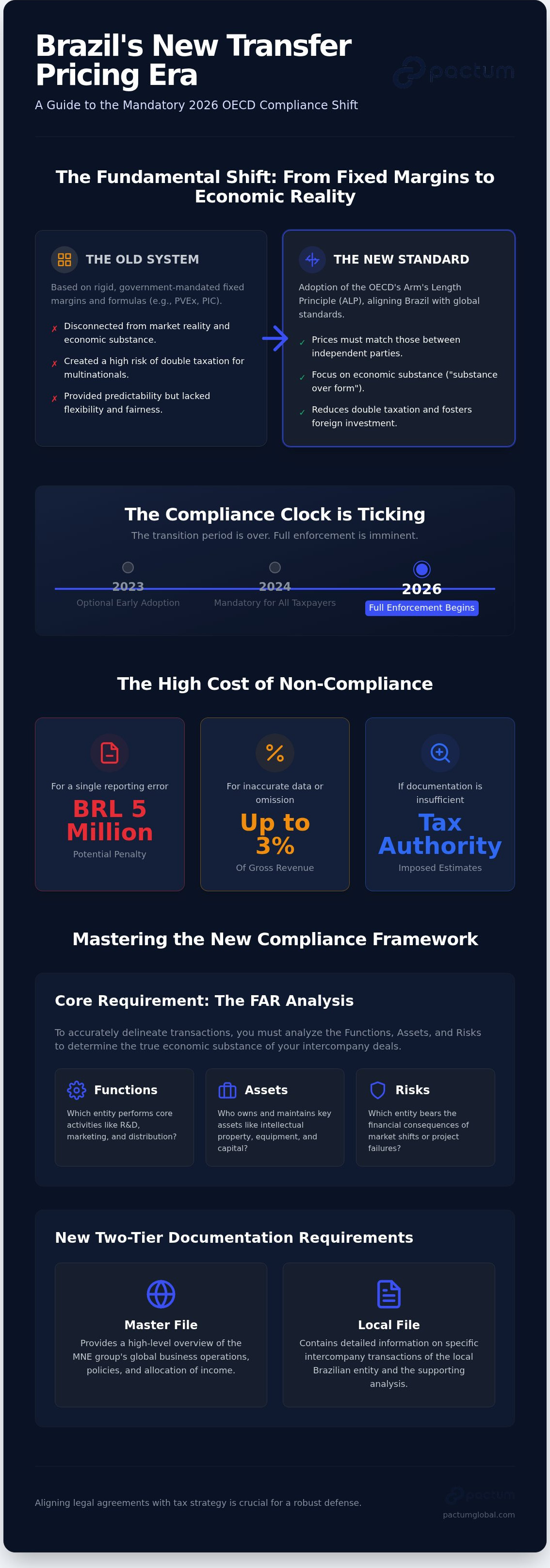
A single reporting error in your Brazilian tax documentation can now trigger a penalty of up to BRL 5 million. For decades, maintaining transfer pricing compliance Brazil was a predictable exercise in applying fixed, government-mandated margins. That era is officially over. The shift to OECD-aligned rules means the Brazilian Federal Revenue Service now prioritizes economic substance over rigid formulas. If your intercompany service agreements and contracts don't reflect the new Arm's Length Principle, your multinational group is exposed to fines as high as 3% of gross revenue.
You're likely feeling the weight of this transition. It's notoriously difficult to find reliable comparable data in the Brazilian market; and the new documentation requirements can feel like an overwhelming bureaucratic hurdle. We're here to replace that stress with a sense of calm confidence. This article provides a clear, methodical roadmap for your 2026 compliance strategy. You'll learn how to master the Master and Local file requirements, understand the new hierarchy of methods, and shield your operations from costly tax authority estimates. We've mapped out the journey so you can focus on your growth.
Key Takeaways
- Understand the fundamental shift from fixed margins to the Arm's Length Principle and why the 2026 mandatory adoption is a critical deadline for your operations.
- Learn how to achieve transfer pricing compliance Brazil by accurately delineating controlled transactions based on economic reality rather than just written contracts.
- Master the new two-tier documentation requirements, including the specific submission deadlines and digital filing protocols for the Master File and Local File.
- Protect your multinational group from severe financial risks, such as the 3% gross revenue penalty for inaccurate data or omitted information.
- Discover how to align your legal and tax structures by drafting intercompany service agreements that provide a robust defense during OECD-level audits.
The New Era of Transfer Pricing Compliance in Brazil
Brazil is undergoing its most significant tax transformation in decades. For years, the country operated as a tax outlier with its own unique set of rules. Now, the transition to global standards is no longer a distant goal but a mandatory reality. Achieving transfer pricing compliance Brazil requires a complete overhaul of how your multinational group views its intercompany transactions. This shift aligns Brazil with the transfer pricing standards used by the majority of the world's developed economies.
The core of this change is the removal of the fixed margin system. In the past, Brazil relied on government-mandated formulas like PVEx and PIC. While these provided a level of certainty, they were often disconnected from market reality. This disconnect frequently resulted in double taxation, making it difficult for international businesses to justify Brazilian operations. The new OECD-aligned framework aims to eliminate these barriers, fostering a more competitive environment for foreign investment and reducing the risk of being taxed twice on the same profit.
From Fixed Margins to the Arm’s Length Principle
The old formulaic approach was unique to the Brazilian market. It allowed companies to calculate taxes based on pre-determined percentages regardless of the actual economic substance of the transaction. The new rules replace these formulas with the Arm’s Length Principle (ALP). The Arm’s Length Principle requires that intercompany prices match those of independent parties. By 2026, you can't rely on safe harbors that don't reflect the true functional profile of your business. If your prices don't mirror what third parties would pay, your old tax strategy becomes a significant liability.
Why 2026 is the Critical Compliance Deadline
The transition timeline has been swift. What started as an optional choice in 2023 became the mandatory standard for all taxpayers in 2024. By 2026, the period of learning the ropes ends and full enforcement begins. The Federal Revenue Service (RFB) has spent the last few years upgrading its digital auditing tools. They can now cross-reference your global Master File with local Brazilian filings in real time. This modernization means that errors are much easier to spot and harder to defend.
For US-based parent companies, this deadline is a point of no return. Waiting until the last minute to adjust your intercompany service agreements or shareholders' contracts creates massive exposure. Early compliance allows you to secure your operations and avoid the "estimates" that tax authorities might impose if your data is found lacking. It's about building a stable foundation for your Brazilian subsidiary before the window for adjustment closes.
The Arm’s Length Principle: Delineating Controlled Transactions
The core of the Joint Brazil-OECD Transfer Pricing Project is the transition from rigid formulas to the Arm’s Length Principle. This principle demands that your controlled transactions reflect the same terms as those between independent entities. However, achieving transfer pricing compliance Brazil isn't just about matching prices. It starts with the "accurate delineation" of the transaction itself. This means looking beyond the written word to the actual conduct of the parties involved.
Brazilian tax inspectors now prioritize "substance over form." If your contract says one thing but your daily operations show another, the Federal Revenue Service (RFB) will disregard the document in favor of economic reality. To secure your position, you must perform a FAR analysis for every intercompany deal. This framework evaluates three pillars:
- Functions: Which entity actually performs the core activities, such as R&D, marketing, or distribution?
- Assets: Who owns and maintains the intellectual property, equipment, or capital used in the transaction?
- Risks: Which entity bears the financial consequences if a project fails or a market shifts?
Conducting a Robust Comparability Analysis
A successful defense relies on comparing your deals to those of independent companies. Ensuring transfer pricing compliance Brazil during this analysis means looking at five specific factors: the characteristics of the property or service, the functions performed, contractual terms, economic circumstances, and business strategies. Finding local Brazilian comparables is notoriously difficult due to limited public data. While you can use foreign comparables, you must adjust them for local market conditions. A lack of reliable data allows the RFB to make their own estimates, which are rarely favorable to the taxpayer.
Selecting the Right Transfer Pricing Method
You can no longer simply choose the method that results in the lowest tax bill. The "Best Method Rule" requires you to select the most appropriate approach from the five OECD-standard methods: Comparable Uncontrolled Price (CUP), Resale Price, Cost Plus, Transactional Net Margin Method (TNMM), or Profit Split. Your 2026 Local File must explicitly justify why your chosen method is the most reliable for your specific circumstances. If you're looking for clarity on which method fits your structure, our Transfer Pricing Services can help you document your selection with precision.
Mandatory Documentation: Master File and Local File Requirements
Achieving transfer pricing compliance Brazil now involves a two-tier documentation strategy. This approach replaces the old, fragmented reporting with a system that balances global transparency and local specificity. By adopting the standards outlined in the OECD's Joint Transfer Pricing Project with Brazil, the Receita Federal (RFB) now requires multinational enterprises (MNEs) to provide a comprehensive view of their global operations alongside granular local data. This alignment ensures that your Brazilian entity's tax story matches the narrative told by the rest of the corporate group.
The submission deadline for these documents is October 31st. This date falls exactly three months after the ECF (Brazilian Tax Return) deadline of July 31st. For 2026, all filings must be submitted electronically. Not every subsidiary faces the same burden, however. Brazil has established "de minimis" thresholds to protect smaller operations. You're exempt from submitting the Local and Global files if your controlled transactions total less than BRL 15 million. For transactions between BRL 15 million and BRL 500 million, a simplified submission is available. Full documentation is only mandatory for those exceeding the BRL 500 million mark.
The Master File: Your Global Narrative
The Master File provides a high-level overview of your entire multinational group. It must include your organizational structure, a description of the MNE's business, and your global IP policies. It's vital to align your Brazilian Master File with your global corporate disclosures. If your global report mentions high-value intangibles, the RFB will expect to see how those assets benefit the Brazilian subsidiary. Your intercompany financial activities also require clear documentation here to prove that global funding structures aren't being used to shift profits artificially.
The Local File: Brazilian Specifics
While the Master File looks at the big picture, the Local File focuses on the details. It requires a deep dive into the local entity and its specific controlled transactions. You must reconcile your transfer pricing results directly with your local statutory accounts. This step ensures that the financial data used for tax calculations is accurate and verifiable. Supporting your royalty payments is particularly sensitive. We recommend registering a brand in Brazil through official channels. This legal registration provides a robust foundation for the royalty deductions you claim in your Local File, shielding you from potential challenges during an audit.
Finally, the Country-by-Country Report (CbCR) remains a key component for the largest groups. If your multinational group has consolidated revenues of EUR 750 million or more, you must ensure your CbCR is accessible to the RFB. This report gives tax authorities a snapshot of where profits are earned and taxes are paid globally. It serves as a primary risk assessment tool that helps the RFB decide where to focus its auditing resources in the coming years.
The Cost of Non-Compliance: Penalties and Audit Risks
The stakes for transfer pricing compliance Brazil have never been higher. Under the 2026 regime, the Federal Revenue Service (RFB) has shifted from minor administrative fees to aggressive, revenue-based penalties. This change ensures that multinational groups take the new Arm's Length Principle seriously. If your documentation is missing or flawed, the financial impact can quickly erode your local subsidiary's profitability. Proactive documentation is no longer just a best practice; it's a vital shield for your capital.
The RFB now treats "obstruction" with extreme severity. If you fail to provide required information during an audit, you face a penalty of 5% of the value of the corresponding transaction. This is a separate risk from the standard filing fines and can be triggered by simple delays in responding to tax authority inquiries. Mitigating these risks requires a methodical approach to data management and a clear understanding of how the new penalty brackets apply to your specific operations.
Revenue-Based Fines vs. Transaction-Based Fines
Understanding the hierarchy of fines is essential for risk management. For late submissions of the Master or Local files, the penalty is 0.2% of the taxpayer's gross income per month. While this is capped at 5% of gross revenue, even a short delay can create a significant liability. The minimum fine for any non-compliance is BRL 20,000.
The real threat to your margins is the 3% fine for inaccurate, incomplete, or omitted information. Because this penalty is based on the taxpayer's total gross income rather than the specific transaction value, a minor error in one intercompany deal can lead to a massive fine. There's a maximum cap of BRL 5 million for these penalties, but this limit applies per period. If you have multiple years of non-compliance, these costs compound rapidly.
Surviving a Brazilian Tax Audit
The RFB has modernized its oversight using advanced AI systems. These tools cross-reference your Tax Accounting Bookkeeping (ECF) with your transfer pricing files in seconds. Discrepancies that would've gone unnoticed under the old fixed-margin rules are now immediate red flags. Inspectors look for consistency between your global narrative and your local financial reality. Maintaining a robust Brazil corporate compliance checklist helps ensure your legal and tax structures are aligned before an audit begins.
Another complex risk involves transaction reclassification. If the RFB determines that a transaction lacks economic substance, they can recharacterize the payment. A service fee might be reclassified as a dividend, leading to unexpected withholding taxes and additional penalties. Securing your operations against these risks requires expert guidance. Our Transfer Pricing Services provide the technical depth needed to navigate these audits with confidence and protect your multinational group's revenue.
Strategic Integration: Aligning Legal and Tax Structures
Effective transfer pricing compliance Brazil isn't a task you can leave for the end of the fiscal year. It's a foundational requirement that begins with your corporate legal structure. Many multinationals make the mistake of treating tax compliance as a separate silo from legal documentation. In the new OECD-aligned environment, this separation is a dangerous liability. Your shareholders agreement and intercompany contracts must proactively reflect the economic reality the Federal Revenue Service expects to see in your tax files.
Global Mobility also plays a critical role in this strategic alignment. When you move executives or specialized talent between the US and Brazil, their costs must be allocated according to the functions they perform and the value they create locally. If a parent company pays an expatriate's salary while they work exclusively for the Brazilian subsidiary, tax inspectors will scrutinize the lack of a formal cost-sharing or service agreement. Pactum Global bridges this gap by integrating corporate law, immigration, and tax compliance into a single, cohesive strategy that protects your operations from day one.
The Legal Foundation of Transfer Pricing
Using "template" service agreements is a major red flag for Brazilian inspectors in 2026. These generic documents often fail to describe the specific services provided or the tangible benefit received by the local entity. To withstand OECD-level scrutiny, your contracts must be granular and transaction-specific. This precision extends to financial structures as well. You must align your SAFE contracts and debt-equity ratios with the new interest rate rules to ensure your interest deductions aren't disqualified during an audit. Every intercompany payment must have a corresponding, detailed legal contract that justifies the transfer of funds and the methodology used.
Managing the Brazil-USA Corridor
US citizens opening a company in Brazil face a unique challenge. There's currently no double tax treaty between the United States and Brazil. This absence makes OECD transfer pricing rules your primary tool for preventing double taxation. Without a treaty to fall back on, the accuracy of your "Tested Party" selection and comparability analysis becomes your only defense against being taxed twice on the same dollar. We provide a "no-nonsense" market entry by ensuring your legal setup is built to support your global tax goals. Our integrated approach removes the bureaucratic hurdles, allowing you to focus on your growth with the security of a seasoned global navigator.
Securing Your Global Growth in the New Brazilian Tax Landscape
The 2026 transition represents a permanent shift in how multinational enterprises operate in South America. By moving from rigid formulas to the Arm's Length Principle, Brazil has aligned itself with global standards, but this change demands a new level of precision in your documentation. Success now depends on your ability to accurately delineate transactions and maintain a robust Local File that reflects economic reality. It's a strategic requirement that impacts your entire corporate structure.
Achieving transfer pricing compliance Brazil is no longer just a tax department responsibility; it requires a strategic alignment of your legal contracts. A single inaccuracy can trigger revenue-based fines that threaten your local margins. You don't have to navigate this complex bureaucracy alone. We specialize in Brazil-USA cross-border legal structures, providing integrated support across tax, legal, and immigration needs. Our no-nonsense approach removes the friction from international growth, acting as a protective shield for your operations.
Secure your Brazilian operations with Pactum Global’s compliance services and move forward with the confidence that your foundation is secure. Your international journey is already mapped out, and we're here to guide you every step of the way.
Frequently Asked Questions
What is the deadline for filing transfer pricing documentation in Brazil for 2026?
The deadline for filing your 2026 transfer pricing documentation is October 31st. This date falls exactly three months after the July 31st deadline for the ECF (Tax Accounting Bookkeeping). You must submit both the Master File and the Local File electronically through the Federal Revenue Service's digital portal. Missing this date triggers automatic monthly penalties, so it's vital to have your data reconciled well in advance.
Does Brazil now follow the OECD Transfer Pricing Guidelines exactly?
Brazil now uses the 2022 OECD Transfer Pricing Guidelines as a subsidiary source for interpreting its own national laws. While the core Arm's Length Principle is identical, the Federal Revenue Service (RFB) has issued specific Normative Instructions, such as NI 2,161/2023, to govern local implementation. This alignment ensures that transfer pricing compliance Brazil matches international standards, significantly reducing the risk of double taxation for multinational groups operating in the region.
What are the penalties for failing to submit a Local File in Brazil?
Failing to submit a Local File results in a monthly penalty of 0.2% of your subsidiary's gross income. If you submit the file but it contains inaccurate or omitted data, the fine increases to 3% of gross income. There's a minimum penalty of BRL 20,000 and a cap of BRL 5 million per period. These revenue-based fines make inaccuracies far more expensive than simple late filings.
Can my company still use fixed margins for Brazilian tax purposes in 2026?
No, the old fixed-margin system was officially repealed and replaced by the Arm's Length Principle. As of 2024, the new rules became mandatory for all taxpayers. By 2026, you can't use the formulaic PVEx or PIC methods for any intercompany transactions. You must now justify your pricing using one of the five approved OECD methods, ensuring your tax strategy reflects the actual economic substance of your deals.
What is the 'Best Method Rule' in the new Brazilian transfer pricing legislation?
The 'Best Method Rule' requires taxpayers to select the transfer pricing method that provides the most reliable measure of an arm's length price. You can't simply choose the method that results in the lowest tax liability. Instead, you must evaluate the nature of the transaction, the availability of reliable data, and the degree of comparability. Your Local File must include a detailed justification for why your chosen method is the most appropriate.
How does the lack of a US-Brazil Tax Treaty affect transfer pricing compliance?
The lack of a double tax treaty means there's no automatic mechanism to resolve conflicting tax claims between the US and Brazil. Consequently, transfer pricing compliance Brazil becomes your primary defense against being taxed twice on the same profit. Without a treaty, you must ensure your documentation is exceptionally robust. Precise benchmarking and a clear FAR analysis are essential to prove to both jurisdictions that your intercompany prices are market-based.
Is a Master File required if my Brazilian subsidiary is small?
You are exempt from the Master File requirement if the total value of your controlled transactions is less than BRL 15 million per year. However, if your transactions exceed this threshold, you must provide the global narrative regardless of your subsidiary's local headcount. For transactions between BRL 15 million and BRL 500 million, you may qualify for a simplified reporting format, which reduces the administrative burden on mid-sized operations.
What should I do if I cannot find comparable companies in the Brazilian market?
If local comparables are unavailable, you can use foreign comparable data from international databases. However, you must apply specific adjustments to account for differences in economic circumstances, such as inflation rates or market volatility in Brazil. Relying on unadjusted foreign data is a common audit trigger. If you don't provide a reliable comparison, the RFB has the authority to use its own estimates, which often lead to higher tax assessments.


