

Your transfer pricing strategy isn't just a tax calculation; it's a legal framework built on robust intercompany contracts that must be defensible across multiple borders. For many international leaders, the complexity of differing tax laws feels like a constant threat to profitability. You likely worry about the looming shadow of double taxation or the exorbitant fees associated with traditional Big 4 consulting. It's a valid concern, especially as global authorities increase their scrutiny of related-party transactions. Our transfer pricing services for multinationals focus on removing this stress by providing a clear, protective roadmap for your global operations.
This guide will help you master the complexities of cross-border tax compliance and shield your business with a legal-first approach. You'll learn how to align with the latest OECD standards, navigate the 2026 U.S. international tax law changes under the OBBBA, and ensure your documentation is audit-ready. We'll show you how to optimize your global effective tax rate while maintaining full compliance in key jurisdictions like Brazil, Portugal, and the USA. By the end of this article, you'll have the tools to transform compliance from a burden into a strategic foundation for growth.
Key Takeaways
- Understand the arm's length principle to ensure your related-party transactions mirror market conditions and satisfy global tax authorities.
- Navigate the evolving landscape of OECD BEPS 2.0 and local compliance requirements by leveraging specialized transfer pricing services for multinationals.
- Implement intercompany service agreements as your primary legal defense to align economic substance with your contractual reality.
- Master the Functional and Risk Analysis (FAR) process to accurately document roles and select the most defensible pricing method for your operations.
- Integrate your transfer pricing strategy with your broader legal structure and immigration plans to optimize your global effective tax rate and protect your growth.
What are Transfer Pricing Services for Multinationals?
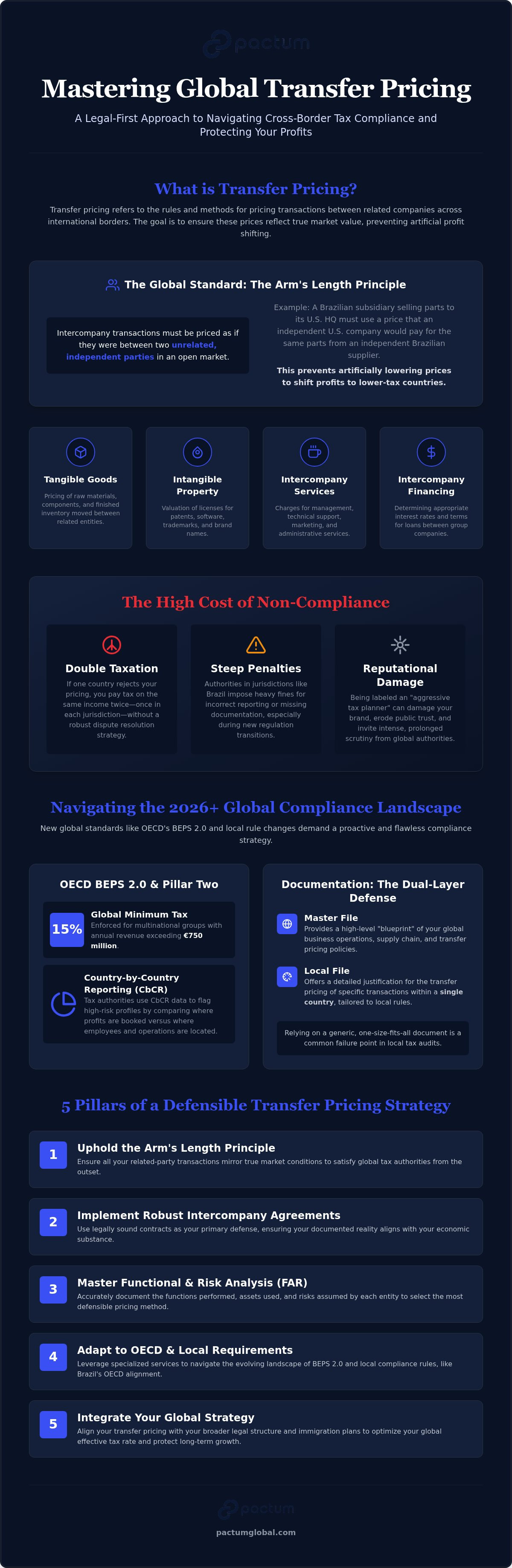
Transfer pricing refers to the rules and methods for pricing transactions between enterprises under common ownership or control. Because these transactions occur across international borders, they're a primary focus for tax authorities worldwide. Our transfer pricing services for multinationals help companies establish prices that reflect market reality. The "arm's length principle" is the global standard. It requires that intercompany prices match what two unrelated businesses would agree upon in an open market. If your Brazilian subsidiary sells components to your U.S. headquarters, the price can't be artificially low to shift profits. It must mirror a standard market transaction.
Why is 2026 a turning point? The U.S. One Big Beautiful Bill Act (OBBBA) took effect on January 1, 2026, fundamentally altering how international taxes are calculated. Simultaneously, the OECD's Pillar Two introduces a 15% global minimum tax for groups with revenue over €750 million. These changes mean that "business as usual" is no longer a safe option. You need a strategy that accounts for these shifting global standards to protect your bottom line.
The four pillars of transfer pricing include:
- Tangible goods: Raw materials and finished inventory.
- Intangible property: Patents, software, and trademarks.
- Intercompany services: Technical support and management fees.
- Intercompany financing: Loans and interest rates.
The Scope of Cross-Border Transactions
Moving inventory across borders requires precise valuation to avoid triggering customs or tax audits. Licensing your IP globally is equally complex. Tax authorities closely watch how you value trademarks to ensure profits aren't being moved to low-tax jurisdictions. Management fees and technical support must also be backed by evidence. You can't just send an invoice; you need to prove the service was actually rendered and provided value to the receiving entity. This requires clear documentation and a logical economic justification.
The Cost of Non-Compliance
Double taxation is the most immediate risk. If one country rejects your pricing and another has already taxed that income, you'll pay twice on the same profit without a robust dispute resolution strategy. Penalties are also steep. In Brazil, missing documentation or incorrect reporting during the OECD alignment transition can result in heavy fines. Our transfer pricing services for multinationals act as a shield against these bureaucratic errors. Reputational damage is also real. Being labeled an "aggressive tax planner" can hurt your brand and invite unwanted scrutiny from multiple jurisdictions simultaneously.
Navigating Global Compliance: OECD Standards vs. Local Rules
The OECD BEPS framework remains the primary architect of global tax policy in 2026. Pillar Two is now a reality, enforcing a 15% global minimum tax on multinational groups with annual revenue exceeding €750 million. This shift creates a high-stakes environment where your intercompany pricing must be flawless. Tax authorities use Country-by-Country Reporting (CbCR) to identify high-risk profiles by looking at where profits are booked versus where employees actually work. If your data shows high profits in low-tax jurisdictions with minimal headcount, you'll likely face an immediate audit.
Standardizing your approach is essential, yet "global" templates often fail when they hit specific borders. The gold standard for documentation remains the dual-layer approach of the Master File and the Local File. The Master File provides a high-level overview of your global operations and supply chain. In contrast, the Local File focuses on specific transactions within a single jurisdiction. Relying on a generic document can lead to immediate rejection during a local audit. Our transfer pricing services for multinationals bridge the gap between global strategy and local requirements, ensuring every file is defensible in its specific jurisdiction.
Brazil's OECD Alignment: A New Era
Brazil is currently in a historic transition. The country has moved away from its unique system of fixed margins and is adopting the OECD's arm's length principle. This change is vital for U.S. companies with Brazilian subsidiaries. Under the old rules, Brazilian tax calculations often led to double taxation because they didn't align with U.S. or international standards. The new alignment aims to eliminate this friction and provide a more stable environment for foreign investment. If you're managing operations in the region, understanding Brazil's New Transfer Pricing Rules is essential for maintaining compliance. It's no longer enough to follow local formulas; you must now prove economic substance through detailed functional analysis.
Portugal and EU Transfer Pricing Regulations
Operating in Portugal requires adherence to the EU's Directive on Administrative Cooperation (DAC). These rules demand transparency across all member states and facilitate the automatic exchange of information. Portuguese tax authorities have specific documentation thresholds that companies must meet. If your intercompany transactions exceed certain limits, you're required to maintain detailed records that justify your pricing. Managing IP transfers within the Eurozone is particularly sensitive. The EU focuses heavily on whether the entity receiving the IP has the functional capacity to manage it. If you're unsure about your current standing, we can help you review your transfer pricing services for multinationals to ensure your European operations are fully protected from aggressive tax audits.
The Critical Role of Intercompany Agreements in Transfer Pricing
The legal contract is your first line of defense during a tax audit. While many firms treat transfer pricing as a purely accounting exercise, tax authorities in 2026 prioritize the legal reality of your transactions. When an auditor begins an investigation, they don't start with your spreadsheets. They ask for the signed agreements that govern your intercompany relationships. If those contracts are missing or poorly drafted, your entire tax strategy becomes vulnerable to challenge. Contracts provide the necessary evidence to justify why money moved between your entities.
Tax authorities follow the "substance over form" rule. This means they'll look past a contract if the actual business behavior doesn't match the written terms. To protect your business, your legal documentation must align perfectly with your economic substance. If your U.S. parent company provides management services to a Portuguese subsidiary, the contract must detail exactly what those services are and how they add value. Our transfer pricing services for multinationals focus on bridging this gap between high-level tax planning and precise legal drafting. We ensure your contracts aren't just templates but defensible legal instruments.
Every intercompany service agreement should include specific clauses to withstand scrutiny. You must define the service scope, establish clear payment terms, and outline the risks each party assumes. Without these details, authorities may recharacterize your payments as dividends or "gratuitous" transfers, which often triggers higher tax rates and penalties. We act as a protective shield, ensuring your global structure is built on a foundation of compliant, enforceable agreements.
Drafting Effective Service and Customer Agreements
Clearly defining the scope of services is essential to justify management fees. You must prove that the service was actually rendered and that the receiving entity benefited from it. Setting payment terms that reflect market reality is equally vital. If your subsidiary pays more than an unrelated third party would, you'll likely face an audit. For a comprehensive look at the paperwork required for global growth, see our guide on Legal Documents for International Startups. These documents serve as the evidentiary trail for your transfer pricing services for multinationals.
Intellectual Property and Trademark Licensing
Determining royalty rates for cross-border IP use is one of the most sensitive areas of compliance. You must protect your brand value while remaining tax compliant in every jurisdiction where you operate. Tax authorities are increasingly skeptical of IP transfers to low-tax regions without significant functional activity. To build a defensible IP framework, you need a strategy that balances legal protection with economic reality. You can explore these complexities further in our Intellectual Property Strategy for Startups. Aligning your IP licensing with your transfer pricing policy ensures you don't overpay taxes or lose control of your most valuable assets.
Developing a Robust Transfer Pricing Documentation Strategy
Building a defensible strategy requires a methodical, step-by-step approach that moves beyond simple spreadsheets. A robust documentation strategy serves as your primary shield during a tax audit. It proves to authorities that your pricing wasn't arbitrary but based on sound economic logic. We recommend a five-step process to ensure your global operations remain protected:
- Step 1: Functional and Risk Analysis (FAR). This is the foundation. It identifies which entity performs key functions, owns valuable assets, and bears significant risks. If your U.S. entity makes all the strategic decisions, your documentation must reflect that reality.
- Step 2: Selecting the right TP method. You must choose a method that fits your specific transaction type, whether it's the Transactional Net Margin Method (TNMM) or the Cost Plus method.
- Step 3: Benchmarking. This involves finding comparable data from independent companies in your industry. It provides the "market range" that justifies your chosen price.
- Step 4: Annual documentation updates. Markets change rapidly. Your 2026 documentation must reflect current interest rates, inflation, and industry trends to remain valid.
- Step 5: Audit readiness. We help you prepare a "defense file" that contains all supporting evidence, from meeting minutes to market research, ready for immediate presentation to tax authorities.
Our transfer pricing services for multinationals focus on creating this comprehensive evidentiary trail. By identifying which entity actually controls the risks, you create a narrative that tax authorities can follow and respect.
Choosing the Right Transfer Pricing Method
Selecting the wrong method is a common mistake that leads to immediate audit flags. The Transactional Net Margin Method (TNMM) is often the most practical choice for intercompany services. It looks at the net profit margin relative to an appropriate base, such as costs or sales. In contrast, the Comparable Uncontrolled Price (CUP) method is the gold standard but requires nearly identical transactions to be valid. A SaaS company will have different documentation needs than a manufacturing firm. Matching the method to your specific business model ensures your profit allocation is logical and defensible.
Operationalizing Your TP Policy
A policy only works if it's integrated into your daily operations. You should incorporate your transfer pricing rules into your monthly invoicing process to avoid massive year-end adjustments. Large adjustments often trigger scrutiny from customs and tax officials. Monitoring your profit margins throughout the year allows for small, defensible corrections. Training your local teams on intercompany compliance is equally vital. When everyone understands the "why" behind the pricing, the risk of bureaucratic error drops significantly. If you need assistance setting up these internal workflows, our transfer pricing services for multinationals provide the expert guidance needed to secure your global growth.
Strategic Transfer Pricing Services: Why Your Legal Structure Matters
Your global legal structure is the foundation of your tax strategy. It's impossible to separate transfer pricing from your broader corporate architecture. The way you incorporate your subsidiaries and define their roles determines your global tax liability. When these elements are disjointed, bureaucratic friction increases and profits leak through inefficient structures. Our transfer pricing services for multinationals focus on creating a unified strategy where your legal entity setup and tax obligations work in harmony. This holistic approach ensures that your business remains agile as you expand into new markets.
Global mobility and immigration strategy also play a significant role in compliance. Moving executives or technical teams across borders changes where "mind and management" occurs. If a key decision-maker relocates from Brazil to the USA, the functional profile of your entities shifts. This can trigger unexpected tax residency issues or require a complete revision of your intercompany agreements. By integrating transfer pricing services for multinationals with your mobility plans, you prevent your immigration moves from creating accidental tax risks. A steady, reliable partner who understands both the visa process and the tax code is essential for maintaining this balance.
Integrating TP into Your Market Entry Strategy
Success in a new jurisdiction begins long before the first invoice is sent. Planning for transfer pricing during USA company setup allows you to build a defensible framework from day one. This proactive approach includes succession planning and asset protection for international founders. You must ensure that your intellectual property and capital are shielded from local bureaucratic errors. Additionally, understanding how Legal Support for Global Mobility impacts tax residency is vital. When your legal structure reflects your actual business operations, you remove the complexity that typically leads to audits.
Why Choose Pactum Global for Your Multinational Needs?
We provide a boutique focus on the high-growth corridors between Brazil, Portugal, and the USA. Our team offers a rare combination of expertise in corporate law, immigration, and international tax compliance. This "one-stop" model reduces the need for multiple consultants and ensures that your legal documents always match your tax reality. We're committed to transparency and the removal of international hurdles. We act as a seasoned navigator, mapping out your journey so you can focus on growth. By choosing a partner that prioritizes legal precision, you build a secure foundation that protects your multinational business for years to come.
Securing Your Global Growth in a Transparent Era
The 2026 landscape for international tax is marked by unprecedented transparency and stricter enforcement. With the OBBBA rules now active in the U.S. and Brazil completing its alignment with OECD standards, your documentation requires a legal-first approach. Success in this environment depends on more than just numbers; it requires aligning your intercompany agreements with your actual business behavior. Our transfer pricing services for multinationals provide the specialized legal and tax expertise needed to navigate the complex Brazil and Portugal corridors. We focus on comprehensive intercompany contract drafting to ensure your global structure is both defensible and optimized.
Don't let the fear of double taxation or bureaucratic complexity stall your expansion. We've built a proven track record in cross-border corporate structuring to act as your proactive shield against audit risks. Secure your global operations with Pactum Global's transfer pricing services today. You've worked hard to build an international presence. We're here to ensure your business foundation is strong enough to support your continued growth on the global stage.
Frequently Asked Questions
What is the 'arm's length' principle in transfer pricing?
The arm's length principle is the global standard requiring that prices for transactions between related entities mirror those between independent businesses under similar circumstances. This prevents companies from artificially shifting profits to low-tax jurisdictions. Tax authorities use this benchmark to ensure each entity reports income that reflects its actual economic activity. If your pricing deviates from this standard, you risk immediate adjustments and significant penalties during a tax audit.
Does my startup need transfer pricing documentation if we aren't profitable yet?
Yes, startups must maintain documentation even if they aren't profitable yet. Tax authorities often scrutinize loss-making entities to determine if the deficit is due to genuine business conditions or artificial intercompany pricing. Proper documentation justifies your operational costs and protects your future tax attributes, such as carried-forward losses. Establishing a defensible framework early prevents retroactive challenges once the company becomes profitable and faces higher scrutiny from global authorities.
How often should we update our transfer pricing study?
You should update your transfer pricing documentation annually to reflect changes in market conditions and internal operations. While benchmarking studies are typically refreshed every three years, the significant tax law changes in 2026, such as the U.S. OBBBA, may require more frequent reviews. Regular updates ensure your defense file remains current and accurate. This proactive approach prevents the use of outdated data that tax authorities could easily disqualify during an investigation.
What are the penalties for transfer pricing non-compliance in Brazil?
Penalties for non-compliance in Brazil are severe, especially during the current transition to OECD standards. Missing or incorrect documentation can lead to heavy fines based on a percentage of the transaction value or the company's gross income. Additionally, tax authorities may recharacterize intercompany payments, leading to double taxation. Utilizing transfer pricing services for multinationals helps mitigate these risks by ensuring your Brazilian operations align with the latest federal revenue requirements and reporting standards.
Can transfer pricing help reduce my company's global tax bill?
Transfer pricing can optimize your global effective tax rate by ensuring profits are allocated where value is actually created. This isn't about tax evasion; it's about avoiding double taxation and utilizing legal incentives in different jurisdictions. When your pricing strategy aligns with your operational substance, you can naturally reduce tax leakage. Our transfer pricing services for multinationals focus on this synergy between legal compliance and legitimate tax optimization to protect your group's overall bottom line.
What is a 'Master File' vs. a 'Local File' in OECD standards?
The Master File provides a high-level overview of a multinational group's global business operations, including its supply chain and intangible assets. It's designed to give tax authorities a global context of the business. The Local File focuses on specific transactions within a single country. It provides detailed economic analysis and justifications for the pricing used in that specific jurisdiction. Together, they form the comprehensive documentation package required by current OECD BEPS standards.
How does transfer pricing affect intercompany service agreements?
Transfer pricing dictates the pricing terms that must be included in your intercompany service agreements to ensure they are defensible. These legal contracts act as the primary evidence that a service was actually provided and that the fee was set at a market rate. Without a clear agreement that matches your transfer pricing study, tax authorities may reject the deduction of management fees. This creates a critical link between your legal drafting and tax compliance.
Is transfer pricing only for large corporations, or do SMEs need it too?
SMEs definitely need transfer pricing documentation if they have cross-border transactions. While some jurisdictions have higher reporting thresholds for large corporations, tax authorities are increasingly targeting smaller businesses that lack robust compliance structures. Even if you aren't required to file a formal Master File, you still must prove your pricing is at arm's length. Managing this risk early prevents small bureaucratic errors from turning into massive financial liabilities as your business scales.


