

An international joint venture is a corporate marriage where your governance documents are far more important than your initial investment. While the potential for global growth is exciting, the reality of managing a partnership across borders often brings significant stress. You might worry about losing control of your intellectual property to a foreign partner or feel overwhelmed by the question of which country's laws actually apply to your deal. Securing the right legal documents for international joint venture operations is the only way to replace that anxiety with a sense of calm security.
We understand that navigating local tax compliance and transfer pricing feels like a bureaucratic maze. This 2026 compliance guide helps you master the essential legal framework required to protect your cross-border partnership and ensure seamless operations. You'll gain a clear roadmap of the documentation you need to keep your assets safe across multiple jurisdictions. We'll also outline a professional framework for resolving partner disputes, ensuring your business stays focused on growth rather than conflict.
Key Takeaways
- Learn how to distinguish between contractual and equitable structures to ensure your alliance has the correct legal standing from day one.
- Discover why the Shareholders’ Agreement is the most vital of all legal documents for international joint venture operations when defining voting rights and veto powers.
- Protect your competitive advantage by documenting clear ownership rules for both pre-existing intellectual property and new foreground developments.
- Bridge the gap between corporate strategy and daily operations with precise service agreements and expert-led global mobility support for your partners.
- Secure a clean exit or transition by implementing proactive sunset clauses and buy-sell provisions long before a dispute arises.
The Legal Framework of an International Joint Venture
An international joint venture is a strategic alliance where two or more parties from different nations pool their resources to achieve a common goal. This International Joint Venture Overview highlights how these partnerships rely on shared risk and reward. Before signing deep commitments, partners often start with a Memorandum of Understanding (MoU). This non-binding precursor outlines the intent and basic terms without creating immediate legal obligations. It's the first step in assembling the necessary legal documents for international joint venture success.
Contractual vs. Equity-Based Structures
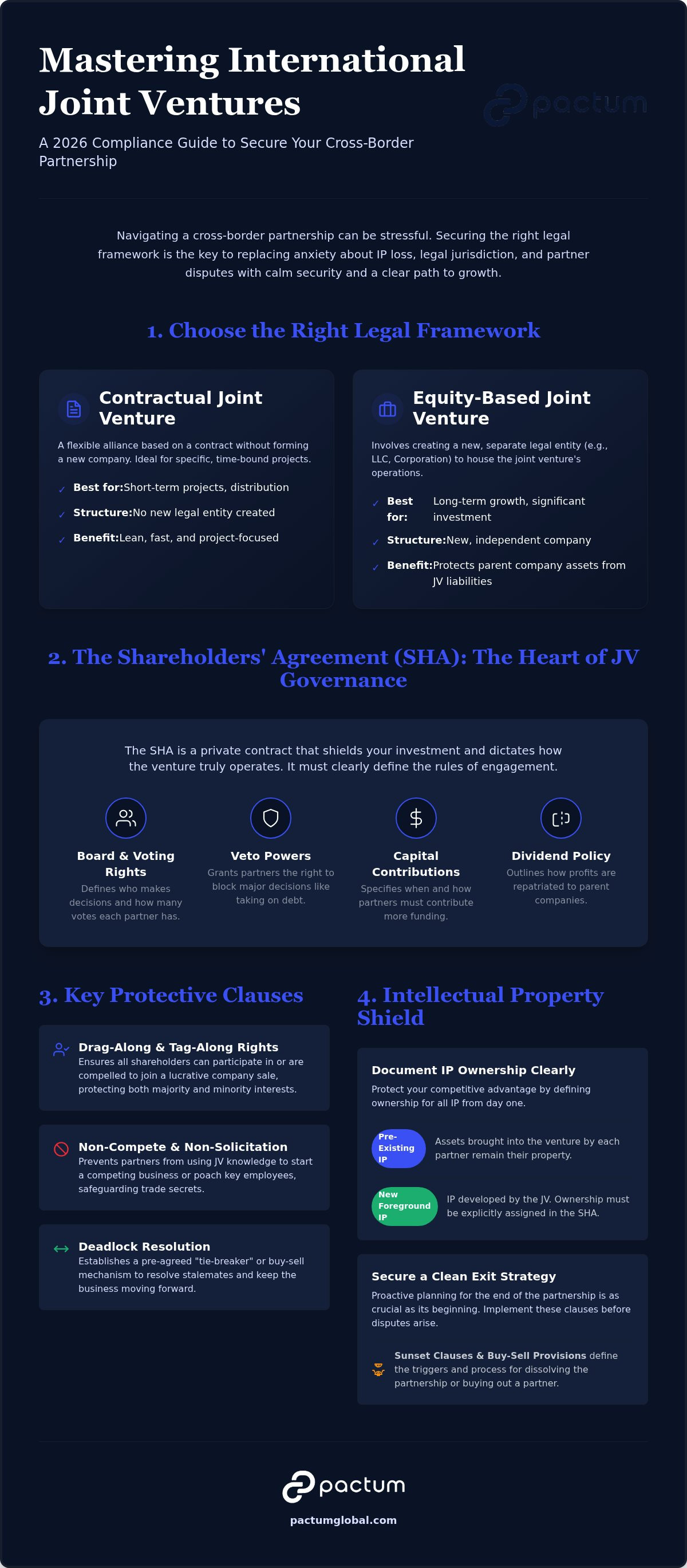
The choice between a contractual and an equity-based structure depends on your long-term goals. A contractual joint venture is ideal for short-term projects or distribution agreements where you don't want to form a new legal person. You simply agree to work together via a contract. This path is lean and punchy. In contrast, an equitable JV involves creating a separate legal entity, such as an LLC or a Corporation. This structure is better for long-term growth as it creates a clear boundary between the venture and the parent companies. It protects your existing assets from the venture's specific liabilities. If you are targeting the South American market, Pactum Global provides specialized support for company setup in Brazil for these specific JV entities. We ensure the local formation aligns perfectly with your global governance strategy.
Jurisdiction and Governing Law
Deciding which country's laws apply is one of the most critical decisions in your legal documents for international joint venture operations. Many businesses seek a "home court" advantage by choosing their own domestic laws. However, this isn't always practical when operating in a foreign market with strict local regulations. International treaties often influence how cross-border agreements are enforced. We typically recommend including arbitration clauses rather than relying on local litigation. Arbitration offers a neutral, private, and often faster way to resolve disputes. It ensures that a disagreement doesn't become a public, bureaucratic nightmare in a foreign court system. Choosing the right jurisdiction removes the "what if" anxiety that plagues many cross-border leaders. It provides a steady, predictable foundation for your partnership.
The Shareholders' Agreement (SHA): The Heart of JV Governance
The Shareholders' Agreement (SHA) is the most critical component among the legal documents for international joint venture operations. It serves as the primary shield for your investment. While the articles of association are often public and generic, the SHA is a private contract that dictates how the venture actually functions. Without a robust SHA, partners often face confusion regarding who makes the final call on strategic pivots. You must define board representation and voting rights with absolute clarity. Veto powers are equally vital; they ensure that major decisions, such as taking on significant debt or changing the core business model, require unanimous consent from all partners.
Managing these Legal Aspects of JV Agreements requires a forward-thinking approach to funding and profit. Your SHA should explicitly state when and how partners must contribute additional capital. This prevents the venture from stalling during a cash crunch. Equally important is the dividend policy. Establishing how and when profits are repatriated across borders removes the stress of uncertain cash flows. It ensures that the rewards of the partnership reach the parent companies in a predictable and tax-efficient manner.
Critical Clauses for Cross-Border Protection
- Drag-along and Tag-along rights: These clauses protect your exit options. Drag-along rights allow a majority to force a sale of the entire company, while tag-along rights ensure minority partners can join a lucrative exit on the same terms.
- Non-compete and non-solicitation: These prevent a partner from using the venture's resources or trade secrets to start a rival business or poach key staff.
- Deadlock resolution: When a 50/50 split leads to a stalemate, you need a pre-agreed "tie-breaker" or "buy-sell" mechanism to keep the business moving forward.
Customizing the SHA for Specific Markets
Every jurisdiction has unique requirements that influence your legal documents for international joint venture success. For instance, drafting a shareholders agreement for Portuguese company requires specific attention to local corporate codes and 2026 compliance standards. Similarly, US-Brazil partnerships must align with the distinct regulatory hurdles of both nations. The SHA acts as a formal roadmap that reduces the operational friction often caused by different cultural approaches to decision-making and risk management. If you are looking to secure your partnership, Pactum Global offers specialized Shareholders' Contracts (SHA) drafting to protect your global interests.
Intellectual Property and Compliance Documentation
Intellectual property is often the most valuable asset brought to the table. You need specific IP Licensing Agreements to define how the venture uses each partner's pre-existing technology. Without these, you risk losing control over your core innovations. You also need to determine who owns 'Foreground IP', which refers to the new inventions or software created by the venture itself. Will it belong to the JV entity, the contributing partner, or be shared? Using a Joint Venture Checklist helps ensure no detail is overlooked during these complex negotiations.
Compliance doesn't stop at IP. International partnerships must adhere to strict anti-corruption standards, such as the FCPA or the UK Bribery Act. Including these standards in your legal documents for international joint venture setups protects you from the legal fallout of a partner's actions. It's a proactive shield against global regulatory scrutiny. We ensure your contracts include audit rights so you can verify compliance at any time, maintaining a sense of calm security for your board.
Protecting Your Brand Internationally
Startups entering a JV need a specialized intellectual property strategy for startups to avoid being swallowed by larger partners. Trademark registration is a priority in every market where the JV operates. Brazil and the European Union (via Portugal) have different filing requirements and timelines that you must respect. You must also account for data protection. Regulations like the GDPR in Europe and the LGPD in Brazil dictate how shared data is handled and stored. We help you map out these requirements to ensure total transparency between partners.
Tax Compliance and Transfer Pricing
Taxation is where many JVs face unexpected hurdles. If you move goods or services between partners, transfer pricing documentation is mandatory to satisfy local tax authorities. This prevents authorities from claiming you're shifting profits to avoid taxes. You must also manage 'Permanent Establishment' risks. This happens when a foreign partner's activities create a taxable presence in a new country unintentionally. Managing withholding taxes on royalty payments is another vital step in your legal documents for international joint venture planning. It ensures your cross-border payments remain compliant and cost-effective, removing the stress of unforeseen tax bills.
Operational Contracts and Global Mobility Support
Governance provides the structure, but operational contracts provide the momentum. Service Level Agreements (SLAs) are essential legal documents for international joint venture management because they define the daily contributions of each partner. If one party provides the manufacturing facility and the other handles global distribution, the SLA codifies these specific responsibilities. Without this clarity, partnerships often stall due to finger-pointing when targets aren't met. We help you draft these agreements to ensure every stakeholder knows exactly what they owe the venture.
The "human element" is just as critical as the corporate structure. You must secure employment and consultancy agreements for key personnel assigned to the JV. These documents need to align with the local labor laws of the target country to avoid costly legal disputes. Customizing vendor and customer agreements for the new JV entity is also a priority. This ensures the venture can operate as a standalone business from day one, with clear terms that protect the interests of all founding partners.
Service and Customer Agreements
When drafting master service agreements, you must account for multiple currencies and fluctuating exchange rates. This removes the risk of one partner bearing an unfair financial burden due to currency devaluations. Limitation of liability clauses are another staple in international commercial contracts. They protect the parent companies from unlimited exposure if the venture faces a lawsuit. We ensure these contracts are compliant with local standards in Brazil, Portugal, or the USA, providing a seamless foundation for your sales team.
Global Mobility: Visas for Partners and Executives
A joint venture is only as effective as the people running it. Our legal support for global mobility ensures that partners and executives can actually visit the JV site without bureaucratic delays. Choosing between a business visa and a work permit depends on the length of the stay and the nature of the work. For ventures centered in Portugal, the D2 visa or the Golden Visa programs offer strategic paths for long-term residency. We manage the entire immigration process for your global team, so you can focus on scaling your partnership rather than filling out visa forms.
Exit Strategies and Succession Planning
Every joint venture should be viewed as an evolving corporate structure rather than a static agreement. While the initial focus is usually on growth, your legal documents for international joint venture must account for the possibility of an exit. A 'Sunset Clause' defines the natural conclusion of the venture, ensuring all parties know when the project has reached its logical end. Without this, partnerships can linger in a state of unproductive limbo. It's better to plan for a graceful conclusion while the relationship is strong.
Buy-sell provisions provide a clear mechanism for one partner to buy out the other if interests diverge. These are often triggered by specific events, such as a change in control at the parent company level or a persistent deadlock. Liquidation and winding-up procedures in foreign jurisdictions like Brazil or Portugal can be notoriously complex. We help you map these steps early, turning a potentially chaotic closure into a methodical, step-by-step transition. This foresight protects your capital and your reputation.
Planning the Clean Break
Deciding between a Right of First Refusal (ROFR) and a Right of First Offer (ROFO) is a strategic choice. A ROFR allows a partner to match a third-party offer, while a ROFO requires the selling partner to offer the shares to the existing partner first. Both protect the cap table from unwanted outsiders. Pre-agreeing on valuation methodologies is equally vital. It removes the emotional friction of price negotiations during an exit. Finally, your exit plan must address the return of licensed IP and trade secrets. This ensures your core technology doesn't remain in a foreign market after the venture concludes.
Cross-Border Succession Planning
Succession planning for individual partners is often overlooked but remains a critical risk factor. If a key founder passes away, the venture could face immediate instability. This is why legal documents for international startups must include clear succession rules for foreign assets. Including these in your legal documents for international joint venture setups prevents assets from getting trapped in probate across different jurisdictions. Pactum Global manages these cross-border asset transitions with a focus on transparency and legal continuity. We act as a proactive guide to ensure your business interests remain secure and transferable across borders.
Building a Resilient Global Partnership
Mastering the legal documents for international joint venture operations is about more than just checking boxes. It's about building a foundation for sustainable growth. By prioritizing a robust Shareholders' Agreement and clear intellectual property rules, you remove the uncertainty that often stalls cross-border alliances. You've learned that a successful venture requires a balance between strong governance and the operational agility provided by global mobility support and precise exit strategies.
Pactum Global acts as your steady navigator through the complexities of international bureaucracy. We specialize in the unique jurisdictions of Brazil, Portugal, and the USA, offering end-to-end support from initial company setup to succession planning. Our expertise in cross-border shareholders' agreements ensures your interests remain protected at every turn. You don't have to face these hurdles alone. Secure your international partnership with Pactum Global’s expert legal structuring today. Your global expansion is within reach, and we're here to ensure your journey is efficient, secure, and successful.
Frequently Asked Questions
What is the most important legal document for an international joint venture?
The Shareholders' Agreement (SHA) is the most vital among the legal documents for international joint venture operations. It serves as the primary governance tool that dictates voting rights, board representation, and veto powers. While other contracts manage daily tasks, the SHA protects your capital and ensures you maintain control over strategic pivots. It replaces the anxiety of a 50/50 deadlock with a clear, pre-agreed roadmap for decision-making.
Do I need a separate shareholders' agreement if we already have a joint venture agreement?
Yes, you typically need both if the venture involves a separate legal entity. A Joint Venture Agreement (JVA) often outlines the strategic goals and initial contributions of the partners. However, the Shareholders' Agreement provides the granular detail needed to manage the actual corporation. It covers specific share transfer restrictions, dividend policies, and exit mechanisms. Having both documents ensures that the broad partnership vision doesn't clash with the practical requirements of corporate governance.
How do I protect my intellectual property when partnering with a foreign company?
You protect your intellectual property by executing robust IP Licensing Agreements before sharing any proprietary technology. These legal documents for international joint venture success must clearly distinguish between pre-existing Background IP and Foreground IP created by the venture itself. Additionally, you must register your trademarks in every target jurisdiction, such as Brazil or Portugal. This proactive approach prevents a foreign partner from claiming ownership of your brand or technology after the partnership ends.
Can I use a US law contract for a joint venture based in Brazil or Portugal?
You can often choose US law to govern the contract, but you must still comply with local mandatory laws. While partners may prefer the predictability of New York or Delaware law for the Shareholders' Agreement, the local entity must follow the corporate codes of Brazil or Portugal. This includes labor laws, tax filings, and registration requirements. We help you harmonize these jurisdictions so your global governance stays consistent without triggering local regulatory errors.
What happens if my international partner goes bankrupt or changes ownership?
Your Shareholders' Agreement should include trigger events that address bankruptcy or a change in partner control. These clauses often grant you a Right of First Refusal to buy out the partner’s interest or the right to terminate the venture entirely. This prevents an unknown third party or a bankruptcy trustee from becoming your new business partner. Planning for these scenarios provides a sense of security that your investment won't be compromised by your partner's external financial troubles.
What are the tax implications of forming an international joint venture?
The tax implications involve transfer pricing, withholding taxes, and avoiding Permanent Establishment (PE) risks. When you move goods or services between partners, you must document that the pricing is at arm's length to satisfy tax authorities in Brazil, Portugal, or the USA. You must also account for withholding taxes on cross-border royalty or dividend payments. Proactive tax planning ensures that your profits aren't eroded by double taxation or unexpected penalties from foreign revenue services.
How long does it take to draft and execute all the necessary JV documents?
Drafting and executing a full suite of JV documents typically takes between three and six months. This timeline accounts for the negotiation of the SHA, IP licensing, and the formal company setup in the target jurisdiction. Complexity increases when dealing with different legal systems, such as the civil law systems in Brazil or Portugal compared to US common law. Starting early allows you to map out the journey thoroughly so you don't rush into a flawed structure.
Is arbitration better than local courts for international business disputes?
Arbitration is generally superior to local litigation for international business disputes. It offers a neutral forum, private proceedings, and the ability to choose experts as judges. Most importantly, the New York Convention makes arbitration awards much easier to enforce across borders than foreign court judgments. Choosing arbitration removes the fear of a home court advantage for your partner, providing a level playing field for resolving complex commercial disagreements.


