

For the Brazilian founder, the dream of a US headquarters often hits a wall before the first flight. This happens not because of a lack of ambition, but because of a fragmented strategy. Securing a US visa for Brazilian entrepreneurs is a multi-layered challenge that requires more than just filling out forms. It demands a precise synchronization of Brazilian and American legal frameworks to avoid costly errors.
You likely feel the weight of managing compliance between the IRS and Receita Federal, or the fear of double taxation on your global income. It's frustrating to face the lack of an E-2 treaty for Brazil when you're ready to invest. We understand these hurdles. This guide provides a clear, step-by-step strategic framework to navigate these complexities. You'll learn how to secure a valid visa for yourself and your key staff while protecting your intellectual property. We will preview the most viable pathways for 2026, including L-1A and EB-2 NIW options, and show you how to build a tax-optimized corporate structure that supports long-term growth.
Key Takeaways
- Understand why capturing USD revenue is the top priority for Brazilian founders in the current 2026 economic landscape.
- Determine whether an LLC or C-Corporation fits your five-year growth plan and institutional investment goals.
- Discover how to secure a US visa for Brazilian entrepreneurs using the L-1A executive transfer or the E-2 dual-citizenship workaround.
- Protect your Brazilian brand and intellectual property while ensuring your intercompany transactions meet 2026 OECD transfer pricing standards.
- Learn to synchronize your Brazilian tax exit with your US entity launch through a structured, end-to-end strategic framework.
The Strategic Case for Expanding Your Business from Brazil to the USA
The 2026 "Brazil-US Corridor" represents a massive opportunity for founders who are ready to look beyond their home borders. Economic synergies between the two nations have matured significantly; specifically in sectors like fintech, agtech, and green energy. Brazilian founders aren't just looking for new customers. They're prioritizing USD-denominated revenue to protect their balance sheets. Earning in dollars provides a natural hedge against the volatility of the Real and increases a company's valuation in the eyes of global acquirers. In 2026, we see a specific synergy between the tech hubs of São Paulo and emerging US centers like Austin and Miami. These connections allow for seamless talent sharing and co-development, provided the legal architecture is in place.
Securing a US visa for Brazilian entrepreneurs is often the first hurdle in accessing the US venture capital ecosystem. Most institutional investors and top-tier accelerators require a Delaware-based entity before they'll even consider a term sheet. This legal requirement makes the US more than just a market; it's a necessary infrastructure for any startup with global ambitions. For those who can make a substantial capital investment, the EB-5 Immigrant Investor Program remains a pathway to permanent residency, though operational visas are often more practical for active founders who need to manage daily growth.
Managing this transition requires a global navigator. You need a partner who understands the specific gap between the business culture of São Paulo or Rio and the legal realities of Delaware or Florida. This role is about more than filing papers. It's about bridging two distinct legal and tax worlds to ensure your expansion doesn't create liabilities back home. We act as a shield against the bureaucratic errors that often stall international growth.
Market Entry vs. Corporate Relocation
Success starts with choosing the right level of presence. A sales outpost allows you to test the waters with minimal overhead. In contrast, a full-scale corporate headquarters signals a long-term commitment to US partners. Florida remains the top choice for Brazilian physical relocation because of its cultural ties, time zone alignment, and strategic location. However, you must assess your readiness for the 2026 US competitive landscape. The market moves fast. Your operational structure must be lean enough to adapt while remaining robust enough to comply with both US and Brazilian regulations.
The "Custo Brasil" vs. US Operational Realities
One of the biggest shocks for Brazilian founders is the shift in labor dynamics. Moving from the high-friction CLT system to the US "at-will" employment model provides immense flexibility; however, it demands better internal management and clearer service agreements. You're shifting from a reactive legal defense posture to a proactive structural planning approach. A credible US expansion in 2026 requires more than just a plane ticket. It requires initial capital for entity setup, transfer pricing services, and the legal work required for a US visa for Brazilian entrepreneurs. Investing in a solid foundation now prevents expensive bureaucratic errors later.
Choosing the Right Entity: LLC vs. C-Corporation for Brazilian Founders
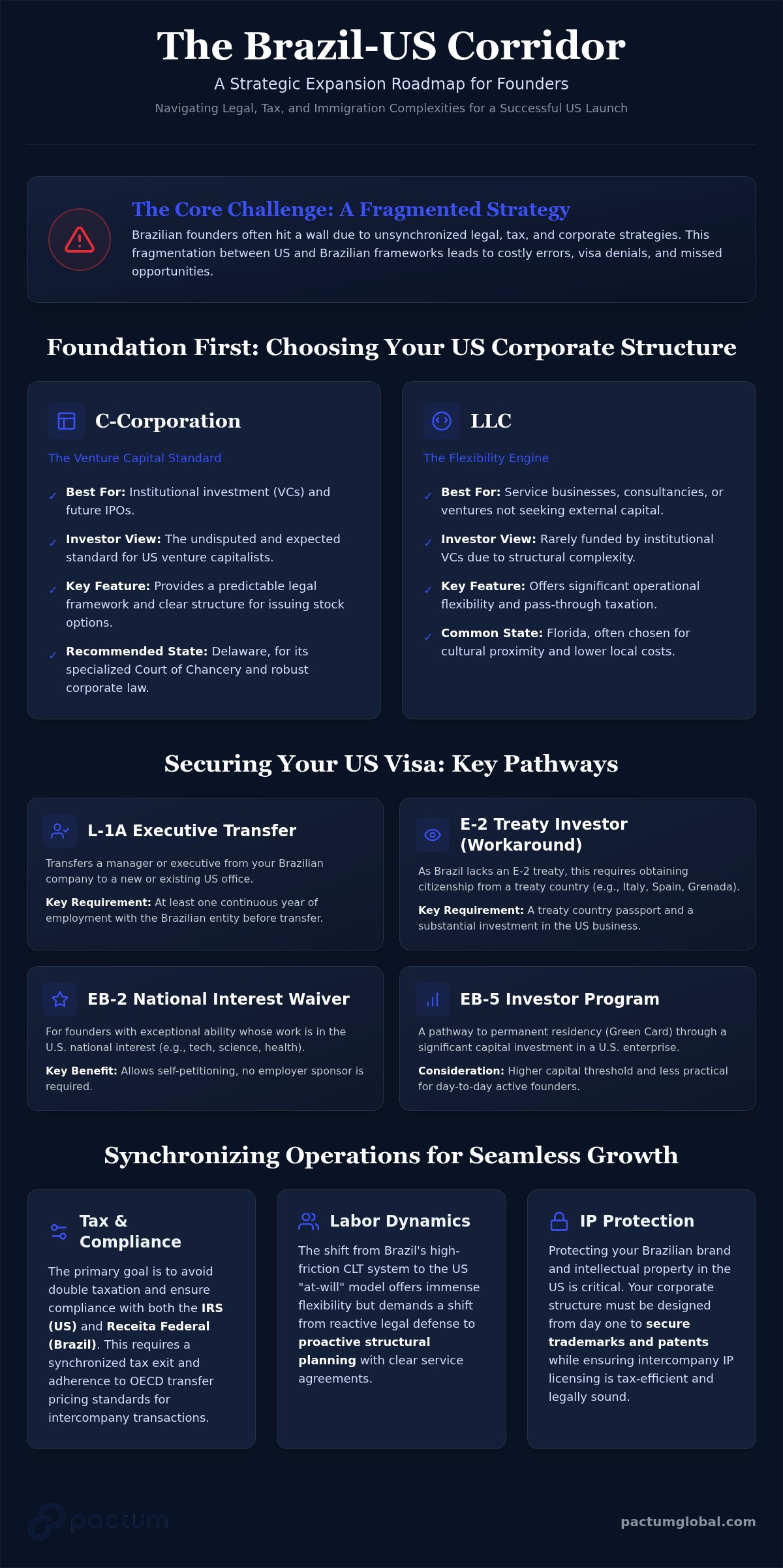
Choosing between an LLC and a C-Corporation is a decision that dictates your five-year growth trajectory. For founders targeting institutional investment or an eventual IPO, the Delaware C-Corporation remains the undisputed standard. Investors expect Delaware. US venture capitalists rarely deviate from this structure because it offers a predictable legal environment and a clear framework for issuing stock options. Conversely, an LLC offers operational flexibility and pass-through taxation. This is often the preferred route for family-owned service businesses or Brazilian consultancies that don't intend to raise external capital. Your choice of entity is a critical component when applying for a official USCIS guidance for entrepreneurs, as the business must demonstrate a credible structure to support its executives.
The state of incorporation is just as vital as the entity type. While Florida offers cultural proximity and lower local costs, Delaware provides unmatched legal protections through its specialized Court of Chancery. Most sophisticated investors will insist on Delaware to minimize litigation risks. Selecting the wrong jurisdiction can complicate your path to a US visa for Brazilian entrepreneurs, especially if the business structure appears too informal to immigration officials. It's about building a foundation that commands respect from both banks and government agencies.
Tax Implications for the Brazilian Parent Company
Your US entity choice directly impacts your Brazilian tax obligations. One common pitfall is ignoring the "tax exit" implications when relocating operations. Because Brazil and the US lack a formal income tax treaty, you must use proactive structural planning to avoid double taxation. Utilizing specific strategies like the "Check-the-Box" election can help align your US tax status with your Brazilian filing needs. For a deeper look at these requirements, see our guide on USA company setup for non-residents. We can help you design a tax-efficient roadmap that protects your global income while you focus on scaling.
Governance and Strategic Shareholders Agreements
The logic of a Brazilian "Contrato Social" doesn't translate well to the US legal system. US corporate governance relies heavily on private contracts and bylaws rather than public registration documents. You need a robust shareholders agreement for cross border business to manage the relationship between your Brazilian headquarters and the new US subsidiary. This document should clearly define control, dispute resolution, and intellectual property rights. Without these protections, the shift from a Rio or São Paulo office to a US entity can lead to governance deadlocks that threaten your expansion. Clarity in your governance structure is essential for a successful transition.
Immigration Pathways: Securing Visas for Founders and Key Executives
Selecting a corporate structure is only half the battle. The next phase involves choosing the correct US visa for Brazilian entrepreneurs. This choice depends on your timeline, available capital, and long-term residency goals. While your choice of LLC vs. C-Corporation for founders impacts your tax liability, it also serves as the evidence of your business's existence for immigration officers. You must demonstrate that your US entity is a viable, active enterprise capable of supporting executive leadership. For most, the L-1A visa remains the gold standard because it allows for the transfer of established managers from the Brazilian headquarters to the new US office.
If you're seeking permanent residency, the EB-5 Immigrant Investor Program offers a path to a Green Card for those who can invest at least $800,000 in a Targeted Employment Area. However, many tech innovators find the O-1 visa for extraordinary ability to be a faster alternative if they possess high-level industry recognition. Data from 2024 shows that Brazilian professionals have a strong track record in these categories, with a 78% approval rate for EB-2 National Interest Waivers. Success requires a proactive strategy that aligns your immigration petition with your corporate governance.
The L-1 "New Office" Petition Process
For a Brazilian company establishing its first US footprint, the L-1A "New Office" petition is a primary tool. It's initially granted for one year, requiring a renewal that proves the office has become operational. You must follow three critical steps:
- Establish a qualifying relationship: The Brazilian parent company must own or control the US subsidiary.
- Draft a 5-year business plan: This document must meet strict USCIS standards, showing that the US office will support a managerial position within 12 months.
- Prove executive capacity: You must show that the transferee will manage an essential function or a department rather than performing daily operational tasks.
The Dual-Citizenship Strategy for E-2 Visas
It's vital to remember that Brazil does not have an E-2 treaty with the United States. Brazilian citizens are not directly eligible for this category. To bypass this, many founders leverage dual citizenship from treaty countries like Italy, Spain, or Portugal. This "workaround" allows you to apply for an E-2 Treaty Investor Visa, which is favored for its flexibility. In the 2026 market, you must demonstrate a "substantial" investment. While there's no fixed dollar amount, the capital must be enough to ensure the business's success. You'll also need to maintain an "intent to depart" the US once the visa expires, even as you scale a permanent operation. This strategy requires careful coordination between your two citizenships and your US corporate entity.
Operational Compliance: IP Protection and Transfer Pricing
Expanding your business is more than a physical move. It's a strategic realignment of your corporate assets. While you focus on securing a US visa for Brazilian entrepreneurs, you must also build a legal shield around your brand and revenue. Operational compliance ensures that your US presence is respected by both the IRS and the USPTO. Without this foundation, your expansion remains vulnerable to legal challenges and tax audits that could jeopardize your immigration status. You're shifting from the reactive legal culture of Brazil to a proactive, structural planning model in the United States.
This phase of expansion requires you to define the relationship between your Brazilian headquarters and the new US subsidiary. You must formalize every interaction through intercompany service agreements. These documents serve as the primary evidence for both immigration officials and tax authorities that your US office is a distinct, functioning entity. A well-structured intercompany framework protects your Brazilian assets from US liabilities while ensuring your US staff can operate with full legal authority.
Intellectual Property Strategy
Protecting your brand starts with a federal trademark filing at the USPTO. Many Brazilian founders mistakenly believe their INPI registration offers global protection. It doesn't. In the US, trademark "squatting" is a real threat. If you don't secure your mark early, a third party can register it and force you to rename your company or pay high settlement fees. You must decide which entity owns your global patents and trademarks. Often, a US-based holding company is the best choice for protecting IP, but this requires a robust intellectual property strategy. Licensing agreements then allow you to repatriate profits to Brazil as royalties, which is often more tax-efficient than simple dividends.
Transfer Pricing and Tax Compliance
The 2026 Brazil-US landscape remains complex due to the lack of a formal double-taxation treaty. To avoid paying tax twice on the same dollar, you must implement strict transfer pricing documentation. All intercompany transactions must meet 2026 OECD standards to be considered "arm's length." This includes management fees, technical support, and royalty payments. You must also avoid the "Permanent Establishment" trap. If a Brazilian executive manages the US subsidiary without a clear corporate boundary, the IRS may claim the entire Brazilian company is subject to US tax. We can help you implement a compliant transfer pricing framework that keeps your global operations secure while you scale your American presence. This proactive approach turns a bureaucratic hurdle into a competitive advantage.
The Pactum Global Roadmap: Your Partner in US Expansion
Moving from a Brazilian corporate base to a US operation is a high-stakes transition. Most founders struggle because they try to manage separate providers for tax, corporate law, and immigration. This fragmented approach leads to conflicting advice and missed deadlines. Pactum Global acts as your global navigator, removing this friction through a unified strategy. We provide end-to-end support that starts with your Brazilian tax exit and concludes with a successful US entity launch. Our process ensures that your corporate structure isn't just legally sound; it's also optimized for securing a US visa for Brazilian entrepreneurs. We replace stress with a sense of calm confidence by handling the heavy lifting of international bureaucracy.
Our "no-nonsense" approach replaces bureaucratic confusion with clear, actionable steps. We don't just provide generic templates that fail under scrutiny. We specialize in customized legal drafting, including international startup legal packages that protect your interests across both jurisdictions. This integrated model means your Shareholders Agreement and your immigration petition work in harmony. By building a protective shield around your expansion, we allow you to focus on growth while we secure your foundation. We are deeply invested in your success, acting as a steady partner throughout your journey.
Why a One-Stop Consultancy Wins
Traditional firms often separate immigration from corporate governance. This creates a dangerous information gap. An immigration lawyer might suggest a structure that a corporate lawyer finds restrictive for future investment or IPO goals. We eliminate this risk by bridging the gap between Rio de Janeiro and Delaware. By managing legal support for global mobility for your entire team, we ensure consistency across all filings. Our network of localized experts in both Brazil and the US provides the specific jurisdictional knowledge required to avoid costly errors. You gain the benefit of high-level legal authority with an approachable, supportive demeanor.
Next Steps for Your 2026 Expansion
Your journey begins with a clear assessment of your current standing. We conduct an initial diagnostic of your Brazilian corporate structure to identify any potential hurdles for expansion. From there, we develop a strategic timeline for your market entry and executive transfer. This methodical approach ensures you don't miss critical 2026 deadlines or fail to meet USCIS "New Office" requirements. We help you map out the journey so you can move with efficiency and ease. When you're ready to secure your US visa for Brazilian entrepreneurs and launch your American office, you can schedule a consultation with Pactum Global to begin your expansion roadmap. Let us handle the complexity so you can lead your company into the US market.
Launching Your American Legacy with Confidence
Expanding your business from Brazil to the United States is a transformative milestone. It requires more than just a market entry plan; it demands a robust legal architecture that aligns your corporate goals with your immigration status. By selecting the right entity and protecting your intellectual property early, you build a foundation that investors and regulators respect. Securing a US visa for Brazilian entrepreneurs is a manageable process when your corporate governance and immigration petitions work in harmony. You're building more than a company; you're establishing a global presence.
Pactum Global provides the specialized expertise in Brazil-US cross-border law needed to navigate these complexities. Our integrated immigration and corporate services eliminate the information gaps that often stall international expansion. We offer modern, protective, and results-focused legal guidance designed to demystify the intricacies of global mobility. You don't have to navigate this transition alone. We act as your steady partner, ensuring every legal detail is handled with precision so you can focus on scaling your vision.
Secure your US business future with a Pactum Global consultation. Your expansion into the American market is within reach, and we're here to ensure your journey is efficient, secure, and successful.
Frequently Asked Questions
Do I need to be a US citizen to open a business in the USA from Brazil?
You don't need US citizenship or a Green Card to establish a business in the United States. Foreign nationals, including Brazilian citizens, can own 100% of a US entity from abroad. While you can incorporate a company without a visa, you will need a valid US visa for Brazilian entrepreneurs to legally work for that company or reside in the US. This distinction is vital for founders who want to manage their expansion remotely initially.
Which US state is best for a Brazilian company to incorporate in?
Delaware and Florida are the two primary choices for Brazilian founders. Delaware is the gold standard for startups seeking venture capital because of its specialized Court of Chancery and investor-friendly laws. Florida is often preferred for businesses with physical operations due to its cultural ties to Brazil and time zone alignment. Your choice should reflect your five-year exit strategy and whether you intend to raise institutional capital or maintain a family-owned service business.
How much capital do I need to invest for an L-1 or E-2 visa?
The capital requirements vary significantly by category. For an EB-5 visa, the minimum investment is $800,000 in a Targeted Employment Area or $1,050,000 elsewhere. The E-2 visa requires a substantial investment, which is often interpreted as $100,000 or more depending on the business type. The L-1 visa doesn't have a fixed minimum investment but requires proof that the US office can support a managerial role within one year, usually through a detailed business plan.
Can I use my Brazilian trademark in the US automatically?
No, your Brazilian trademark registered with the INPI doesn't provide protection in the United States. Trademarks are territorial, meaning you must file a new application with the USPTO to protect your brand from US-based squatting. We recommend filing before your official market entry to secure your intellectual property. This proactive step ensures that your brand remains yours as you scale and prevents costly rebranding or legal disputes with third parties as you grow.
Will I be double-taxed on my US and Brazilian income?
Brazil and the US don't have a formal double-taxation treaty as of 2026. This makes strategic structural planning essential to avoid paying tax twice on the same income. You can use mechanisms like the Check-the-Box election or specific intercompany service agreements to manage your global tax burden. Proper transfer pricing documentation is also required to ensure your intercompany transactions meet OECD standards and remain compliant with both the IRS and Receita Federal requirements.
What is the difference between a Representative Office and a Subsidiary?
A representative office is typically limited to non-commercial activities like market research or liaison work. It doesn't allow for direct revenue generation in the US. A subsidiary is a separate legal entity, such as an LLC or C-Corp, that can sign contracts, hire employees, and generate profit. For founders seeking a US visa for Brazilian entrepreneurs, a subsidiary is usually required to demonstrate a credible, active business presence that justifies an executive transfer to the United States.
How long does the process of expanding a business from Brazil to the USA take?
A full expansion usually takes between six and twelve months. Incorporating a US entity takes only a few days, but securing an EIN and opening a bank account can take several weeks. The immigration phase is the longest variable. Standard USCIS processing for an L-1 petition is approximately seven months, though premium processing can reduce the I-129 adjudication to 15 business days. We recommend starting the process at least nine months before your target launch date.
What legal documents are essential for an international startup expanding to the US?
You need a robust set of documents to protect your interests across borders. Essential filings include your Articles of Incorporation, Bylaws or Operating Agreement, and a cross-border Shareholders Agreement. You also need an Intellectual Property assignment agreement and intercompany service agreements to formalize the relationship between your Brazilian HQ and the US subsidiary. These documents serve as critical evidence for both tax authorities and immigration officials during your expansion journey and provide the foundation for your success.


