

A 2025 survey of industry professionals revealed that half of all respondents spend between 50 and 200 hours responding to a single audit, with case costs often exceeding $1 million. For an international entrepreneur, these figures represent more than just a financial risk; they are a significant distraction from your core mission. It's understandable to feel anxious about conflicting regional laws or the looming threat of double taxation. You need a strategy that offers security and clarity rather than complexity. We believe that international bureaucracy shouldn't be a barrier to your success.
This guide will help you master the essentials of transfer pricing so you can protect your cross-border business and optimize your international tax structure. Our goal is to replace confusion with a sense of calm confidence. We will demystify the arm's length principle and provide a practical framework for preparing the documentation that tax authorities now demand. You will learn how to align your compliance with your long-term growth goals in jurisdictions like the USA, Brazil, and Portugal. We have mapped out the journey so you can focus on scaling your reach.
Key Takeaways
- Identify how ownership and control trigger specific tax regulations to ensure your cross-border transactions meet the modern arm's length standard.
- Evaluate the five OECD-recognized valuation methods to determine which strategy best protects your business assets and profit margins.
- Master the two-tier documentation approach by preparing Master and Local Files that satisfy 2026 global transfer pricing requirements.
- Anticipate regional regulatory shifts in Brazil, Portugal, and the USA to shield your operations from audits and the risk of double taxation.
- Strengthen your corporate structure by aligning intercompany agreements with your broader international tax and growth strategy.
What is Transfer Pricing? Defining the Modern Cross-Border Standard
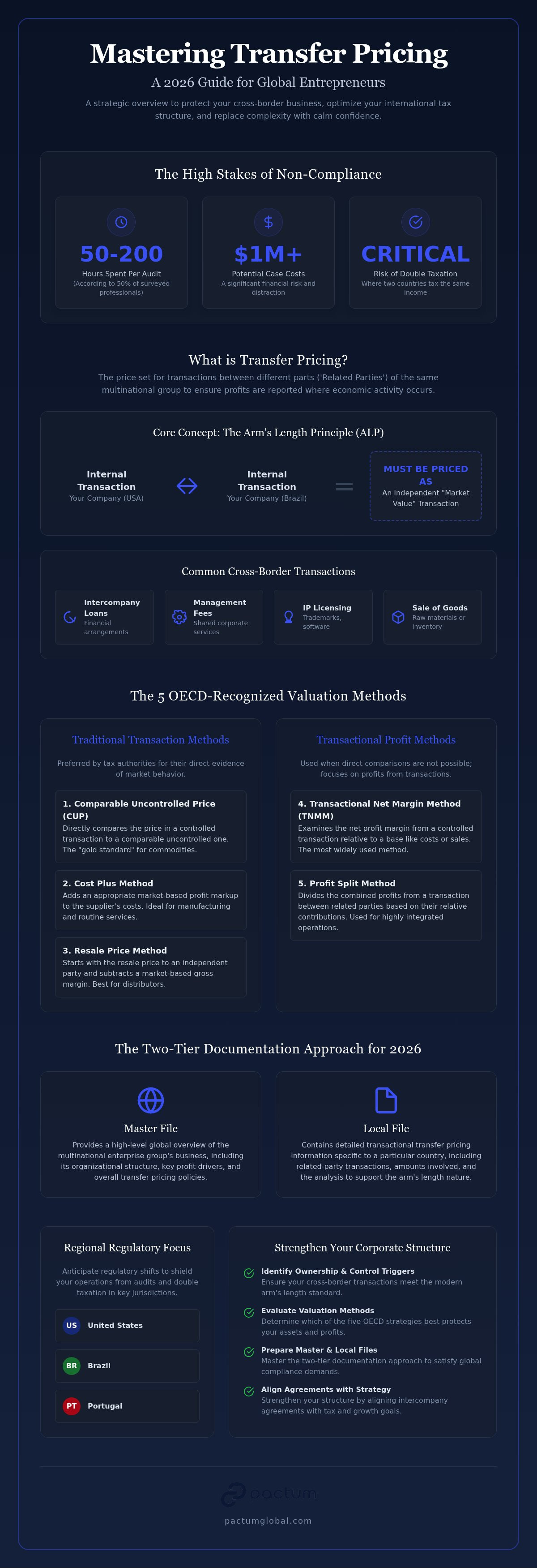
Transfer pricing is essentially the price set for transactions between different parts of the same multinational group. When one branch of your business sells goods, provides services, or licenses intellectual property to another branch in a different country, you must assign a value to that exchange. This isn't just an internal accounting choice. It's a regulatory requirement that ensures profits are reported where the actual economic activity occurs. Understanding Defining the Modern Cross-Border Standard is crucial for any business operating across jurisdictions.
The "Related Party" concept is the trigger here. If one entity has significant ownership or control over another, tax authorities assume their transactions might not naturally reflect market prices. Without oversight, companies could theoretically shift profits to lower-tax regions. By managing this properly, you achieve profit transparency and, more importantly, avoid the trap of double taxation where two countries tax the same income.
Common transactions include:
- Intercompany loans and financial arrangements.
- Management fees for shared corporate services.
- Licensing of trademarks or proprietary software.
- Sales of raw materials or finished inventory.
The Arm’s Length Principle (ALP) Explained
The Arm's Length Principle is the global yardstick for transfer pricing compliance. It requires you to price your internal deals exactly as if you were transacting with a completely independent party on the open market. Tax authorities use this "Market Value" benchmark to verify that your intercompany pricing isn't artificially inflated or deflated. Because the ALP is the foundation of every audit, having a clear justification for your pricing is your best protective shield.
Who Needs to Worry About Transfer Pricing in 2026?
Compliance isn't just for massive conglomerates. It's a strategic necessity for:
- Startups with R&D teams in one country and sales operations in another.
- Service providers using offshore talent hubs or remote management structures.
- Entrepreneurs pursuing international company formation to enter new markets.
If your business moves value across a border, you are on the radar of tax authorities. Modern tax systems are increasingly sophisticated. They expect you to have your documentation ready before an audit starts. We believe that international bureaucracy shouldn't be a barrier to your growth, and mastering these basics is the first step toward a secure global structure.
Transfer Pricing Methods: Choosing the Right Valuation Strategy
Selecting the right method is the cornerstone of your transfer pricing strategy. It isn't just about compliance; it's about building a defensible narrative for tax authorities. The OECD recognizes five primary Transfer Pricing Methods that serve as the global standard for 2026. Choosing between them depends on your business model, the type of transaction, and the availability of reliable market data. You need a strategy that balances precision with the practical reality of your operations.
Traditional Transaction Methods
These methods look directly at the prices or margins of specific transactions. They are often preferred by tax authorities because they provide the most direct evidence of market behavior.
- Comparable Uncontrolled Price (CUP): This is the gold standard for commodities and simple services. It compares the price charged in a controlled transaction directly to the price charged in a comparable uncontrolled transaction.
- Cost Plus Method: This is ideal for manufacturing and routine service providers. You take the costs incurred by the supplier and add an appropriate markup to ensure a fair, market-based profit.
- Resale Price Method: This is best for distributors who don't add significant value to a product. It starts with the price at which a product is resold to an independent party and subtracts an appropriate gross margin.
Transactional Profit Methods
When direct price comparisons aren't possible, these methods look at the profits arising from transactions rather than the price of the goods or services themselves.
- Transactional Net Margin Method (TNMM): This is the most widely used method for complex tech firms. TNMM is the standard for 2026 due to its flexibility with net profit margins.
- Profit Split Method: This applies when both entities contribute unique, high-value intangibles. The total profit is divided between the entities based on the relative value of each party's contribution.
Selecting the right approach requires a deep understanding of your operational reality and the specific data available in your industry. It's about finding the "path of least resistance" that satisfies regulators while supporting your business growth. If you're unsure which method fits your structure, our team can help you identify the most robust Transfer Pricing Services to protect your international expansion. The goal is to establish a clear, methodical framework that removes complexity and provides long-term security for your cross-border ventures.
Documentation and Compliance: The Master File and Local File
Documentation is your first line of defense. In the current regulatory environment, tax authorities no longer accept "check-the-box" compliance. They demand a deep dive into the economic substance of your transactions. By following the OECD Transfer Pricing Guidelines, you create a protective shield that justifies your profit allocation before an auditor even asks. For 2026, global consistency is the new standard under the BEPS framework, meaning your records in one country must seamlessly align with those in another.
Most jurisdictions now require a two-tier documentation approach. The Master File provides a high-level overview of your global business operations and transfer pricing policies. In contrast, the Local File focuses on specific transactions within a single country, detailing the economic analysis that supports your pricing. For larger multinational groups, Country-by-Country (CbC) Reporting adds a third layer, requiring a breakdown of revenue and taxes paid across every territory. Failing to maintain these files can lead to IRS penalties of 20% or 40% in the USA, or missed deadlines in Brazil where the Master and Local Files are due by October 2026.
Step-by-Step Compliance Checklist
Building a robust compliance file doesn't have to be overwhelming. We recommend a methodical process to ensure nothing is missed:
- Identify Related Parties: Map out every entity in your group and the transactions between them.
- Functional Analysis: Document who performs the key tasks, who owns the assets, and who truly bears the financial risks.
- Benchmarking Study: Use commercial databases to find comparable market data that supports your chosen price.
- Draft the Local File: Tailor your narrative to meet local requirements, such as the specific 2026 deadlines in Portugal or Brazil.
Common Pitfalls and Audit Triggers
Auditors look for inconsistencies that suggest profit shifting. A sudden shift in profit margins without a clear business reason is a major red flag. Similarly, if your accounting entries don't match a signed intercompany agreement, you're vulnerable. We've seen many businesses struggle because their pricing varies wildly across different borders for the same service. This lack of a unified strategy is exactly what triggers a transfer pricing audit. Professional guidance ensures your documentation is proactive and "audit-ready," removing the stress of potential penalties and reputational damage. It's about building a foundation that supports your growth without the weight of bureaucratic errors.
Regional Regulatory Focus: Brazil, Portugal, and the USA
Startups and mid-market companies expanding between the US, Brazil, and Portugal face a unique set of hurdles. Managing transfer pricing across these specific corridors requires more than just local knowledge; it requires a unified strategy. As your team moves across borders, ensuring you have the right legal support for global mobility is essential. This support directly impacts your tax residency and, consequently, your intercompany pricing requirements. We believe that a proactive approach is the best way to shield your business from bureaucratic errors.
Brazil’s New Transfer Pricing Era
Law No. 14,596/2023 represents a historic shift in the Brazilian tax landscape. Brazil has officially abandoned its unique "fixed margin" system in favor of the OECD's Arm's Length Principle. This change is in full effect for the 2026 fiscal year. If you have existing structures between the US and Brazil, they need an urgent review because the old "Preços de Transferência" methods no longer provide a safe harbor. Brazilian subsidiaries must now meet mandatory documentation thresholds, with Master and Local files due by October 2026. This transition requires a "no-nonsense" approach to ensure your filings align with these modern standards.
Portugal and the EU Perspective
Within the EU framework, Portugal maintains rigorous standards for cross-border transactions. Entities with annual revenue exceeding €3 million are generally expected to maintain detailed documentation to justify their intercompany dealings. This is particularly relevant for entrepreneurs utilizing the Golden Visa or D7 ecosystem to establish a European hub. Your shareholders agreements for Portuguese companies should explicitly reflect your transfer pricing policies to ensure consistency across all legal documents. Portuguese tax authorities are increasingly scrutinizing management fees to prevent improper tax deductions, so clarity is your best defense.
In the USA, Section 482 remains the primary tool for IRS enforcement. There's a heightened focus on intangible property and intellectual property licensing, especially with the "One Big Beautiful Bill Act" of 2025 impacting international tax rules. IRS penalties can reach 40% for significant underpayments, making robust documentation a non-negotiable requirement. Whether you're managing a US-based parent or a foreign subsidiary, your model must withstand intense scrutiny. If you're ready to secure your operations against these regional risks, contact us for specialized Transfer Pricing Services tailored to your international growth strategy.
Strategic Implementation: Why Professional Guidance is Non-Negotiable
Many entrepreneurs view company formation and tax compliance as separate milestones. This is a dangerous misconception. In reality, these two elements are inextricably linked. The way you structure your initial legal documents for international startups sets the stage for your future transfer pricing obligations. If your shareholders' agreement or intellectual property assignments don't align with your economic reality, you're creating a target for tax authorities. We believe that your focus should stay on growth, not on untangling bureaucratic errors.
Intercompany agreements serve as the legal backbone of your cross-border operations. They don't just satisfy tax auditors; they protect your corporate veil by demonstrating that your entities operate as distinct, professional units. Attempting a "DIY" approach to these filings is a high-risk gamble that rarely pays off. Founders often find themselves buried in conflicting regional laws or facing heavy penalties because they relied on year-end adjustments rather than a proactive strategy. Professional guidance ensures that your strategy is built on a solid foundation from day one.
The Pactum Global Approach
Our methodology focuses on removing complexity so you can scale with calm confidence. We provide a seamless, end-to-end service that bridges the gap between different jurisdictions. Our approach includes:
- End-to-end support: We guide you from the initial company formation through to long-term tax compliance.
- Pragmatic solutions: We provide right-sized documentation tailored specifically for startups and mid-market firms, avoiding the "one-size-fits-all" trap.
- Multi-jurisdictional expertise: Our team understands the intricate interplay between the laws of Brazil, Portugal, and the United States.
Getting Started: Your 2026 Transfer Pricing Audit
The best time to secure your structure is before the tax year ends. We recommend starting with a comprehensive "health check" of your current intercompany transactions. This allows us to identify potential risks and establish a defensible policy that stands up to scrutiny. By mapping out your journey early, you ensure that every dollar moved across borders is backed by robust, compliant documentation. Don't leave your international success to chance. Contact Pactum Global today for a transfer pricing consultation and let us build a protective shield for your business.
Future-Proofing Your Global Expansion
Managing an international business requires a no-nonsense approach to regulatory changes. We have explored how Brazil's historic transition to OECD standards and the IRS's heightened focus on intangible assets create a complex landscape for 2026. Documentation is no longer just a checkbox exercise; it's a protective shield for your corporate assets. By establishing a robust transfer pricing strategy now, you replace the anxiety of double taxation with a sense of calm security. It's about building a foundation that supports your vision without the weight of bureaucratic errors.
Pactum Global offers specialized expertise in the critical Brazil-US-Portugal tax corridors. We provide integrated legal and tax compliance that supports global mobility while ensuring proactive risk management for cross-border startups. You don't have to navigate these hurdles alone. We have already mapped out the journey so you can focus entirely on scaling your international reach. Our goal is to provide the clarity you need to move forward with confidence.
Secure your international business with Pactum Global’s transfer pricing services today. Your global growth deserves a solid foundation that stands up to any level of international scrutiny.
Frequently Asked Questions
Is transfer pricing only for large multinational corporations?
No, it applies to any business with cross-border transactions between related parties. Startups and mid-market firms often trigger these rules when they expand into markets like Portugal or the USA. If your entity in one country provides services or goods to your entity in another, you must justify the price. Ignoring this can lead to audits regardless of your company's total revenue or size.
What happens if my transfer pricing is found to be non-compliant?
Non-compliance typically results in heavy financial penalties and the risk of double taxation. In the USA, the IRS can assert penalties of 20% or 40% of the tax underpayment. You may also face interest on unpaid taxes and significant reputational damage. Beyond the costs, responding to an audit is time-consuming. A 2025 survey showed that half of professionals spend between 50 and 200 hours on a single audit response.
Can I use the same transfer pricing method for all my international subsidiaries?
You don't have to use the same method for every subsidiary. The choice depends on the specific functions, assets, and risks of each entity. While the Transactional Net Margin Method is widely used due to its flexibility, a distribution hub in Portugal might require the Resale Price Method. Your documentation must explain why a specific method was chosen for each unique intercompany arrangement to ensure global consistency.
What is an Advance Pricing Agreement (APA), and do I need one?
An Advance Pricing Agreement is a contract between a taxpayer and tax authorities to determine transfer pricing methods for a set period. It provides high levels of certainty but is a lengthy process. In 2025, the average time to complete an APA with the IRS was approximately 44 months. Most startups don't need one. However, it can be a valuable "protective shield" for very large or high-risk transactions.
How often should I update my transfer pricing documentation?
You should update your documentation annually to reflect the current fiscal year's data. Significant changes in your business model or new regulatory shifts, like Brazil’s 2024 move to OECD standards, also require immediate updates. For 2026, many entities in Portugal must file supplementary tax information by September 30. Keeping your files current ensures you are always "audit-ready" and protected against sudden shifts in regional tax laws.
Does transfer pricing apply to intellectual property and trademarks?
Yes, transfer pricing rules apply heavily to the licensing and transfer of intellectual property. Tax authorities like the IRS have increased their focus on intangible property in recent years. When a US parent company licenses a trademark to a Brazilian subsidiary, the royalty rate must meet the arm's length principle. Proper documentation prevents authorities from re-characterizing these payments or denying tax deductions for royalty expenses.
What is the difference between transfer pricing and tax evasion?
Transfer pricing is a legal compliance requirement, while tax evasion is the illegal non-payment or underpayment of taxes. TP ensures that profits are allocated fairly based on where economic activity actually happens. Evasion involves misrepresenting facts or hiding income. By following the OECD guidelines, you demonstrate transparency and legitimate business substance. This proactive management protects your international structure from being misidentified as a high-risk tax avoidance scheme.
How do I choose between the Master File and the Local File?
You generally don't choose between them because most jurisdictions require both as part of a two-tier approach. The Master File provides a high-level overview of your entire global group's policies. The Local File provides the specific economic analysis for transactions involving a particular country. For example, a Brazilian subsidiary with related-party transactions will need a Local File that justifies its specific margins to the Brazilian tax authorities.


