
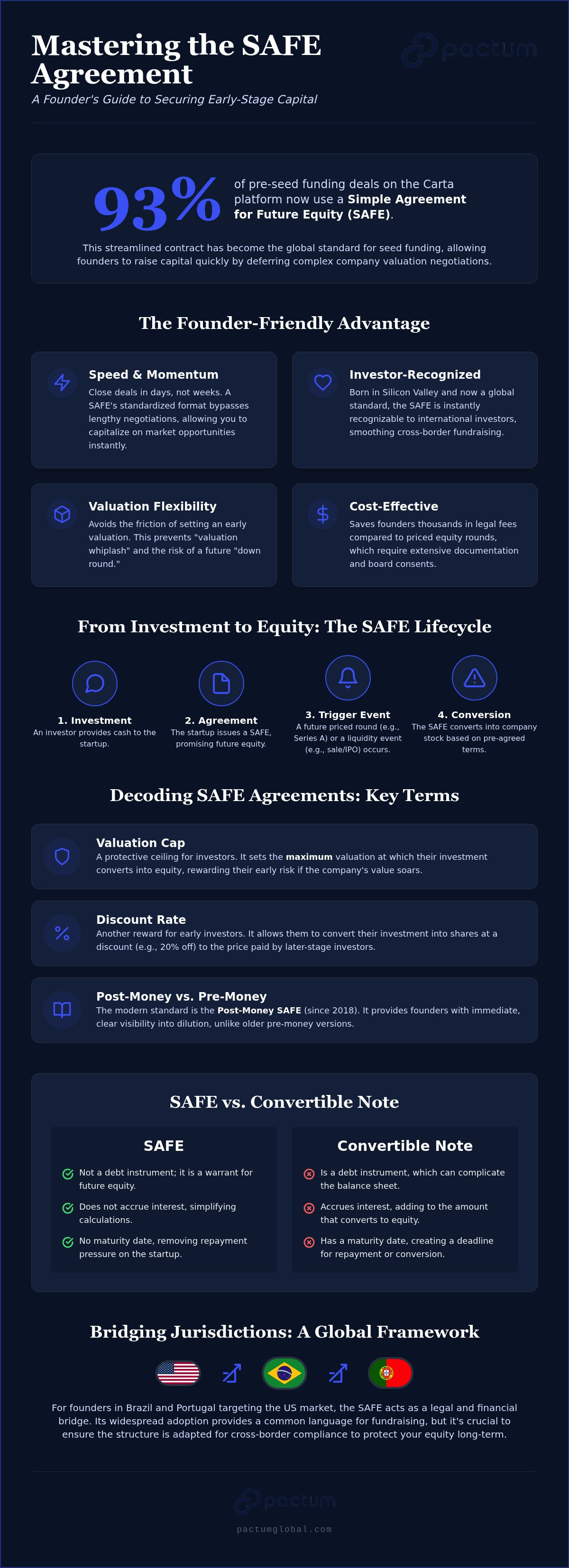
By early 2026, a staggering 93% of all pre-seed funding deals on the Carta platform used a SAFE agreement for startups. You likely know that this instrument is the quickest way to get capital into your company. However, if you're a founder in Brazil or Portugal looking toward the US market, you might feel a lingering anxiety about how these Silicon Valley documents translate into your local legal system. It's common to worry about excessive equity dilution or the complexity of US legal terminology when your primary operations are abroad.
We're here to replace that uncertainty with a sense of calm confidence. This guide will help you master the Simple Agreement for Future Equity so you can secure early-stage capital while maintaining strict cross-border compliance. We'll break down the mechanics of the 2026 post-money SAFE, compare it directly to traditional convertible notes, and provide a clear framework for founders navigating the legal bridge between Brazil, Portugal, and the USA. By the end of this article, you'll have the roadmap needed to fundraise with authority and protect your equity for the long term.
Key Takeaways
- Understand why the SAFE is the global standard for seed capital by eliminating immediate valuation hurdles and excessive legal complexity.
- Master the mechanics of a SAFE agreement for startups to protect your ownership through strategic valuation caps and discount rates.
- Evaluate the critical differences between SAFEs and convertible notes to choose the most founder-friendly path for your early-stage capital raise.
- Learn how to adapt US fundraising instruments for international compliance, ensuring your structure works seamlessly across Brazil, Portugal, and the USA.
- Build a long-term strategy that transitions smoothly from initial startup contracts to a comprehensive Shareholders’ Agreement (SHA) as your company scales.
What is a SAFE Agreement and Why is it the Startup Standard?
A Simple Agreement for Future Equity (SAFE) is a streamlined contract used by founders to raise capital without setting an immediate valuation on their company. Y Combinator introduced this instrument to solve the inefficiencies of debt-based convertible notes. In the 2026 landscape, the SAFE agreement for startups has moved beyond a Silicon Valley trend to become a global necessity. It provides a standard framework that international investors recognize instantly, allowing founders to focus on growth rather than months of legal negotiations.
For early-stage teams, the core promise is speed. Traditional fundraising often stalls because founders and investors can't agree on what a company is worth before it has significant revenue. The SAFE bypasses this friction. It defers the valuation conversation until a later, more established stage of the business. This approach is particularly effective for founders bridging the gap between markets like Brazil or Portugal and the United States, where high-velocity fundraising is the norm.
How the SAFE Mechanism Works
The process is straightforward. An investor provides immediate cash to the startup today. In return, the founder promises to issue stock to that investor during a future financing round. This transition is known as a 'Conversion Event.' Usually, this happens during a Series A priced round when professional investors set a formal share price. Because the current post-money SAFE version released in 2018 is the standard, it provides clear visibility into exactly how much of the company is being sold.
If the company is sold or goes public before this conversion, a 'Liquidity Event' occurs. In these cases, the SAFE usually gives the investor the choice to receive a cash payout or convert their investment into stock. This structure ensures that early supporters are protected regardless of how the company exits. It removes the pressure of repayment that often suffocates young companies during their first years of operation.
SAFE vs. Traditional Equity Rounds
Choosing a SAFE over a traditional priced equity round saves founders thousands in legal fees. Priced rounds require extensive documentation, including amended articles of incorporation and detailed board consents. A SAFE agreement for startups is far leaner. It allows you to close a deal in days rather than weeks, which is vital when you need to capitalize on market momentum.
This instrument also prevents 'valuation whiplash' in volatile markets. When you fix a price too early, you risk setting a valuation that you can't live up to in the next round, leading to a painful 'down round.' A SAFE acts as a bridge to future equity rather than immediate debt. It gives your startup the breathing room to build value before the equity is officially priced and distributed.
Key Terms and Mathematical Mechanics of a SAFE
The SAFE agreement for startups functions through a few critical levers that determine how much of your company you are actually selling. Unlike a priced round, where you set a specific share price, a SAFE uses "caps" and "discounts" to account for the risk early investors take. Understanding these mechanics is essential for maintaining control of your cap table. You can review the specific variations of these terms in the official SAFE financing documents provided by Y Combinator.
- Valuation Cap: This is a protective ceiling for the investor. It sets the maximum valuation at which their investment converts into equity. If your company's value skyrockets to $50 million during a Series A, an investor with a $12 million cap converts at that lower price, granting them a larger ownership stake.
- Discount Rate: This rewards early risk-takers by offering a lower price per share than later investors. A common discount is 20%, meaning the SAFE holder buys shares at 80% of the Series A price.
- Most Favored Nation (MFN) Clause: This ensures that if you issue subsequent SAFEs with better terms, the early investor can "reset" their agreement to match those improved terms.
- Pro-Rata Rights: These give investors the option to invest more money in future rounds to maintain their specific ownership percentage.
Post-Money vs. Pre-Money SAFEs
The 2018 post-money SAFE is now the industry standard because it provides immediate clarity on dilution. Before this update, pre-money SAFEs made it difficult for founders to calculate exactly how much equity they had given away until the final conversion. With a post-money structure, you know your ownership percentage immediately after the SAFE round is closed. It's vital to track this "phantom" dilution carefully. Even though the equity hasn't officially moved yet, the promise is already on your books.
Negotiating Caps and Discounts
Setting a valuation cap requires a balance between attracting capital and protecting your future. According to Carta data from Q1 2026, the median post-money cap for pre-seed rounds sat at approximately $12 million. However, sectors like AI often command a premium; pre-seed caps for AI-focused startups frequently ranged from $12 million to $25 million in early 2026. If you find yourself in a high-demand position, you might opt for an uncapped SAFE with an MFN clause, which defers the cap conversation entirely.
When you're ready to formalize these terms, ensure your startup contracts are drafted to protect your interests across international borders.
SAFE vs. Convertible Notes: Which is Better for Your Startup?
Many founders assume that these two instruments are identical because they both defer a formal valuation. They aren't. A convertible note is fundamentally a debt instrument. It has a maturity date and an interest rate. In contrast, a SAFE agreement for startups is a warrant. It represents a contractual right to future equity without the baggage of debt. This distinction changes how your balance sheet looks and how much pressure you feel during the early stages of growth.
In jurisdictions like Brazil or Portugal, the distinction is even more critical. Local regulations often treat debt differently than equity-like contracts. A convertible note might trigger specific tax or reporting requirements that a SAFE avoids. While some traditional venture capital funds still prefer the legal security of debt, the modern trend favors the simplicity of the SAFE. It allows for a cleaner capital structure that doesn't look like a liability to future investors.
The Hidden Cost of Debt
Convertible notes carry a ticking clock. If you don't reach a priced round by the maturity date, the investor could technically demand repayment. This creates immense stress for founders who need a longer runway to reach their milestones. There's also the "accrued interest" trap. As of August 17, 2026, the U.S. Prime Rate stands at 6.75%. If your note is tied to this benchmark, the debt grows every month. By the time it converts, the interest has turned into extra equity for the investor, diluting you more than you planned. SAFEs don't accrue interest. They don't have maturity dates. They let you focus on building the product instead of watching a debt clock.
Choosing the Right Instrument
Choosing between these options depends on your startup's stage and your target investors. If you're raising from Silicon Valley angels, the SAFE is the default. If you're dealing with a conservative European fund, they might insist on a note for the added protection. You should check the legal documents for international startups to ensure your choice aligns with your long-term roadmap. In some cases, local laws in Brazil or Portugal might require a debt-based structure to fit specific tax benefits. It's about finding the balance between founder-friendly terms and investor comfort. We always recommend choosing the instrument that provides the most flexibility for your next eighteen months of operations.
Adapting the SAFE for International Jurisdictions
Using a template you found online is a significant risk for international founders. While the SAFE agreement for startups was designed for simplicity, it assumes a US-centric legal environment. Most global founders solve this by implementing a "Flip" structure. This involves creating a US Delaware C-Corp as the parent company, which then owns the operating subsidiaries in Brazil or Portugal. This setup allows you to issue SAFEs that US investors understand while keeping your local operations intact.
Tax and currency risks are the two biggest hurdles in this cross-border dance. If you aren't careful, the future conversion of a SAFE into equity could trigger double taxation for founders residing outside the US. You must also decide whether to negotiate the SAFE in USD or your local currency. Raising in dollars while your costs are in Brazilian Reais or Euros introduces exchange rate volatility. This can shorten your runway overnight without any change in your actual spending.
Implementing SAFEs in Brazil and Portugal
In Brazil, the Mútuo Conversível is the traditional tool for early-stage capital. It's a debt-based instrument that carries interest and maturity dates. To move toward a more founder-friendly SAFE structure, you often need the Delaware Flip mentioned above. If you're still in the early stages of planning, read our guide on how to open a company in Brazil for foreigners. In Portugal, founders frequently use holding companies to centralize ownership. This makes the startup more attractive to international venture capital funds that prefer standardized documentation and clear exit paths.
Compliance and Global Mobility
Your fundraising efforts must comply with both US and local securities laws. In the United States, issuing a SAFE agreement for startups usually requires an exemption under Regulation D. You'll need to file a Form D with the SEC within 15 days of your first investment. This is a critical step that many founders miss. Beyond the paperwork, your corporate structure directly impacts your ability to secure founder visas or move between countries. We also emphasize that all intellectual property must be legally assigned to the company before you sign your first SAFE. Investors want to know that the company owns the technology they are funding.
Setting up these structures correctly from day one prevents expensive legal corrections later. If you're ready to secure your foundation, explore our specialized startup contracts and international structuring services.
Structuring for Success: From SAFE to Shareholders' Agreement
Signing a SAFE agreement for startups is an exciting milestone, but it's just the first step in a long-term corporate journey. Many founders focus solely on the immediate cash injection and forget that these instruments are designed to convert into equity. When that conversion happens, usually during your Series A, the "simple" phase of your legal structure ends. You move from a single-page contract to a complex ecosystem of governance, rights, and responsibilities. Preparing for this transition early ensures that you don't lose control of your vision when your cap table expands.
The transition from a SAFE to a priced round requires a shift in mindset. You're no longer just managing a promise of future stock; you're managing actual shareholders with legal rights. This is where your foundational work pays off. If you've tracked your dilution and maintained a clean corporate structure, the conversion will be a seamless event rather than a legal nightmare. It's about building a bridge that is strong enough to support the weight of your future growth.
The Role of the Shareholders' Agreement (SHA)
When your SAFE holders become actual stockholders, the rules of the game change. You'll need a robust Shareholders' Agreement (SHA) to manage this new reality. This document defines who gets a seat on the board, how voting rights are exercised, and what happens when someone wants to sell their shares. If you're building in Europe, you should explore the shareholders agreement for Portuguese companies to understand local nuances. Standard templates often fail international startups because they don't account for the friction between different legal jurisdictions or the specific needs of a diverse, global investor base.
Before you sign your first SAFE, run through this final checklist to ensure your foundation is secure:
- Verify that all intellectual property is fully assigned to the company.
- Model your cap table to visualize post-conversion dilution.
- Confirm that your corporate structure is tax-efficient for your home country.
- Ensure your SAFE agreement for startups includes the 2018 post-money clarity.
How Pactum Global Protects Your Foundation
At Pactum Global, we act as your seasoned global navigator. We don't just hand over a document; we map out your entire journey from seed funding to global corporate governance. Our team specializes in customizing SAFE contracts that bridge the gap between US standards and local laws in Brazil and Portugal. We provide the end-to-end support needed for company formation and global mobility, acting as a shield against bureaucratic errors. We prioritize transparency and the removal of complexity so you can focus on your business. If you're ready to build on a secure foundation, contact Pactum Global for a custom international startup legal package today. We'll help you navigate the intricacies of cross-border compliance with calm confidence.
Fundraising for a Global Future
Raising capital is about more than just securing cash. It's about building a foundation that supports your company as it expands from local operations to global markets. By mastering the 2026 post-money SAFE agreement for startups, you gain immediate clarity on your cap table and avoid the debt traps associated with traditional notes. Remember that a standard template isn't enough when your ambition spans borders. You need a structure that satisfies investors in Silicon Valley while remaining fully compliant with legal requirements in Brazil or Portugal.
The path from a seed-stage SAFE to a robust Shareholders' Agreement requires a proactive partner who understands these unique jurisdictional hurdles. Pactum Global offers specialized expertise across Brazil, Portugal, and the USA to ensure your corporate governance is seamless and secure. We remove the bureaucratic complexity so you can focus on scaling your innovation. Secure your startup's future with a custom SAFE agreement from Pactum Global and move forward with the calm confidence of a seasoned global founder. Your vision deserves a professional legal foundation.
Frequently Asked Questions
What is the difference between a pre-money and post-money SAFE?
The primary difference lies in how dilution is calculated. A post-money SAFE provides founders with a clear ownership percentage immediately after the investment round is closed. In contrast, pre-money versions make it difficult to determine exact dilution until the subsequent priced round occurs. Most founders now prefer the post-money version because it removes the mathematical guesswork and offers transparency for both parties during early-stage negotiations.
Is a SAFE agreement legally binding for a Brazilian startup?
A standard Y Combinator SAFE is not directly recognized as a local instrument under Brazilian law. To make a SAFE agreement for startups legally binding in this context, founders typically use a Delaware Flip structure. This involves creating a US parent company that issues the SAFE while the Brazilian entity operates as a subsidiary. Without this structure, Brazilian founders often rely on the Mútuo Conversível, which is a debt-based alternative.
Do SAFE agreements accrue interest like convertible notes?
No, SAFEs do not accrue interest. This is one of the most significant advantages they hold over convertible notes. Since a SAFE is a contractual right to future equity rather than a debt instrument, there is no principal balance that grows over time. This lack of interest prevents the dilution creep that occurs when unpaid interest converts into extra shares for investors during a future priced round.
What happens to a SAFE if the startup fails before a priced round?
If a startup fails before a conversion event, the SAFE is typically terminated. In a dissolution scenario, SAFE holders are generally entitled to receive their initial investment back from any remaining assets before founders or common stockholders receive anything. However, they remain behind secured creditors and tax authorities. In most early-stage failures, there are rarely enough assets left to provide a meaningful return to SAFE investors.
Can I use a SAFE to raise money for a Portuguese company?
You can use a SAFE for a Portuguese company, but it requires careful cross-border structuring. Portuguese law has specific requirements for equity issuance that differ from the US model. Founders often utilize a holding company in a jurisdiction like Delaware or the UK to issue the SAFE agreement for startups. This setup ensures that international investors feel secure with familiar documentation while your Portuguese operations continue to grow locally.
How much equity should I give up in a SAFE round?
There is no fixed rule, but most startups aim to sell between 10% and 20% of their company during a seed round. The specific amount depends on your valuation cap and the total capital raised. It's vital to model these scenarios before signing to ensure you don't face excessive dilution. High-demand sectors like AI often see founders giving up less equity due to significantly higher valuation caps in the 2026 market.
Does a SAFE agreement give investors a seat on the board?
No, a standard SAFE does not grant an investor a seat on the board of directors. Governance rights, such as board representation or specific voting powers, are typically negotiated later during a priced equity round. The SAFE is designed to be a simple, non-bureaucratic instrument that focuses on capital rather than control. You will usually address board seats and formal voting rights when you draft your first Shareholders' Agreement after the conversion.
What is a valuation cap in a SAFE agreement?
A valuation cap is a protective ceiling that sets the maximum price at which a SAFE will convert into equity. If your company's valuation at the Series A is higher than the cap, the SAFE investor converts their money at the lower capped price. This mechanism rewards early investors for taking a risk on your startup by ensuring they receive a larger ownership stake if the company's value increases significantly before the priced round.


