

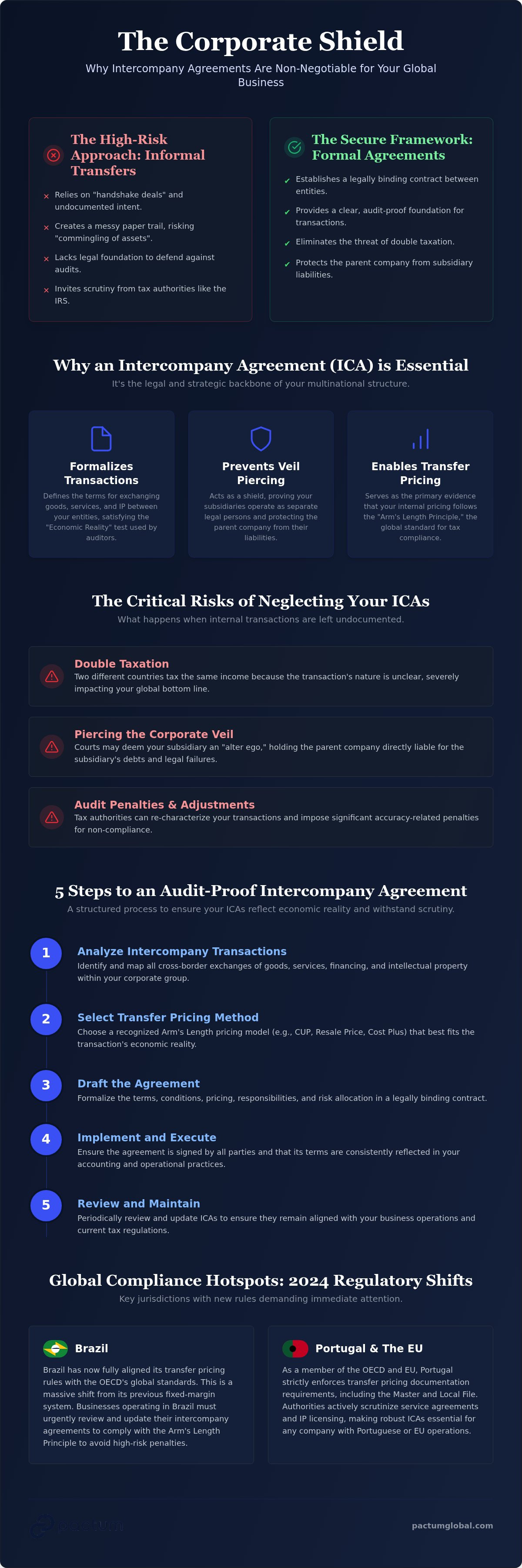
What if the biggest threat to your global expansion isn't a competitor, but a simple lack of paperwork? Many entrepreneurs assume that moving funds or services between their own entities is a private matter, yet tax authorities see it very differently. Without a formal intercompany agreement, your internal transactions are essentially invisible to auditors, leaving your business vulnerable to double taxation and the risk of corporate veil piercing. It's a common source of anxiety, especially when you're trying to keep up with shifting transfer pricing rules across borders.
We understand that international bureaucracy feels like a maze designed to slow you down. You've worked hard to build a multinational presence, and you shouldn't have to lose sleep over "arm's length" principles or potential litigation. This guide provides a clear framework to protect your assets and ensure your records are entirely audit-proof. We'll explore the essential elements of these contracts, the latest 2024 regulatory shifts in Brazil, and how to document your operations so they stand up to the strictest scrutiny from the IRS or European tax authorities. By the end, you'll have the confidence to manage your global structure with total security.
Key Takeaways
- Establish clear corporate separateness to protect your parent company from the legal liabilities of its subsidiaries.
- Use a formal intercompany agreement as the essential evidentiary foundation for your transfer pricing records and audit defense.
- Adapt to the latest regulatory changes in Brazil and Portugal to avoid the high risks associated with new OECD-aligned standards.
- Master the five-step process for drafting agreements that accurately reflect your economic reality and survive rigorous tax scrutiny.
- Shift from informal transfers to a structured framework that eliminates the threat of double taxation across your global operations.
What is an Intercompany Agreement and Why is it Essential?
An intercompany agreement is a formal, legally binding contract between two or more distinct entities within the same corporate group. While it might feel redundant to sign a contract with a subsidiary you fully control, the law treats each entity as a separate legal person. These agreements define the terms under which goods, services, or intellectual property are exchanged across your global structure. Without them, your internal operations lack the legal foundation required to withstand scrutiny from tax authorities, creditors, and legal opponents.
Tax authorities globally use what is known as the "Economic Reality" test to validate your internal transactions. They look past your management's intentions to see if the deal actually happened as described and if it provided a tangible benefit to the receiving entity. If you're transferring funds or sharing resources without a clear framework based on Transfer Pricing Principles, you're essentially inviting an audit. For founders, these contracts are vital components of the legal documents for international startups needed to scale safely across borders.
The Legal Doctrine of the Corporate Veil
An intercompany agreement acts as a primary shield against "piercing the corporate veil." This legal doctrine allows courts or creditors to ignore a company's limited liability and hold the parent company directly responsible for a subsidiary's debts or legal failures. By documenting every transaction, you provide the necessary evidence that your entities operate with formal boundaries. Without this proof, a judge might decide your subsidiary is merely an "alter ego." In a cross-border corporate context, an alter ego is a subsidiary that lacks independent decision-making power and is treated as a mere department of the parent company rather than a distinct legal entity.
Formalizing the Informal: Moving Beyond Handshake Deals
Relying on management "intent" is a high-risk strategy that rarely survives a professional audit. Tax officials don't care about what you meant to do; they care about what you documented before the fiscal year ended. Using informal fund transfers between a parent and a sub creates a messy paper trail that often looks like the commingling of assets. This lack of structure is exactly what triggers accuracy-related penalties and the nightmare of double taxation. Formalizing these deals ensures your transfer pricing compliance is solid from day one. It transforms a vague internal arrangement into a defensible business transaction that protects your global bottom line.
Transfer Pricing: The Strategic Backbone of Your ICA
Transfer pricing isn't just an accounting exercise; it's the strategic engine that determines how profits are allocated across your global footprint. At the heart of this engine lies the "Arm’s Length Principle." This principle requires that transactions between related parties happen at the same price and under the same conditions as those between independent businesses. Your intercompany agreement serves as the primary legal evidence that you've intentionally structured your deals to meet this standard. Without a written contract, tax authorities are free to re-characterize your transactions, often leading to higher tax bills and significant penalties.
Tax auditors start their investigations by requesting your transfer pricing study, and the first document they'll look for is the underlying agreement. This contract sets the stage for your economic analysis by defining which entity bears the risk and who owns the assets. For instance, if a subsidiary in Portugal provides marketing services to a US parent, the agreement must specify the compensation model used. This is particularly urgent for firms entering the South American market, where understanding Brazil transfer pricing regulations is now mandatory following the country's recent alignment with the OECD Transfer Pricing Guidelines.
OECD BEPS and Global Compliance Standards
The OECD’s Base Erosion and Profit Shifting (BEPS) framework has transformed international tax. Under Action 13, many jurisdictions now require a "Master File" and a "Local File" to document global operations. A well-drafted intercompany agreement simplifies the creation of these files by providing a consistent narrative across all jurisdictions. Consistency is your best defense against audits. If your US tax filings describe a transaction differently than your Portuguese filings, you're signaling a lack of control that auditors will exploit. If you're unsure if your current contracts meet these standards, our team provides specialized transfer pricing services to help you navigate the transition.
The Arm’s Length Principle in Practice
Determining "market rates" for internal services or intellectual property requires a methodical approach. You might use the "Cost Plus" method, adding a standard profit margin to the costs incurred by the service provider. Alternatively, the "Resale Price Method" works well when a subsidiary buys products to resell them. Each method requires specific language in your contract to be defensible. Providing a zero-interest loan to a subsidiary is a major audit red flag because it fails to reflect the market-based compensation an independent lender would require. By formalizing these rates in an agreement, you replace guesswork with a defensible, audit-ready framework.
Common Types of Intercompany Agreements
Every cross-border structure involves different types of exchanges, from tangible goods to intangible management support. A single intercompany agreement can often act as a "Master Intercompany Services Agreement" (MISA). This central document covers multiple entities under one umbrella, streamlining your compliance efforts and reducing administrative friction. It's vital to align these terms with your shareholders agreement for cross border business to ensure governance consistency across your entire group. Most importantly, you must have these terms in writing before transactions occur. Tax authorities generally reject retroactive contracts, so documenting the written-down terms today protects you from future disputes.
Management and Administrative Services
Tax authorities focus heavily on "Headquarter Services" like HR, Finance, and Legal support. You need to establish a markup that reflects a reasonable profit for the parent company while following the OECD Transfer Pricing Guidelines. Auditors use the "Benefit Test" to verify that the subsidiary actually received value from the parent’s involvement. For example, if a subsidiary already employs a full-time local accountant, charging them a high fee for global accounting oversight may be flagged. Clear documentation prevents these services from being viewed as artificial profit shifts.
Intellectual Property (IP) Licensing and Cost Sharing
Startups often hold intellectual property (IP) in a central hub and license it to foreign branches. This involves transferring trademarks, software, or patents through royalty payments. These payments are powerful tools for global tax optimization, but they require a rigorous legal foundation. A solid intellectual property strategy for startups is a prerequisite for any licensing deal. The contract must clearly define who owns the economic rights versus the legal rights to the IP to ensure royalties are deductible in the subsidiary’s home country.
Intercompany Loans and Financing
Managing global cash flow often requires intercompany loans or cash sweeps to move liquidity where it's needed most. You must set interest rates that satisfy both the IRS in the USA and local authorities in places like Brazil or Portugal. If a loan lacks a fixed repayment term or a market-based interest rate, tax authorities may reclassify the principal as a dividend. This reclassification usually triggers immediate withholding taxes and penalties. Defining these repayment terms early ensures your working capital moves freely without becoming a tax liability.
Regional Nuances: Brazil, Portugal, and the USA
Global compliance is never a one-size-fits-all process. Each jurisdiction has its own appetite for risk and specific documentation requirements that your intercompany agreement must address. While the "arm's length" principle is the global standard, the way it's enforced in Brazil, Portugal, and the USA varies significantly. Understanding these regional nuances is the difference between a seamless expansion and a costly legal bottleneck. For those just starting, our guide on USA company setup for non-residents provides the necessary context for establishing a compliant US tax nexus.
Brazil: Navigating the Transition to OECD Standards
Brazil is currently a high-risk jurisdiction for multinational groups. Following the enactment of Law 14,596/2023, the country has abandoned its long-standing fixed-margin system in favor of OECD-aligned rules. This shift means that intercompany agreements must now be supported by a detailed functional analysis rather than simple arithmetic. Additionally, starting January 1, 2026, Brazil will reinstate a 10% withholding income tax on dividends paid to non-residents. To ensure your service agreements remain tax-deductible under these new rules, they must clearly demonstrate the actual costs incurred and the specific benefit provided to the Brazilian entity.
Portugal: The Holding Company and Participation Exemption
Portugal serves as a sophisticated European gateway, particularly for businesses utilizing the SGPS (holding company) structure. A well-structured intercompany agreement is essential here to support the "Participation Exemption" regime, which allows for tax-free dividend distributions under specific conditions. You must also be cautious with management fees. If these fees aren't documented with precision, they can trigger VAT complications within the EU or be flagged under Portugal's strict transparency rules for related parties. Note that for large groups, the deadline for filing supplementary global minimum tax information has been extended to September 30, 2026, for certain fiscal years.
USA: Section 482 and IRS Scrutiny
The IRS operates on the principle of "substance over form." This means that even if you have a signed contract, the IRS will ignore it if the actual economic behavior of your companies doesn't match the written terms. Under IRC Section 482, US-based parents must maintain contemporaneous documentation. If you wait until an audit begins to justify your pricing, you face accuracy-related penalties of 20% to 40% on adjustments. In US-Brazil transactions, the IRS is particularly focused on "Economic Substance," ensuring that profit isn't being shifted to avoid higher domestic rates. If you need to secure your cross-border structure, you can book a consultation for our transfer pricing services to ensure your documentation is audit-proof.
Best Practices for Drafting and Managing ICAs
Implementing a robust intercompany agreement requires more than just a standard template. It demands a methodical workflow that aligns your legal documentation with your daily operations. To protect your multinational structure, you must ensure that your "Legal Form" consistently mirrors your "Economic Reality." When these two elements diverge, tax authorities often step in to re-characterize your transactions, leading to the liabilities we've discussed in previous sections. Following a structured process helps you build a defensible framework that grows with your business.
Step 1: Functional and Risk Analysis
Before you begin drafting, you must identify which entity actually bears the risk and performs the work. This analysis involves mapping out functions across your global teams. Does the parent company manage the market risk, or is that responsibility delegated to the local subsidiary? If an entity holds significant inventory or credit risk, its compensation must reflect that exposure. Matching the price to the specific risk and function profile is the only way to satisfy the arm's length principle during a deep-dive audit.
Step 2: Drafting for Consistency and Flexibility
A scalable intercompany agreement structure often utilizes a "Master Agreement" supplemented by specific "Appendices" for each subsidiary. This approach allows you to maintain core legal protections while tailoring commercial terms to local requirements. You must follow the "Golden Rule": your contract terms must match your actual accounting entries exactly. If your agreement specifies a 5% markup but your books show 7%, you've created a discrepancy that auditors will exploit. Don't forget to include standard clauses like Force Majeure and Termination, as these prove the entities are operating as independent business partners.
Step 3: Ongoing Monitoring and Compliance
A "set it and forget it" approach is a primary cause of audit failure. Market conditions change, and your internal rates must change with them to remain compliant. You should perform annual reviews and update your pricing based on fresh market benchmark studies. Centralized document storage is also critical, especially when managing legal support for global mobility. Having all your contracts, appendices, and benchmark data in one accessible location ensures you're always ready for a surprise information request from tax authorities. If you're ready to secure your corporate foundation, contact Pactum Global for a comprehensive cross-border audit and ensure your structure is fully protected.
Build a Defensible Global Foundation
Managing a multinational business requires a shift in mindset from informal internal deals to structured legal frameworks. A formal intercompany agreement is more than a tax requirement; it's a vital shield that preserves your corporate separateness and protects your parent company from foreign liabilities. Whether you're navigating the new OECD-aligned rules in Brazil, utilizing holding company benefits in Portugal, or meeting IRS substance requirements in the USA, your documentation must be precise. Consistency between your contracts and your accounting is your strongest ally against aggressive audits and reclassification risks.
You don't have to navigate these complex bureaucratic hurdles alone. At Pactum Global, we specialize in providing bespoke legal documentation and comprehensive transfer pricing services tailored to the needs of international startups. Our team offers deep expertise in Brazil, Portugal, and USA jurisdictions to ensure your corporate structuring is both efficient and audit-proof. Secure Your Global Structure with Pactum Global today and replace regulatory anxiety with the confidence to scale. Your international journey is already mapped out; we're here to guide you every step of the way.
Frequently Asked Questions
Do I need an intercompany agreement if I own 100% of the subsidiary?
Yes, you absolutely need a formal contract even with a wholly-owned subsidiary. Tax authorities treat every entity as a separate legal person regardless of who holds the shares. Without a documented intercompany agreement, your internal transfers look like informal profit shifting rather than legitimate business deals. This documentation is your primary defense against auditors who want to re-characterize your cash flows as taxable dividends or non-deductible expenses.
Can I use a single agreement for all my global subsidiaries?
You can utilize a Master Intercompany Services Agreement (MISA) to cover multiple entities, but it isn't a one-size-fits-all solution. While the core terms remain consistent, you must attach specific appendices that address regional requirements in markets like Brazil or Portugal. This hybrid approach provides global consistency while allowing you to adjust for local tax laws and specific functional risks. It’s the most efficient way to manage a growing multinational structure.
What happens if I don’t have a formal intercompany agreement during an audit?
Operating without a formal contract during an audit leads to immediate and severe financial consequences. Tax authorities like the IRS may re-characterize your transactions, leading to accuracy-related penalties that range from 20% to 40% in the United States. You also face the high risk of double taxation, as the tax paid in one country may not be credited in another without a valid, pre-existing intercompany agreement to prove the transaction's legitimacy.
How do I determine the correct "Arm’s Length" price for internal services?
Determining the "Arm’s Length" price requires a professional benchmarking study to identify what independent companies charge for similar services. You typically choose a method like "Cost Plus," where you add a standard market margin to your expenses. It's critical to document this logic within your legal contracts before the transaction occurs. This proactive approach ensures your pricing survives scrutiny from tax officials who use the "Economic Reality" test to validate your internal rates.
Are intercompany agreements public documents?
These agreements are private commercial contracts, so they aren't available to the general public or your competitors. However, they are mandatory disclosures for tax authorities during audits or as part of your transfer pricing documentation filings. In some jurisdictions, you may also need to register these contracts with local central banks or commerce registries to facilitate international fund transfers. Always treat these documents as sensitive but ready for official inspection at any time.
How often should I update my intercompany agreements?
You should review and update your documentation at least once a year to ensure it reflects current market conditions. A "set it and forget it" approach is a major red flag for auditors, as it suggests your pricing isn't based on real-time economic data. If your business model changes or you enter a new market like Portugal, you must update your contracts immediately to maintain compliance and protect your assets.
Do intercompany agreements need to be translated for local tax authorities?
Yes, most local tax authorities require documentation to be submitted in their official language. While you might draft your master agreement in English for internal use, jurisdictions like Brazil often require a Portuguese translation for the document to be legally enforceable or tax-deductible. It's best practice to maintain bilingual versions of your intercompany agreement to ensure that both your global headquarters and local tax officials have a clear, undisputed understanding of the terms.
Can an intercompany agreement protect me from legal lawsuits against my subsidiary?
A well-drafted contract is a powerful tool for asset protection because it reinforces the corporate veil. By clearly defining the separate responsibilities and risks of each entity, you prevent a legal opponent from arguing that a subsidiary is merely an "alter ego" of the parent company. This formal boundary is essential for preventing lawsuits against a subsidiary from bleeding into the parent company’s assets, providing a critical layer of security for your global operations.


