

If a disgruntled former partner or a sophisticated hacker initiated a domain transfer today, could you legally prove you own your brand's digital home? It's natural to feel uneasy about the security of your online assets when the line between technical privacy and actual legal ownership feels so thin. You've likely enabled two-factor authentication and hidden your contact details, yet the fear of unauthorized transfers or international disputes remains. Effective domain protection requires more than just a locked registrar account; it demands a comprehensive legal framework.
With the ICANN Transfer Policy update effective August 4, 2026, the responsibility for authorizing transfers sits squarely with the Registered Name Holder. This shift highlights why your digital assets must be treated as core intellectual property rather than IT footnotes. You'll learn how to move beyond basic settings to build a legally airtight strategy that safeguards your brand across international borders. This guide provides a clear roadmap for integrating your domains into your broader IP strategy and securing your assets against evolving global threats.
Key Takeaways
- Shift your perspective by treating domains as core intellectual property rather than simple technical assets managed by IT.
- Build a robust domain protection strategy that pairs technical registrar locks with the legal power of international trademark registration.
- Secure your digital identity against internal disputes by clearly defining domain ownership within your Shareholders' Agreements.
- Navigate global expansion with confidence by aligning your digital assets with the legal requirements of jurisdictions like the USA, Brazil, and Portugal.
- Implement a centralized company asset register to ensure seamless communication between your legal advisors and technical teams.
Understanding Domain Protection: Beyond the Registrar Checkbox
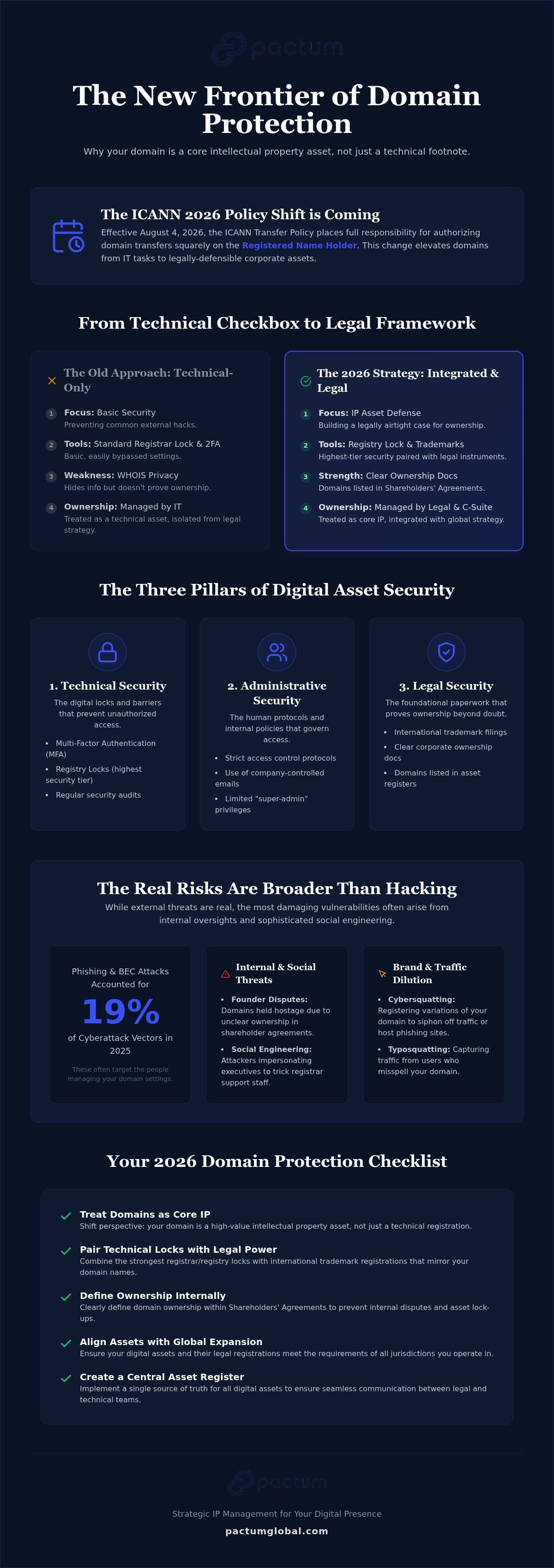
Many business owners treat their URL as a simple line item on a monthly hosting bill. In reality, your domain is the foundation of your digital real estate portfolio. It is an intangible asset that holds the entirety of your brand's online value. Security is not a checkbox. Comprehensive domain protection isn't a single setting you toggle on; it's a multi-layered strategy. This approach combines technical barriers, administrative protocols, and legal safeguards to ensure your brand remains under your control. While ICANN provides the global framework for domain governance, the security of your specific assets depends on how you bridge the gap between IT and legal strategy.
The Three Pillars of Digital Asset Security
Securing a global brand requires a methodical approach. We view digital security through three distinct lenses to ensure no single point of failure exists. This framework moves your strategy from reactive to proactive.
- Technical Security: This includes enabling multi-factor authentication (MFA) on all registrar accounts and utilizing Registry Locks. These locks require manual, out-of-band verification before any major changes occur.
- Administrative Security: You must establish internal access protocols. This involves using redundant, company-controlled email addresses for registration and strictly limiting who holds "super-admin" privileges.
- Legal Security: This is often the most overlooked pillar. It ensures your domain registration matches your international trademark filings. Clear corporate ownership documentation prevents domains from being held hostage by individual employees or former partners.
Why Basic Privacy is No Longer Enough in 2026
There is a critical distinction between domain privacy and domain protection. Privacy services simply mask your contact information in the public WHOIS database. While this reduces spam, it does nothing to prevent DNS hijacking or unauthorized transfers. In fact, excessive privacy settings can sometimes complicate your ability to prove legal ownership during a high-stakes dispute. If the public record is blank, you must rely on internal registrar logs that may be difficult to access during a crisis.
Modern threats have evolved. Attackers now use sophisticated social engineering to impersonate company executives and trick registrar support staff. The industry is shifting toward identity-based protection. This requires verifiable proof of corporate identity rather than just a password. By moving beyond basic privacy, you build a resilient foundation that protects your brand identity in every jurisdiction where you operate.
The Real Risks: Why Hijacking is Only Half the Story
While many companies focus on external hackers, the most devastating threats to your digital assets often come from within or through subtle brand erosion. In 2025 alone, phishing and Business Email Compromise (BEC) accounted for 19% of cyberattack vectors. These attacks frequently target the individuals who manage your domain protection settings. If an attacker gains access to a single administrative email, they can bypass standard security questions by using information gathered from your public corporate filings. This makes the technical lock on your registrar account only as strong as your internal human protocols.
Hijacking and Social Engineering
Modern hijacking rarely involves "cracking" a server. Instead, attackers use social engineering to trick registrar support staff into thinking they are a legitimate company representative. They exploit "shadow" accounts—old logins created by former IT contractors—or unmonitored administrative emails to initiate transfers. Once a transfer is initiated, the window to stop it is remarkably small. To combat this, elite brands utilize a Registry Lock, which is the highest tier of technical security that requires manual, multi-person authorization before any domain changes can be finalized.
Beyond direct theft, your brand faces dilution through cybersquatting and typosquatting. Malicious actors register variations of your name to siphon off traffic or host phishing sites. Even though the .com extension remains the most abused TLD by volume, newer extensions are increasingly used for these predatory registrations. This creates a fragmented digital presence that confuses customers and weakens your legal standing in international markets.
The "Founder Dispute" Trap
Internal risks are just as potent as external ones. We frequently see startups where the primary domain was registered using a founder's personal Gmail account during the "garage phase." If that founder leaves or a dispute arises, the domain becomes a high-stakes bargaining chip. Without clear documentation, the company may find itself unable to prove ownership to the registrar, leading to months of "legal limbo" that can paralyze a cross-border business.
This is where your corporate structure must protect your technology. A robust Shareholders' Agreement (SHA) should explicitly define all domains and digital accounts as company property rather than individual assets. When domains are registered under the corporate entity from day one, you remove the leverage an individual might hold during a breakup. Ensuring your digital assets are correctly categorized within your Intellectual Property and Trademarks strategy is a critical step in building a resilient global foundation. It transforms a vulnerable login into a protected corporate asset.
Technical vs. Legal Domain Protection: A Comparative Framework
Think of technical settings as the deadbolt on your front door. They are essential for immediate security, but they don't prove ownership. Legal protections are the title deeds that ensure the property remains yours in the eyes of the law. A complete domain protection strategy balances these two forces. Technical locks are designed to prevent the event of theft, while legal frameworks exist to enable recovery after an incident has occurred. Relying on one without the other leaves your global brand vulnerable to both external hackers and internal administrative errors.
The Registrar Tier: Locks and Alerts
Your registrar provides the first line of defense against unauthorized changes. You should ensure your most critical domains carry the ServerTransferProhibited status rather than just the standard ClientTransferProhibited. The client-level status is common but can be bypassed if an attacker gains access to your registrar account. In contrast, the server-level status, often called a Registry Lock, requires a higher level of manual verification from the registry itself. This makes it nearly impossible for a domain to be moved without multi-factor authorization from your authorized company representatives.
High-value commercial domains should also utilize 90-day renewal guarantees. This safeguard ensures your domain doesn't enter the public auction pool if a corporate credit card expires or a billing cycle fails. These "ultimate" protection plans are no longer optional for international startups. They provide the administrative breathing room needed to manage a complex portfolio across different time zones and currencies without the risk of accidental asset loss.
The Legal Tier: Trademarks and UDRP
When a domain is hijacked or targeted by a cybersquatter, technical locks can't help you reclaim it. This is where a robust Intellectual Property Strategy becomes your most valuable tool. A registered trademark is the primary evidence required by the Uniform Domain-Name Dispute-Resolution Policy (UDRP). This administrative process allows trademark holders to reclaim domains registered in bad faith through a streamlined legal channel rather than through expensive, multi-year litigation.
To succeed in a UDRP proceeding, you must prove that the domain is confusingly similar to your trademark and that the current holder has no legitimate interest in it. For global brands, this domain protection must extend to regional extensions like .com.br in Brazil or .pt in Portugal. Registering your trademark in these specific jurisdictions is vital. It ensures that your regional digital presence is as secure as your primary .com address. This dual-layered approach transforms your domain from a vulnerable technical entry into a resilient, legally protected corporate asset that supports your long-term growth.
Securing Your Digital Assets: A 2026 Checklist for International Startups
For a global brand, domain protection is a cross-departmental responsibility. It requires a centralized Asset Register that tracks every digital property, its registrar, and its legal owner. This document serves as the single source of truth for your legal team and IT department. You must also verify WHOIS accuracy for all global top-level domains (TLDs) to ensure the registrant data matches your corporate filings exactly. Always use corporate aliases like [email protected] for registration. It stops an employee's exit from paralyzing your operations.
Step 1: Structural Setup
Your domain must be owned by your legal entity, such as an LLC, Ltda, or SA, rather than an individual founder. This setup ensures that the asset is transferable and survives individual personnel changes. You should treat domain management as a core task on your Global Founder’s Checklist. By ensuring the administrative contact is a permanent corporate role, you maintain continuity even as your team scales across borders. This structural clarity is the foundation of any professional-grade security strategy.
Step 2: Technical Hardening
Technical defense begins with hardware-based 2FA. We recommend using a physical key to secure registrar accounts. This makes it impossible for attackers to gain access through remote phishing alone. For your primary brand domains, implement Registry Locks. This adds a layer of manual verification from the registry that prevents any unauthorized transfer or DNS change. Finally, set up auto-renewal with at least two backup payment methods to avoid accidental expiration during international banking delays. These steps provide the domain protection needed to withstand sophisticated external threats.
Step 3: Cross-Border Compliance
Startups operating in Brazil and Portugal face unique challenges. You must align your domain ownership with local tax and corporate filings to avoid regulatory friction. Digital assets are often overlooked in Succession Planning for Foreign Assets, yet they are vital for business continuity. If a founder or shareholder passes away, having these domains properly titled to the corporate entity prevents them from being frozen in probate. This alignment ensures your digital footprint remains secure through every transition. For expert assistance in aligning your digital and legal structures, consider our Company setup in Brazil services to ensure every asset is correctly registered from the start.
Strategic IP Management: How Pactum Global Safeguards Your Digital Presence
Pactum Global serves as the vital bridge between complex international law and your daily business operations. We don't view domain protection as a standalone technical task. Instead, we treat it as a core component of your global intellectual property roadmap. When you work with us, digital asset security is integrated into your company's DNA from the moment of inception. This proactive approach ensures that your brand identity remains a solid foundation for growth rather than a liability during a dispute or market expansion.
Integrating Digital Assets into Corporate Governance
Effective governance requires clear documentation. We specialize in drafting Shareholders' Agreements (SHA) that include specific clauses regarding digital assets. These clauses define exactly who owns and manages your domains. This prevents the "founder dispute" trap mentioned earlier. If you are planning an international relocation or entering a new market, we manage the transition of your digital properties to ensure compliance with local regulations. Whether you are focusing on the USA, Brazil, or Portugal, we ensure your brand is legally anchored in each jurisdiction.
Proactive Brand Protection and Trademarking
Our approach to domain protection is deeply rooted in international trademark law. We don't just register names; we build defensive barriers. Pactum Global provides expert guidance on international trademark filing to ensure your brand is recognized by registries worldwide. This legal standing is your most powerful tool when dealing with cybersquatting or brand infringement. We offer ongoing monitoring to identify bad actors before they can dilute your market presence.
Your next step should be a thorough audit. Look at your current domain portfolio with a legal eye. Are your primary URLs registered to the correct corporate entity? Do your SHAs cover digital succession? We help you answer these questions with clarity and confidence. By aligning your technical settings with professional legal drafting, you transform your digital presence into a resilient corporate asset. This allows you to focus on scaling your business while we act as the shield for your global brand identity.
Building a Resilient Foundation for Global Expansion
Your domain is more than a web address; it's the digital face of your international enterprise. We've explored how a robust domain protection strategy requires a fusion of technical locks and rigorous legal governance. By aligning your digital assets with corporate structures like Shareholders' Agreements and international trademark registrations, you remove the vulnerabilities that often cripple scaling startups. This approach transforms a simple technical setting into a legally enforceable corporate asset.
Our team of international legal experts specializes in cross-border corporate governance across Brazil, Portugal, and the USA. We provide comprehensive trademark and IP protection to ensure your brand remains secure in every jurisdiction. Don't leave your digital identity to chance or basic registrar settings. Instead, treat it as the cornerstone of your global IP roadmap. This proactive stance prevents administrative errors and shields you from bad actors.
Secure your global brand with Pactum Global’s IP Strategy services. Your brand identity is your most valuable asset. With the right legal framework in place, you can move forward with the calm confidence that your digital home is airtight and ready for the global stage.
Frequently Asked Questions
What is the difference between domain privacy and domain protection?
Domain privacy masks your personal contact information in public records, while domain protection actively prevents unauthorized transfers and hijacking. Privacy is a basic setting that primarily reduces spam. Protection involves higher-tier security like registry locks and administrative logs. In 2026, masking your identity is insufficient. You need protocols that verify your corporate authority before any changes occur to your digital assets.
Can a stolen domain be recovered legally without a trademark?
Recovering a stolen domain without a trademark is significantly more difficult and often requires expensive litigation. While you can use registration logs or purchase contracts as evidence, these lack the streamlined power of the UDRP process. A registered trademark provides the legal standing needed to prove bad faith registration. Without it, you may be forced to negotiate a private buyout with the thief, which rarely favors the original owner.
Is it better to register a domain in my name or my company’s name?
You should always register your domain in the company’s legal name to ensure corporate ownership and easy succession. Registering in a founder’s personal name creates significant risks during exits or internal disputes. When the asset is titled to the entity, it remains a stable part of the company's valuation. This structure also simplifies trademark alignment and ensures that the business maintains control over its digital identity across multiple jurisdictions.
How does a Shareholders Agreement protect my company’s domain?
A Shareholders Agreement protects your company’s domain by explicitly defining all digital assets as property of the legal entity. This prevents individual shareholders from using the domain as leverage during a business breakup. By including specific clauses for digital succession and management, you remove ambiguity about who holds the administrative keys. It transforms the domain from a personal login into a formal corporate asset protected by contract law.
Does domain protection prevent my domain from expiring?
Domain protection doesn't inherently prevent expiration, but it provides the administrative safeguards to ensure it doesn't happen accidentally. High-level protection plans often include 90-day renewal guarantees and multiple backup payment methods. These features are critical for global brands that may face credit card processing delays or currency issues. You must still actively monitor your registration dates to maintain your digital footprint and brand authority.
What should I do if someone registers a domain that is very similar to mine?
If someone registers a domain similar to yours, you should first evaluate if it constitutes typosquatting or brand dilution. If you hold a registered trademark, you can initiate a UDRP proceeding to reclaim the domain or file a cease-and-desist order. Monitoring services can alert you to these registrations before they impact your traffic. Acting quickly is essential to prevent cybercriminals from using these domains for phishing attacks against your customers.
How do I protect my domain in multiple countries like Brazil and Portugal?
Protecting your domain in countries like Brazil and Portugal requires registering local extensions like .com.br and .pt alongside your primary .com address. You must also file for trademark protection in these specific jurisdictions to have legal standing for local disputes. Aligning your digital presence with local corporate filings ensures that your brand identity is airtight. This localized approach prevents competitors from squatting on your brand in emerging markets.
Is registry lock worth the extra cost for a small startup?
Registry lock is absolutely worth the investment for a small startup because it provides the highest tier of technical security. The cost of recovering a hijacked domain through legal channels far exceeds the annual fee for a server-level lock. For a growing brand, your domain is often your most valuable asset. Securing it early prevents catastrophic disruptions that could stall your market entry or damage your reputation with investors.


