

What if the will you signed in your home country is completely ignored by the authorities governing your foreign real estate? Many international investors believe a single document protects their global legacy, but the reality of cross-border inheritance is far more fragmented. It's natural to feel anxious about "forced heirship" rules in places like Brazil or the 40 percent federal estate tax rate for U.S. assets. Effective succession planning for foreign assets requires more than a generic template; it demands a strategy that respects the local laws of every jurisdiction where you hold wealth.
You deserve the peace of mind that comes with a secure, compliant estate. This guide provides a clear roadmap to navigate these complexities, helping you avoid double taxation and ensure your assets pass to your heirs without the nightmare of multi-year probate delays. We'll explore the critical concept of asset "situs," the 2026 tax landscape in key jurisdictions like Portugal and the U.S., and how to build a protective framework that keeps your family's future certain and your legacy intact.
Key Takeaways
- Understand why foreign courts often reject domestic wills and how the legal principle of "scission" can fragment your global estate across borders.
- Learn how to manage forced heirship rules in jurisdictions like Brazil and Portugal that legally mandate asset distribution regardless of your written wishes.
- Discover how proactive succession planning for foreign assets protects your family from double taxation and the high costs of uncoordinated probate.
- Explore specific legal tools, including the European Certificate of Succession and local Brazilian "Inventory" processes, that streamline cross-border transfers.
- Follow a practical 5-step framework to audit your global holdings and establish a compliant residency status for the 2026 tax landscape.
Why Your Domestic Will Fails for Foreign Assets in 2026
Your local will is likely a masterpiece of domestic law. However, once it crosses a border, it often loses its authority. This happens because many countries don't follow the principle of "Unity of Succession," where one law governs your entire estate. Instead, they apply "Scission." This legal doctrine splits your estate into pieces. It forces different sets of laws onto different assets based on where they're located. Local courts frequently refuse to recognize foreign documents because they don't meet specific local formalities, such as notarization or the "homologation" process required in Brazil. Without proper coordination, your testamentary wishes become mere suggestions to a foreign judge.
The "Situs," or legal location of an asset, is the ultimate decider of its fate. If you own a condo in Lisbon or a ranch in São Paulo, the laws of Portugal or Brazil will dictate how those titles transfer. If your succession planning for foreign assets doesn't account for this, the consequences are immediate and stressful. Bank accounts are frozen. Real estate titles are locked in legal limbo. Heirs can spend years in foreign courts just trying to prove they have the right to sell a property or pay a utility bill. These bureaucratic deadlocks don't just delay the process; they erode the value of the legacy you worked to build.
Defining Cross-Border Succession Planning
Succession planning for foreign assets is a multi-jurisdictional legal strategy designed to align an individual's testamentary wishes with the conflicting laws and tax requirements of multiple sovereign nations. This strategy distinguishes between "movable" assets, like stock portfolios or cash, and "immovable" assets, such as land and buildings. While movable assets might follow the law of your home country, immovable assets almost always follow the law of their physical location. In 2026, new tax reporting requirements and the sunsetting of certain exemptions make this distinction even more critical for global estate transparency.
The Limits of the 'International Will' Convention
The 1973 Washington Convention attempted to solve this by creating a standardized "International Will." While it sounds like a perfect solution, it's rarely a complete one. Many jurisdictions haven't ratified it, or they've added local layers that complicate its use. This creates a gap where a document valid in Miami is worthless in Rio de Janeiro.
- Signatories that recognize International Wills: USA, Portugal, Italy, Canada (most provinces), and France.
- Non-signatories (Local documents required): Brazil, Spain, Germany, and the United Arab Emirates.
Pactum Global bridges this gap by drafting specific succession documents that meet the unique requirements of each jurisdiction. We ensure your documents are not just legally valid, but also culturally and linguistically prepared for local authorities. We act as your shield against bureaucratic errors, providing a steady hand to guide your family through the complexities of international law.
Core Challenges: Forced Heirship, Situs, and Double Taxation
In common law countries like the USA, you generally enjoy testamentary freedom. You decide exactly who receives your assets. Civil law jurisdictions like Brazil and Portugal operate under a different philosophy. They enforce forced heirship. This means a significant portion of your estate is legally reserved for "necessary heirs," regardless of what your will says. In Brazil, this reserved portion is 50 percent. In Portugal, the "legítima" often reaches two-thirds of the total value if a spouse and children survive. If your succession planning for foreign assets ignores these local mandates, foreign courts will simply override your instructions to satisfy their own statutes.
Taxes present another layer of risk that can deplete a global legacy. The US federal estate tax rate for 2026 is 40 percent for amounts exceeding the $15 million individual exemption. While that's a high threshold for citizens, non-resident foreign nationals with US-sited assets only receive a $60,000 exemption. Without a tax treaty, your heirs might pay the full 40 percent to the IRS and then pay Brazil's ITCMD, which can reach 8 percent, or Portugal's Stamp Duty on the same dollar. The US only maintains estate tax treaties with about 15 countries. If your assets are in a non-treaty country, you face a genuine double taxation trap where two nations claim the right to tax the same wealth.
Domicile and residency aren't the same, and the distinction is vital for your tax bill. Residency is where you live; domicile is where you intend to remain indefinitely. Many expats mistakenly assume their tax liability is tied only to where they spend their time. However, your domicile often determines which country has the primary right to tax your worldwide estate. Miscalculating this status can lead to unexpected tax claims from a country you left years ago.
Forced Heirship vs. Testamentary Freedom
This conflict is particularly sharp for US citizens with property in Lisbon or São Paulo. The "Legitime" portion is a legal entitlement that heirs can claim in court, making it impossible to disinherit certain family members. To balance your personal wishes with these rules, you might need to restructure how titles are held or establish specific succession documents that respect local civil codes while protecting your overall intent.
Mitigating the Global Tax Burden
Timing is everything. Reporting a foreign inheritance late can trigger massive penalties. You can often claim foreign death tax credits to offset what you owe in one country against the taxes paid in another. Integrating legal support for global mobility into your strategy ensures your tax residency doesn't create accidental liabilities. Our team at Pactum Global acts as a proactive guide, helping you map out these transitions before they become bureaucratic hurdles.
Navigating Succession Laws in Brazil, Portugal, and the USA
Every jurisdiction handles death and taxes differently. Success in succession planning for foreign assets depends on your ability to reconcile these conflicting rules before they collide. While the USA operates under a common law system that prioritizes your written intent, Brazil and Portugal are civil law jurisdictions. In these countries, the law itself often dictates asset distribution, regardless of what's written in your will. Understanding these nuances is the only way to prevent your global estate from becoming a multi-year legal burden for your family.
The timelines and costs for probate vary significantly across these borders. In Brazil, judicial "Inventory" (probate) can take 12 to 24 months, with costs rising if the estate is contested. Portugal is generally more efficient, often settling estates within 6 to 12 months, especially when direct heirs are involved. The USA presents a dual challenge: probate occurs at the state level, while the IRS manages federal estate taxes. For non-residents, the $60,000 exemption threshold means that federal tax filings are often mandatory, adding another 9 to 15 months to the administrative timeline.
Succession in Brazil: A Local Perspective
Brazilian law is uncompromising regarding real estate located within its borders. You must have a Brazilian will to handle these assets; relying on a foreign document triggers a complex "homologation" process in the Superior Court of Justice. The National Council of Justice reported 1.23 million new probate filings in 2024, a 14 percent increase from the previous year. This volume creates significant backlogs. One effective strategy to bypass these delays is opening a company in Brazil to hold your property. Transferring shares of a company is a private, contractual matter that avoids the public court system entirely, significantly reducing both time and ITCMD tax exposure.
Portugal and the EU Succession Regulation
Portugal follows the EU Succession Regulation, also known as Brussels IV. This regulation stipulates that the law of your "last habitual residence" governs your succession by default. If you live in Lisbon, Portuguese law applies to your worldwide assets. However, you can proactively opt-out by stating in your will that you want the law of your nationality to apply instead. This choice is vital if you wish to avoid Portugal's forced heirship rules. Once established, the European Certificate of Succession allows your heirs to prove their legal status across all EU member states, removing the need for separate, redundant probate processes in each country.
Managing these three distinct systems requires a methodical approach. By aligning your Brazilian holdings through corporate structures and utilizing EU opt-out provisions in Portugal, you create a seamless transition that protects your heirs from the most common bureaucratic traps.
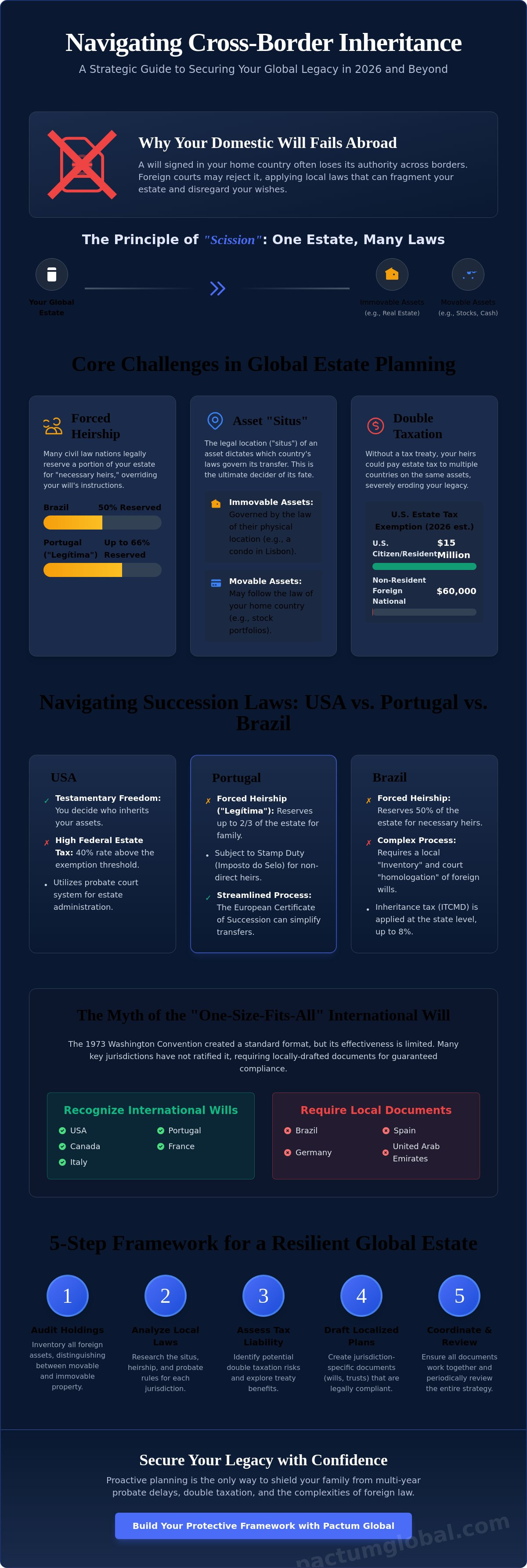
A 5-Step Framework for Cross-Border Succession Planning
Securing a global legacy requires a shift from reactive document signing to a proactive, structured strategy. A scattered approach leads to the very delays and tax traps discussed earlier. By following a methodical framework, you can align your international holdings with local requirements while maintaining a clear path for your heirs. Successful succession planning for foreign assets isn't a one-time event; it's a coordinated process that bridges the gap between different legal systems and tax authorities.
Step 1 & 2: The Discovery Phase
The foundation of any cross-border strategy is a comprehensive global asset audit. You must document every piece of property, every bank account, and all digital assets, identifying the "situs" or legal location for each. This isn't just about real estate. It includes intellectual property, brokerage accounts, and shares in foreign entities. Once you've mapped your assets, you must verify your tax domicile. Under 2026 guidelines, the IRS and foreign authorities look closely at where you intend to remain indefinitely, not just where you spend your time. This distinction is critical because it dictates which country has the primary right to tax your worldwide estate. If you don't establish this clearly, you risk multiple jurisdictions claiming a share of your legacy.
Step 3 & 4: Drafting and Alignment
Once the audit is complete, the next step is drafting jurisdiction-specific "situs" wills. A single international will often fails to meet the local formalities of civil law countries. You need documents that are legally "native" to the country where the asset sits. This requires coordination between legal experts who understand how a will in Portugal interacts with a probate process in the USA. Beyond personal wills, your corporate documents must be aligned. We ensure that Shareholders' Agreements (SHA) and Startup Contracts (SAFE) include specific "transfer on death" clauses. This prevents a company's operations from seizing up if a major shareholder passes away. Coordinating executors who speak the local language and understand the local time zones is the final piece of this administrative puzzle.
The final step is the periodic review of international tax treaties. Laws change, and the 2026 tax landscape is particularly volatile. New reforms in Brazil and the sunsetting of certain US exemptions mean that a plan drafted five years ago may now be obsolete. Maintaining a relationship with a global navigator ensures your strategy evolves alongside these regulations. If you are ready to build a resilient structure for your international holdings, you can start your succession planning process with our expert team today. We provide the clarity and methodical oversight needed to protect your global expansion and your family's future.
Securing Your Global Legacy with Pactum Global
Succession planning for foreign assets is too complex to manage through a collection of disconnected local attorneys. When your legal team in Lisbon doesn't communicate with your advisors in Miami or São Paulo, your estate falls into the gaps between their jurisdictions. Pactum Global acts as your "Global Navigator," providing a unified strategy that spans continents. We serve as a single point of contact for your affairs in Brazil, Portugal, and the USA, ensuring that every document we draft works in harmony across every border you cross.
Our team specializes in creating succession documents that are specifically designed to hold up in local courts. We don't just provide translations; we provide legally native solutions. By proactively structuring your holdings, we reduce the administrative burden on your heirs. They won't have to navigate foreign bureaucracies alone or struggle with frozen assets. Instead, they'll follow a clear, pre-mapped path that you've established with our guidance. This proactive approach transforms a potentially chaotic transition into a steady, methodical transfer of wealth.
Why Choose a Cross-Border Consultancy?
A local generalist understands their own backyard, but they often lack the perspective needed for international expansion. An international specialist looks at the entire map. Pactum Global maintains a network of certified professionals in multiple jurisdictions, allowing us to anticipate how a change in Brazilian tax law might affect your US reporting requirements. In one instance, we helped a family resolve a complex inheritance conflict involving US-sited shares and Brazilian forced heirship rules. By aligning their corporate contracts with local succession mandates, we prevented a multi-year court battle and secured the family's business continuity.
Next Steps for Your Estate
The 2026 tax year brings significant changes to international reporting and estate exemptions. Now is the time to initiate a confidential review of your current global assets. We'll help you identify potential "situs" conflicts and ensure your residency status is correctly documented for both the IRS and foreign authorities. Don't leave your global legacy to chance or the default whims of a foreign civil code. You can schedule a consultation for your cross-border succession plan today to begin building a foundation that lasts for generations.
Protecting Your Global Legacy Across Borders
The complexities of international inheritance don't have to be a burden for your family. By addressing the conflicts between common law and civil law systems now, you prevent the bureaucratic gridlock that often follows uncoordinated estate transfers. Success in 2026 requires a strategy that respects the local mandates of Brazil, Portugal, and the USA while maintaining a clear, unified vision for your wealth. Effective succession planning for foreign assets is the bridge between your current growth and your family's future security.
At Pactum Global, we provide more than just documentation. We offer specialized expertise in the Brazil, Portugal, and USA corridors, guiding you from initial company setup to final succession. Our transparent, no-nonsense approach removes the stress of international bureaucracy, replacing it with a sense of calm confidence. Secure your global assets with Pactum Global's expert succession planning and move forward with the knowledge that your legacy is in steady, reliable hands. Your hard-earned success deserves a foundation that lasts for generations.
Frequently Asked Questions
Do I need a separate will for my property in Brazil or Portugal?
Yes, you should have a jurisdiction-specific will for assets in these countries. Brazilian authorities require local documents for real estate to avoid a lengthy homologation process in the Superior Court of Justice. In Portugal, a local will allows you to explicitly invoke the EU Succession Regulation (Brussels IV), ensuring your national law governs the estate instead of Portuguese default rules.
What is forced heirship and how does it affect my US assets?
Forced heirship is a civil law rule that reserves a fixed portion of your estate for specific family members. While it doesn't typically apply to assets located in the USA for US-domiciled citizens, it governs any property you own in countries like Brazil or Portugal. If you don't structure these assets correctly, local courts will override your will to satisfy these mandatory legal shares.
Can I avoid probate for my foreign assets?
You can often bypass judicial probate by holding foreign assets through corporate structures. Holding Portuguese or Brazilian real estate within a company allows you to transfer ownership via shares rather than deed transfers. This private contractual process avoids the 12 to 24 month delays common in Brazilian courts and reduces the administrative burden on your family.
How does the US-Portugal tax treaty affect my inheritance?
The existing US-Portugal treaty primarily addresses income tax rather than estate or inheritance tax. This means US citizens with Portuguese assets must still navigate the 40 percent federal estate tax threshold. However, Portugal offers a Stamp Duty exemption for direct heirs, which provides significant relief if your succession planning for foreign assets is coordinated to handle the US tax reporting requirements correctly.
What happens if I die without a will (intestate) in a foreign country?
If you die intestate, the laws of the country where the asset is located will determine who inherits your property. In civil law jurisdictions, this follows a rigid statutory hierarchy that may not align with your wishes. Your heirs will face significantly higher legal fees and longer court delays as they struggle to prove their relationship and rights under foreign law.
Is an International Will valid in all countries?
No, the International Will is only recognized in countries that ratified the 1973 Washington Convention. While the USA and Portugal are signatories, Brazil is not. Relying on a single international document is a risky strategy for succession planning for foreign assets. It's far more secure to maintain "situs" wills that are drafted to meet the specific formal requirements of each local jurisdiction.
How often should I update my cross-border succession plan?
You should review your plan every three years or whenever you acquire new international property. Global tax regulations and treaty interpretations change frequently, as seen with the 2026 reforms in Brazil and the USA. Regular updates ensure that your strategy accounts for new reporting requirements and remains the most efficient way to protect your global legacy from shifting tax burdens.
Can a Shareholders' Agreement (SHA) override inheritance laws?
A Shareholders' Agreement is a powerful tool for business continuity, but it cannot completely override forced heirship laws regarding the value of an estate. An SHA can dictate who has the right to manage and vote the shares, ensuring the business stays operational. However, the economic value of those shares may still need to be accounted for when satisfying the mandatory portions required by local civil codes.


