

Did you know that SAFE agreements comprised roughly 90% of all pre-seed deals leading into 2026? While these instruments offer speed, they often mask a deeper complexity that can stall your international expansion. Establishing the right corporate governance documents for startups isn't just about checking a legal box. It's about building a portable asset that translates your vision across borders, whether you're operating in Delaware, Portugal, or Brazil.
You likely feel the weight of conflicting legal requirements as you scale. It's exhausting to balance the fear of losing control to investors with the urgent need for capital. You know that a single error discovered during due diligence can be incredibly expensive to fix. This guide will help you master the essential frameworks required to protect your equity and manage cross-border operations with calm confidence. We'll provide a clear list of required documents, clarify the 2026 shift toward post-money SAFEs, and show you how to structure your company so it's ready for any global investor.
Key Takeaways
- Learn why 2026 investors prioritize "governance hygiene" earlier in the startup lifecycle than ever before to mitigate global risks.
- Identify the essential corporate governance documents for startups, including the specific roles of the Shareholders’ Agreement (SHA) and the post-money SAFE.
- Understand the unique legal nuances of operating in Brazil, Portugal, and the USA to avoid the high costs of fixing documentation errors during due diligence.
- Discover how to build a stage-fit framework that evolves from a seed-stage "Minimum Viable Board" to the rigorous reporting standards required for Series A.
- Establish an investment-ready foundation that protects your equity and ensures seamless cross-border operations as you scale.
The Strategic Role of Corporate Governance in 2026 Startups
Corporate governance is the framework of rules, practices, and processes that dictate how your startup is directed and controlled. It involves balancing the interests of many stakeholders, such as founders, investors, and the community. While many early-stage founders view this as a bureaucratic hurdle, it's actually a vital strategic asset. Adhering to fundamental Corporate Governance Principles ensures your company remains transparent and accountable as it scales across borders.
In 2026, the global investment climate has shifted. Investors now prioritize "governance hygiene" much earlier than they did in previous cycles. With global instability and new regulations like the EU AI Act becoming applicable in August 2026, VCs are looking for startups that can prove they're resilient. By formalizing corporate governance documents for startups before your first major round, you demonstrate a level of maturity that separates you from the competition. This preparation is the direct link to a successful Series A or B due diligence process. If your paperwork is messy, you'll face high costs to fix legal errors while potentially losing your lead investor's trust.
For founders operating in emerging markets like Brazil, which hosts over 20,000 active startups, governance acts as a trust bridge. It signals to international investors that your company follows global standards, regardless of local complexities. It's the difference between being seen as a risky local bet and a scalable global enterprise.
Beyond Compliance: Governance as a Valuation Driver
Clear decision-making frameworks reduce "founder risk" for venture capitalists by proving the company can function beyond the original founders' daily presence. When you define how the board operates and how major decisions are made, you remove ambiguity that often leads to internal conflict. Comprehensive governance documents protect minority shareholder rights to attract diverse capital and institutional backing. This transparency is also essential for maintaining a clean cap table, ensuring that every equity grant and SAFE agreement is documented accurately to prevent future dilution surprises.
Common Pitfalls of "Minimum Viable" Legal Structures
The danger of handshake deals among international co-founders cannot be overstated. While they feel easy at the start, they lack the legal weight to resolve disputes when the stakes are high. Many founders also fall into the trap of using generic online templates. These often fail to address local tax nuances, such as Brazil's 2026 dual VAT transition phase or Portugal's specific CIT rates for SMEs. The long-term cost of untangling poorly drafted bylaws during an exit can be devastating, often resulting in significant legal fees that eat into your final payout. Building a custom, robust foundation from day one is always the more efficient path.
Core Governance Documents: From Articles of Incorporation to SAFE Agreements
Setting up a global entity requires more than a simple registration. You need a cohesive set of corporate governance documents for startups that work together to protect your interests. The foundation rests on the "Big Three": Articles of Incorporation, Bylaws, and Shareholders’ Agreements. While the Articles create your legal entity and Bylaws set the internal rules, the Shareholders’ Agreement (SHA) defines the relationship between the people behind the equity.
Beyond these, you must prioritize Intellectual Property (IP) Assignment Agreements. Your code, trademarks, and trade secrets must belong to the company, not the individual developer or founder. Investors will walk away if they find gaps in your IP chain. Additionally, maintaining formal Board Resolutions creates a historical paper trail. This documentation is vital for auditors and future buyers during an exit. When you're Scaling with Governance, these records prove your company has been managed with professional oversight from day one.
The Shareholders’ Agreement (SHA): The Startup’s Constitution
The SHA is where you address the "what ifs" of business growth. For international exits, drag-along and tag-along rights are essential. Drag-along rights allow a majority to force minority shareholders to join a sale, preventing a single person from blocking a lucrative buyout. Conversely, tag-along rights protect minority holders by allowing them to join a deal if the founders sell their shares. These protections are vital for maintaining harmony among a diverse cap table.
Vesting schedules are equally critical. They ensure founder commitment by requiring you to earn your equity over time, typically four years with a one-year cliff. This structure protects the company if a co-founder leaves early. If you're managing teams across borders, having a tailored Shareholders Agreement for Cross Border Business ensures these clauses are enforceable in every jurisdiction where you operate.
SAFE vs. Convertible Notes: Choosing Your Fundraising Instrument
In 2026, the post-money SAFE has become the industry standard, used in roughly 90% of pre-seed deals. It offers a simpler path than convertible notes because it doesn't carry interest or a maturity date. For international founders, SAFEs reduce the complexity of cross-border deals by focusing on two main levers: valuation caps and discount rates. This simplicity allows you to close rounds faster without getting bogged down in debt-like negotiations.
While SAFEs are efficient, you must understand the tax implications. A structure that works in the US might trigger immediate tax liabilities for a founder in Europe or Brazil. Convertible notes, which carry annual interest rates between 4% and 8% in 2026, might be preferred in specific European jurisdictions for regulatory reasons. If you're unsure which instrument fits your roadmap, consulting with a global structuring expert can prevent costly mistakes before you sign.
Navigating Cross-Border Complexity: Brazil, Portugal, and the USA
A template designed for a Delaware C-Corp won't protect you in the Brazilian market. International expansion requires a nuanced understanding of how different legal systems interact. When you scale, your corporate governance documents for startups must adapt to local regulations while remaining attractive to global investors. Bridging the gap between the US, Brazil, and Europe is a strategic challenge that requires expert navigation. You can't rely on a "one size fits all" approach when your assets and operations span multiple continents.
Brazil: Protecting Founders in a Complex Regulatory Environment
Brazil presents a unique landscape for founders. The legal role of the "Administrador" carries significant personal liability for labor and tax debts. You must decide between a "Limitada" structure, which is flexible and cost-effective, or an "S.A." (Sociedade Anônima), which is often required for more complex investment rounds. Managing local compliance and transfer pricing is essential to keep your company investor-ready. For a deeper look at these requirements, see our guide on How to Open a Company in Brazil for Foreigners. It's vital to protect your personal assets while navigating the 2026 tax reform transitions.
Portugal and the EU: Structuring for the Digital Nomad Era
Portugal serves as an ideal gateway to the European market. Aligning your governance with EU standards is no longer optional. With the EU AI Act becoming applicable on August 2, 2026, your documentation must reflect high-level oversight of any automated systems you use. A robust Shareholders Agreement for Portuguese Company is vital for securing interest from European VCs. These documents must also account for residency requirements linked to Portugal’s D2 and D7 visas. This ensures your corporate structure supports your personal mobility goals. GDPR compliance remains a non-negotiable pillar of European startup governance that you must integrate into your core bylaws.
Many founders eventually face the "Delaware Flip." This process involves creating a US parent company to satisfy American investors who prefer familiar legal frameworks. As noted in Harvard on Startup Governance, establishing these high-level standards early simplifies the transition. However, keep in mind that Delaware increased its Division of Corporations fees on August 1, 2026. You'll need to manage these costs alongside your local subsidiary requirements to maintain a seamless global operation. Proper governance acts as the shield that protects your vision as you move into the US market.
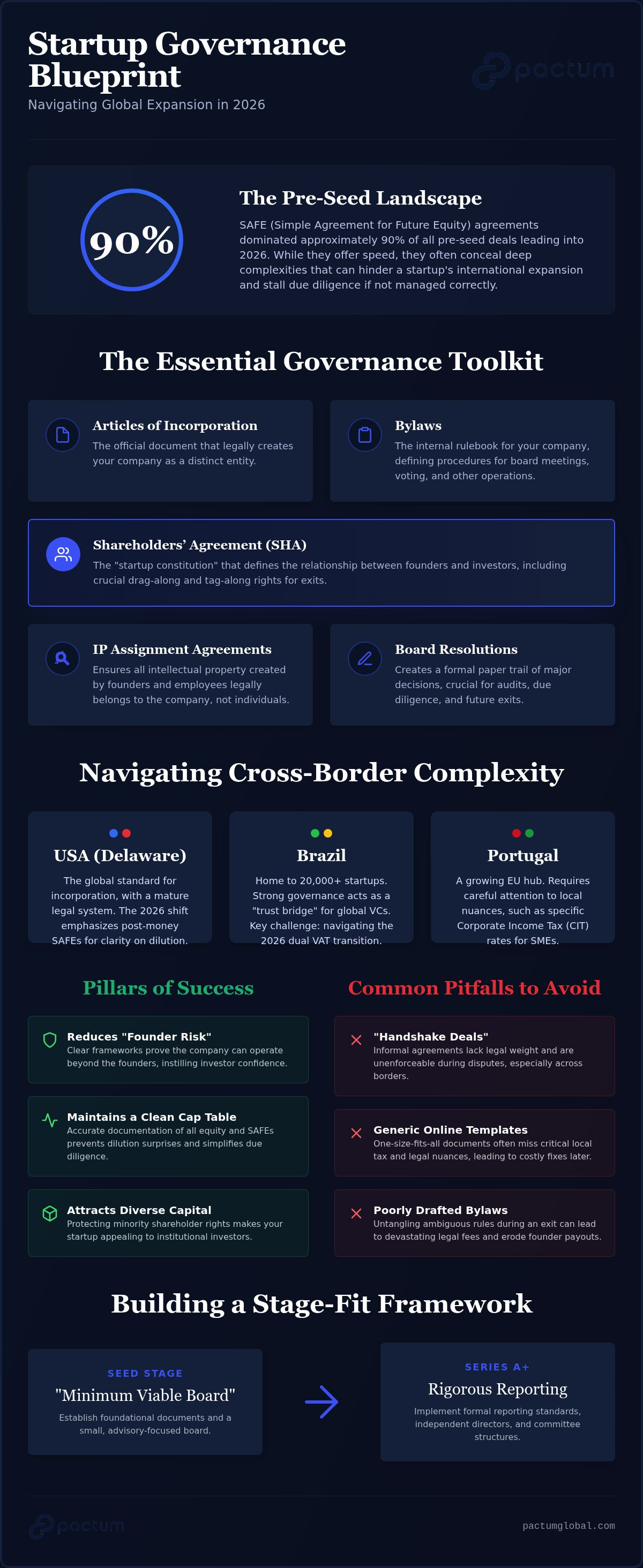
Building a Stage-Fit Governance Framework: Seed to Series A
Governance isn't a static set of rules; it's a living framework that must evolve alongside your cap table. At the seed stage, your focus should be on speed and clarity. You don't need a complex committee structure yet. Instead, you need a "Minimum Viable Board" and airtight IP protection. By establishing the right corporate governance documents for startups early, you prevent the friction that often kills young companies. This foundation ensures that every line of code and every trademark is legally owned by the entity, not the individual founder.
As you move toward a Bridge or Series A round, the expectations from investors shift. You'll need to tighten your reporting standards and likely add independent directors to your board. One of the most effective tools for this transition is the "Consent List." This document explicitly defines which decisions you can make as a founder and which require formal board approval. It provides the guardrails necessary to maintain investor trust while preserving your operational agility. Start building an "Investor Data Room" from day one. Having your board minutes, cap table, and IP assignments organized and ready for inspection can shave weeks off your next funding cycle.
The 5-Step Governance Implementation Roadmap
Implementing governance doesn't have to be overwhelming. Follow this methodical sequence to build your structure:
- Step 1: Formalize the Founders’ Agreement and IP assignment to ensure clear ownership.
- Step 2: Adopt standard Bylaws and appoint initial officers to satisfy basic legal requirements.
- Step 3: Implement a basic Board of Directors, even if it only includes the founders initially.
- Step 4: Establish a regular cadence for financial reporting and board minutes to create a professional paper trail.
Managing Global Mobility and Successive Structuring
Your governance needs can change instantly if a founder relocates. For example, moving from Brazil to the USA impacts your fiduciary duties and tax residency. Such a move requires an immediate update to your corporate documents to ensure compliance in both jurisdictions. This is a critical moment where poorly drafted bylaws can lead to unexpected tax liabilities or legal disputes. If you're planning an international move, our guide on Legal Support for Global Mobility provides a strategic roadmap for 2026. Maintaining a seamless structure during relocation is essential for protecting your company's "investment-ready" status. If you're ready to professionalize your international structure, contact Pactum Global for an expert consultation today.
Securing Your Global Foundation with Pactum Global
Removing the complexity of international corporate law is our core mission. When you rely on "off-the-shelf" templates for your corporate governance documents for startups, you're often inviting future litigation or due diligence failures. These generic forms can't account for the specific friction between Brazilian labor liabilities and US investor expectations. At Pactum Global, we provide custom-drafted SHAs and SAFE agreements that act as a protective shield for your equity. We ensure that every document is enforceable across the borders of Brazil, Portugal, and the USA simultaneously.
Our proactive approach extends beyond basic formation. We focus heavily on intellectual property protection and succession planning. Your code and trademarks must be secured within the proper entity to maintain your valuation during a Series A round. We also help you map out the future of your leadership to ensure the company remains stable even as founders relocate or exit. By working with a firm that understands the intricacies of multiple jurisdictions, you avoid the high cost of untangling legal errors later.
A Partner in Your Global Growth Journey
We pride ourselves on a "no-nonsense" approach to global mobility and immigration. Our team understands that legal structures and personal residency are deeply intertwined. For example, moving a Brazilian tech startup to the US market involves more than just a simple registration. It requires managing the "Administrador" role in Brazil while ensuring the new US entity is compliant with Delaware's 2026 fee increases. We've navigated these transitions for numerous founders, allowing them to focus on growth rather than bureaucracy. Schedule a consultation with our cross-border legal experts to start your journey with confidence.
Why Founders Choose Pactum Global
Founders choose us because we offer a rare blend of expertise. We are deeply knowledgeable in both local civil law (found in Brazil and Portugal) and common law (the foundation of the USA). This dual perspective allows us to translate complex legal concepts into clear, actionable advice. You won't find cold, detached academic jargon here. Instead, you'll receive professional, reassuring guidance that removes obstacles to your success.
Our commitment to transparency means you'll always have a structured overview of your global transition. We provide end-to-end support, from the first day of company formation to the final signatures on complex SHA negotiations. We act as your seasoned global navigator, ensuring your foundation is secure so you can scale with speed and security. Whether you're navigating Portugal's SME tax benefits or the SEC's 2026 filing fees, we have the expertise to guide you through every hurdle.
Build Your Global Legacy on a Secure Foundation
Establishing robust corporate governance documents for startups is a strategic investment in your company's longevity. By prioritizing governance hygiene early, you move beyond simple compliance to create a trust bridge that attracts high-tier global investors. Whether you're navigating the complexities of Brazilian liability, leveraging Portugal’s gateway to Europe, or preparing for a Delaware Flip, your legal framework must be as ambitious as your growth plans. A well-structured organization isn't just about avoiding errors; it's about being ready for the opportunities that 2026 presents.
Pactum Global acts as your seasoned global navigator. We specialize in the unique legal landscapes of Brazil, Portugal, and the USA. Our team provides expert cross-border SHA and SAFE drafting tailored to your specific needs, alongside dedicated support for global mobility and immigration. Don't let bureaucratic hurdles or generic templates slow your momentum. We're here to demystify the process and provide clear, actionable legal advice so you can focus on scaling your business.
Secure your startup’s future with expert international legal structuring from Pactum Global. You've built the vision; let's ensure the foundation is strong enough to carry it across every border.
Frequently Asked Questions
What are the most important corporate governance documents for a new startup?
The essential corporate governance documents for startups include the Articles of Incorporation, Bylaws, and the Shareholders’ Agreement (SHA). You also must have Intellectual Property (IP) Assignment Agreements and initial Board Resolutions. These documents establish the legal foundation, internal rules, and ownership rights that international investors expect to see before they commit capital to your venture.
Do I really need a Shareholders’ Agreement if I only have one co-founder?
Yes, you do. A Shareholders’ Agreement isn't just about resolving conflicts; it's about defining the "what ifs" of your business relationship. It establishes vesting schedules to ensure long-term commitment and dictates what happens to shares if a founder exits. Without this document, you risk a "dead equity" situation that can make your company uninvestable during future funding rounds.
How does a SAFE agreement differ from a traditional convertible note?
A SAFE is an equity-based instrument that doesn't carry interest or a maturity date. In 2026, SAFEs are used in roughly 90% of pre-seed deals because they're simple and fast to execute. Traditional convertible notes are debt instruments. They carry annual interest rates, typically between 4% and 8% in 2026, and include a deadline for repayment or conversion into equity.
What is an IP Assignment Agreement and why is it mandatory for investors?
An IP Assignment Agreement legally transfers ownership of all intellectual property created by founders or employees to the startup entity. Investors require this because they're buying into your technology and brand. If the code or trademarks remain with an individual rather than the company, the startup’s valuation drops to zero. It's a non-negotiable part of any professional due diligence process.
Can I use the same corporate documents for my companies in Brazil and the USA?
No, you cannot. Brazil operates under a civil law system, while the USA uses common law. Each jurisdiction has vastly different requirements for liability, tax residency, and corporate structure. A Brazilian "Limitada" requires specific clauses regarding the "Administrador" role that don't apply to a Delaware C-Corp. Using generic, non-localized templates is a fast way to trigger expensive compliance errors.
How often should a startup board of directors meet in the early stages?
Quarterly meetings are the standard cadence for most early-stage startups. This frequency allows you to maintain a consistent paper trail of major decisions without slowing down your operations. If you're currently in the middle of a fundraising round or a major pivot, you might move to monthly meetings. The goal is to keep a clear record of board resolutions for future auditors.
What is the "Delaware Flip" and when should an international startup consider it?
The "Delaware Flip" is a process where you create a US parent company that owns your original international entity. You should consider this when you're targeting US-based venture capital firms that require a familiar legal jurisdiction. It's a complex transition that impacts your tax residency and governance structure, so it's best performed before you reach a Series A round.
How does corporate governance impact my ability to get a business visa in Portugal or the USA?
Strong governance proves the legitimacy and professional oversight of your business. For the Portugal D2 visa or US E-2 and L-1 categories, immigration officers look for evidence that the company is an active, well-managed entity. Providing official board minutes, clear bylaws, and a formal SHA supports your case that the company is a real enterprise rather than just a shell for residency.


