

If you think your domestic contract will protect you in a foreign jurisdiction, you're building your global expansion on a foundation of sand. It's a common mistake to assume that a standard shareholders agreement for cross border business translates perfectly across borders. You likely feel the pressure of global M&A activity hitting a five-year high in early 2026, yet the fear of unenforceable clauses in a foreign court remains a constant source of anxiety. You need more than a document; you need a jurisdictional bridge that harmonizes conflicting legal philosophies.
We understand that navigating the gap between US Common Law and European Civil Law is daunting and often confusing. This guide will teach you how to structure a contract that protects your interests while minimizing tax and compliance risks. We'll explore the critical clauses you need for clear governance, secure exit rights, and compliance with the 2026 EU FDI Screening Regulation. You'll gain a methodical roadmap to master international corporate governance, ensuring your global ventures are built on a secure and predictable foundation.
Key Takeaways
- Understand how a shareholders agreement for cross border business acts as a vital bridge between local regulations and international investor expectations.
- Identify the essential reserved matters and board representation clauses that ensure you maintain control over your foreign investments.
- Learn the differences between the flexible Common Law used in the US and the statutory rigidity found in Civil Law jurisdictions like Brazil and Portugal.
- Discover how to evaluate legal partners based on their ability to provide dual-qualified expertise and localized networks in your target markets.
- Master the strategic approach to drafting customized agreements that remain enforceable and compliant across multiple jurisdictions.
What is a Shareholders Agreement for Cross Border Business?
A shareholders agreement for cross border business isn't just a rulebook for your company; it is a sophisticated jurisdictional bridge. At its core, this is a private contract tailored to manage the rights and obligations of partners who live and work under different legal systems. While a standard domestic agreement focuses on internal governance within a single country, a cross-border instrument must reconcile the mandatory corporate laws of the company's home country with the specific legal protections international investors expect. Understanding What is a Shareholders Agreement? provides the foundation, but applying those concepts across borders requires a specialized lens.
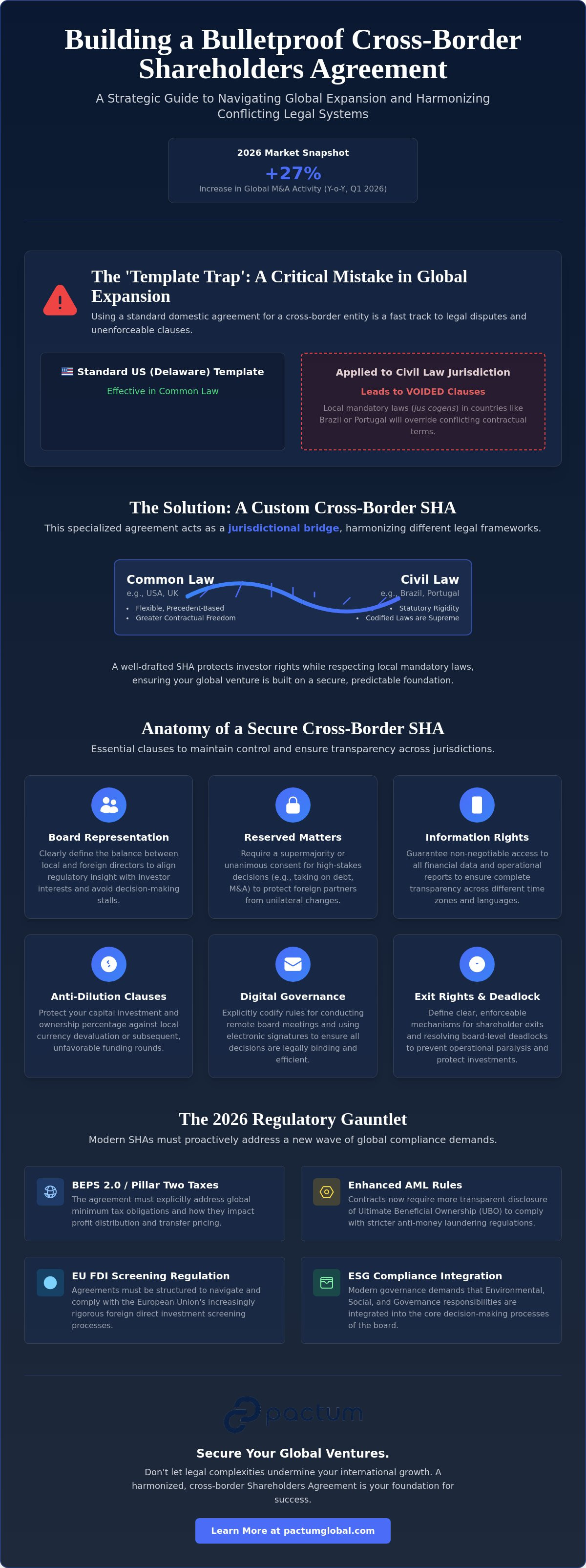
In 2026, the need for this specialized approach is undeniable. Global M&A activity reached a five-year high in the first quarter of 2026, with volumes up 27% year-over-year. As businesses expand into markets like Brazil and Portugal, the "one-size-fits-all" template approach has become a liability. A shareholders agreement for cross border business must account for international tax treaties, currency volatility, and the specific regulatory hurdles of each region. It transforms a generic legal document into a protective shield for your global interests.
The 'Template Trap' in International Business
Using a standard Delaware template for a Brazilian or Portuguese entity is a fast track to the courtroom. Generic templates fail here. In many Civil Law jurisdictions, mandatory local laws, known as jus cogens, often take precedence over private contracts. If your agreement includes clauses that conflict with these local statutes, a judge may simply declare them void. This often happens with provisions regarding director liability or the priority of dividend payments. The 'Template Trap' is the failure to account for local corporate formalities when drafting international governance documents.
Why 2026 Regulations Demand Strategic SHA Structuring
The regulatory environment of June 2026 demands a higher level of precision. With the implementation of BEPS 2.0 and the first Pillar Two tax returns due this month, your SHA must now address global minimum tax obligations. Anti-money laundering (AML) rules also require more transparent disclosure of beneficial ownership within the contract. Beyond taxes, the agreement must reflect modern operational realities. It should explicitly codify how remote board meetings and digital voting are conducted to ensure every decision is legally binding. Governance has also shifted toward ESG compliance, requiring that environmental and social responsibilities are integrated into the core decision-making process of the board.
Critical Provisions for International Corporate Governance
A robust shareholders agreement for cross border business acts as a safeguard against the unpredictability of foreign legal systems. To build this security, you must focus on critical provisions for corporate governance that define who holds the power and how they exercise it. Board representation is the first hurdle. You need to clearly define the balance between local directors, who understand the domestic regulatory environment, and foreign directors, who represent the international investors' interests. Without this clarity, decision-making can stall, leaving your investment vulnerable.
Reserved matters are equally vital. These are specific high-stakes decisions, such as taking on debt or changing the company's bylaws, that require a supermajority or even unanimous consent. In a global setup, these clauses prevent a local majority from making unilateral changes that could harm foreign partners. Additionally, anti-dilution clauses protect your capital against local currency devaluation or subsequent funding rounds. When working across borders, information rights must be non-negotiable. You need guaranteed access to financial data and operational reports, ensuring transparency despite time zone differences and language barriers.
Governance in Multi-Jurisdictional Entities
Operating between countries like the USA and Portugal requires a methodical approach to board management. Your agreement should explicitly allow for digital board meetings and electronic signatures to maintain momentum. Choosing between local representatives and foreign directors involves weighing legal liabilities against tax implications. For early-stage ventures, structuring a startup for global investment requires these governance foundations to be established before the first dollar is committed. If you need assistance with these complex frameworks, our team at Pactum Global can help you draft a contract that bridges these gaps.
Exit Strategies: Navigating Global Liquidity
Exits become complex when multiple legal systems and currencies intersect. Tag-along and drag-along rights ensure that all shareholders can participate in a lucrative acquisition, or conversely, that a minority cannot block a beneficial sale. Valuation is often a sticking point. Your put and call options must specify a valuation formula that accounts for currency fluctuations to avoid disputes during the exit phase. Finally, a well-drafted deadlock provision is essential. It provides a clear, step-by-step resolution for 50/50 split disputes, preventing a boardroom stalemate from destroying the company's value.
Jurisdictional Conflict: Common Law vs. Civil Law
The success of a shareholders agreement for cross border business often depends on which legal philosophy governs it. In the United States, the "freedom of contract" principle allows partners to draft nearly any provision they see fit. However, when your business enters Brazil or Portugal, you encounter "statutory rigidity." These Civil Law systems rely on comprehensive codes that often restrict what a private contract can override. For instance, the "Social Object" of a company in Brazil is a strictly defined purpose within its articles of incorporation. If your agreement tries to steer the company toward activities outside this object, those actions could be deemed ultra vires and unenforceable.
Enforcement mechanisms also differ significantly. In Common Law jurisdictions, a breach of contract often results in monetary damages. Conversely, Civil Law courts are more inclined toward "Specific Performance." This forces the breaching party to actually fulfill their obligation, such as transferring shares at a specific price, rather than just paying a fine. Because of these fundamental differences, the choice of law and choice of forum clauses are the most heavily negotiated parts of the document. They determine which set of rules applies when a partnership sours.
Governing Law and Dispute Resolution: The Arbitration Debate
Most international partners avoid local courts to sidestep potential bias or procedural delays. International arbitration through bodies like the ICC or LCIA is the preferred alternative. Choosing a "Seat of Arbitration" in a neutral location like New York or Lisbon provides a predictable framework. The primary advantage here is the New York Convention. This treaty ensures arbitral awards are recognized and enforced in over 160 countries. It gives your agreement teeth that a local court judgment might lack in a foreign territory.
Tax and Compliance Intersections
Your agreement's financial clauses cannot exist in a vacuum. Dividend distribution and share valuation must align strictly with Brazil transfer pricing regulations compliance essentials to avoid heavy penalties. Cross-border share transfers also trigger withholding tax considerations that can significantly impact the net value of a deal. Additionally, you must account for Foreign Direct Investment (FDI) reporting requirements. In Brazil, this involves registration with the Central Bank, while in Portugal, specific declarations to tax authorities are mandatory. Failing to codify these reporting responsibilities in your shareholders agreement for cross border business can lead to bureaucratic gridlock.
Buying Guide: Evaluating an International SHA Lawyer
Selecting the right counsel is the most consequential decision you'll make when drafting a shareholders agreement for cross border business. A domestic corporate lawyer, no matter how skilled, often lacks the specialized perspective required to bridge the gap between conflicting legal systems. You should prioritize firms that offer dual-qualified experts or maintain a deeply integrated localized network in your target markets. This ensures your contract isn't just a translation but a legally sound instrument in every jurisdiction involved.
Expertise must extend beyond the letter of the law to include cultural legal fluency. This means your advisor understands the business etiquette and negotiation styles of both the US and countries like Brazil or Portugal. For example, the way a board deadlock is handled in Lisbon may differ culturally from a boardroom in New York. Transparency in fee structures is also a hallmark of a professional firm. You should understand whether you're paying a flat fee for the initial drafting or entering into an ongoing advisory relationship. As of June 2026, the average annual salary for an International Corporate Lawyer in the US is approximately $144,688, reflecting the high level of specialized knowledge required for this work.
Use this checklist to vet your legal partner:
- Does the firm have experience with both Common Law and Civil Law systems?
- Can they provide references from other cross-border entrepreneurs?
- How do they handle communication across different time zones?
- Are they familiar with the intersection of corporate law and immigration?
The Role of Global Mobility in Shareholder Structuring
Your SHA can directly impact your ability to secure residency. For instance, the specific wording in your agreement must often support a Portugal D2 visa application for entrepreneurs. In Brazil, there are often minimum shareholding requirements that must be codified to qualify for investor visas. It's also essential to ensure that founder vesting schedules don't conflict with immigration residency requirements. If a founder must leave the country to maintain their visa status, the SHA shouldn't penalize them for "abandoning" the business.
Assessing Multi-Jurisdictional Legal Expertise
When vetting a firm, ask about their direct experience with opening a company in Brazil. Their track record should include converting cross-border SAFE agreements into full SHAs as the company matures. Don't hesitate to request case studies of successfully resolved international shareholder disputes. This evidence of proactive protection is what separates a generic service provider from a true global navigator. If you're ready to secure your international interests, contact Pactum Global to discuss your specific jurisdictional needs.
Pactum Global: Harmonizing Your International SHA
At Pactum Global, we don't just draft documents; we map your entire international expansion. Our "Navigator" approach ensures that your shareholders agreement for cross border business remains enforceable in Miami, São Paulo, and Lisbon simultaneously. We specialize in customized SHA drafting that respects the statutory rigidity of Civil Law while maintaining the flexibility of Common Law. This dual-lens perspective prevents the common pitfalls where local mandatory laws override private contracts. By adopting a proactive, "shield-first" philosophy, we identify and resolve bureaucratic friction before it can disrupt your operations.
Our integrated service model is what sets us apart from traditional, siloed law firms. We combine corporate structuring with immigration strategy and tax compliance. This means your SHA won't just govern your board; it will also support your residency requirements and align with transfer pricing rules. We act as your steady partner, demystifying the complexities of global business so you can focus on growth. Whether you're entering the US market or expanding into South America or Europe, we provide the clarity and security you need to move forward with confidence.
From SAFE to SHA: Managing the Startup Lifecycle
We help founders transition from simple agreements to complex, multi-jurisdictional SHAs as their ventures mature. Our team ensures your cap table remains healthy and attractive for future global venture capital investment. We protect early-stage interests while preparing the foundation for Series A and beyond. Pactum Global provides a seamless experience by managing the entire end-to-end process of international relocation and corporate incorporation. This holistic view prevents governance gaps that often occur when startups grow across borders too quickly.
Global Reach, Local Expertise
Our network of experienced lawyers in Lisbon, São Paulo, and Miami provides the localized expertise necessary for true global compliance. You benefit from a single point of contact for your multi-country expansions, removing the need to manage multiple disconnected legal teams. We understand the nuances of each market, from Brazilian Central Bank registrations to Portuguese tax declarations. This localized knowledge, combined with our international reach, makes us a one-stop solution for the modern entrepreneur. Ready to build a secure foundation for your venture? Book a consultation with our cross-border experts today.
Build a Foundation for Global Success
Expanding your business across borders requires more than just ambition; it requires a legally binding bridge that survives multiple jurisdictions. You've learned how a shareholders agreement for cross border business must harmonize conflicting legal systems while protecting your long-term interests. Whether it's navigating the statutory rigidity of Brazil or the board representation requirements in Portugal, your documentation must be as dynamic as your growth strategy. A well-structured agreement ensures that your governance, tax compliance, and exit rights remain secure regardless of where you operate.
Don't leave your global interests to chance or generic templates. At Pactum Global, we provide specialized expertise across the USA, Brazil, and Portugal. We offer integrated legal and immigration support to ensure your corporate structure works in harmony with your personal and professional goals. Our no-nonsense, results-focused approach removes the bureaucratic friction that slows down international entrepreneurs. We act as your proactive shield, mapping out the journey so you can focus on scaling your business.
Secure your global foundation with a Pactum Global SHA consultation. Your international journey is already mapped out; it's time to take the first step toward a secure and predictable future.
Frequently Asked Questions
Is a US-governed shareholders agreement enforceable in Brazil?
A US-governed agreement is only partially enforceable in Brazil if its provisions conflict with mandatory local corporate statutes. Brazilian courts prioritize domestic law for entities registered within their borders, meaning certain "freedom of contract" clauses from the US might be voided. To ensure a shareholders agreement for cross border business holds weight, you must register the document with the company's head office in Brazil. This step ensures that specific rights, such as voting blocks, are recognized by local authorities.
What is the difference between a Founders Agreement and a Shareholders Agreement in cross-border deals?
A Founders Agreement serves as a preliminary roadmap for initial partners, while a Shareholders Agreement is a comprehensive legal contract that includes outside investors. In international deals, the SHA is significantly more complex. It must address cross-border tax liabilities, dispute resolution forums, and compliance with multiple sets of national laws. The SHA effectively replaces the simpler founders' document once the company seeks global scale or begins accepting external capital.
Can I include an arbitration clause that bypasses Portuguese local courts?
You can absolutely include an arbitration clause to bypass local Portuguese courts. Most international partners prefer this because it offers a neutral forum and typically faster resolution times. Portugal is a signatory to the New York Convention, which means local authorities must recognize and enforce international arbitral awards. This provides a level of predictability that local litigation often lacks, especially for foreign investors who aren't familiar with Portuguese procedural rules.
How do transfer pricing rules affect my shareholders agreement?
Transfer pricing rules dictate the market value of transactions between related parties, which directly impacts dividend and service fee clauses in your SHA. If your agreement sets values that tax authorities in Brazil or the US deem unrealistic, you could face significant audits and penalties. Your shareholders agreement for cross border business should include provisions that require all valuations and intercompany payments to remain compliant with the latest OECD or local transfer pricing guidelines.
Do I need a separate SHA for each country where my business operates?
You don't always need a separate agreement for every country, but you do need a document that accounts for every jurisdiction involved. Many global companies use a master agreement combined with localized appendices to handle specific legal requirements in Brazil or Portugal. This approach maintains a unified corporate vision while ensuring that the specific mandatory laws of each local entity are fully respected and legally enforceable in their respective courts.
What happens to the SHA if a shareholder loses their work visa or residency?
The loss of a work visa or residency should trigger a specific "compulsory transfer" clause within your agreement. This allows the remaining shareholders to buy back the shares of the departing member to ensure operational continuity. Without this provision, a shareholder who can no longer legally live or work in the country might become a "deadweight" on the cap table. This could potentially block critical corporate actions or complicate future funding rounds.
Can a cross-border SHA protect against currency fluctuation risks?
A cross-border SHA can mitigate currency risks by defining a "stable currency" for all financial calculations. You can mandate that share buy-backs, dividend payments, and valuation formulas are pegged to the US Dollar or the Euro. This prevents a sudden devaluation of a local currency, like the Brazilian Real, from unfairly stripping value away from international investors or founders during a liquidity event or a scheduled partner exit.
How often should an international shareholders agreement be reviewed for compliance?
You should review your international agreement at least once a year or whenever a significant regulatory shift occurs in your target markets. For example, the June 2026 revisions to the EU FDI Screening Regulation may require updates to how foreign investments are reported or structured. Regular audits ensure that your contract remains a protective shield rather than a liability as global tax laws and geopolitical sanctions continue to evolve across different jurisdictions.


