
Your product might be ready for the world, but if your corporate structure remains anchored in a local jurisdiction like a Brazil LTDA, international VCs will likely walk away. With venture capital funding reaching $300 billion in early 2026, the capital is available, but the scrutiny is higher than ever. Investors want a "VC-ready" entity that feels familiar and safe. You've likely felt the stress of explaining your local legal setup while fearing the traps of double taxation or regulatory delays. We know that structuring a startup for global investment feels like navigating a maze of conflicting laws and bureaucratic hurdles.
You shouldn't have to choose between rapid growth and legal security. This guide shows you how to build a robust, cross-border corporate structure that simplifies global expansion and satisfies rigorous due diligence. We'll explore the "flip" strategy to jurisdictions like Delaware, explain why the new 45-day EU screening phase matters for your timeline, and help you decide between a SAFE or a traditional equity round. By the end, you'll have a clear plan to minimize compliance friction and position your company for a successful international raise.
Key Takeaways
- Understand how to align your corporate governance with the specific expectations of international venture capital to eliminate jurisdictional friction.
- Compare the advantages of Delaware, Portugal, and the Caymans when executing a "flip" to create a parent holding company.
- Master the nuances of structuring a startup for global investment by securing your intellectual property and standardizing your Shareholders’ Agreements (SHA).
- Learn how to transform compliance and governance from a bureaucratic burden into a strategic asset that de-risks your company for foreign investors.
- Follow a step-by-step roadmap to transition from a local foundation to a global scale by auditing your legal health and targeting specific investment markets.
What Does it Mean to be "Investment-Ready" Globally?
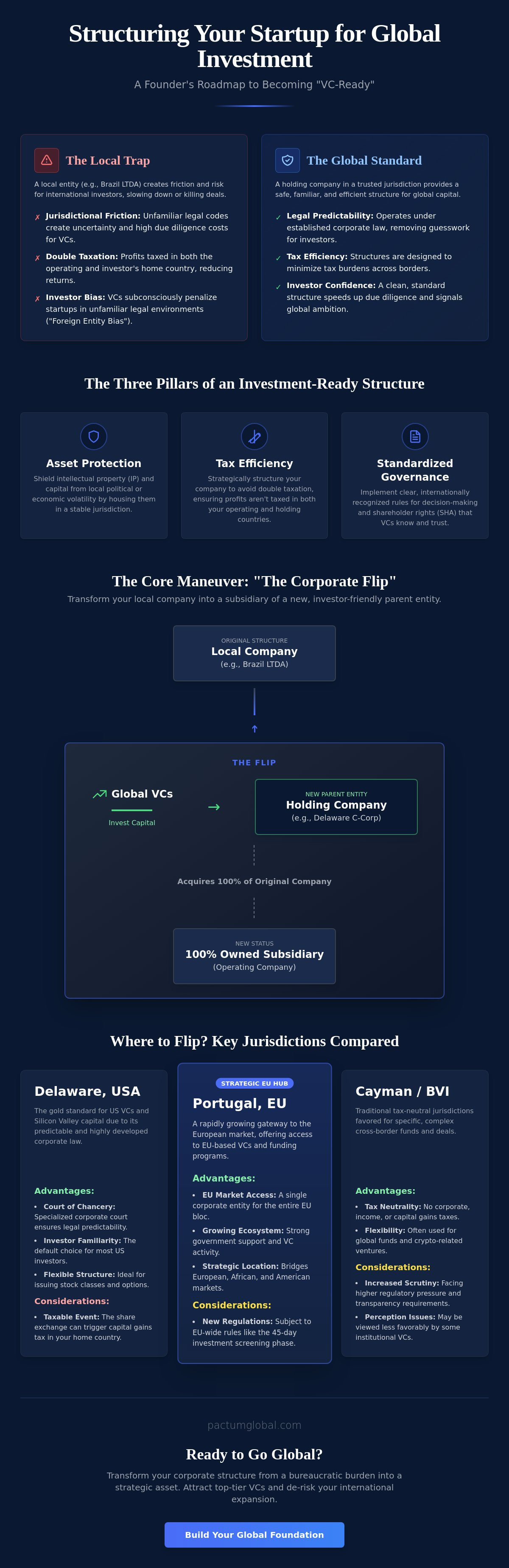
Global investment readiness isn't just a buzzword. It's the precise alignment of your corporate governance with the expectations of international venture capital. Many founders start with a local entity, such as a Brazilian LTDA, to get their operations off the ground. While these structures work for domestic growth, they often create "jurisdictional friction" during an international raise. Investors don't want to learn a new legal code just to fund your company. They want a structure they can trust without hiring a dozen local consultants to interpret the risks.
Success in structuring a startup for global investment rests on three fundamental pillars:
- Asset Protection: Ensuring intellectual property and capital are shielded from local political or economic volatility.
- Tax Efficiency: Avoiding the "double taxation" trap where profits are taxed in both the operating country and the investor's home country.
- Governance: Implementing clear rules for decision-making and shareholder rights that mirror international standards.
An Investment-Ready Structure is one that eliminates legal uncertainty for foreign capital. At Pactum Global, we consider this the necessary foundation for any founder looking to attract Tier 1 capital from overseas.
The Investor Psychology of Jurisdictional Risk
VCs have a strong preference for jurisdictions like Delaware in the US or Portugal in the EU because of established legal precedents. This preference stems from a desire for predictability. If a dispute arises, they know how the courts will react. This often leads to "Foreign Entity Bias," where investors subconsciously penalize startups in unfamiliar legal environments. By adopting a global structure, you remove this bias. Transparency is your greatest tool here. A clean, standard structure speeds up the due diligence process and builds the confidence needed to close a round quickly.
The Shift from Local to Global Mindset
Scaling requires you to think beyond your home market's legal boundaries. A global setup isn't just about the current funding round. It's about your ultimate exit. Whether you're targeting an IPO on the Nasdaq or an M&A deal with a European conglomerate, Pinnacle Global Advisory offers the specialized M&A advisory and strategic growth solutions necessary to support that transition. A Holding Company serves as the central hub for this strategy. It allows you to manage multiple subsidiaries across different countries while keeping your equity and IP in a single, stable location. Transitioning to this model is a critical step in structuring a startup for global investment that pays dividends throughout the life of your business.
The Holding Company Model and "The Flip"
If you want to move beyond your local borders, you must master "The Flip." This is the corporate maneuver where you establish a new parent company in a high-trust jurisdiction. This new entity then acquires 100% of your original local company. The result is a clean, familiar entry point for international venture capital. When structuring a startup for global investment, this architecture is often a non-negotiable requirement for Tier-1 investors.
Founders typically choose between three primary routes for their holding company:
- Delaware (USA): The undisputed gold standard for startups seeking Silicon Valley capital.
- Portugal (EU): A rapidly growing strategic hub for those targeting the European market and EU-based funding.
- Cayman Islands or BVI: Traditional tax-neutral jurisdictions that remain common for specific cross-border deals, though they face increasing regulatory scrutiny in 2026.
Choosing the right location depends on where your future investors are based and where you plan to scale your operations. Each jurisdiction offers different levels of legal protection and tax implications.
Delaware C-Corp: The Global Standard
US investors favor Delaware because of the Court of Chancery. This specialized court focuses exclusively on corporate law, providing a level of legal predictability that doesn't exist elsewhere. A Delaware C-Corp also offers immense flexibility for issuing various classes of stock and managing employee option pools. However, the "flip" to the US is not without risks. A common pitfall for Brazilian or European founders is failing to account for the "taxable event" during the share exchange. Without careful planning, you might trigger a significant capital gains tax bill in your home country before the investment even hits your bank account.
Portugal as a Strategic Gateway to Europe
For startups with a European focus, a Portuguese holding company is an excellent alternative. It provides a direct path to EU venture capital and various innovation grants. One of the most significant advantages is the participation exemption regime. This legal framework prevents double taxation on dividends flowing from your subsidiaries to the parent company. It ensures that more of your capital stays within the business to fund growth. If you are evaluating this route, our team can streamline the company setup in Portugal to ensure your entity is fully compliant with EU regulations. Structuring a startup for global investment through a European lens requires a partner who understands both local nuances and international standards. This proactive approach acts as a shield against the bureaucratic errors that often stall global transitions.
Essential Legal Documentation for Global Due Diligence
Investors won't fund a promise. They fund a legally binding reality. Once you've established your holding company, the next step in structuring a startup for global investment is assembling the "Holy Trinity" of legal documents. These include your Shareholders’ Agreement (SHA), the Simple Agreement for Future Equity (SAFE), and your IP Assignment documents. These files form the core of your data room and determine how quickly you can close a round.
Relying on standard templates is a common mistake. A YC-style SAFE is perfect for a Delaware company raising from a California VC. However, it doesn't account for the tax implications of a parent company in Portugal or the specific labor laws affecting founders in Brazil. These "one-size-fits-all" documents often fail during cross-border due diligence because they don't bridge the gap between different legal systems. At Pactum Global, we emphasize customization to avoid these "template traps" that lead to deemed dividends or unexpected capital gains taxes.
Many founders fear losing control during their first major raise. This is a valid concern. We address this by using clear, protective language that balances investor rights with founder autonomy. You can attract capital without handing over the keys to your company, provided your documents are drafted with a global perspective.
The Cross-Border Shareholders' Agreement (SHA)
A robust SHA is the backbone of your corporate governance. It must include specific clauses to protect all parties:
- Drag-along Rights: Ensures a minority of shareholders cannot block a lucrative exit.
- Tag-along Rights: Protects minority shareholders by allowing them to join a sale on the same terms as the founders.
- Anti-dilution: Shields early investors from losing value if you raise a future round at a lower valuation.
Dispute resolution is equally critical. You must decide whether Delaware or Portuguese law governs the contract. Choosing an international arbitration seat, like New York or Lisbon, provides a neutral ground that avoids the delays of local court systems. Customizing the SHA for diverse founder locations ensures that everyone's tax and legal obligations are met without friction.
Intellectual Property (IP) as the Anchor of Value
Investors aren't just betting on your team. They're buying your technology. If your IP stays with the founders personally or sits in a local subsidiary, it creates a massive red flag. Structuring a startup for global investment requires all intellectual property to be owned by the parent holding company. This is non-negotiable for Tier-1 venture capital firms.
An IP Assignment Agreement is the only way to ensure the company legally owns every line of code and every design. Without this, your valuation is essentially zero in the eyes of a VC. You also need a coordinated trademark strategy. Protecting your brand in the USA, Brazil, and the EU simultaneously ensures your market presence is secure as you expand. This methodical approach to documentation acts as a shield, protecting your most valuable assets from future legal challenges.
Compliance and Governance as Investor De-risking
Investors frequently view international startups as high-risk ventures due to unfamiliar regulatory environments. You can flip this narrative by treating compliance as a strategic asset. When structuring a startup for global investment, a clean bill of health regarding local and international laws acts as a powerful de-risking tool. It signals to venture capitalists that your company is mature, organized, and ready for institutional capital. This transparency replaces investor hesitation with a sense of calm confidence.
Robust governance goes beyond simple record-keeping. It involves maintaining a defensible "corporate veil" between your parent company and its subsidiaries. If you treat your holding company and your local operations as a single bank account, you expose your entire structure to liability. Investors look for clear separation. They want to see that each entity operates as a distinct legal person with its own documented decisions and financial records. This methodical approach ensures your international structure is legally defensible if ever challenged.
Transfer Pricing and Intercompany Agreements
Once your holding company is in place, you must formalize the relationship between your various entities. This is where transfer pricing becomes essential. The "arm's length principle" requires that any transaction between your US or Portuguese parent and your local operations mirrors a transaction between independent parties. Without this, you risk aggressive tax audits and significant red flags during due diligence. It's a common point of failure that can stall a funding round indefinitely.
You need ironclad service agreements that define exactly what the local team provides and how they're compensated. These intercompany contracts are the first thing a sophisticated investor will ask to see. Utilizing professional transfer pricing services ensures your intercompany flows are compliant and defensible. This proactive step prevents the tax traps mentioned in previous sections and keeps your cap table attractive to foreign capital. Structuring a startup for global investment requires this level of precision to ensure long-term scalability.
Succession Planning and Asset Protection
Global founders often overlook the personal side of corporate structure. If a founder becomes incapacitated, what happens to the shares in the Delaware or Portuguese holding company? Without cross-border succession documents, your company could be paralyzed by legal limbo in multiple jurisdictions. This "Key Person Risk" is a major deterrent for long-term investors who prioritize business continuity. They want to know the company can survive individual life events.
Integrating personal asset protection with your corporate governance ensures that your growth remains stable. By mapping out share transitions and protection strategies now, you provide investors with the security they need to commit significant capital. This level of foresight is a hallmark of a seasoned global navigator. It acts as a shield against bureaucratic errors and ensures your focus remains on growth rather than crisis management.
Strategic Roadmap: From Local Foundation to Global Scale
Transitioning from a local player to a global contender requires more than just a great product. It demands a methodical execution of your corporate architecture. Structuring a startup for global investment is a sequential process. Skipping a step or moving out of order often leads to expensive "re-work" later. Follow this roadmap to ensure your transition is seamless and your entity remains attractive to international capital.
- Step 1: Audit Local Health. Before looking abroad, you must clean up your home operations. Audit your current cap table, resolve any pending local litigation, and ensure all local tax filings are current.
- Step 2: Define Your Investment Target. Your choice between the US and Europe dictates your entire legal strategy. Decide early if you are chasing Silicon Valley VCs or leveraging the grants and ecosystems in Portugal and the wider EU.
- Step 3: Establish the Holding Layer. Execute "The Flip" by setting up your parent company in your target jurisdiction. This entity will now own your local operating company and all core assets.
- Step 4: Align Global Mobility. Move the human capital to where the financial capital lives. Relocating founders to the target market signals commitment and facilitates faster networking with investors.
- Step 5: Finalize the Data Room. Package your SHA, IP assignments, and transfer pricing documents into a professional, searchable digital repository for investor review.
Each of these steps builds upon the last. By the time you reach Step 5, your company shouldn't just look like a global startup; it should function as one. This level of preparation turns the due diligence process from a hurdle into a victory lap.
Global Mobility: The Human Side of Structuring
Investors often prefer founders to be physically present in the market where the capital is raised. Proximity builds trust. However, moving yourself and your family is a complex legal maneuver. You need to navigate US business visas for founders or Portuguese D2 and Golden visas while keeping your corporate setup in mind. Coordinating your immigration with your corporate structure is the only way to avoid residency tax traps. If you trigger personal tax residency in the wrong country at the wrong time, you could face unexpected liabilities on your global income.
Choosing Your Partners for the Journey
Local law firms are excellent for local problems, but they often lack the multi-jurisdictional perspective required for global scaling. A "no-nonsense" international consultancy provides a bird's-eye view of your entire operation. Having a single point of contact for Brazil, Portugal, and the USA ensures that no detail falls through the cracks between different legal systems. We act as your proactive expert guide, mapping out the journey so you can focus on your own growth. If you're ready to begin structuring a startup for global investment, booking a consultation is the most efficient way to define your specific cross-border roadmap.
Ready Your Business for the Global Stage
Building a world-class company requires more than just innovative technology. It requires a corporate architecture that international investors recognize and trust. You've seen that the "flip" to a holding company in Delaware or Portugal isn't just a legal formality. It's a strategic bridge that connects your local operations to international venture capital. By prioritizing specialized documents like cross-border Shareholders' Agreements and securing your IP at the parent level, you remove the friction that often kills early-stage deals.
For industrial firms, ensuring your technology is supported by modern digital workflows is another key component of scaling; you can find out more about how PLM-Sme FZC helps businesses manage these complex transformations.
Success in structuring a startup for global investment comes down to foresight. When you treat compliance as a competitive advantage rather than a bureaucratic hurdle, you signal to VCs that your business is built on a stable, scalable foundation. Our team provides the expertise you need across Brazil, Portugal, and USA jurisdictions to make this transition seamless. We specialize in SAFE instruments and cross-border contracts while offering end-to-end support for both your corporate setup and global mobility needs.
The global market is waiting for your vision. Don't let administrative complexity hold your growth back. Start your global journey with a professional corporate structure review and build with confidence.
Frequently Asked Questions
Is a Delaware C-Corp the only option for international startups?
No, while a Delaware C-Corp is the gold standard for US venture capital, it's not the only viable path. Portugal is an increasingly popular choice for founders targeting the European market, while the Cayman Islands remain a traditional hub for specific tax-neutral structures. The right choice depends on your specific investor base and where you plan to scale your operations.
How long does it take to "flip" a Brazilian company to a US structure?
The process typically takes between 8 and 16 weeks to complete. This timeline includes the incorporation of the US holding company and the subsequent share exchange with the Brazilian entity. It's a methodical transition that requires careful coordination between legal teams in both jurisdictions to ensure all regulatory filings are handled correctly.
What are the tax implications of owning a US company as a non-resident?
You'll navigate a flat 21% federal corporate tax rate in the US, along with varying state-level taxes. Non-residents must also account for potential withholding taxes on dividends sent abroad. Structuring a startup for global investment requires a clear tax strategy and robust transfer pricing to ensure your home country doesn't tax the same profits twice.
Do I need to move to the US to raise money from US investors?
You don't strictly need to relocate, but physical proximity significantly increases your funding chances. Investors generally prefer founders who are active in their local ecosystem and available in their time zone. This is why many founders coordinate their corporate setup with US business visas to establish a local presence during their fundraising rounds.
What is the difference between a SAFE and a Convertible Note for global deals?
A SAFE is an agreement for future equity, while a Convertible Note is a debt instrument that carries interest and a maturity date. SAFEs are generally preferred for early-stage structuring a startup for global investment because they're simpler and don't create debt on your balance sheet. However, some institutional investors still request notes for their specific regulatory protections.
How do I protect my trademarks in multiple countries simultaneously?
The most efficient way is to utilize the Madrid Protocol for international registration or file directly in your key markets like the USA, Brazil, and the EU. It's essential that your parent holding company owns these trademarks. This consolidation ensures that your brand value is protected and easily verifiable during an investor's due diligence process.
Can I use a Portuguese company to raise money from US VCs?
Yes, Portuguese entities are increasingly recognized by global investors as stable and compliant gateways to the European market. While some US-based VCs might eventually ask for a Delaware flip in later rounds, a Portuguese structure is often sufficient for seed and Series A capital. It provides an excellent balance of legal security and access to EU innovation grants.
What are the most common legal mistakes in cross-border startup setups?
The biggest errors are failing to assign intellectual property to the parent company and ignoring transfer pricing requirements. These mistakes create significant red flags that can stall or kill an investment deal. Many founders also wait too long to formalize their structure, leading to complex tax liabilities that could have been avoided with early planning.


