

Your business plan is more than a pitch deck; it's the legal foundation of your entire future in the European Union. Most entrepreneurs view the application as a hurdle to clear, but the reality is that Portuguese authorities now prioritize business viability over simple paperwork. Understanding the exact Portugal D2 visa requirements is the difference between a rejected application and a successful relocation. You've likely felt the weight of managing cross-border documents or the fear that a single compliance error could derail your dreams of Portuguese residency.
We understand that navigating international bureaucracy is exhausting, but it doesn't have to be a gamble. This guide provides a clear roadmap to master the legal and financial thresholds, such as the €11,040 minimum subsistence requirement and the new AIMA "complete application" standards. You'll learn how to build a compliant corporate structure that secures your initial two-year residence permit and sets you on a ten-year path to EU citizenship. We'll break down the 2026 regulations to ensure your startup launch is both strategic and secure.
In this guide:
- Understand the D2 visa's strategic role in the 2026 Portuguese economy for entrepreneurs and independent service providers.
- Master the core Portugal D2 visa requirements, focusing on the €11,040 subsistence fund and the necessity of a viable business plan.
- Navigate the strict AIMA "complete application" standards to protect your submission from immediate bureaucratic rejection.
- Compare the D2 against the D7 and Golden Visa to identify the most efficient legal path for your specific business goals.
- Follow a methodical roadmap for NIF acquisition, bank account setup, and corporate incorporation to secure your residency.
What is the Portugal D2 Visa in 2026?
The Portugal D2 Visa is the definitive residency path for non-EU entrepreneurs, freelancers, and independent service providers. In 2026, it functions as a vital engine for the national economy, specifically designed to attract innovation and high-impact foreign investment. Unlike the Golden Visa, which often focuses on passive capital, the D2 requires active business management or a credible, documented intent to launch a venture. It's a commitment to the local market that involves real-world operations rather than just holding assets. This approach reflects the broader evolution of Immigration to Portugal, where the government prioritizes applicants who contribute to the country's social and economic fabric through job creation or service provision.
The regulatory environment has shifted significantly since the Agency for Integration, Migrations and Asylum (AIMA) replaced the SEF. There's now a sharper focus on business viability and the "complete application" rule. Meeting the Portugal D2 visa requirements isn't just about filing forms; it's about demonstrating that your enterprise has the legs to survive in a competitive European market. Whether you're starting a small service business or a scalable tech firm, the authorities expect a professional approach to compliance, capitalization, and local integration. This means your business plan must be more than a formality; it must be a functional blueprint for success.
Who is the D2 Visa for?
Tech founders find the D2 route particularly attractive for tapping into the European market from a cost-effective, talent-rich base. It's also the go-to choice for independent professionals and freelancers who have existing international contracts and want to establish a legal tax home in Europe. Additionally, established business owners—such as those looking to scale high-quality production through local partners like Athleisurebasics—use this visa to expand their operations, allowing them to legally incorporate and manage a Portuguese branch while securing residency for themselves and their leadership teams.Key Benefits of the Entrepreneur Route
The D2 visa provides rights that go beyond a simple work permit. You gain full access to the Schengen Area for business travel and the right for your family to live, work, and study in Portugal. Spouses and dependents are included through family reunification, ensuring your household remains together. This path leads to permanent residency after five years of legal stay. While 2026 rules now require ten years for citizenship, the D2 remains the most reliable foundation for a permanent EU life.
Core Portugal D2 Visa Requirements: The Three Pillars
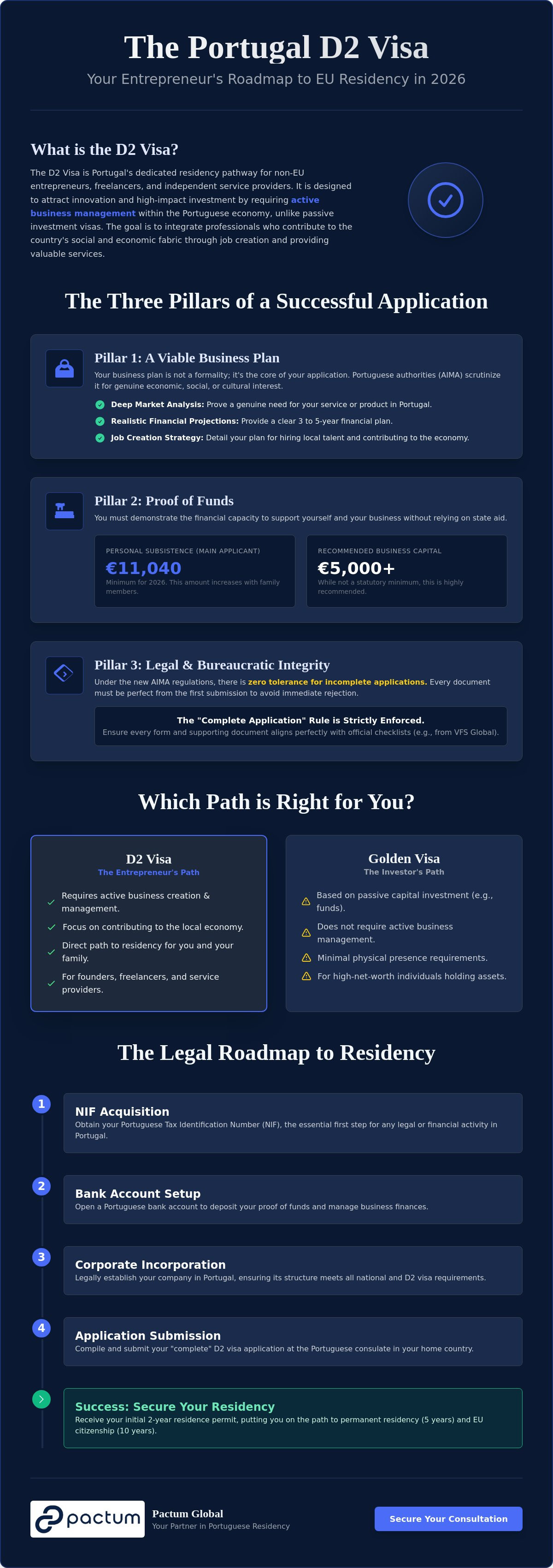
Securing residency through entrepreneurship requires more than just a creative idea. The Portuguese authorities, through AIMA, evaluate applications based on three structural pillars: business viability, financial sustainability, and legal integrity. These Portugal D2 visa requirements are designed to filter for high-value contributors who will actively participate in the local economy. Since the 2025 shift toward the "complete application only" rule, there is no room for administrative errors. Every document must be present and perfectly aligned with your stated business goals from the moment of submission. Consulting the official D2 visa checklist provided by VFS Global is a mandatory first step for any serious applicant.
Crafting a Compliant Business Plan
The "Economic Impact" clause is the most heavily scrutinized portion of your dossier. Portuguese officials look for specific evidence that your venture provides social, cultural, or economic interest to the country. This involves a deep market analysis that proves a genuine need for your services within Portugal. You must include realistic three to five year financial projections and a clear strategy for job creation. Aligning your plan with regional development goals, such as launching in the interior regions rather than just Lisbon or Porto, can often strengthen your case. If you are unsure about the strength of your initial proposal, our team provides expert company setup in Portugal to ensure your corporate structure meets every legal standard.
Financial Sustainability and Proof of Funds
You must demonstrate you have the means to support yourself without relying on the Portuguese social security system. As of 2026, the minimum personal means of subsistence for the main applicant is €11,040. This figure is based on the national minimum wage and increases if you include family members in your application. Beyond personal funds, you need to show business capitalization. While there is no statutory minimum investment, a funded capital of at least €5,000 is highly recommended for credibility. Acceptable proof includes personal bank statements, investment contracts, or even signed Startup Contracts (SAFE) if you have secured early-stage backing.
Finally, your application must include a clean criminal record from your country of origin and any country where you've resided for over a year. These background checks must be apostilled or legalized to be valid. Proof of business activity, such as a certificate of incorporation for a Portuguese Lda or a formal declaration of intent to invest, rounds out the file. Remember that AIMA will reject incomplete files immediately. Precision in your documentation is your best shield against bureaucratic delays.
D2 vs. D7 vs. Golden Visa: Which is Right for You?
Choosing the right residency path depends on your long-term goals and the nature of your income. While many individuals look at the D7 for its perceived simplicity, active entrepreneurs often find it restrictive. The D7 is specifically designed for those with passive income, such as pensions or rental revenue. If you intend to operate a business or provide professional services, the Portugal D2 visa requirements offer a more appropriate legal framework. This route legitimizes your professional activity from day one, allowing you to build a local corporate reputation and deduct business expenses that a passive income visa wouldn't support.
The Golden Visa has historically been the choice for those seeking minimal physical presence, but recent regulatory shifts have removed real estate as an investment option. This change has made the D2 a more accessible and attractive alternative for many. While the D2 requires more administrative effort up front, it doesn't demand the massive capital outlay of the Golden Visa's remaining investment categories. For a founder, the D2 is a strategic choice that aligns residency with operational growth. It's a sustainable model for those who want to be part of the Portuguese economy rather than just holding an asset.
Strategic Comparison for Founders
Founders must weigh their physical presence against their business needs. The D2 requires you to spend significant time in the country, typically six consecutive months or eight non-consecutive months per year. This is ideal for those building a local team or tapping into the Portuguese market. In contrast, the D7 is better suited for retirees or those with purely remote employment. By meeting the Portugal D2 visa requirements, you establish yourself as a resident who is deeply integrated into the local ecosystem, which is a significant advantage when applying for permanent residency later.
Tax and Legal Synergy
One of the most powerful advantages of the D2 is how it interacts with the NHR 2.0 (Non-Habitual Resident) scheme. By structuring your business correctly, you can optimize your global tax burden while remaining fully compliant. For many international entrepreneurs, setting up a holding company in Portugal provides a sophisticated way to manage multiple ventures under the D2 umbrella. This structure allows for efficient profit distribution and protects your intellectual property across borders. Integrating your Portuguese entity with your global operations ensures that your relocation is a financial asset, not just a lifestyle change. It provides a level of protection and foundation-building that passive visas simply can't match.
The Legal Roadmap: From Application to Residency
Transitioning from a business concept to a legal resident involves a precise, multi-stage sequence. You cannot skip steps. The process begins in your home country but concludes with a biometric appointment on Portuguese soil. Because the 2026 AIMA standards are unforgiving, your documentation must be flawless from day one. Understanding the chronological order of Portugal D2 visa requirements ensures you don't waste time or capital on redundant filings. It's a journey that moves from tax registration to corporate architecture and, finally, to physical residency.
- Step 1: Secure your Portuguese Tax Identification Number (NIF) and open a local bank account. This is the prerequisite for all corporate activity.
- Step 2: Incorporate your entity. Most entrepreneurs choose a Sociedade por Quotas (Lda) for its flexibility and limited liability.
- Step 3: Draft your internal governance documents, specifically a Shareholders' Agreement, to define management roles and profit distribution.
- Step 4: Submit your visa application at the Portuguese consulate. This visa is valid for 120 days and allows two entries into the country.
- Step 5: Attend your AIMA appointment in Portugal to exchange your visa for a two-year residence permit.
Corporate Foundations for the D2 Visa
Standard corporate templates often fail to meet the scrutiny of modern immigration officers. Your corporate bylaws must explicitly reflect the activities described in your business plan. If there's a disconnect between your stated goals and your legal structure, AIMA may flag the application for inconsistency. Beyond the bylaws, you need a custom Shareholders’ Agreement (SHA) if your venture involves multiple partners. This document protects your interests and provides the "active management" evidence required by the D2 route. You'll also need a registered business address and a local representative to handle initial tax filings before your residency is finalized.
Navigating the 2026 AIMA Landscape
The final hurdle occurs after you arrive in Portugal. Your 120-day visa acts as a bridge to your biometric appointment. During this meeting, officials verify your original documents against the digital file submitted at the consulate. The most common pitfall is presenting outdated bank statements or uncertified translations. Since the April 2025 "complete application" mandate, any missing piece can result in an immediate rejection rather than a request for more information. Mastering the Portugal D2 visa requirements means moving beyond the checklist to build a sustainable corporate architecture. Once approved, the processing time for the physical card is approximately 60 days. We provide end-to-end immigration processes for Portugal to ensure your roadmap remains clear and your transition is legally secure.
How Pactum Global Secures Your Portuguese Future
The complexity of Portuguese bureaucracy doesn't have to be your burden. At Pactum Global, we act as your seasoned global navigator, ensuring that every detail of the Portugal D2 visa requirements is met with surgical precision. We don't just provide a checklist; we build the legal and corporate infrastructure your business needs to thrive in a new jurisdiction. By integrating legal, corporate, and immigration support into a single, seamless process, we remove the friction often found when dealing with multiple detached service providers. Our team understands the nuances of the 2026 AIMA landscape, acting as a proactive shield against the administrative errors that lead to costly delays or rejections.
Our approach is rooted in protection and foresight. We recognize that your relocation is a significant life transition, and our goal is to replace uncertainty with a sense of calm security. Whether it's drafting your initial business plan or managing complex cross-border documentation, we ensure your foundation is legally sound. This end-to-end oversight allows you to focus on growing your venture while we handle the intricacies of local compliance and governmental relations. We've mapped out the journey so you can focus on your own growth.
Beyond the Visa: Long-term Compliance
Your journey doesn't end when you receive your residency card. As your business scales within the EU, you'll face new challenges regarding intellectual property and trademark protection. We provide ongoing support to safeguard your brand and assets across borders. Additionally, we assist with succession planning to ensure your Portuguese and international assets are structured for the long term. Our legal support for global mobility is designed to adapt as your corporate needs evolve, keeping you compliant with both local and international regulations as you expand.
Get Started with Your Portugal Strategy
The first step toward your new life in Europe is a comprehensive assessment of your business viability. We analyze your goals against the current Portugal D2 visa requirements to identify any potential hurdles before they become problems. From there, we customize a legal package specifically for your 2026 launch, ensuring every contract and filing is optimized for success. Don't leave your international expansion to chance; professional oversight is the best way to secure your timeline. Schedule a consultation with Pactum Global to start your D2 journey and build a secure foundation for your future in Portugal.
Secure Your Global Business Foundation
The 2026 landscape for international entrepreneurs in Portugal is defined by precision and strategic planning. You've seen that mastering the Portugal D2 visa requirements goes beyond mere document collection. It requires a robust business plan that proves economic interest and a corporate structure designed for long-term EU compliance. By navigating the thresholds of subsistence funds and the procedural shifts of AIMA, you position your venture for sustainable growth and a clear path to eventual citizenship.
Pactum Global specializes in the cross-border corporate law required for US and international founders to thrive. We provide end-to-end management of your company formation and immigration filings, ensuring no bureaucratic error stalls your progress. Our expertise in drafting complex Shareholders’ Agreements and SAFE contracts protects your interests from day one. Secure your Portuguese residency with Pactum Global’s expert legal support.
Your expansion into the European market is a bold move toward a more global future. With the right legal partner, you can navigate these transitions with calm confidence and focus on building your legacy. We're ready to map out your journey so you can focus entirely on your growth.
Frequently Asked Questions
Can I apply for the Portugal D2 visa as a freelancer?
Yes, you can apply as a freelancer or independent service provider. The D2 visa is specifically designed for professionals who can demonstrate a viable independent activity in Portugal. You'll need to provide service agreements, invoices, or evidence of existing contracts with clients. This route is ideal for digital professionals who want a stable legal base in Europe while continuing their global operations.
What is the minimum investment required for the D2 visa in 2026?
There is no statutory minimum investment amount for the D2 visa. Instead, authorities focus on whether your capital is adequate for your specific business model and industry. For credibility, it's highly recommended to have a funded capital of at least €5,000. This is separate from the personal Portugal D2 visa requirements for subsistence, which currently stand at €11,040 for the main applicant.
Do I need to speak Portuguese to qualify for the D2 visa?
You don't need to speak Portuguese to obtain the initial D2 visa or your first residence permit. The application process and business plan can be handled in English through professional advisors. However, if you plan to apply for permanent residency or citizenship later, you'll need to demonstrate an A2 level of Portuguese proficiency through an official exam. Learning the basics early helps with local business integration.
How long does the D2 visa processing take at the consulate?
Processing times at the consulate typically take approximately 60 days. This timeline can vary depending on your country of origin and the specific workload of the Portuguese diplomatic mission. It's vital to submit a complete file from the start. Under the 2025 "complete application" rules, any missing document can lead to an immediate rejection rather than a request for more information.
Can I bring my family to Portugal on a D2 visa?
Yes, you can include your spouse and dependent children in your relocation plan through the family reunification process. You must demonstrate additional financial means for each dependent to ensure you can support the entire household without relying on local social systems. Bringing your family provides them with the same legal rights to live, work, and study within Portugal as the main applicant.
Is a physical office required for the D2 visa business plan?
A physical business address is mandatory for the legal incorporation of your Portuguese company. While you don't necessarily need a long-term commercial lease on day one, you must have a registered office address for tax and legal purposes. Many entrepreneurs use coworking spaces or virtual office services to satisfy this requirement while they scout for permanent locations during their first year of operations.
What happens if my Portuguese business fails after I get residency?
If your business fails, your residency status isn't automatically revoked, but it can complicate your renewal process. Your residence permit is initially granted for two years based on your entrepreneurial activity. During the renewal, AIMA will verify that you are still meeting the Portugal D2 visa requirements. If the original venture closes, you must demonstrate a new viable economic activity or show you've transitioned to a different residency category.
Can I convert my D2 visa into a permanent residence permit?
You can apply for permanent residency after five years of legal stay in Portugal. The D2 visa provides a direct path to long-term EU integration. While permanent residency is available at the five-year mark, note that 2026 regulations now require ten years of residency for citizenship for most nationals. Both paths require you to pass a basic A2-level Portuguese language exam to demonstrate your integration into the community.


