

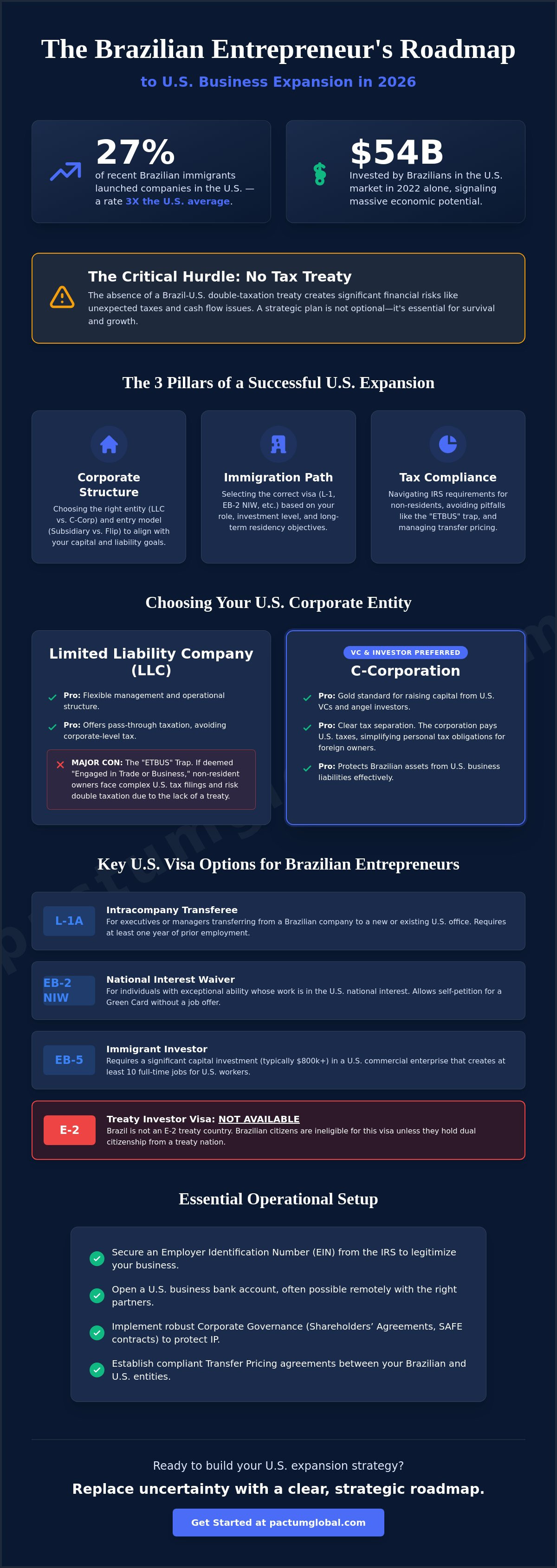
Nearly 27% of Brazilian immigrants who moved to the U.S. after 2015 launched their own companies within five years, a rate that is triple the U.S. average. This surge in entrepreneurship highlights a massive opportunity, yet finding the right US visa options for Brazilian entrepreneurs remains a significant hurdle. You likely recognize the potential for growth but feel held back by the lack of a Brazil-U.S. tax treaty. It's common to feel stuck between choosing an LLC or a C-Corp while worrying about the complexity of filing without an SSN. In 2022 alone, Brazilians invested $54 billion in the U.S. market, yet many still struggle with the initial bureaucratic friction.
We're here to replace that uncertainty with a clear, strategic roadmap for 2026. This guide provides a methodical look at corporate setup, tax compliance, and the specific visa pathways, such as the L-1 and EB-2 NIW, that fit your business size. We'll preview the essential steps to protect your intellectual property and ensure your transition is both legal and efficient. Our goal is to provide a steady foundation so you can focus entirely on your company's international growth.
Key Takeaways
- Define your expansion strategy by distinguishing between a subsidiary model and a complete business flip.
- Evaluate the tax implications of LLCs versus C-Corps to avoid common non-resident pitfalls like the "ETBUS" trap.
- Navigate the specific US visa options for Brazilian entrepreneurs, focusing on the L-1A for transfers and the EB-5 for investment.
- Master the operational requirements for 2026, including how to secure an EIN and open a U.S. business bank account remotely.
- Implement robust corporate governance through professional Shareholders’ Agreements and SAFE contracts to protect your IP and stakeholders.
Strategic Foundations: Why Moving a Business to the USA from Brazil Requires a Roadmap
The 2026 market presents a unique window for Brazilian innovation. Tech, fintech, and agritech firms are scaling northward at record speeds, driven by a search for stability and capital. A 2026 study by Endeavor Brazil found that 49% of Brazilian businesses now operating in the U.S. have AI at their core. This isn't just a trend; it's a strategic shift toward global competitiveness. However, moving a business isn't as simple as registering a name. It requires a synchronized approach across three pillars: corporate structure, immigration, and tax compliance. Without a roadmap, you risk double taxation or visa denials that could stall your operations for years.
Identifying your primary objective is the first step. Are you seeking U.S. venture capital, or is your goal to relocate your family while running a service firm? Your choice of US visa options for Brazilian entrepreneurs depends entirely on this answer. We see three main drivers for this move:
- Capital Raising: Accessing the deep liquidity of U.S. venture capital markets.
- Market Access: Reaching a consumer base with significantly higher purchasing power.
- Personal Relocation: Seeking better educational opportunities and safety for your family.
The Brazilian-US Economic Nexus
Brazil and the United States don't have a double-taxation treaty. This reality often catches founders off guard, leading to unexpected cash flow issues. You can't treat a U.S. expansion like opening a branch in another Brazilian state. The legal systems are fundamentally different, requiring a "no-nonsense" approach to documentation. For instance, many entrepreneurs explore the E-2 investor visa, but Brazilian citizens are ineligible unless they hold dual citizenship with a treaty country. This makes understanding the available US visa options for Brazilian entrepreneurs even more critical for those without a second passport.
Defining Your Entry Strategy
Choosing between a subsidiary and a parent company structure changes your entire trajectory. A subsidiary allows your Brazilian company to own the U.S. entity, which works well for established service firms. Startups, however, often prefer the "flip." A flip structure is a legal reorganization where a US entity becomes the parent of a foreign business. This setup is the gold standard for founders who want to raise capital from American investors. Whether you choose a subsidiary or a flip, your roadmap must align your corporate governance with your long-term immigration goals from day one.
Choosing the Right US Entity: LLC vs. C-Corp for Brazilian Owners
Selecting the correct corporate vehicle is the foundation of your expansion. It's not just about administrative ease; it's about tax efficiency and liability management. When you choose your business structure, you're deciding how the U.S. government will tax your income and how investors will perceive your venture. This choice also dictates which US visa options for Brazilian entrepreneurs will be most effective for your long-term residency goals.
Many Brazilian founders lean toward the LLC because of its flexibility and pass-through taxation. However, the "ETBUS" trap is a significant risk for non-residents. If the IRS deems you "Engaged in Trade or Business in the U.S.," you may face complex filing requirements and potential double taxation in Brazil. This is a common pitfall because the two nations lack a formal tax treaty. For those who want a simpler tax relationship with the IRS, the C-Corporation remains the gold standard. It provides a familiar framework for equity that American venture capitalists expect.
State selection is another critical decision. While Delaware and Wyoming are the traditional favorites, the right choice depends on your specific operations. Delaware offers a sophisticated legal system for complex corporate disputes, while Wyoming provides robust privacy and lower fees. Regardless of the state, these structures provide a vital shield. They ensure your Brazilian holdings remain isolated from U.S. commercial liabilities, protecting your domestic wealth as you scale abroad.
Tax Implications for Non-Resident Owners
The IRS requires strict transparency from foreign-owned entities. If you own 25% or more of a U.S. company, you must file Form 5472 annually. Failure to comply can result in penalties starting at $25,000 per violation. It's vital to understand that the IRS views a Brazilian owner differently than a domestic one, particularly regarding "Permanent Establishment" risks. Professional guidance is essential to navigate these 2026 tax standards without draining your cash flow.
The Legal Foundation: Shareholders Agreements (SHA)
Standard templates don't account for the unique pressure points of a Brazil-U.S. move. Your Shareholders Agreement (SHA) must bridge the gap between Brazilian partner rights and U.S. corporate law. For early-stage startups, integrating a SAFE (Simple Agreement for Future Equity) is essential for attracting U.S. capital. If you need help tailoring these documents to your specific needs, Pactum Global offers specialized company setup in the USA services that ensure your legal foundation is secure from day one.
US Visa Options for Brazilian Entrepreneurs and Executives
Selecting the right path through the American immigration system requires a clear understanding of your current corporate footprint. While many look for the easiest route, the "E-2 Trap" remains a significant barrier. Brazil doesn't have an E-2 treaty with the United States. Unless you hold dual citizenship with a treaty country like Italy or Portugal, you can't apply for this specific investor visa. This reality makes the L-1A and O-1 pathways the primary engines for Brazilian expansion in 2026. Understanding these US visa options for Brazilian entrepreneurs is the difference between a successful launch and a costly rejection.
For tech founders with a documented record of achievement, the O-1 visa offers a faster, merit-based alternative. It doesn't require a specific investment amount or a pre-existing foreign company. High-net-worth individuals might prefer the EB-5 program instead. In 2026, the investment threshold stands at $800,000 for Targeted Employment Areas and $1,050,000 for standard projects. While the EB-5 path involves longer wait times, it offers a direct route to permanent residency without the need for ongoing company management.
The L-1A Intercompany Transferee Pathway
The L-1A visa serves as the most logical bridge for established businesses. It allows you to transfer yourself or key managers to a U.S. office. To qualify, your Brazilian company must remain active and maintain a qualifying ownership link with the new U.S. entity. If you're starting from scratch, the "New Office" L-1 provides a one-year initial period to get operations running. This is a strategic stepping stone. It often leads to the EB-1C green card category for multinational managers, providing a reliable path to permanent residency.
Immigration Compliance and Business Planning
Your business plan is the heartbeat of your petition. It must prove to USCIS that your U.S. company will be large enough to require a manager within twelve months. Vague descriptions won't work. You need a detailed hiring plan that aligns with specific "managerial" definitions. For those navigating these complexities, securing legal support for global mobility is essential. This ensures your corporate and immigration strategies remain perfectly aligned as you scale. We focus on building a defensive file that anticipates bureaucratic questions before they are even asked.
Operational Setup: EIN, Banking, and Transfer Pricing Compliance
Setting up a legal entity is only half the battle. To actually trade, you must navigate the U.S. banking and tax identification systems. Your first step is obtaining an Employer Identification Number (EIN). Many founders mistakenly believe they need a Social Security Number (SSN) to apply, but you can secure an EIN as a non-resident. With this number in hand, you can open a U.S. business bank account. In 2026, the landscape is split. Digital-first banks often allow remote setup, but traditional "Tier 1" banks usually require a physical presence to complete the process. This operational foundation is vital. Even the most favorable US visa options for Brazilian entrepreneurs won't help if your capital is stuck in Brazil due to a lack of local banking.
Asset protection also extends to how you manage your daily operations. You need a clear separation between your personal finances and your corporate holdings. This requires not just a bank account, but a disciplined approach to corporate governance. By establishing these boundaries early, you protect your Brazilian assets from any potential U.S. commercial liabilities. It's about building a fortress around your business that can withstand the pressures of international scaling.
The Transfer Pricing Challenge
The IRS and the Brazilian Receita Federal both scrutinize transactions between related parties. They look for the "Arm's Length Principle," which dictates that intercompany prices must reflect market rates. If you undercharge or overcharge your U.S. subsidiary, you risk aggressive audits and heavy penalties. You must document every intercompany service, royalty payment, and product sale with precision. Transfer pricing services are essential for any business operating in both Brazil and the USA to avoid double taxation. To keep your cash flow secure and your records audit-ready, Pactum Global offers comprehensive Transfer Pricing Services tailored for international founders.
IP and Trademark Protection
Don't assume your brand is safe just because it's registered with the INPI in Brazil. Intellectual property rights are territorial. Your Brazilian trademark provides no legal standing in the U.S. market. Registering your brand with the USPTO is the only way to prevent squatting and protect your market share. This is especially urgent for tech and service firms where the brand is the primary asset. Additionally, you should implement robust international service agreements. These contracts ensure that any code, design, or strategy created by your Brazilian team for the U.S. entity remains clearly owned by the parent company. Protecting your IP early prevents expensive legal battles during later funding rounds.
The Pactum Global Approach to US Expansion
Pactum Global acts as your strategic partner throughout the entire expansion process. We manage the transition from your Brazilian operations to U.S. growth by aligning your corporate structure with your long-term goals. Our team handles the complexities of U.S. company setup and governance so you can focus on scaling your product. We don't just file paperwork; we build a foundation that protects your interests on both sides of the border. This integrated method ensures that the US visa options for Brazilian entrepreneurs you pursue are supported by a compliant and robust corporate framework.
Our expertise includes drafting precision Shareholders’ Agreements (SHA) and SAFE contracts. These documents are vital for international founders who need to balance Brazilian partner rights with U.S. investment standards. We also provide coordinated immigration support for your executive team and their families. This holistic approach ensures that your move is a cohesive strategy rather than a series of disconnected tasks. By centralizing your legal and corporate needs, we eliminate the friction that often stalls international ventures. You gain a steady, reliable partner invested in your success.
Why a Global Navigator Matters
Working with separate lawyers for tax, corporate law, and immigration often creates a "silo" effect. Inconsistencies between these areas can lead to visa denials or tax penalties. Pactum Global serves as a global navigator, ensuring every piece of your expansion fits together perfectly. We streamline the process to reduce bureaucratic stress and provide a clear path forward. If your needs involve the reverse journey, you can explore our guide on how to open a company in Brazil for foreigners.
Next Steps for Your Move
Your journey begins with a clear assessment of your business readiness. We start by reviewing your current Brazilian entity and identifying which US visa options for Brazilian entrepreneurs align with your specific timeline. Document collection is the next phase. You'll need organized records from your Brazilian company to support your U.S. petition and entity formation. We guide you through this process step-by-step to ensure nothing is missed. Our goal is to replace confusion with calm confidence.
Ready to map out your expansion? You can Book a strategy session with Pactum Global to discuss your specific goals and start building your 2026 roadmap today. We provide the clarity and security you need to turn your U.S. expansion into a profitable reality.
Securing Your Global Future in the U.S. Market
Your expansion into the United States is more than a simple registration. It's a structural transformation that requires aligning your corporate entity with your long-term residency goals. Choosing the right C-Corp or LLC structure and maintaining strict transfer pricing compliance are the guardrails that prevent double taxation and legal friction. By addressing these operational hurdles early, you ensure that your business remains audit-ready and attractive to international investors.
Start your US expansion with Pactum Global today. The roadmap to 2026 is clear, and we're ready to help you take the first step toward your international success.
Frequently Asked Questions
Can I move my business to the USA without a US partner?
Yes, you can own 100% of your U.S. entity as a Brazilian national. While having a local partner can assist with operational trust, it isn't a legal requirement for company formation or most visa petitions. You simply need to ensure your corporate governance and management structure meet the specific requirements of the visa category you select. This independence allows you to maintain full control over your brand and strategic direction.
How much capital do I need to invest to get a US business visa as a Brazilian?
Investment amounts vary significantly by visa type. For the EB-5 program in 2026, the minimum is $800,000 in Targeted Employment Areas or $1,050,000 elsewhere. Visas like the L-1A don't have a fixed minimum investment but require enough capital to sustain a "new office" and pay employees for the first year. Evaluating these US visa options for Brazilian entrepreneurs requires matching your available capital to your business growth plan.
What is the difference between an LLC and a C-Corp for a Brazilian owner?
The primary difference lies in taxation and investor preference. An LLC is a pass-through entity where profits flow directly to the owner, which can trigger complex tax issues for non-residents. A C-Corp is taxed as a separate legal entity. Most international founders choose the C-Corp because it simplifies tax reporting for non-residents and is the preferred structure for U.S. venture capital investors who require a familiar equity framework.
Do I need a Social Security Number (SSN) to start a US company?
No, you don't need an SSN to incorporate a business. You can obtain an Employer Identification Number (EIN) from the IRS by using your Brazilian passport. While an SSN is required for certain personal activities, the EIN serves as the tax identity for your business. This allows you to sign contracts, hire staff, and fulfill tax obligations without being a U.S. resident or holding a domestic identity number.
How long does the process of moving a business to the USA from Brazil take?
A full transition typically takes six to twelve months. Company formation and EIN issuance can happen in weeks, but visa processing is the primary variable. Premium processing can reduce USCIS wait times to 15 or 45 days for certain petitions, but consular interviews and document preparation add several months to the timeline. Starting your planning at least a year before your target move date is the safest strategy to avoid operational gaps.
Will I be double-taxed on my profits in Brazil and the USA?
Double taxation is a risk because Brazil and the U.S. lack a formal tax treaty. However, you can mitigate this through careful structural planning and transfer pricing. By correctly documenting intercompany transactions and utilizing foreign tax credits available under Brazilian law, you can often offset taxes paid in the U.S. against your Brazilian obligations. Professional guidance is essential to navigate these conflicting tax codes and protect your global cash flow.
Can I open a US bank account remotely from Brazil in 2026?
Yes, remote opening is possible through specific digital-first banking platforms. These institutions specialize in serving international founders and accept digital applications backed by your EIN and Brazilian passport. Traditional brick-and-mortar banks, however, almost always require an in-person visit from a company officer to finalize the account setup. Your choice depends on your immediate operational needs and your ability to travel during the initial setup phase.
What is a SAFE agreement and do I need one for my US expansion?
A SAFE (Simple Agreement for Future Equity) is a concise contract used to raise early-stage capital. It allows investors to provide funding now in exchange for equity later during a priced round. You need one if you plan to raise funds from U.S. angel investors or venture capitalists. It's a standard tool that simplifies the investment process while exploring US visa options for Brazilian entrepreneurs who need to demonstrate capital commitment to immigration authorities.


