

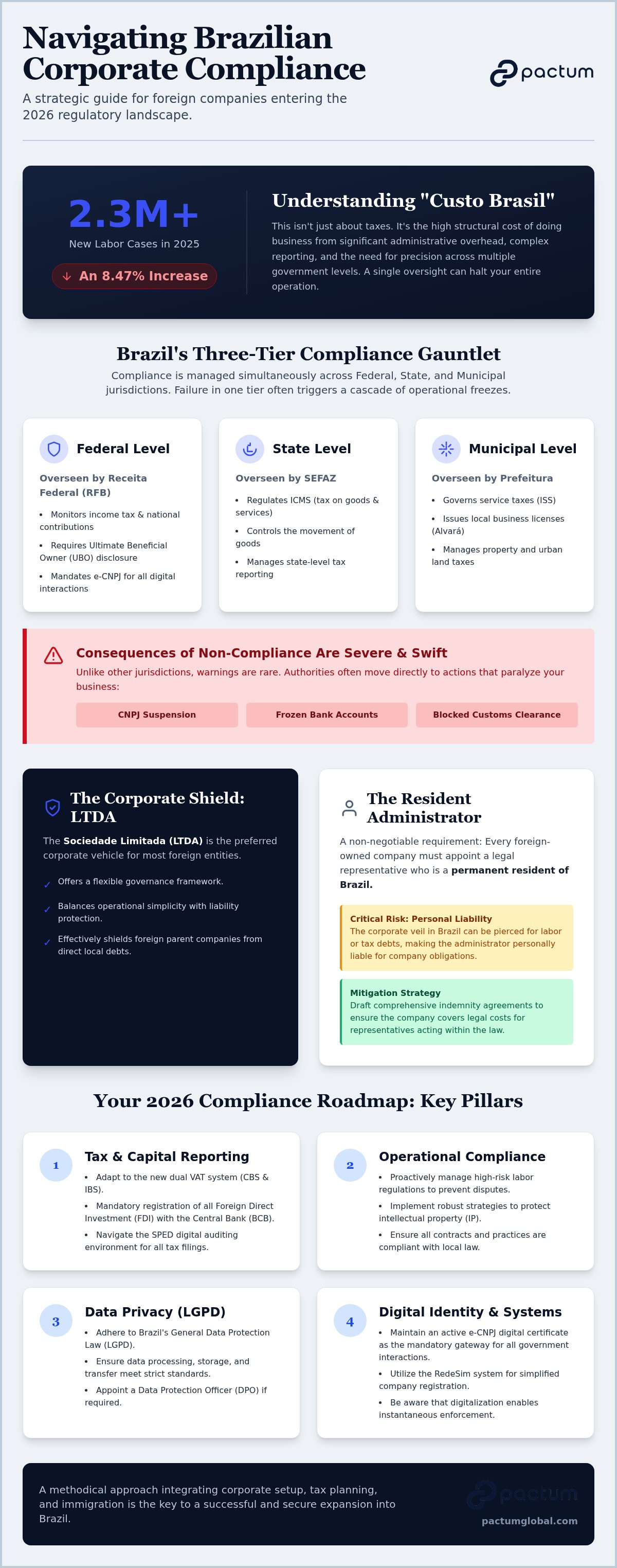
In 2025, over 2.3 million new labor cases were filed across the country, representing an 8.47% jump from the year before. For an international executive, this figure isn't just a data point. It's a stark reminder that legal compliance for foreign companies in Brazil is a high-stakes endeavor where a single oversight can lead to significant financial exposure. While the "Custo Brasil" remains a tangible hurdle, the market's immense potential continues to draw ambitious firms from around the globe.
You probably feel the weight of the country's notorious tax complexity and the personal risks associated with acting as a legal representative. We're here to replace that uncertainty with a sense of calm confidence. This roadmap will help you master the intricacies of Brazilian corporate law and the new 2026 tax reforms to ensure your expansion stays profitable. We will cover the mandatory 2026 compliance calendar, robust risk mitigation strategies for leadership, and the latest structures for protecting your intellectual property and tax efficiency.
Key Takeaways
- Identify the 2026 regulatory requirements for legal compliance for foreign companies in Brazil to effectively mitigate the administrative overhead known as "Custo Brasil."
- Learn why the LTDA remains the preferred corporate vehicle and how appointing a qualified resident administrator protects your international leadership from personal liability.
- Understand the mandatory registration of foreign direct investment with the Central Bank and how to navigate the complexities of the SPED digital auditing environment.
- Develop proactive strategies to manage high-risk labor regulations and ensure your intellectual property and data remain fully protected under LGPD standards.
- Discover a methodical approach to integrating corporate setup, tax planning, and immigration into a single, efficient workflow for your global expansion.
Understanding the Regulatory Landscape for Foreign Entities in Brazil
Expanding into Brazil's economic landscape offers immense rewards, but the regulatory entry price is steep. In 2026, legal compliance for foreign companies in Brazil requires more than just a local tax ID. It demands an understanding of "Custo Brasil," a term describing the structural costs that make administrative overhead significantly higher than in the US or EU. This isn't just about higher taxes; it's about the sheer volume of reporting and the precision required to satisfy three distinct levels of government.
Compliance isn't a single lane. You're operating in three distinct jurisdictions simultaneously. At the Federal level, the Receita Federal (RFB) monitors income and national contributions. State authorities (SEFAZ) oversee the movement of goods, while Municipalities (Prefeitura) regulate service taxes and business licenses. If one tier fails, the others often cascade into a freeze. Unlike many jurisdictions where you might receive a warning letter, Brazilian authorities often move directly to suspending your CNPJ. This suspension immediately freezes bank accounts and blocks customs clearances for imports, effectively halting your operations overnight.
The Role of the Receita Federal (RFB) and CNPJ
The CNPJ is your company's identity. Keeping it in good standing is non-negotiable. A major hurdle for international groups is the Ultimate Beneficial Owner (UBO) disclosure. The RFB requires total transparency regarding who ultimately controls the entity, reaching back to the individual level. To manage these filings, you'll need an e-CNPJ digital certificate. It's the mandatory gateway for all legal interactions with the government; without it, your company is effectively paralyzed. We ensure this digital key is always secure and active.
The Impact of the 2026 Regulatory Environment
The 2026 landscape is defined by the transition to a new dual VAT system. Companies must now manage legacy taxes while preparing for the pilot rates of CBS and IBS. Digitalization via the RedeSim system has simplified some registrations, but it has also made enforcement instantaneous. The Brazilian compliance environment is a multi-jurisdictional challenge that demands proactive, localized oversight to protect foreign capital. Legal compliance for foreign companies in Brazil is no longer about checking boxes; it's about maintaining a dynamic shield against bureaucratic friction.
Corporate Governance and the Resident Administrator Requirement
Choosing the right corporate vehicle is the first step toward long-term security. For most international groups, the Limited Liability Company, known as the Sociedade Limitada or LTDA, is the preferred structure. It offers a flexible governance framework that balances simplicity with protection. When you look at the U.S. government analysis of Brazil's investment climate, it becomes clear that while the market is lucrative, the legal requirements are rigid. One of the most critical mandates for legal compliance for foreign companies in Brazil is the appointment of a resident administrator.
Every foreign entity must have a legal representative who is a permanent resident of Brazil. This is not a mere formality. This individual holds the power to sign documents and represent the company before the Receita Federal and other regulatory bodies. If you're curious about the full setup process, our guide on how to open a company in Brazil for foreigners details the technical milestones. However, the choice of administrator is often where foreign founders face the most risk. In Brazil, the corporate veil can be pierced relatively easily, especially regarding labor or tax debts, making the administrator personally liable for company obligations.
Managing the Resident Administrator Liability
The Brazilian Civil Code imposes strict fiduciary duties on administrators. They must act with the same care they would give to their own affairs. Many companies confuse a statutory director with a simple power-of-attorney holder. A statutory director has broader responsibilities and higher liability. To mitigate these risks, we recommend drafting comprehensive indemnity agreements. These contracts ensure the company covers legal costs or damages incurred by the representative, provided they acted within the law. Our team at Pactum Global helps you structure these protective layers from day one.
Shareholders Agreements (SHA) in a Cross-Border Context
A well-drafted Shareholders Agreement (SHA) is essential to maintain control from abroad. While you can use global governance standards, they must be tailored to comply with Brazilian mandatory law. For instance, certain voting rights or dividend distribution rules must align with local statutes. Dispute resolution is another vital factor. You can choose between Brazilian courts or international arbitration, but this must be explicitly stated. Finally, for the SHA to be enforceable against third parties, it must be filed with the Board of Trade, or Junta Comercial. This step ensures that legal compliance for foreign companies in Brazil extends beyond internal policies and into the public record.
Tax Compliance and Foreign Capital Reporting (BCB)
Founding your subsidiary is only the first step. Maintaining legal compliance for foreign companies in Brazil requires rigorous attention to the country's world-leading digital auditing environment. The SPED system (Public Digital Bookkeeping System) ensures that every invoice, payroll entry, and tax filing is visible to the Receita Federal in real time. This level of transparency means that errors aren't just found during audits; they're flagged the moment they're submitted. To operate safely, you must master the ECD (Digital Accounting Bookkeeping) and ECF (Tax Accounting Liquidations) filings, which serve as the definitive record of your company’s financial health.
Beyond standard taxes, foreign investors face unique reporting obligations with the Central Bank of Brazil (BCB). Every dollar that enters the country as equity must be registered in the RDE-IED (Electronic Declaratory Registry - Foreign Direct Investment). This isn't a one-time task. Any change in the company's net equity or capital structure must be updated to reflect the current reality. Within the broader corporate governance framework in Brazil, tax transparency and capital reporting are the pillars that prevent your assets from being trapped behind bureaucratic walls.
Central Bank Reporting Deadlines and Fines
The 2026 calendar is particularly demanding for foreign-owned entities. Brazilian companies with direct foreign participation and total assets of BRL 100,000 or more as of December 31, 2025, must file the Five-Year Foreign Capital Census by March 31, 2026. If your assets exceed BRL 300 million, you're also subject to quarterly declarations. Missing these deadlines leads to heavy fines and can jeopardize your ability to move funds. Profit dividends can only be remitted to shareholders abroad if all BCB filings are current and accurate. We act as your proactive guide to ensure these milestones never slip through the cracks.
Transfer Pricing and Legal Documentation
Brazil has fully aligned its transfer pricing rules with OECD standards through Law 14.596. This shift replaces old fixed-margin methods with the "Arm's Length Principle," requiring sophisticated benchmarking and functional analysis. Legal compliance for foreign companies in Brazil now depends on having robust intercompany service agreements that satisfy the Receita Federal's new scrutiny. You can't simply apply global templates. These documents must be localized and supported by economic data that proves your cross-border transactions reflect market reality. Pactum Global specializes in drafting these specialized contracts to protect your profit margins and ensure tax efficiency.
Operational Compliance: Labor, IP, and Data Privacy
Operational reality in Brazil often surprises international teams who are used to more flexible markets. While corporate and tax structures provide the foundation, your day-to-day legal compliance for foreign companies in Brazil is tested in the workplace and the digital space. In 2025 alone, over 2.3 million new labor cases were filed. This statistic highlights a litigious environment where the Consolidation of Labor Laws (CLT) heavily favors the employee. Beyond the office walls, Brazil’s General Data Protection Law (LGPD) and strict Intellectual Property (IP) regulations create a multi-front compliance requirement that demands local expertise.
The CLT Trap: Labor Compliance Essentials
The CLT is a rigid framework that leaves little room for negotiation. You must provide mandatory benefits that are often unfamiliar to US-based founders. These include:
- 13th Salary: An additional month's pay distributed at year-end.
- FGTS: A monthly 8% deposit into a government-held severance fund.
- Vacation Bonus: A mandatory 1/3 additional payment on top of the 30-day paid leave.
A common mistake for foreign firms is misclassifying regular workers as independent contractors. Brazilian courts look at the reality of the relationship, not just the contract. If a contractor follows your schedule and reports to a manager, they're likely an employee in the eyes of the law. Additionally, you'll need to navigate collective bargaining agreements with local labor unions. As of May 2026, you must also manage psychosocial risks like burnout and stress under the updated NR-1 regulations to avoid heavy penalties.
Trademark and Brand Protection (INPI)
Owning a trademark in the US or Europe doesn't grant you protection in Brazil. The country follows a "First to File" principle. This means a local squatter could register your brand name before you do, forcing an expensive legal battle. You must register with the National Institute of Industrial Property (INPI) immediately upon entry. This registration is more than just a brand shield; it's a tool for customs enforcement to block counterfeit imports. If your business model involves technology transfer or licensing, these agreements must be registered with INPI to allow for tax-deductible royalty payments. For a deeper look at protecting your assets, read our intellectual property strategy for startups guide.
Finally, data privacy is no longer optional. Under the LGPD, you must notify the National Data Protection Authority (ANPD) of any security incident within just two business days. Fines can reach 2% of your Brazilian revenue, capped at BRL 50 million. If you're transferring data between a Brazilian subsidiary and a global headquarters, you need specific legal clauses to remain compliant. We help you secure your intellectual property and trademarks while ensuring your operational workflow meets these strict 2026 standards.
A Strategic Roadmap for Compliance Management in 2026
Successfully managing legal compliance for foreign companies in Brazil requires more than just reacting to deadlines. It demands a holistic strategy that connects your corporate structure, tax obligations, and human capital. At Pactum Global, we act as your "Global Navigator." We don't just provide a list of requirements; we build a unified workflow that removes the bureaucratic friction often faced by US and EU founders. Our approach is designed to replace the stress of the unknown with a clear, methodical path toward growth.
The transition into the Brazilian market is a journey, not a transaction. By integrating every legal facet into a single point of oversight, we ensure that your corporate acts in Brazil mirror your global standards. This "no-nonsense" methodology allows you to focus on your core business while we handle the intricate layers of the "Custo Brasil." We bridge the gap between international expectations and local mandatory laws, ensuring your expansion remains both secure and profitable through 2026 and beyond.
End-to-End Company Structuring
We partner with you from the very first draft of your bylaws through to your first official board meeting. This isn't just about incorporation. We specialize in tailoring Shareholders' Agreements (SHA) and SAFE contracts specifically for the Brazilian startup ecosystem. These documents are vital for maintaining control and protecting investor interests. Furthermore, we incorporate succession planning for cross-border assets into your initial setup. This proactive step ensures that your shareholders and their heirs are protected from future legal complications, creating a foundation that lasts for decades.
Global Mobility and Immigration Integration
Compliance often extends to the people leading your local operations. If you're relocating founders or managers, securing a VITEM IX investor visa is a critical milestone. We coordinate this immigration process with the mandatory legal representative role, ensuring that your leadership team has the legal standing to operate in the country. Our specialized legal support for global mobility removes the hurdles of international relocation, allowing for a seamless transition for your key personnel.
The 2026 roadmap is complex, but you don't have to navigate it alone. A single error in tax reporting or a missed Central Bank deadline can stall your progress for months. Protecting your international expansion starts with a thorough review of your current standing. To ensure your business is fully aligned with the latest regulations, you should contact Pactum Global for a compliance audit. Let's map out your journey together and secure your place in the Brazilian market.
Secure Your Growth in the Brazilian Market
The 2026 landscape is demanding but full of opportunity for those who plan ahead. Success depends on moving beyond reactive filings to a proactive, integrated strategy. By prioritizing a secure resident administrator structure and staying ahead of OECD-aligned transfer pricing rules, you protect your capital and your reputation. Mastering legal compliance for foreign companies in Brazil is the only way to ensure your expansion remains a profitable asset rather than a liability.
Pactum Global specializes in bridging the gap between US, Brazil, and Portugal cross-border structures. We provide comprehensive global mobility and visa support to ensure your leadership team is positioned for success from day one. Our no-nonsense approach removes the complexity of international bureaucracy, allowing you to focus on your commercial goals without the fear of sudden bank freezes or labor disputes. You've mapped out your vision; let us map out the legal safety net that makes it possible.
Secure your Brazilian expansion with a Pactum Global compliance audit. Your international journey is ready to take flight. We're here to ensure it stays on course and remains fully protected.
Frequently Asked Questions
Do I need a physical office in Brazil to be legally compliant?
Yes, every company must have a registered fiscal address to obtain a CNPJ and register with the Board of Trade. While some service companies utilize specialized business addresses, the location must be valid for receiving legal notifications and tax inspections. Authorities require a physical point of contact to ensure the company exists within the local jurisdiction and can be held accountable for its operations.
What are the penalties for failing to report foreign capital to the Central Bank?
Failing to file the Five-Year Foreign Capital Census or quarterly declarations can result in fines reaching BRL 250,000. Beyond these financial penalties, the Central Bank will block your ability to register new foreign direct investment in the RDE-IED system. This administrative block effectively traps your capital, as banks will refuse to process outward remittances for companies with an irregular reporting status.
Can a foreigner be the sole administrator of a Brazilian company?
No, a foreigner can only serve as an administrator if they possess a permanent residence visa and a valid CPF. Most international firms appoint a Brazilian resident to act as the legal representative to satisfy the mandatory residency requirement. This allows the foreign owners to maintain strategic control while the resident administrator handles the local legal and tax responsibilities required by the Civil Code.
How does the Brazilian LGPD differ from the European GDPR?
The LGPD follows the general principles of the GDPR but imposes a much tighter timeline for security incident notifications. Under ANPD Resolution CD/ANPD No. 4/2023, you must notify the National Data Protection Authority within just two business days of becoming aware of a breach. This is significantly faster than the 72-hour window allowed under European law, requiring a more responsive local compliance team.
What is the most common legal mistake foreign companies make in Brazil?
The most frequent error is underestimating the complexity of legal compliance for foreign companies in Brazil, specifically regarding labor "misclassification." Many founders hire staff as independent contractors to save on payroll taxes, only to face massive retroactive claims in labor court. Judges look at the actual nature of the work relationship rather than the contract, often awarding full benefits to misclassified workers.
Is it possible to repatriate profits if the company is not 100% compliant?
No, profit dividends can only be remitted to shareholders abroad if all tax filings and Central Bank registrations are current. Local banks act as gatekeepers and will block any transaction that lacks the necessary SPED documentation or RDE-IED updates. Maintaining total compliance is the only way to ensure the movement of funds from your Brazilian subsidiary back to your global headquarters.
How often do labor laws change in Brazil?
While the core CLT labor code is stable, specific regulatory standards and court interpretations change frequently. As of May 2026, for example, companies must now manage psychosocial risks like burnout under updated NR-1 guidelines. These shifts happen through Labor Ministry ordinances and Supreme Court rulings, making it essential to have a proactive partner who monitors these operational changes in real time.
What is the "resident administrator" and why is it mandatory?
The resident administrator is a local individual who serves as the company's legal shield and primary point of contact for the government. This role is mandatory because the Brazilian state requires a resident who can be served legal process and held personally accountable for corporate debts. We position this service as a protective layer, ensuring that your international leadership is buffered from the direct friction of local bureaucracy.


