

What if the 6 trillion dollars set to change hands in 2026 evaporates because of a single jurisdictional oversight? You've worked hard to build a legacy that spans borders, yet you likely feel the constant weight of conflicting legal systems. It's natural to worry that a lack of international succession planning might leave your family facing double inheritance taxes or a paralyzed business in Brazil, Portugal, or the USA. The friction between Civil Law and Common Law isn't just a legal curiosity; it's a direct threat to your wealth preservation.
We understand that managing global bureaucracy feels overwhelming, but it doesn't have to be. This strategic guide provides the legal certainty you need to protect your cross-border assets and ensure your business continues without friction. We'll show you how to bridge the gap between different legal systems and optimize your tax exposure for 2026. You'll gain a clear roadmap to transform a complex web of global holdings into a secure, lasting legacy for the next generation.
Key Takeaways
- Understand why traditional, single-country strategies are obsolete in 2026 and how to manage wealth transfer across multiple national borders.
- Learn to navigate the friction between Civil Law and Common Law systems, particularly the "forced heirship" rules common in Brazil and Portugal.
- Discover how to protect your company from paralysis by using Shareholders' Agreements (SHA) to ensure business continuity across jurisdictions.
- Identify the specific roles of international wills and holding companies in the USA and Portugal for efficient asset consolidation.
- Gain a clear roadmap for international succession planning that aligns your residency and immigration status with your global legacy goals.
What is International Succession Planning and Why is it Critical in 2026?
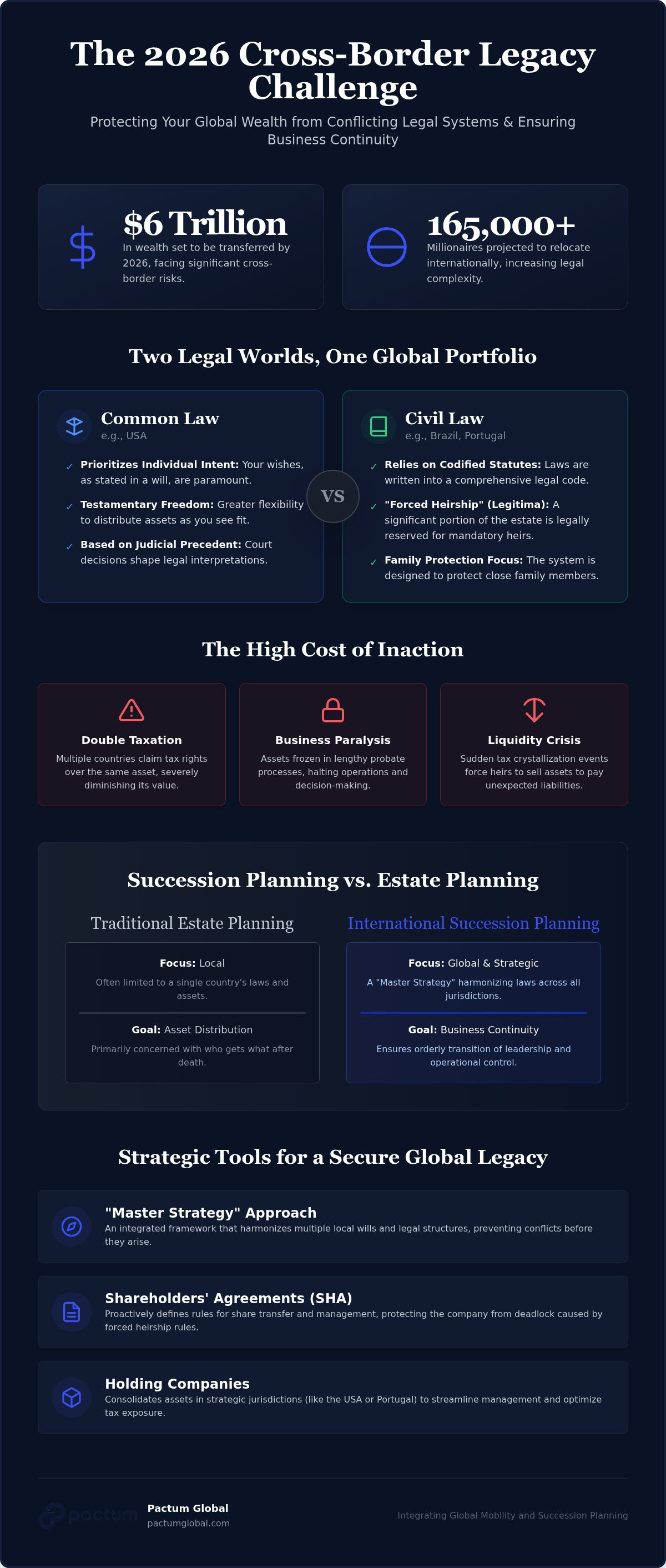
At its core, international succession planning is the deliberate process of managing the transfer of wealth and operational control across national borders. It isn't just about drafting a will. It's a strategic framework designed to resolve the friction between different legal systems. With an estimated $6 trillion in wealth set to change hands in 2026 alone, the need for a coordinated global approach has never been more urgent. Traditional, single-country plans are no longer sufficient for families whose lives and businesses span the globe.
Global mobility is now the standard for high-net-worth individuals. A record 165,000 millionaires are projected to relocate internationally this year, often moving between jurisdictions with fundamentally different legal philosophies. If you hold assets in Brazil, Portugal, and the USA, you face the "Conflict of Laws." This occurs when multiple countries claim authority over the same asset, leading to legal gridlock. Without a proactive strategy, your legacy faces severe risks, including prolonged asset freezing, intense family disputes, and "accidental" double taxation that can decimate your estate's value.
Succession vs. Estate Planning: Understanding the Difference
Many people use these terms interchangeably, but they serve distinct purposes. Estate planning is often a local exercise focused on the distribution of personal assets. In contrast, succession planning is an inherently global and strategic discipline. It prioritizes business continuity and the orderly transition of leadership. For the international entrepreneur, a collection of local wills isn't enough. You need a "Master Strategy" that harmonizes these documents, ensuring that a decision made in a Lisbon notary's office doesn't trigger a tax crisis in Florida or a corporate deadlock in São Paulo.
The Cost of Inaction: Real-World Scenarios
The consequences of neglecting this coordination are often immediate and expensive. In the USA, foreign-owned assets can become trapped in the probate system for years, causing total business paralysis while the court verifies foreign documents. Meanwhile, the "forced heirship" rules in Brazil and Portugal can completely disrupt a US-based estate plan. These laws mandate that a specific portion of your wealth must pass to certain heirs, regardless of your personal wishes. This conflict often triggers tax "crystallization" events, where massive tax liabilities become due the moment a founder becomes incapacitated or passes away, leaving the family with a liquidity crisis instead of a legacy.
Navigating the Conflict of Laws: Civil Law vs. Common Law
The global legal landscape is split between two dominant philosophies. Understanding this divide is the first step in effective international succession planning. Civil Law jurisdictions, such as Brazil and Portugal, rely on codified statutes that prioritize family protection. In contrast, Common Law systems like the United States prioritize individual intent and judicial precedent. When your assets exist in both worlds, these systems often collide, leaving your heirs to navigate contradictory rules. Organizations like the International Succession Planning Association (ISPA®) emphasize that bridging this gap requires more than just a translation of documents; it requires a structural overhaul of your global holdings.
Specific doctrines like "Droit de Prélèvement" further complicate matters. This principle allows heirs in certain Civil Law countries to "compensate" themselves from local assets if they were excluded from a foreign estate. Such rules can lead to unexpected asset seizures that disrupt your entire distribution plan. Without a coordinated strategy, the flexibility you enjoy in one country can be completely nullified by the rigid requirements of another.
Forced Heirship in Brazil and Portugal
In Civil Law countries, the concept of "Legitima" or forced heirship prevails. You can't always disinherit family members as you might in other regions. A significant portion of your estate is legally reserved for mandatory heirs, such as children and spouses. For a founder, this is a massive hurdle. You might want to leave your business to the child who actually manages it, but the law may force you to split shares equally among all siblings. This often leads to corporate deadlock. To mitigate this, we frequently implement specific corporate structures and succession documents to manage these mandatory portions without sacrificing business control.
Testamentary Freedom and Trusts in the United States
The United States offers vast testamentary freedom. You generally have the right to leave your assets to anyone you choose. Trusts are the primary tool for this, providing privacy and tax efficiency. However, a major conflict arises because Brazilian and Portuguese tax authorities often don't recognize the legal "transparency" of a US Trust. They might view it as a direct gift or a taxable corporation, leading to "accidental" double taxation. Harmonizing a US Trust with a Brazilian inventory process is essential. It ensures that your US-based tools don't become a liability when viewed through the lens of a Civil Law tax auditor.
Protecting Business Continuity: Succession for Founders and Shareholders
A business is the most fragile asset in an international estate. Unlike a bank account or a piece of real estate, a company requires active, daily decision-making to survive. When a founder passes away or becomes incapacitated without a clear plan, the enterprise often enters a state of paralysis. Banks may freeze corporate accounts, suppliers might cancel contracts, and key employees often look for more stable opportunities. In these moments, international succession planning transitions from a personal wealth strategy into a vital survival mechanism for the brand you've built.
Incapacity is a risk that many entrepreneurs overlook. It isn't just about death; it's about who signs the checks if you're unable to do so. Without specific legal documents for international startups, your company could be stuck in a jurisdictional limbo for months. The Chambers' Global Practice Guide for Succession & Estate Planning notes that cross-border incapacity is one of the most complex hurdles in modern corporate law. Resolving this requires a proactive approach that bridges the gap between your personal estate and your corporate governance.
Succession Clauses in Shareholders' Agreements
The most effective shield against corporate paralysis is a robust Shareholders' Agreement (SHA). This document should include specific buy-sell clauses that trigger upon a succession event. These clauses provide immediate liquidity for your heirs while ensuring the remaining partners can keep the business stable. Many successful founders use key-person insurance to fund these international buyouts, ensuring that the company has the cash flow to pay out an estate without depleting operational capital. It's vital that these clauses are drafted to be enforceable in both the USA and Brazil, accounting for the different ways these jurisdictions treat corporate transfers.
Managing SAFE and Early-Stage Startup Assets
Startups present unique challenges because their value is often tied to future equity rather than current profit. If you hold a Simple Agreement for Future Equity (SAFE) or convertible notes, you must ensure your heirs can actually exercise those rights. These instruments often behave differently in a succession event than standard stock. Effective international succession planning involves integrating these startup-specific assets into your broader master plan. This ensures that your heirs don't just inherit a piece of paper, but a clear, legally recognized path to ownership in a foreign-domiciled startup. We help you map these rights across borders, ensuring your family benefits from the long-term growth of your early-stage investments.
Strategic Tools for Cross-Border Asset Protection and Transfer
Securing a global legacy requires a specialized toolkit that accounts for the unique friction of each jurisdiction. While many people hope for a "silver bullet" solution, effective international succession planning relies on a combination of structures. One such tool is the "International Will" under the Washington Convention. While useful, it isn't universally recognized. In practice, we often use more robust mechanisms like holding companies in Portugal or the USA to consolidate assets under a single corporate umbrella. This simplifies the transition of ownership and prevents the need for multiple, simultaneous probate processes in different languages.
In Brazil and Portugal, the concept of "Usufruto" (Usufruct) is a cornerstone of wealth transfer. It allows a founder to transfer the "bare ownership" of an asset to their heirs while retaining the right to use it and receive income from it during their lifetime. This ensures you maintain control and financial security while the legal transfer is already settled. Additionally, life insurance serves as a critical non-probate asset. Because insurance payouts typically bypass the court-supervised inventory process, they provide the immediate liquidity your family needs to pay taxes and professional fees without selling off business interests at a discount.
The Multi-Jurisdictional Will Strategy
It's a common mistake to assume one will can cover everything. The "Situs" rule dictates that the law of the location where the property sits usually governs its transfer. This means you likely need complementary wills for your assets in Brazil, Portugal, and the US. The challenge is drafting these documents so they don't accidentally revoke each other. A standard "I revoke all prior wills" clause in a US document could inadvertently nullify your Portuguese succession plan. We coordinate these documents to ensure they work in harmony rather than in conflict.
Tax Optimization and Double Taxation Treaties
Taxation is where an uncoordinated plan falls apart. While Brazil and Portugal share a tax treaty that helps prevent double taxation on income, inheritance tax (ITCMD in Brazil and Stamp Duty in Portugal) requires careful navigation. The stakes are even higher in the United States. For non-residents, US situs assets exceeding just $60,000 are subject to federal estate taxes that can reach 40%. To protect your family from this "tax trap," a specialized USA company setup for non-residents can be structured to hold these assets, effectively shielding them from direct estate tax exposure. If you're ready to build a tax-efficient structure for your global holdings, we can help you implement a cross-border succession strategy that preserves your wealth for the next generation.
The Pactum Global Approach: Integrating Global Mobility and Succession
Your residency status isn't just about where you pay income tax or which passport you hold. It's a fundamental trigger for your estate's legal obligations. Whether you're relocating via a D2, D7, or Golden Visa, your physical move changes the laws that apply to your global assets. At Pactum Global, we view international succession planning as an essential component of the immigration journey. By aligning your residency strategy with your legacy goals, we prevent the bureaucratic friction that often traps families during an international transition.
Our "Global Navigator" model acts as a bridge between the disparate legal, tax, and corporate requirements of Brazil, Portugal, and the USA. Rather than forcing you to manage three separate legal teams, we provide a unified strategy. This integrated approach ensures that your legal support for global mobility includes a robust succession framework from day one. We identify potential conflicts before they become crises, acting as a shield against the procedural errors that can paralyze a cross-border estate.
Why Residency Matters for Your Heirs
There's a dangerous "hidden trap" in the distinction between tax residency and legal domicile. You might consider yourself a resident of Portugal for tax purposes while your legal domicile remains in Brazil. This confusion often leads to heirs facing competing claims from both governments. For instance, moving to Portugal under a Golden Visa can suddenly subject your Brazilian estate to European succession regulations. We treat international succession planning as a prerequisite for a smooth relocation. This proactive step ensures that your move to a new country doesn't inadvertently compromise the wealth you've built elsewhere.
Securing Your Legacy with Pactum Global
Our process begins with a comprehensive Cross-Border Asset Audit. We map out every holding, from real estate in Florida to corporate shares in São Paulo and holding companies in Lisbon. Following this audit, we move into multi-jurisdictional implementation. This involves drafting the necessary succession documents and corporate structures that harmonize your global footprint. We don't just provide paperwork; we build a foundation that supports your family's growth across borders.
The primary benefit of working with our team is the simplicity of a single point of contact. We understand the intricacies of both Civil Law and Common Law systems. We provide a clear path forward that removes complexity and restores confidence. Your legacy is too important to be left to chance or conflicting court systems. Protect your international legacy today with Pactum Global.
Securing Your Global Legacy for 2026 and Beyond
Building a multi-jurisdictional wealth strategy is no longer optional for the modern entrepreneur. You've seen how the friction between Civil Law and Common Law can lead to business paralysis or unexpected tax liabilities. By coordinating your assets across the Brazil, Portugal, and USA corridors, you replace uncertainty with a structured, resilient foundation. Effective international succession planning ensures that your residency status and corporate holdings work together to protect your family's future.
Our team provides the specialized cross-border corporate documentation and end-to-end global mobility support needed to navigate these complex legal hurdles. We simplify the transition of wealth so you can focus on continued growth. It's time to move from a reactive posture to a proactive, protective strategy that spans continents. Secure your global legacy with a professional asset audit from Pactum Global. We're ready to guide you through every step of this journey with clarity and confidence.
Frequently Asked Questions
Do I need a separate will for every country where I own assets?
You generally need separate wills or a coordinated multi-jurisdictional strategy for each country where you hold significant real estate or corporate assets. The "Situs" rule means the location of the asset determines the governing law. While an international will exists, local courts in Brazil, Portugal, and the USA often require documents that comply with specific local formalities. Coordinated wills prevent your US estate plan from accidentally revoking your Portuguese instructions.
How does the Brazil-Portugal tax treaty affect inheritance?
The current Brazil-Portugal tax treaty focuses primarily on preventing double taxation of income and capital gains rather than inheritance taxes. In 2026, beneficiaries may still face Brazilian ITCMD and Portuguese Stamp Duty on the same assets. Effective international succession planning involves using corporate holding structures to consolidate assets. This can potentially shift the taxable event from an individual inheritance to a more controlled corporate transfer.
Can a US Trust protect my assets in Brazil from forced heirship?
A US Trust cannot directly override Brazilian forced heirship laws for assets located within Brazil. Brazilian authorities often view trusts as transparent or treat them as direct gifts, which can trigger immediate tax liabilities. To protect your legacy, you must harmonize the trust with Brazilian "Usufruto" or corporate holdings that the local legal system recognizes. This ensures your US-based tools don't become a liability for your Brazilian heirs.
What happens to my international startup shares if I pass away without a will?
Your shares are subject to the intestacy laws of the jurisdiction where the company is domiciled if you pass away without a will. This often leads to a forced distribution among all legal heirs, which can trigger a corporate deadlock. For startups, this is particularly dangerous. It may prevent the exercise of SAFE rights or convertible notes, effectively freezing the asset's value during a critical growth phase.
Is my Portuguese Golden Visa status inheritable by my family?
Your family members don't automatically inherit your Golden Visa, but they can maintain their path to residency through family reunification. If the primary applicant passes away, the family can typically keep their legal status provided the underlying investment remains intact. This requires ensuring the underlying assets are correctly transferred through your succession documents. Clear planning prevents a lapse in legal residency for your dependents during the transition.
What is 'forced heirship' and how can I legally plan around it?
Forced heirship is a legal requirement in Civil Law countries like Brazil and Portugal that reserves a specific portion of your estate for mandatory heirs. You can legally plan around this by using Shareholders' Agreements (SHA) and holding companies to dictate how business management is transferred. These structures allow you to satisfy the financial "legitima" requirements without giving operational control to heirs who aren't active in the business.
How much does international succession planning typically cost in 2026?
The total investment for international succession planning varies based on the number of jurisdictions and the complexity of the corporate structures involved. Because each plan requires specialized legal and tax analysis for Brazil, Portugal, and the USA, prices aren't standardized. You should expect the cost to reflect the depth of the asset audit and the multi-jurisdictional implementation required to secure your legacy and prevent future litigation.
Can Pactum Global help with both business succession and personal estate planning?
Pactum Global specializes in both business succession and personal estate planning across the Brazil-Portugal-USA corridor. We integrate your Shareholders' Agreements and startup contracts with your personal succession documents to ensure a seamless transition. Our "Global Navigator" model ensures that your business continuity and family wealth preservation are managed under a single, coordinated strategy. This removes the stress of managing multiple legal teams across different continents.


