

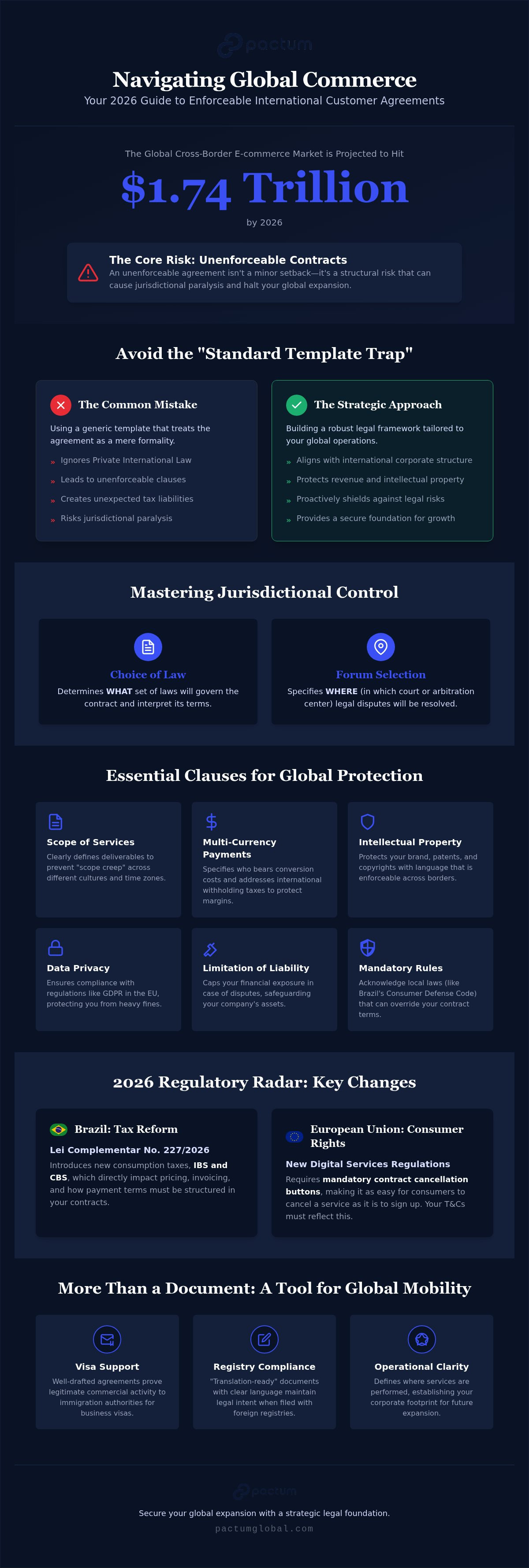
With the global cross-border e-commerce market projected to hit $1.74 trillion in 2026, an unenforceable contract isn't just a minor setback; it's a structural risk to your expansion. You've likely felt the stress of wondering if a document signed in your home office will actually hold up in a court in Lisbon or São Paulo. Utilizing a robust customer agreement template for global business is essential to avoid the jurisdictional paralysis that stalls growth. We understand the fear of unexpected tax liabilities or unenforceable clauses that keep many founders awake at night.
This guide provides a strategic framework to help you master international trade complexities and protect your global operations. You'll gain clarity on how to align your contracts with 2026 regulatory shifts, including the EU’s new mandatory contract cancellation buttons and Brazil’s significant tax reforms under Lei Complementar No. 227/2026. We will preview the essential clauses that ensure your documentation supports your corporate structure rather than undermining it. By following this methodical approach, you can replace confusion with a sense of calm security as you scale across borders.
Key Takeaways
- Learn why moving beyond local consumer law to a private international law framework is vital for protecting your rights in foreign markets.
- Discover how to customize a customer agreement template for global business to ensure your contracts remain enforceable across the USA, Brazil, and Portugal.
- Master the distinction between choice of law and forum selection to maintain control over where and how legal disputes are resolved.
- Understand how to handle multi-currency transactions and 2026 tax reforms to prevent unexpected liabilities from international sales.
- Align your legal documentation with your international corporate structure to build a robust shield against bureaucratic errors and operational risks.
Understanding the Global Customer Agreement: More Than Just a Template
A global customer agreement is more than a simple set of terms and conditions. It's a comprehensive legal framework that defines the rights, obligations, and risk allocation between your business and its international clients. While many founders look for a generic customer agreement template for global business, treating this document as a mere formality is a mistake. In cross-border commerce, the "global" label changes everything. You aren't just dealing with local consumer laws. You're operating within the complex sphere of private international law.
Relying on a standard template often leads to the "Standard Template Trap." Some generic providers suggest that these agreements are simply for educating customers about your service. In a global context, this perspective is dangerously incomplete. An international agreement must act as a proactive shield against jurisdictional paralysis. A robust agreement serves as the essential foundation for all legal documents for international startups, protecting your revenue and intellectual property across multiple borders simultaneously.
The Role of the Customer Agreement in Global Mobility
Your agreement must align with your physical and digital business presence, often referred to as your "nexus." If your contract claims one jurisdiction while your operations are centered in another, you risk tax complications and unenforceable terms. These documents also play a practical role in global mobility through the following functions:
- Visa Support: Well-drafted agreements facilitate business visas and work authorizations by proving legitimate commercial activity to immigration authorities.
- Registry Compliance: Ensuring documents are "translation-ready" is vital. This means using clear language that maintains its legal intent when filed with foreign registries in countries like Portugal or Brazil.
- Operational Clarity: Defining where services are performed helps establish your corporate footprint for future expansion.
Contractual Strategy vs. Regulatory Compliance
There is a critical gap between your contractual strategy and mandatory regulatory compliance. You might want specific payment terms, but local laws may dictate otherwise. For instance, the Brazilian Consumer Defense Code contains provisions that override private contracts regardless of what you've signed. You must distinguish between what you want to achieve and what the foreign law requires for your contract to remain valid.
In the context of international private law, Mandatory Rules are legal provisions so essential to a country's public interest that they apply even if the parties chose a different Choice of Law clause. Balancing your business goals with these non-negotiable local requirements is what transforms a simple customer agreement template for global business into a strategic asset. By mapping out these hurdles early, you can focus on growth with the confidence that your legal foundation is secure.
Essential Clauses for Your International Business Contract
Building a global operation requires moving beyond the basic terms used in local trade. While a standard customer agreement template for global business provides a starting point, your contract must address the unique friction points of cross-border sales. Clear definitions of the scope of services are vital to prevent "scope creep" when working across different time zones. Without precise deliverables, you may find your team performing unpaid work due to cultural or linguistic misunderstandings about what a service actually entails.
Payment terms also demand a sophisticated approach in 2026. You must account for multi-currency transactions and the complexities of withholding taxes. For example, Brazil's recent tax reform under Lei Complementar No. 227/2026 introduced new consumption taxes, IBS and CBS, which directly impact how you structure pricing and invoicing. Your agreement should clearly state which party bears the cost of currency conversion and international wire fees to ensure your net margins remain protected. If you need help refining these financial terms, our team offers comprehensive customer agreement drafting to secure your revenue streams.
Safeguarding your brand is equally critical as you enter new jurisdictions. Your contract should integrate a forward-thinking intellectual property strategy for startups to ensure your ownership remains undisputed in every market. Additionally, 2026 data privacy requirements are stricter than ever. Your documentation must now harmonize the EU’s GDPR, which as of June 2026 requires a mandatory "Cancel Contract" button for online consumers, with Brazil’s LGPD and the updated CCPA risk assessments in the United States.
Tax Compliance and Transfer Pricing Clauses
Your customer agreement is often the first document a tax auditor examines during a cross-border review. It must clearly allocate responsibility for VAT, GST, and local service taxes. Beyond simple tax collection, these clauses must link directly to your transfer pricing documentation. By aligning your contract terms with the economic reality of your corporate structure, you create a defensive shield against audits and ensure that your intercompany transactions meet international arm’s length standards.
Limitation of Liability in a Global Context
Drafting liability caps that actually stand up in court requires local expertise. An enforceable cap in a US court might be viewed as a violation of public policy in the EU or Brazil. Your agreement needs specific carve-outs for gross negligence and mandatory local protections. Effectively excluding indirect and consequential damages is not enough; you must tailor these limitations to respect the "Mandatory Rules" of the jurisdictions where your customers reside. This precision prevents a single dispute from escalating into a catastrophic financial loss for your international entity.
Navigating Choice of Law and Jurisdictional Disputes
Many founders mistakenly believe that choosing a legal system is the same as choosing a courtroom. This misunderstanding is a common point of failure in international trade. Choice of Law determines which country's rules interpret your customer agreement template for global business. Forum Selection, however, decides where the actual legal proceedings happen. If you select Delaware law but your customer is in Lisbon, the cost of litigating across the Atlantic can be ruinous. We often see businesses default to their home jurisdiction without considering the logistical nightmare of enforcing those terms against a foreign entity.
In cross-border deals, you'll frequently encounter the "Battle of the Forms." This occurs when you send your agreement, but the customer responds with a Purchase Order containing their own conflicting terms. Without a clear "precedence" clause in your documentation, a court might decide that the last document sent governs the deal. Neutral jurisdictions like Singapore or London remain popular because they provide a predictable, business-friendly environment that doesn't favor either party's home turf. They offer a level of stability that reassures both sides during high-stakes negotiations.
International Arbitration vs. Litigation
Arbitration is generally the preferred choice for global deals. The New York Convention ensures that arbitration awards are enforceable in over 170 countries, a level of reciprocity that court judgments rarely achieve. When drafting your template, you must specify the arbitration seat, such as the ICC or LCIA. Choosing the right seat impacts both the cost and the speed of resolution. An airtight arbitration clause prevents your opponent from dragging you into a local court where you lack a home-field advantage and face potential bias.
The CISG: Does the UN Convention Apply to You?
The UN Convention on Contracts for the International Sale of Goods (CISG) is a default legal framework that applies to many international transactions. Unless you explicitly "opt-out" in your agreement, the CISG may override your chosen law on issues like risk of loss or delivery terms. The CISG applies automatically to contracts for the sale of goods between parties whose places of business are in different member states. For many modern service-based startups, opting out is the safer path to maintain total control over how your contract is interpreted in a dispute.
Localizing Your Agreement: Brazil, Portugal, and the USA
A one-size-fits-all approach fails in high-stakes markets. While you might start with a customer agreement template for global business, you must tailor it to the specific legal soil of your target market. Localization isn't just about language; it's about structural compliance. In Brazil, the 'Código de Defesa do Consumidor' is non-negotiable. It protects local buyers with a strength that often surprises foreign founders. If your terms contradict this code, a Brazilian judge will likely set them aside entirely.
Portugal offers a different set of challenges and opportunities. It requires alignment with EU-wide consumer protection and the Digital Services Act. Meanwhile, the USA requires a strategy focused on state-specific rules. You must address the 2026 CCPA updates in California and include robust class-action waivers to mitigate litigation risk. This localized approach is a key part of a successful USA company setup for non-residents. Understanding these nuances ensures your legal shield remains intact as you scale.
Specific Requirements for Brazilian Customer Agreements
For a contract to be enforceable in Brazilian courts, it must be translated into Portuguese. You also need to decide how to handle the Brazilian Real (BRL). Indexing your fees to the USD or EUR is common, but it requires careful drafting to comply with local financial regulations. Some high-value service contracts may even require a Public Deed to be fully recognized by local authorities. If you're ready to localize your documents for this market, contact Pactum Global for an integrated legal review.
The European Advantage: Portugal as a Gateway
Using a Portuguese entity allows you to standardize your terms across the entire European Economic Area (EEA). This creates operational efficiency. You should integrate a shareholders agreement for Portuguese company into your broader governance strategy to ensure consistency. Remember that EU law grants consumers a 'Right of Withdrawal,' or cooling-off period. As of June 2026, you must also provide a clear and easily accessible "Cancel Contract" button for online consumer contracts to remain compliant with the latest European Data Protection Board priorities.
Implementing Your Global Agreement Strategy with Pactum Global
A customer agreement template for global business is a useful starting point, but it isn't a complete solution for a scaling enterprise. Relying solely on a static document leaves you vulnerable to the hidden risks of international trade. These risks include shifting tax laws in Brazil or new consumer rights in the EU that can render a generic template obsolete overnight. We don't just hand you a file and walk away. We ensure your documentation works in tandem with your corporate setup to create a seamless, secure operational flow.
A proactive legal audit of your sales process identifies gaps before they become liabilities. Professional drafting moves your business beyond simple "compliance." It establishes a clear framework for dispute resolution and risk allocation that protects your bottom line. By anticipating hurdles in markets like the USA or Portugal, you can focus on growth while we act as your protective shield. This strategic alignment transforms your legal documents from a bureaucratic hurdle into a distinct competitive advantage.
Our Process: From Company Setup to Contractual Shield
Our methodical approach ensures that your legal foundation remains secure as you expand across borders. We follow a logical, three-step process designed to remove complexity:
- Step 1: Assessing your jurisdictional footprint. We analyze your physical and digital presence in Brazil, Portugal, and the USA to identify specific local legal and tax requirements.
- Step 2: Drafting bespoke customer and service agreements. We create tailored documents that reflect your actual business operations and your specific risk tolerance.
- Step 3: Ongoing compliance monitoring. We track 2026 regulatory updates and beyond, ensuring your contracts stay current as laws evolve in your target markets.
Ready to Secure Your Global Operations?
Choosing professional support provides the peace of mind you need to lead an international team. You won't have to worry about whether your customer agreement template for global business will hold up during a high-stakes audit or a cross-border dispute. We've already mapped out the journey for you, identifying the pitfalls before they affect your revenue. Our team acts as a steady partner, demystifying the bureaucracy of international expansion.
For more insights on building a secure international framework, read our legal support for global mobility guide. If you're ready to build a robust contractual shield and harmonize your legal documents with your corporate structure, Contact Pactum Global for a Comprehensive Legal Strategy Review today.
Secure Your Global Expansion with Confidence
Scaling an international business requires more than just luck; it demands a legal foundation that moves with you. You've seen how a basic customer agreement template for global business often falls short when faced with the specific demands of Brazilian tax reforms or European consumer rights. By harmonizing your service terms with your corporate structure, you eliminate the friction that often stalls global growth. You've learned that choosing the right arbitration seat and mastering choice of law clauses are strategic decisions that protect your revenue and your peace of mind.
Pactum Global provides the specialized expertise in Brazil, Portugal, and USA law needed to build this contractual shield. Our integrated approach combines legal drafting with tax compliance to ensure your documentation is founder-friendly and fully scalable. Secure your global business with expert legal drafting from Pactum Global. Your vision is global. Your legal strategy should be too.
Frequently Asked Questions
Is a digital signature on a customer agreement enforceable globally in 2026?
Digital signatures are widely enforceable in 2026 across major jurisdictions, including the USA, the EU, and Brazil. Most countries follow standards similar to the US ESIGN Act or the EU's eIDAS regulation, which recognize cryptographic signatures as legally binding. You should ensure your agreement specifically states that electronic signatures carry the same weight as traditional ones to avoid any procedural hurdles during enforcement.
Can I use the same customer agreement for both B2B and B2C international sales?
You shouldn't use a single document for both because B2C sales are subject to strict, mandatory consumer protection laws that don't apply to B2B transactions. For example, EU regulations as of June 2026 require a "Cancel Contract" button for consumers, a feature rarely required in business-to-business deals. Using a B2B framework for consumers often leads to clauses being declared void by local regulators.
What is the difference between a Master Service Agreement (MSA) and a Customer Agreement?
A Master Service Agreement (MSA) serves as a long-term framework for ongoing projects, while a customer agreement is typically a standardized contract for individual or recurring sales. A customer agreement template for global business is often more streamlined and designed for rapid scaling. MSAs are better suited for complex relationships where specific statements of work define the evolving scope of services over several years.
How do I handle dispute resolution if my customer is in a country with a weak legal system?
International arbitration is the most effective solution for dealing with jurisdictions that have unpredictable court systems. By including an arbitration clause that specifies a neutral seat like London or Singapore, you bypass local courts entirely. Arbitration awards are also easier to enforce globally than court judgments because over 170 countries are signatories to the New York Convention.
Do I need to translate my agreement into the local language of every country I sell to?
Translation is a legal requirement for enforceability in several high-stakes markets, including Brazil, where documents must be in Portuguese to be recognized by judicial authorities. In other regions, translating your terms helps demonstrate a "meeting of the minds" and prevents customers from claiming they didn't understand the contract. You should always designate one language as the governing version to resolve any linguistic discrepancies.
What happens if my customer agreement contradicts local consumer protection laws?
Local mandatory rules will almost always override your private contract terms if a conflict occurs. In jurisdictions like Brazil or the EU, consumer rights are non-negotiable and cannot be signed away by a customer. If your agreement contains a clause that violates these local protections, a court will likely strike that specific provision while keeping the rest of the contract intact.
How often should I update my global customer agreement template?
You should conduct a formal review of your customer agreement template for global business at least once a year. Major regulatory shifts, such as the 2026 tax reforms in Brazil or updated data privacy audits in California, require immediate updates to maintain compliance. Regular monitoring ensures your legal shield remains effective against new bureaucratic requirements and changing international trade standards.
Can a customer agreement help reduce my international tax liability?
A precisely drafted agreement helps manage tax liability by clearly allocating responsibility for VAT, GST, and local consumption taxes. By defining where services are performed and how payments are structured, you create the necessary documentation for transfer pricing compliance. This clarity helps you avoid unexpected withholding taxes and ensures your intercompany transactions align with the requirements of local tax authorities.


