

A single oversight in your intercompany pricing can trigger penalties that outweigh the profits of your entire Mexican expansion. For foreign entities, managing transfer pricing mexico requirements is often the most stressful part of cross-border operations. You're likely already aware that the Mexican Tax Administration Service (SAT) is becoming increasingly sophisticated in its audit processes. Balancing broad OECD guidelines with Mexico's specific local nuances feels like a moving target, especially when you're managing transactions across multiple jurisdictions. It's natural to worry about the financial impact of non-compliance or the complexity of keeping your documentation up to date.
We're here to replace that uncertainty with a sense of calm security. This guide provides the clarity you need to master Mexico’s transfer pricing regulations and ensure your operations remain compliant and audit-ready in 2026. We'll walk through the mandatory filings you must submit, clarify the distinction between international standards and local mandates, and offer a methodical approach to protecting your global legal footprint. By the end of this article, you'll have a proactive strategy to turn these tax obligations into a reliable shield for your business growth.
Key Takeaways
- Understand the critical role of the SAT and how their evolving enforcement strategies impact your intercompany transactions.
- Master the three-tiered documentation approach, including the specific transaction data required for a compliant Mexican Local File.
- Identify the most effective economic analysis method from the six recognized hierarchies to validate your arm’s length pricing.
- Learn how to mitigate the risk of disallowed deductions and high fines by maintaining audit-ready transfer pricing mexico records.
- Discover a methodical way to integrate compliance into your corporate structure from day one, ensuring a seamless entry into the Mexican market.
Understanding Mexico Transfer Pricing Regulations in 2026
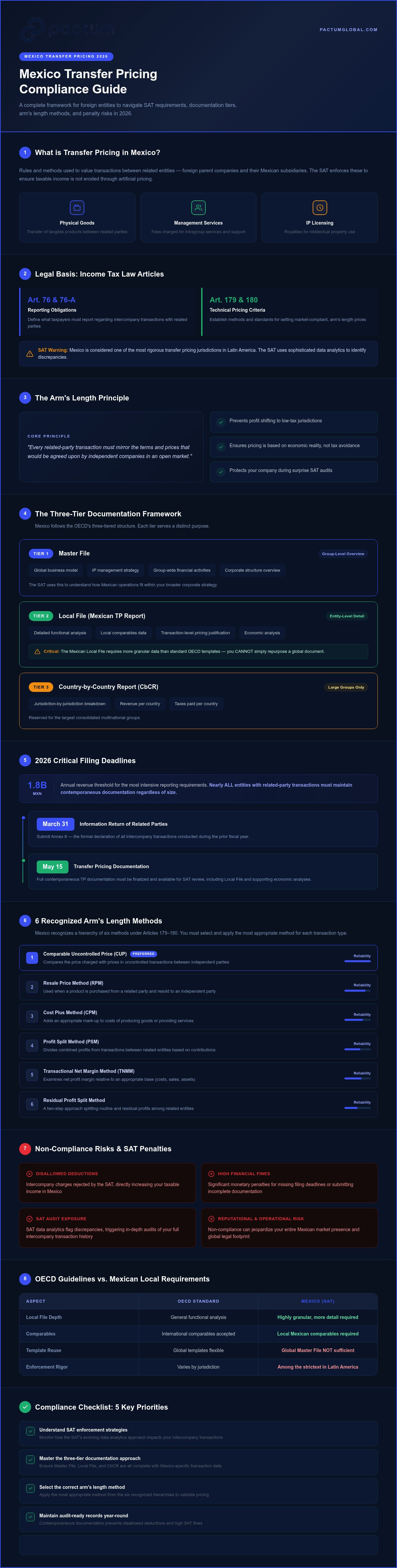
In the Mexican context, transfer pricing refers to the set of rules and methods used to value transactions between related entities, such as a foreign parent company and its local subsidiary. These intercompany transactions encompass the transfer of physical goods, the provision of management services, and the licensing of intellectual property. The Servicio de Administración Tributaria (SAT) serves as the primary enforcer, acting with a high degree of technical expertise to ensure that taxable income isn't eroded through artificial pricing. They monitor these flows closely to ensure that the wealth generated within the country is taxed appropriately.
The legal basis for these requirements is found primarily in the Income Tax Law. Articles 76 and 76-A establish the reporting obligations for taxpayers, while Articles 179 and 180 define the technical criteria for establishing market-compliant prices. Mexico's approach is notably strict; it's widely considered one of the most rigorous jurisdictions in Latin America. The SAT doesn't just look for clerical errors. It proactively uses sophisticated data analytics to identify discrepancies in transfer pricing mexico filings, making early compliance a business necessity rather than a simple administrative task.
The Arm’s Length Principle: A Practical Framework
The SAT operates on the expectation that every transaction with a related party should mirror the terms and prices that would be agreed upon by independent companies in an open market. This framework prevents companies from shifting profits to jurisdictions with more favorable tax rates. By treating your own subsidiaries as if they were unrelated parties, you demonstrate that your pricing is based on economic reality rather than tax avoidance. The Arm’s Length Principle serves as the foundation of Mexican tax fairness. Following this principle protects your company from the burden of proving its innocence during a surprise audit.
OECD Alignment and Local Variations
While Mexico is a member of the OECD and adopts its Transfer Pricing Guidelines, the SAT has introduced several local nuances that foreign companies must respect. You can't simply repurpose a global Master File and expect it to satisfy Mexican authorities. There are significant differences between a standard OECD Local File and the specific Mexican TP report requirements, particularly regarding the depth of the functional analysis and the inclusion of local comparables.
International startups and expanding enterprises must look beyond standard OECD templates to ensure their documentation is truly "audit-ready." The SAT often requires more granular data on local operations than other jurisdictions might demand. Taking a "no-nonsense" approach to these local variations ensures that your initial setup in Mexico remains stable and that your global legal footprint is protected from unnecessary friction.
Mandatory Documentation: Master File, Local File, and CbCR
Mexico follows the OECD’s three-tiered documentation structure to provide the SAT with a comprehensive view of your global and local operations. This framework consists of the Master File, the Local File, and the Country-by-Country Report (CbCR). Each serves a distinct purpose in your transfer pricing mexico compliance strategy, ensuring that every intercompany transaction is transparent and justified.
The Master File offers a high-level overview of your entire multinational group. It details your global business model, intellectual property management, and group-wide financial activities. The SAT uses this to understand how your Mexican operations fit into your broader corporate strategy. In contrast, the Local File is far more granular. It focuses specifically on the transactions of the Mexican taxpayer, requiring a detailed functional analysis and the economic data used to justify your pricing. Finally, the CbCR is reserved for the largest consolidated groups, providing a jurisdiction-by-jurisdiction breakdown of revenue and taxes paid.
2026 Filing Thresholds and Deadlines
Identifying whether your business meets the cumulative income thresholds for 2026 is the first step in avoiding penalties. While the most intensive reporting requirements typically apply to large taxpayers with annual revenues exceeding roughly 1.8 billion MXN, nearly all entities with related-party transactions must maintain contemporaneous documentation. You must respect two critical windows in the 2026 tax calendar:
- March 31: The deadline for submitting the Information Return of Related Parties (Annex 9).
- May 15: The deadline for filing the Master File, Local File, and CbCR for the previous fiscal year.
Missing these windows can lead to heavy fines and the disallowance of tax deductions for your intercompany payments. It's often helpful to integrate these deadlines into your broader corporate governance, similar to how you would manage a USA company setup for non-residents to ensure global alignment.
Special Requirements for Foreign Branches
Foreign branches of US or Brazilian companies are often subject to intense scrutiny by the SAT. The tax authorities focus heavily on cross-border service agreements, management fees, and the allocation of head-office expenses. You must ensure that these service agreements are backed by robust documentation that proves the services were actually rendered and provided a benefit to the Mexican branch. Our team provides Transfer Pricing Services designed to help you navigate these specific branch requirements with a no-nonsense, protective approach.
Economic Analysis and Arm’s Length Methods
Selecting the right valuation method is the most technical part of maintaining compliance. Mexico’s Income Tax Law establishes a hierarchy of six specific methods to determine if your intercompany transactions meet the arm’s length standard. While the SAT technically prefers the Comparable Uncontrolled Price (CUP) method, it isn't always the most practical choice for complex service models or unique manufacturing processes. You must choose the method that best reflects the economic reality of your specific industry and the risks your local entity actually carries.
A common pitfall for foreign companies is applying a "one size fits all" approach to their global benchmarking. The SAT expects a methodical justification for why a specific method was chosen over others. This selection process isn't just about picking the easiest data to find; it's about building a logical defense that protects your tax deductions. When you clearly document this choice, you're not just filling out a form, you're creating a proactive legal shield for your business.
Traditional vs. Transactional Profit Methods
Traditional methods like the CUP method are ideal when you can find direct market prices for identical goods or services. If you're a distributor, the Resale Price Method (RPM) might be more appropriate. It focuses on the gross margin you earn when selling products to third parties. However, the Transactional Net Margin Method (TNMM) is the most frequently used approach for transfer pricing mexico filings. It's particularly effective for service firms and startups because it compares net profit margins rather than individual transaction prices, providing a more flexible and reliable benchmark in volatile markets.
Benchmarking and Functional Analysis
Before you can pick a method, you must perform a thorough functional analysis. This process identifies the functions, assets, and risks (FAR) associated with each entity in the transaction. It's not just a list of tasks; it's a deep dive into who makes the decisions and who bears the financial consequences. Functional analysis is the "heart" of any transfer pricing report. Without it, your economic benchmarking has no foundation.
The SAT is increasingly picky about "comparables." While global studies are a good starting point, the Mexican authorities often look for regional data that reflects the specific economic conditions of Latin America. A common mistake is relying on generic North American benchmarks without adjusting for local market differences. To avoid audits, your benchmarking must use fresh data and clear selection criteria that the SAT can easily verify. This methodical approach ensures your documentation acts as a shield, protecting your operations from subjective interpretations by tax inspectors.
Managing Risks: Penalties and SAT Audits in Mexico
The financial consequences of non-compliance in Mexico are immediate and severe. Unlike some jurisdictions where a warning might precede a fine, the SAT often moves directly to assessing penalties. If your transfer pricing mexico documentation is missing or deemed insufficient, you face heavy fines that can reach significant percentages of the omitted tax. Perhaps more damaging is the disallowance of tax deductions. If the SAT rejects your intercompany payments, your taxable income spikes, leading to a much higher tax bill than you originally anticipated.
The burden of proof in Mexico shifts entirely to you. You must proactively demonstrate that your transactions are market-compliant. If you don't, the SAT has the authority to reconstruct your income based on their own benchmarks. This environment also creates a high risk of double taxation. Without a Mutual Agreement Procedure (MAP) under a tax treaty, you could find yourself paying tax on the same income in both Mexico and your home country. Common audit triggers include reporting recurring losses, having profit margins significantly lower than industry averages, or making large, unexplained payments to entities in low-tax jurisdictions.
Penalty Mitigation and Defense Strategies
Maintaining contemporaneous documentation is your most effective defense. By preparing your reports at the same time as your transactions, you show the SAT that you acted in good faith. This can lead to a 50% reduction in documentation-related penalties. For high-value or high-risk transactions, you might consider an Advance Pricing Agreement (APA). An APA is a formal agreement with the SAT on your pricing method for future years, providing absolute certainty. This proactive approach is similar to the strategies we discuss for transfer pricing in Colombia, where regional compliance is equally vital.
Thin Capitalization and Interest Deductibility
Mexico enforces strict thin capitalization rules to prevent companies from stripping profits through excessive interest payments. Generally, you cannot deduct interest on debts with related parties that exceed a 3:1 debt-to-equity ratio. Your intercompany loan agreements must be backed by clear transfer pricing mexico logic. The SAT will check if the interest rate is at market levels and if an independent lender would have actually provided the loan under those terms. Integrating these anti-avoidance rules into your corporate structure is essential for long-term stability. If you need expert guidance to secure your operations, our team at Pactum Global can help you manage your Mexican transfer pricing compliance with ease.
Strategic Compliance: How Pactum Global Navigates Mexico
At Pactum Global, we don't view transfer pricing mexico requirements as a separate administrative hurdle. Instead, we integrate these rules into the very fabric of your Mexican company setup. When you establish a subsidiary, the legal structure and the tax strategy must work in harmony. A common mistake is treating tax compliance as an afterthought, which often leads to expensive restructuring later. Our "no-nonsense" approach ensures that your cross-border documentation is built into your operational DNA from day one.
This integration extends to your Shareholders Agreement (SHA). We ensure that the rights, obligations, and profit-sharing mechanisms in your SHA align perfectly with the economic reality described in your transfer pricing reports. If your legal contracts and tax filings tell different stories, the SAT will likely flag your operations for an audit. We also provide specialized support for global mobility. This helps executives who manage Mexican operations navigate the complexities of international residency and corporate governance without creating unintended tax permanent establishments.
A Foundation for Global Growth
We treat transfer pricing as a vital legal foundation for your international expansion. It’s not just about filling out forms; it's about protecting your right to operate in multiple jurisdictions without friction. We coordinate compliance across your entire footprint, whether you're balancing operations between Mexico, Brazil, and the USA. This holistic view prevents the compliance gaps that often occur when using different firms for each country. For a broader look at the essentials, see our legal documents for international startups checklist.
Next Steps for Your Mexican Expansion
Securing your business requires a proactive stance. Waiting for an audit notice is a high-risk strategy that rarely ends well for the taxpayer. We recommend starting with a preliminary risk assessment to identify potential vulnerabilities in your current intercompany transactions. From there, we help you draft robust intercompany agreements that stand up to the most rigorous SAT scrutiny. These documents provide the "burden of proof" you need to remain secure.
Take control of your compliance before the 2026 deadlines approach. Schedule a consultation with Pactum Global to secure your Mexican operations and ensure your expansion is built on solid ground.
Securing Your Mexican Expansion for 2026 and Beyond
Success in the Mexican market requires more than a great product; it demands a robust legal and tax foundation. You've seen how the SAT's rigorous enforcement makes contemporaneous documentation a necessity rather than an option. By selecting the right economic methods and aligning your shareholders agreements with your tax reality, you protect your business from disallowed deductions. Mastering transfer pricing mexico isn't just about avoiding audits. It's about building a stable platform for long-term international growth.
Pactum Global acts as your proactive expert guide. We offer bespoke international corporate structuring that bridges the gap between legal contracts and tax compliance. Our team provides deep expertise in SAT requirements and intercompany documentation, ensuring your global mobility and immigration needs are seamlessly integrated into your corporate strategy. Our methodical approach removes the complexity of cross-border bureaucracy so you can focus on your growth with confidence.
Secure your cross-border compliance with Pactum Global’s transfer pricing services. We're here to help you navigate every step of your journey with clarity and security.
Frequently Asked Questions
Is transfer pricing documentation mandatory for all companies in Mexico?
Yes, documentation is mandatory for any taxpayer conducting transactions with related parties, regardless of their size. Article 76 of the Income Tax Law requires you to obtain and keep evidence that these transactions were performed at market prices. It's a foundational requirement for transfer pricing mexico compliance. Failing to maintain these records puts your tax deductions at risk during a routine audit, even if your pricing is technically correct.
What is the deadline for filing transfer pricing returns in Mexico for 2026?
You must observe two primary deadlines in 2026 to stay compliant. The Information Return of Related Parties, known as Annex 9, is typically due by March 31. Following this, the more comprehensive Master File and Local File must be submitted by May 15. Missing these windows can trigger immediate fines. It's best to prepare your documentation well in advance to ensure your filings are accurate and reflect your global corporate structure.
Can I use a US transfer pricing study for my Mexican subsidiary?
You cannot simply use a standard US study, as the SAT has specific local requirements that go beyond US regulations. While the underlying data might be similar, your transfer pricing mexico report must include local functional analyses and regional comparables. The Mexican authorities often reject studies that rely solely on US market data without making the necessary economic adjustments. Customizing your report ensures it serves as a protective shield during a local inquiry.
What are the penalties for failing to submit the Local File in Mexico?
The penalties for failing to submit the Local File include significant financial fines and the potential disallowance of your intercompany deductions. The SAT views missing documentation as a major compliance failure. This can lead to a direct increase in your taxable income and a much higher tax liability. Maintaining contemporaneous records can reduce these fines by up to 50%, providing a clear financial incentive for being proactive with your documentation.
Does Mexico recognize Advance Pricing Agreements (APAs)?
Yes, Mexico fully recognizes Advance Pricing Agreements (APAs) as a valid way to secure your pricing strategy. An APA is a formal agreement with the SAT that provides certainty on your transfer pricing methods for a set period, usually up to five years. This is a strategic tool for high-value transactions or complex business models. It effectively removes the risk of future audits and penalties for the transactions covered by the agreement.
How does the SAT define "related parties" for transfer pricing purposes?
The SAT defines related parties broadly to include any entities where one participates in the management, control, or capital of the other. This includes parent companies, subsidiaries, and even sister companies under common control. It also covers transactions between a foreign head office and its Mexican branch. Understanding these relationships is the first step in mapping out your intercompany obligations and ensuring every transaction is properly documented and disclosed.
Is there a minimum transaction threshold for transfer pricing compliance?
While nearly all related party transactions require supporting documentation, specific filing thresholds apply for the more detailed Master and Local Files. Generally, companies with annual revenues exceeding a certain amount, currently around 1.8 billion MXN, must submit these comprehensive reports. However, even if you fall below this threshold, you must still be able to prove your pricing meets the arm’s length principle if the SAT requests it during a review.
What happens if my intercompany pricing is found to be outside the arm’s length range?
If your pricing falls outside the arm’s length range, the SAT will adjust your income or deductions to reflect market reality. This adjustment usually results in a higher tax base, leading to additional taxes, late payment interest, and inflation adjustments. You may also face surcharges. Having a robust economic analysis in place allows you to defend your position and prevents the tax authorities from making subjective or unfavorable adjustments to your financial results.


