

Imagine launching your brand in Lisbon only to find a local competitor already owns your name because they filed their application just days before you. It's a common nightmare for expanding businesses, especially since Portugal operates on a "first-to-file" system while the United States prioritizes "first-to-use." You likely feel the pressure of managing two vastly different legal frameworks while trying to keep costs under control. It's frustrating when international bureaucracy feels like a barrier to your growth rather than a tool for security.
We understand that securing trademark protection in USA and Portugal can feel overwhelming, especially when approximately 60% of do-it-yourself applications face legal rejections. This guide provides an expert roadmap to mastering these complexities, ensuring your intellectual property remains secure on both sides of the Atlantic. We'll break down the specific filing fees, compare national versus international application routes, and show you how to build a unified legal foundation. You'll gain a clear strategy to protect your brand from squatters and navigate the registration timeline with calm confidence.
Key Takeaways
- Understand why legal protection stops at the border and how to navigate the specific requirements for trademark protection in USA and Portugal.
- Learn how to meet the USPTO "Use in Commerce" standard to prevent your American registration from being cancelled or challenged.
- Compare the advantages of filing through Portugal's INPI versus the EUIPO to secure your brand across the European market.
- Simplify your international growth by using the Madrid Protocol as a central hub for managing and renewing cross-border filings efficiently.
- Discover how aligning your trademark strategy with your company setup creates a safer, more efficient path for international expansion.
Understanding Trademark Territoriality: Why One Registration is Never Enough
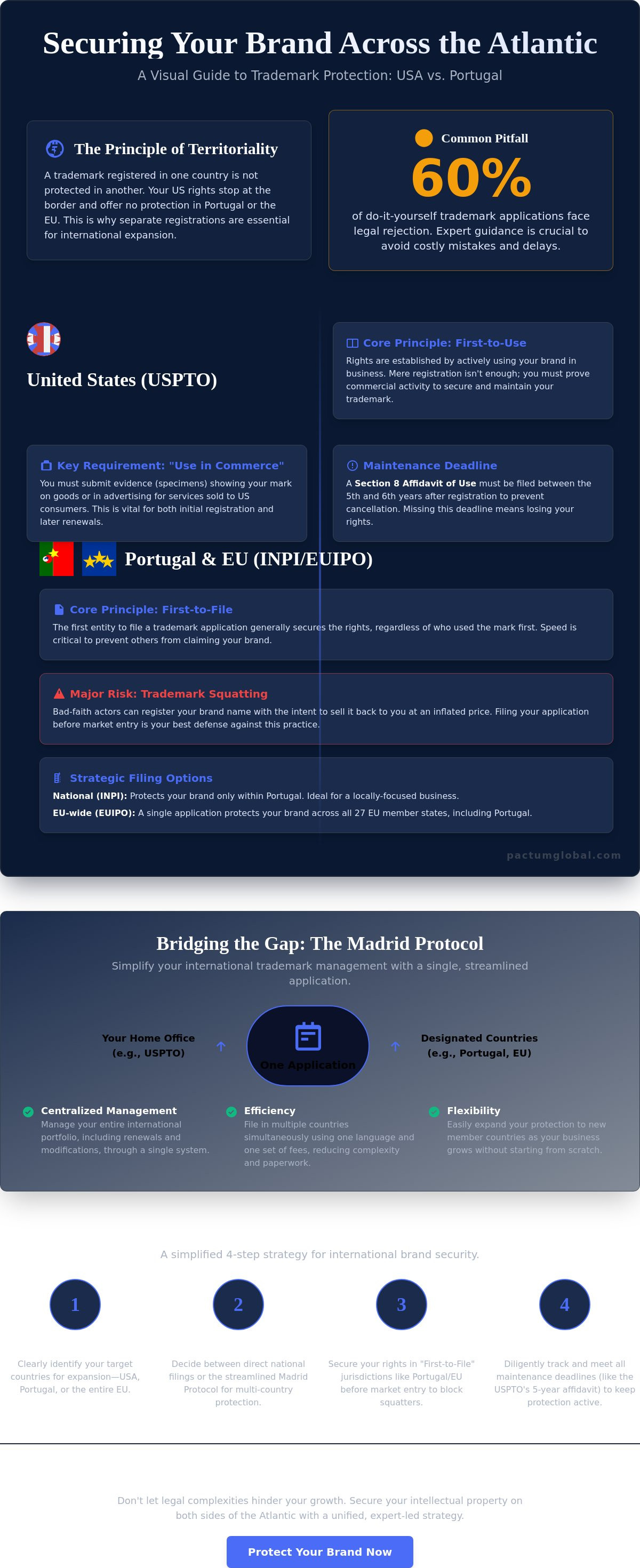
A registration with the United States Patent and Trademark Office (USPTO) provides strong protection across all 50 states. However, that legal shield vanishes the moment your products or services cross the Atlantic. This is the principle of territoriality. It dictates that intellectual property rights are limited to the borders of the country where they are granted. Many entrepreneurs fall for the myth of a "Universal Trademark" that provides automatic global coverage. In reality, securing trademark protection in USA and Portugal requires separate legal actions in each jurisdiction.
Without local registration, your brand is vulnerable. If a competitor in Lisbon registers your name before you do, they may legally prevent you from using your own brand in the Portuguese market. This makes trademark registration an essential insurance policy for international expansion. It protects your marketing investment and ensures your brand identity remains yours as you scale. Think of it as a foundation for your international market entry. You wouldn't build a house on land you don't own; you shouldn't build a brand in a market where you don't own the name.
The Core Differences: Portugal vs. USA Systems
The United States follows a "First-to-Use" system. This means you can often establish rights simply by using your mark in business. Portugal and the wider European Union operate on a "First-to-File" basis. Under this system, the first person to submit an application to the Instituto Nacional da Propriedade Industrial (INPI) generally wins the rights, regardless of who used the name first. Your US common law rights offer zero protection in Lisbon. This legal gap creates a significant risk for "Trademark Squatting." This happens when third parties register famous or growing foreign brands with the intent to sell the rights back to the original owner at a high price. Filing early is the only way to block these bad-faith actors.
Why Portugal is Your Gateway to European IP Protection
Portugal offers a strategic entry point for businesses looking to secure their identity across the continent. As a member of the European Union, Portugal gives you two distinct paths. You can file a national application through the INPI if your focus is strictly local. Alternatively, you can apply for a European Union Trademark (EUTM) through the European Union Intellectual Property Office (EUIPO). A single EUTM registration covers all 27 EU member states, including Portugal. Choosing the right path for trademark protection in USA and Portugal depends on your long-term growth goals. For many businesses, The Madrid Protocol provides an even more streamlined approach by allowing you to manage multiple international filings through a central hub. Using Portugal as your base for EU brand security ensures that your intellectual property foundation is as robust as your business strategy.
Securing Your Brand in the United States: The USPTO Process
The US market is a priority for many Portuguese entrepreneurs, but its legal requirements are distinct and demanding. The United States Patent and Trademark Office (USPTO) serves as the gatekeeper for brand rights. Unlike many European jurisdictions, the US requires "Use in Commerce" to achieve and maintain a full registration. This means you must show that your brand is actually being used in connection with goods or services sold to American customers. It's not enough to simply have an idea; you must demonstrate commercial activity.
When you apply, your mark is typically placed on the Principal Register. This provides the highest level of protection, including a legal presumption of ownership. If your mark is descriptive but has not yet gained "secondary meaning," it might be placed on the Supplemental Register. While this offers less protection, it still allows you to use the ® symbol and provides a basis for international filings. To keep your registration active, you'll need to file Section 8 affidavits between the fifth and sixth years. Failing to meet these deadlines can result in the immediate cancellation of your rights, leaving your brand unprotected.
The USPTO Filing Basis: 1(a) vs. 1(b)
You have two primary ways to start: Section 1(a) for existing use and Section 1(b) for "Intent to Use." For international founders not yet selling in the US, Section 1(b) is a powerful tool. It allows you to reserve your brand name while you finalize your market entry strategy. This locks in your priority date, preventing others from jumping ahead. Given that approximately 60% of DIY applications face rejection, having a clear filing strategy is vital for successful trademark protection in USA and Portugal. The timeline from application to registration currently takes several months, so early action is essential.
Trademark Classes and the Risk of "Likelihood of Confusion"
The USPTO organizes trademarks into 45 different classes. You must select the classes that accurately represent your business. If your chosen mark is too similar to an existing one in a related field, you'll likely face a rejection. A comprehensive "Knockout Search" is necessary to identify these risks before you spend money on filing fees. Likelihood of confusion occurs when two marks are so similar that consumers would mistakenly believe the goods or services come from the same source. This single issue is the primary reason the USPTO issues office actions against new applications.
Ensuring your brand is properly categorized and protected requires a methodical approach. Our team can help you manage these filings alongside your company setup in USA to ensure a seamless transition for your business.
Trademark Registration in Portugal: INPI and EUIPO Options
The Instituto Nacional da Propriedade Industrial (INPI) is the official body governing intellectual property rights within Portuguese borders. When you secure a registration here, your brand is protected for a 10-year period starting from the date of your application. You can renew this protection indefinitely for successive 10-year terms, provided you meet the renewal deadlines. One critical detail for international founders is the language requirement. All national filings submitted to INPI must be in Portuguese. This necessity for precise legal translation is often the first administrative hurdle businesses face when expanding from English-speaking markets.
Once your application is submitted and passes the initial examination, it's published in the Industrial Property Bulletin. This triggers a two-month opposition period. During this window, any third party who believes your mark conflicts with their existing rights can file a formal challenge. Monitoring this period is vital. If no one opposes your mark, the registration process moves toward a final grant. Understanding these procedural steps is a core part of managing trademark protection in USA and Portugal effectively.
National (INPI) vs. European Union (EUIPO) Filings
Deciding between a national Portuguese filing and a European Union Trade Mark (EUTM) depends on your commercial footprint. A national registration with INPI is the most logical choice if your operations are strictly limited to Portugal. As of July 1, 2026, the online filing fee for a single class is €145.56. This is a cost-effective way to secure local rights. However, if you're a scalable startup with plans to enter Spain, France, or Germany, the EUIPO offers a more efficient path. A single EUTM application covers all 27 EU member states for a base fee of €850. While the initial cost is higher, it removes the complexity and expense of managing dozens of individual national filings.
The "Grace Period" for Use in Portugal
Portugal and the EU offer a different approach to brand usage compared to the United States. While the US requires "Use in Commerce" before a mark is fully registered, Portugal provides a five-year grace period. You can register your brand before you've made a single sale. However, this flexibility isn't permanent. If you don't put the mark to "genuine use" within five years of the registration date, your rights become vulnerable to cancellation by third parties. You must maintain clear records of your commercial activity, such as invoices, marketing materials, and labeled packaging, to defend your registration if it's ever challenged. Our team can assist with these filings as part of our broader company setup in Portugal services, ensuring your legal and corporate foundations are aligned from day one.
The Madrid Protocol: Bridging the US and Portugal Protection Gap
Expanding into multiple markets usually means drowning in paperwork and local legal fees. The Madrid Protocol changes that by providing a streamlined system for international brand security. Instead of filing separate applications in every language and jurisdiction, you use a single application through the World Intellectual Property Organization (WIPO). This centralized system acts as a bridge for businesses seeking trademark protection in USA and Portugal. It allows you to manage your entire portfolio from one account. You can renew your mark, change your address, or expand into new countries without hiring local agents in every territory.
To use this system, you must have a "Home Application" or registration in your base country. If you're a US company, your USPTO filing serves as this foundation. If you're based in Lisbon, your INPI registration is the starting point. This base mark is essential because the international application must match the home mark exactly. WIPO acts as a central hub, forwarding your request to the relevant national offices for final approval. This removes the initial complexity of dealing with different bureaucratic systems simultaneously.
Direct Filing vs. Madrid Protocol: Which is Better?
Choosing the right path depends on your immediate expansion goals. If you only need coverage in two countries, filing directly with the USPTO and INPI is often more cost-effective. Direct filing also avoids "dependency risk." Under the Madrid Protocol, if your home application is cancelled or limited within the first five years, your international registrations are also affected. This is known as a central attack. Direct filings are typically faster too. Local offices process direct applications without the extra administrative layer of WIPO. This speed is vital for urgent product launches where every day of legal uncertainty counts.
Strategic Filing Timelines for Cross-Border Success
Timing is a critical legal lever in international brand strategy. You have a six-month "Priority Period" from your first filing date to apply in other countries. If you file in the US today, you have exactly six months to file in Portugal while keeping your original US date. The Paris Convention allows for backdating international priority to the date of your first filing in a member country. This prevents competitors from jumping the queue while you're finalizing your international plans. We recommend sequencing your filings to ensure you don't miss these windows. Managing these deadlines requires a proactive approach to your global portfolio.
Our experts can handle your Intellectual Property and Trademarks filings to ensure your brand is protected across every market you enter.
Integrating IP Protection with Your Global Business Strategy
Securing your brand identity isn't a task to leave for next year. It should happen the moment you begin your company formation. When you align your corporate structure with your intellectual property needs, you create a seamless transition into new markets. This synchronized approach is the most effective way to manage trademark protection in USA and Portugal. It ensures that your legal foundation is ready to support your commercial growth from day one. Without this integration, you risk a fragmented strategy that leaves gaps for competitors to exploit.
Long-term success also requires thorough succession planning for your intellectual property. Your trademarks are often the most valuable assets your company owns. You must ensure these assets are properly documented and protected for the future. This includes planning for potential ownership changes, mergers, or international licensing agreements. A clear roadmap from the initial trademark search to the final registration certificate provides the security your investors and partners expect. It transforms a simple brand name into a protected corporate asset that grows in value over time.
IP in Shareholders Agreements (SHA)
One common mistake for international startups is allowing a founder to own the trademark personally. This often leads to complex legal disputes if the founder leaves or the company seeks investment. We help you draft specific IP clauses within your Shareholders Agreements to ensure the company retains full ownership of its international marks. This protects your brand equity and provides clarity for all stakeholders. By defining these rights early, you remove the ambiguity that often plagues cross-border ventures and ensure your intellectual property remains a stable company asset.
The Pactum Global Approach to Trademark Protection
Our "Global Navigator" method is designed for entrepreneurs who value efficiency and transparency. We manage the entire lifecycle of your brand security, from conducting comprehensive knockout searches to navigating the specific requirements of the USPTO and INPI. We understand the nuances of trademark protection in USA and Portugal, allowing us to act as your proactive guide through international bureaucracy. Our network of legal experts works to reduce friction, ensuring your filings are accurate and timely. You can focus on scaling your business while we handle the complexities of global compliance. Secure your brand assets with Pactum Global’s international IP services and build your business on a foundation of legal certainty.
Secure Your Global Brand Identity
Expanding your brand across borders is a significant milestone. It requires a solid legal foundation to succeed. You now understand that trademark rights end at national borders and that a US registration doesn't stop a competitor in Lisbon. Achieving trademark protection in USA and Portugal means balancing the "first-to-use" American standard with the "first-to-file" Portuguese system. By leveraging tools like the Madrid Protocol and integrating IP clauses into your corporate contracts, you protect your company's most valuable assets from the start.
Pactum Global provides the steady hand you need to navigate these bureaucratic hurdles. Our team offers specialized expertise in US, Portugal, and Brazil jurisdictions. We provide end-to-end management of your corporate and IP documentation through a transparent, nonsense-free consultancy. This approach removes complexity so you can focus on your international growth. You don't have to face international legal filings alone. Protect your brand in the USA and Portugal today and move forward with the confidence that your identity is secure.
Frequently Asked Questions
Is my US trademark valid in Portugal?
No, your US trademark registration doesn't extend to Portugal. Intellectual property rights stop at the national border due to the principle of territoriality. To protect your brand in Lisbon or Porto, you must file a separate application with the Portuguese INPI or the European EUIPO. Securing trademark protection in USA and Portugal requires independent legal actions in each jurisdiction to ensure your brand identity remains secure across the Atlantic.
How much does it cost to register a trademark in both the US and Portugal?
Government filing fees vary by jurisdiction. In the United States, the USPTO standard electronic filing fee is $350 per class of goods. In Portugal, the online application fee through INPI is €145.56 for the first class as of July 2026. These figures only cover the initial government processing fees. Additional costs may apply for custom descriptions, multiple classes, or professional legal assistance to avoid administrative rejection.
How long does the trademark registration process take in Portugal?
The registration process in Portugal typically takes four to six months from the application date. This timeline includes a formal examination and a mandatory two-month opposition period where other parties can challenge your filing. If a third party challenges your mark, the process will take significantly longer. Filing correctly the first time is the best way to avoid administrative delays and ensure your brand is protected as quickly as possible.
Can I file for a trademark in Portugal without a local address?
You can file for a trademark in Portugal without a local business address, but there are specific representation requirements. If you don't have a residence or head office in a European Union member state, you must appoint a qualified representative. This ensures the INPI has a local point of contact for legal notifications. We manage this process for international founders to ensure compliance with Portuguese administrative standards and legal requirements.
What is the difference between a Portuguese national trademark and an EU trademark?
A Portuguese national trademark only provides legal rights within Portugal. In contrast, a European Union Trade Mark covers all 27 member states through a single application. Choosing between them depends on your growth strategy. If you only plan to operate in Portugal, a national filing is more affordable. If you intend to scale across Europe, the EU trademark offers broader protection and simplifies the management of your international portfolio.
What happens if someone else registers my brand name in Portugal first?
Because Portugal is a "first-to-file" jurisdiction, the person who submits the application first generally owns the rights. If a competitor registers your brand name before you, they can legally block your market entry. You may have to undergo a costly legal challenge or negotiate a buyout to regain control of your identity. This risk makes early filing a critical priority for any business expanding to the Portuguese market.
Do I need to be actively selling in Portugal to register a trademark there?
No, you don't need to be actively selling in Portugal to submit a trademark application. Unlike the US "use in commerce" requirement, Portugal allows you to register a mark before you launch your products. However, you must begin "genuine use" of the mark within five years. If the mark remains unused after this five-year grace period, third parties can apply to cancel your registration for non-use through a legal proceeding.
Can Pactum Global handle both my company setup and my trademark filing?
Yes, we provide a unified approach to international expansion by managing both corporate setup and intellectual property filings. We coordinate your trademark protection in USA and Portugal alongside your company formation to ensure all legal assets are correctly owned by your new entity. This integrated strategy reduces bureaucratic friction and prevents the common errors that occur when these processes are handled by separate, uncoordinated service providers.


